Page 60
284.
A monopolist who engages in perfect price discrimination charges each consumer a
price equal to that consumer’s willingness to pay.
A)
True
B)
False
285.
In perfect price discrimination, consumer surplus is larger than it is in a single-price
monopoly.
A)
True
B)
False
286.
Consumer surplus is higher under a single-price monopoly than it is under a perfectly
price-discriminating monopoly.
A)
True
B)
False
287.
If the local phone company, a monopolist, perfectly price-discriminated, there would be
a lower total surplus than if the company did not price discriminate.
A)
True
B)
False
288.
If a monopoly can engage in perfect price discrimination, then its marginal revenue is
equal to price, in contrast to the usual situation for a monopoly, in which price is higher
than is marginal revenue.
A)
True
B)
False
289.
What are the fundamental differences between the perfect competition and monopoly
market structures?
290.
What makes a natural monopoly a distinct form of monopoly? Use an example of a
natural monopoly in your explanation.
291.
Years ago, Callaway Golf patented its signature Big Bertha line of drivers. Today, the
company spends a lot of money prosecuting individuals that try to sell knock-off Big
Bertha drivers to the public. What is the purpose of the patent, and why do companies
like Callaway Golf fight those that try to imitate their products?
Page 61
292.
Why is the demand curve for a monopolist downward sloping, while the demand curve
for the perfectly competitive firm is horizontal?
293.
Explain why the marginal revenue curve lies below the monopolist’s demand curve.
294.
It is often said that the monopolist will never set the price in the inelastic range of the
demand curve. Why?
295.
Suppose a perfectly competitive industry is suddenly transformed to a monopoly
industry. What will happen to price, output, consumer and producer surplus, and
deadweight loss in this industry?
296.
Suppose the government is considering how to regulate a monopolist. An economist
argues that the price should be regulated to maximize total welfare. The monopolist
argues that the price should be regulated so that it can just cover all of its opportunity
costs. Are they basically arguing the same point? How do they differ?
Use the following to answer questions 297-298:
297.
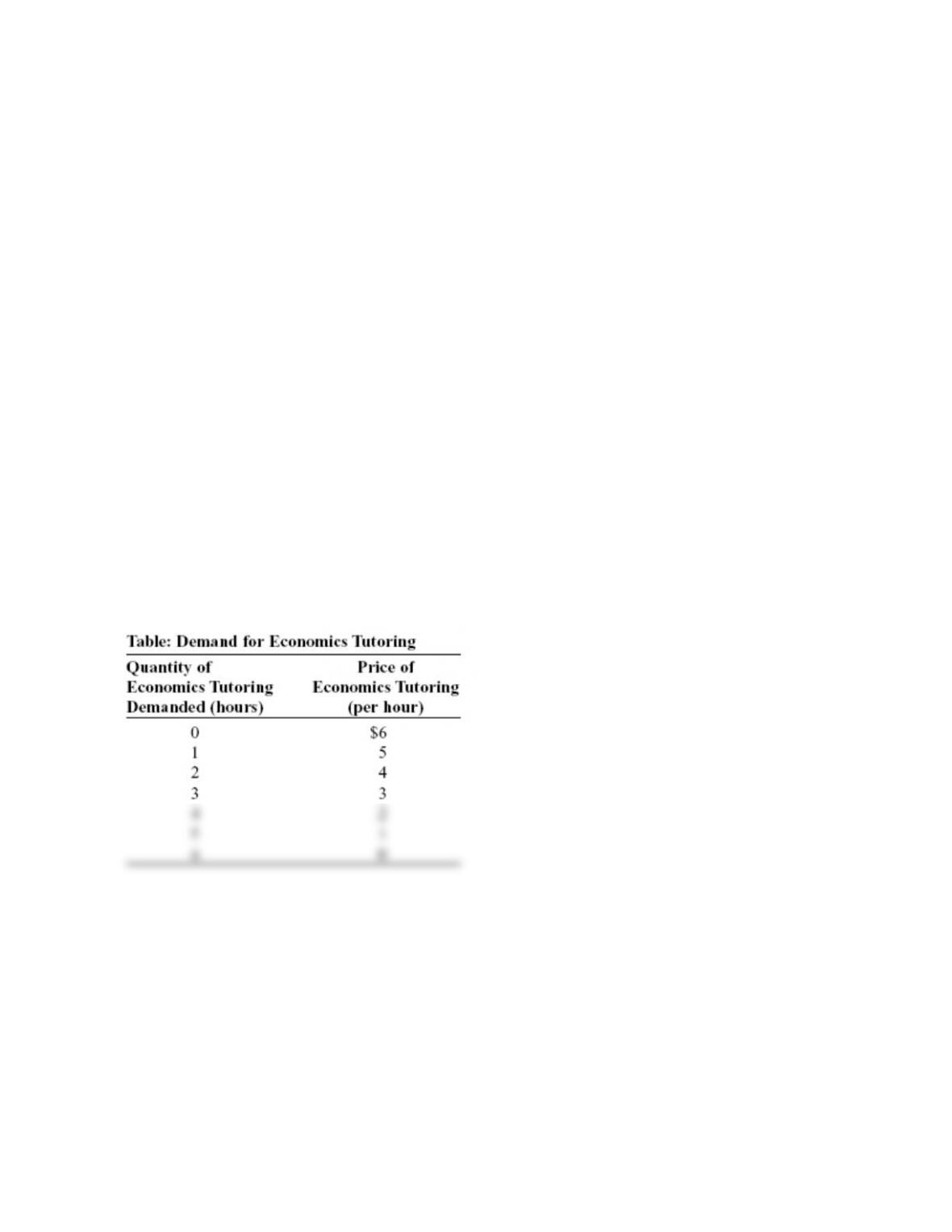
(Table: Demand for Economics Tutoring) Use Table: Demand for Economics Tutoring.
Suppose Eric is the only economics tutor in town and therefore holds a monopoly. Eric
can offer additional hours of tutoring at a constant marginal cost of $2 per hour, and he
has no fixed costs.
A) If Eric acts as a monopolist, how many hours will he offer and what price will he
charge?
B) Calculate Eric’s monopoly profit.
Page 62
298.
(Table: Demand for Economics Tutoring) Use Table: Demand for Economics Tutoring.
Suppose Eric is the only economics tutor in town. Eric can offer additional hours of
tutoring at a constant marginal cost of $2 per hour, and he has no fixed costs. Suppose
Eric can perfectly price-discriminate by charging his customers exactly their willingness
to pay. How many hours will he offer, and how much profit will he earn by
price-discriminating?
299.
An oligopoly is characterized as an industry in which:
A)
there are few firms, each producing a differentiated or similar product.
B)
there are many firms, each producing a similar product.
C)
all market participants are price takers.
D)
only one firm produces a very differentiated product.
300.
A monopolistically competitive industry is made up of:
A)
a few firms, each producing a very differentiated good.
B)
one firm that produces a standardized good.
C)
market participants who are all price takers.
D)
many firms producing a slightly differentiated product.
301.
Entry barriers:
A)
exist in all market structures.
B)
exist in perfect competition and monopolistically competitive markets.
C)
do not exist in any market structures; otherwise nothing would be produced.
D)
exist in monopoly and oligopoly markets.
302.
Control of a scarce resource or input, economies of scale, technological superiority, and
government-set rules and regulations are forms of:
A)
market structure.
B)
pricing behavior.
C)
barriers to entry.
D)
public policy.
303.
When a firm finds that its ATC of production decreases as it increases production, this
firm is said to be experiencing:
A)
profit maximization.
B)
economic profit.
C)
economies of scale.
D)
a barrier to entry.
Page 63
304.
If large fixed costs result in ATC falling as output increases and this occurs over the
relevant range of output, this industry is a:
A)
constant-cost industry.
B)
natural monopoly.
C)
network externality.
D)
profit maximizer.
305.
A natural monopoly exists when:
A)
a few firms collude to make one large firm.
B)
economies of scale provide large cost advantages to having one firm produce the
industry’s output.
C)
firms naturally maximize profit regardless of market structure.
D)
firms enter the industry as a result of profit incentives.
306.
Goods that are subject to network externalities tend to be ones:
A)
for which the value of the good to an individual is lower when more people use it.
B)
that are land-intensive.
C)
for which the value of the good to an individual is higher when more people use it.
D)
for which one person owning the good enhances its value because it’s the only one.
307.
Temporary monopolies via the provision of sole ownership rights to profit from the
production, use, or sale of a good are provided by:
A)
patents and copyrights.
B)
natural monopolies.
C)
profit-maximizing behavior.
D)
network externalities.
308.
For a monopolist, the market demand curve:
A)
is also the demand for the monopolist’s product.
B)
is equal to the monopolist’s MR curve.
C)
must be horizontal.
D)
is not important since the monopolist is the only producer.
309.
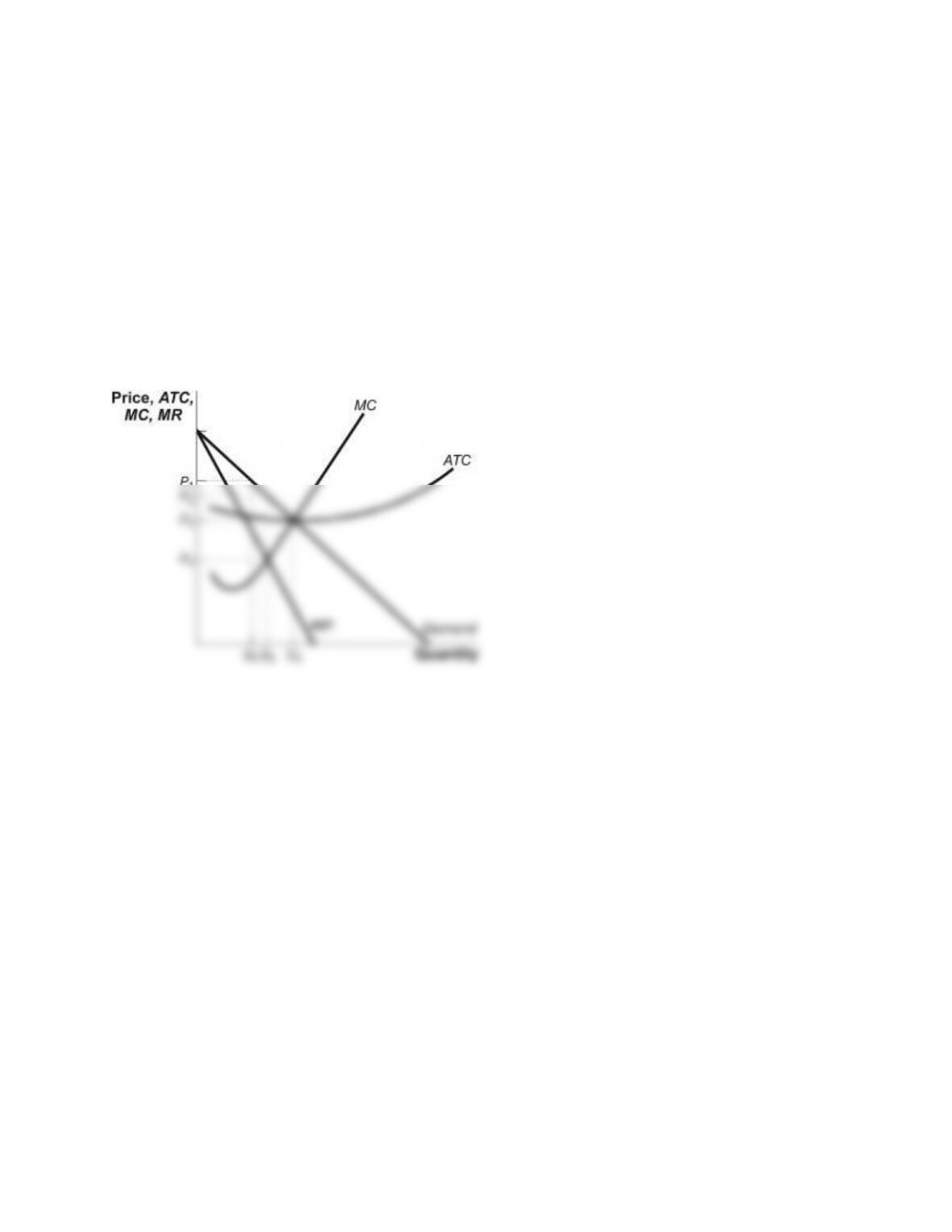
For a monopolist with a downward-sloping demand curve, the quantity effect is MOST
likely to dominate the price effect at:
A)
low levels of production.
B)
all levels of production.
C)
high levels of production.
D)
levels at which elasticity is unit-elastic.
Page 64
310.
At the profit-maximizing level of production, a perfectly competitive industry will
produce an _____ amount of output, and a monopolist produces an _____ amount of
output.
A)
efficient; efficient
B)
inefficient; efficient
C)
inefficient; inefficient
D)
efficient; inefficient
Use the following to answer questions 311-313:
Figure: The Monopolist
311.
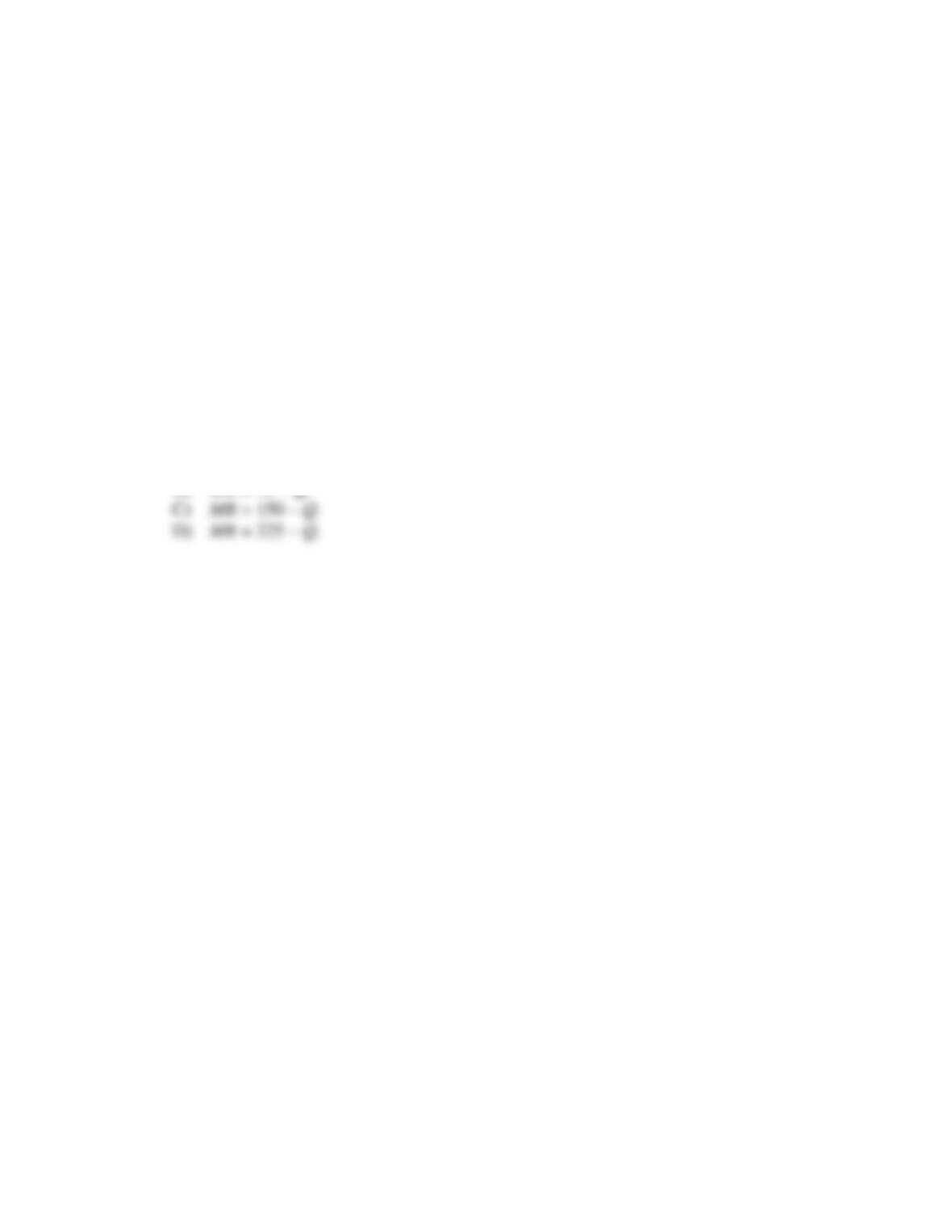
(Figure: The Monopolist) Use Figure: The Monopolist. If this monopolist
profit-maximizes, it will produce _____ units and sell them at _____.
A)
Q1; P1
B)
Q2; P4
C)
Q2; P2
D)
Q3; P3
312.
(Figure: The Monopolist) Use Figure: The Monopolist. At the profit-maximizing level,
this monopolist will:
A)
incur a loss equal to the area (P1 – P4) Q1.
B)
earn a profit equal to the area (P2 – P4) Q2.
C)
earn a profit equal to the area (P2 – P3) Q2.
D)
break even.
Page 65
313.
(Figure: The Monopolist) Use Figure: The Monopolist. If this market became perfectly
competitive, total market production in the long run would be _____ units and the
market price would be _____.
A)
Q1; P1
B)
Q2; P2
C)
Q3; P3
D)
Q2; P4
314.
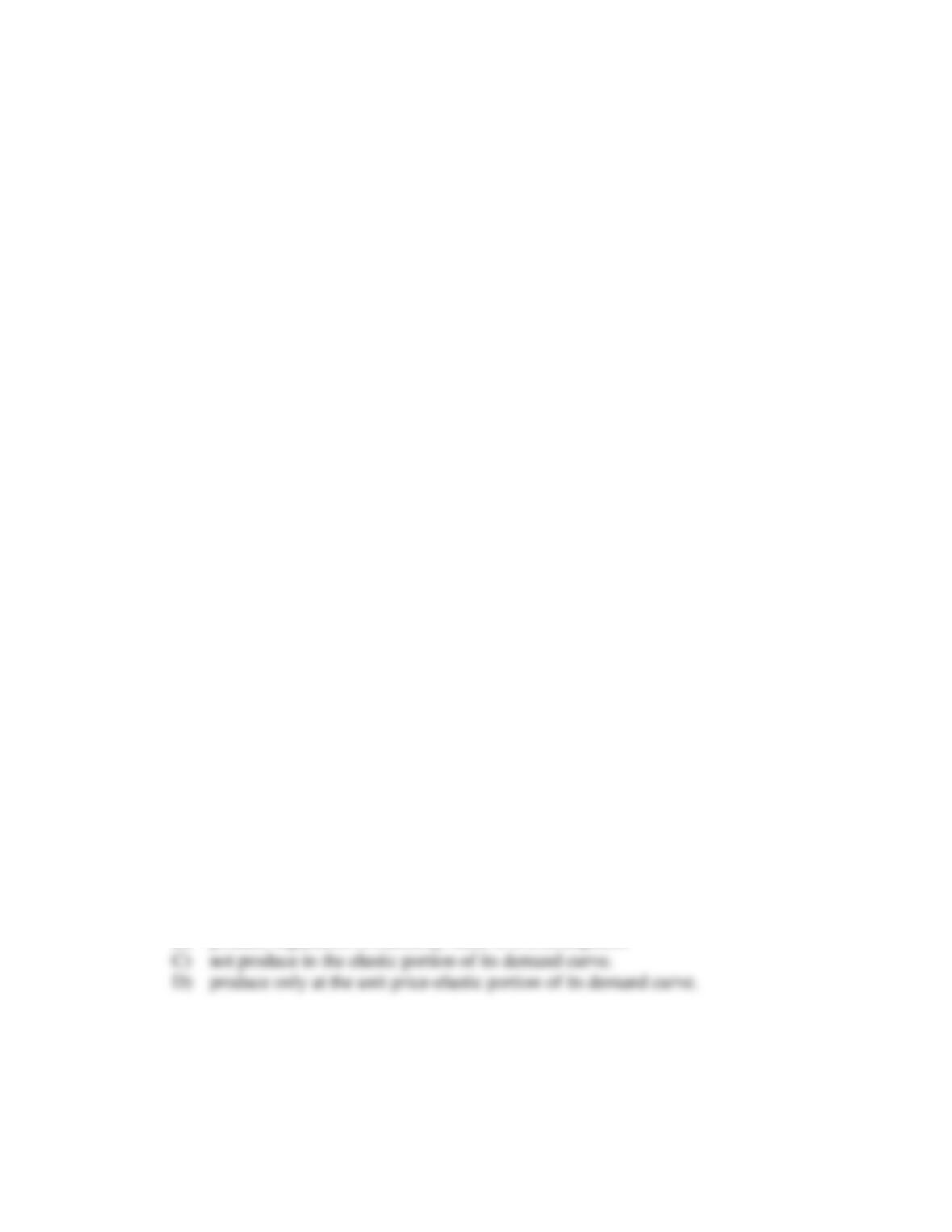
(Scenario: Monopolist) Use Scenario: Monopolist. The MR curve is:
Scenario: Monopolist
The demand curve for a monopolist is P = 75 – 0.5Q, and the monopolist’s marginal
cost curve is defined using the equation MC = 2Q. Assume also that ATC at the
profit-maximizing level of production is equal to $12.50.
A)
MR = 150 – 0.5Q.
B)
MR = 75 – Q.
C)
MR = 150 – Q.
D)
MR = 225 – Q.
315.
(Scenario: Monopolist) Use Scenario: Monopolist. The profit-maximizing output is
_____ units, and the profit-maximizing price is _____.
Scenario: Monopolist
The demand curve for a monopolist is P = 75 – 0.5Q, and the monopolist’s marginal
cost curve is defined using the equation MC = 2Q. Assume also that ATC at the
profit-maximizing level of production is equal to $12.50.
A)
25; $75.00
B)
20; $62.50
C)
25; $75.50
D)
25; $62.50
Page 66
316.
(Scenario: Monopolist) Use Scenario: Monopolist. At the profit-maximizing level of
output, the profit per unit is:
Scenario: Monopolist
The demand curve for a monopolist is P = 75 – 0.5Q, and the monopolist’s marginal
cost curve is defined using the equation MC = 2Q. Assume also that ATC at the
profit-maximizing level of production is equal to $12.50.
A)
$62.50.
B)
$0.00
C)
$75.00.
D)
$50.00.
317.
(Scenario: Monopolist) Use Scenario: Monopolist. The deadweight loss from this
monopolist’s production is:
Scenario: Monopolist
The demand curve for a monopolist is P = 75 – 0.5Q, and the monopolist’s marginal
cost curve is defined using the equation MC = 2Q. Assume also that ATC at the
profit-maximizing level of production is equal to $12.50.
A)
$31.25.
B)
$12.50.
C)
$0.00.
D)
$30.00.
318.
If a monopolist knows its price elasticity of demand is greater than one, then a(n) _____
in price will _____ total revenue.
A)
increase; increase
B)
decrease; increase
C)
decrease; decrease
D)
increase; not change
319.
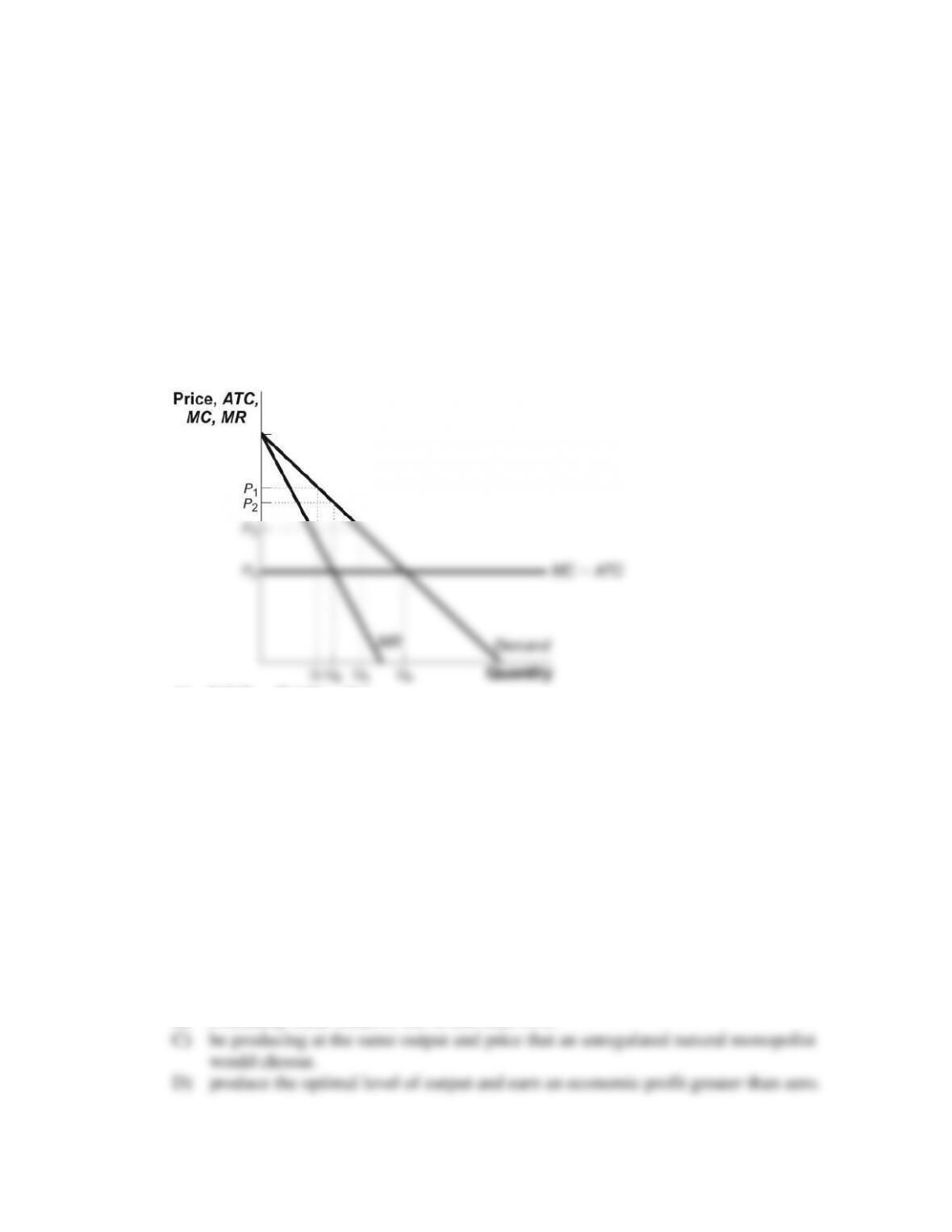
A monopolist with a linear demand curve will:
A)
not produce in the inelastic portion of its demand curve.
B)
produce regardless of elasticity, since it is a monopolist.
C)
not produce in the elastic portion of its demand curve.
D)
produce only at the unit price-elastic portion of its demand curve.
Page 67
320.
If a monopoly market structure is transformed into a perfectly competitive one, holding
all else constant, price will _____ and output will _____.
A)
fall; fall
B)
fall; increase
C)
increase; increase
D)
increase; fall
321.
(Figure: The Monopolist II) Use Figure: The Monopolist II. The deadweight loss
associated with this monopoly can be measured as the area:
Figure: The Monopolist II
A)
0.5(P1 – P2)(Q2 – Q1).
B)
0.5 (P2 – P4)(Q4 – Q2).
C)
0.5 (P1 – P3)Q3.
D)
0.5 (P1 – P3)Q2.
322.
A firm that is a natural monopoly will:
A)
attempt to break even, not profit-maximize.
B)
maximize profit by producing where MR = MC.
C)
face increasing costs of production.
D)
face greater market instability than does a regular monopoly.
323.
A natural monopolist that is price-regulated at the marginal cost output level will:
A)
produce the optimal level of output and earn a normal profit.
B)
eventually incur losses if MC is less than ATC.
C)
be producing at the same output and price that an unregulated natural monopolist
would choose.
D)
produce the optimal level of output and earn an economic profit greater than zero.
Page 68
324.
When firms price-discriminate, people with _____ price elasticity of demand will pay
_____ prices relative to those purchasing the same product who have a _____ price
elasticity of demand.
A)
higher; higher; lower
B)
lower; lower; higher
C)
lower; higher; higher
D)
higher; the same; lower
325.
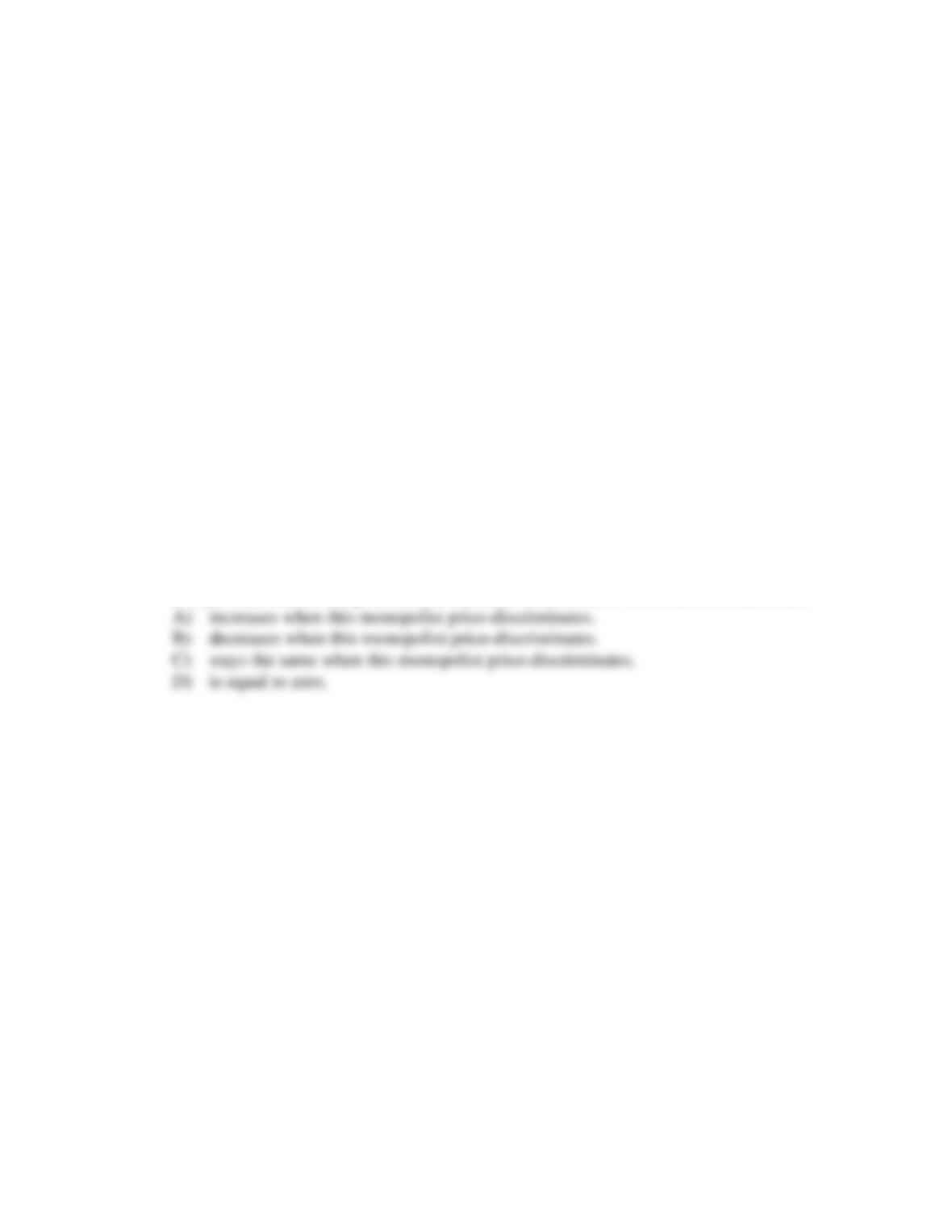
(Figure: The Monopolist III) Use Figure: The Monopolist III. If this monopolist
perfectly price-discriminates, then it will produce _____ units. This will lead to
producer surplus equal to _____, consumer surplus equal to _____, and a deadweight
loss equal to _____.
Figure: The Monopolist III
A)
70; $2,450; $0; $0
B)
50; $1,225; $0; $0
C)
35; $1,225; $612.50; $612.50
D)
100; $1,500; $612.50; $612.50
Page 69
326.
(Scenario: A Small-Town Monopolist) Use Scenario: A Small-Town Monopolist. If this
monopolist must choose between selling 100 or 175 subscriptions, it will choose to sell
_____ units at a price of _____ and earn economic profits equal to _____.
Scenario: A Small-Town Monopolist
A monopolist sells cable subscriptions in a small town and finds that it can sell 100
subscriptions when the price is $15 a week and 175 subscriptions when the price is $10
a week. The MC for the provision of the cable is $5 a week. There are no fixed costs.
A)
175; $10; $500
B)
100; $15; $1,000
C)
175; $15; $1,000
D)
100; $10; $750
327.
(Scenario: A Small-Town Monopolist) Use Scenario: A Small-Town Monopolist.
Compared with charging a single price, the deadweight loss:
Scenario: A Small-Town Monopolist
A monopolist sells cable subscriptions in a small town and finds that it can sell 100
subscriptions when the price is $15 a week and 175 subscriptions when the price is $10
a week. The MC for the provision of the cable is $5 a week. There are no fixed costs.
A)
increases when this monopolist price-discriminates.
B)
decreases when this monopolist price-discriminates.
C)
stays the same when this monopolist price-discriminates.
D)
is equal to zero.
Page 70
328.
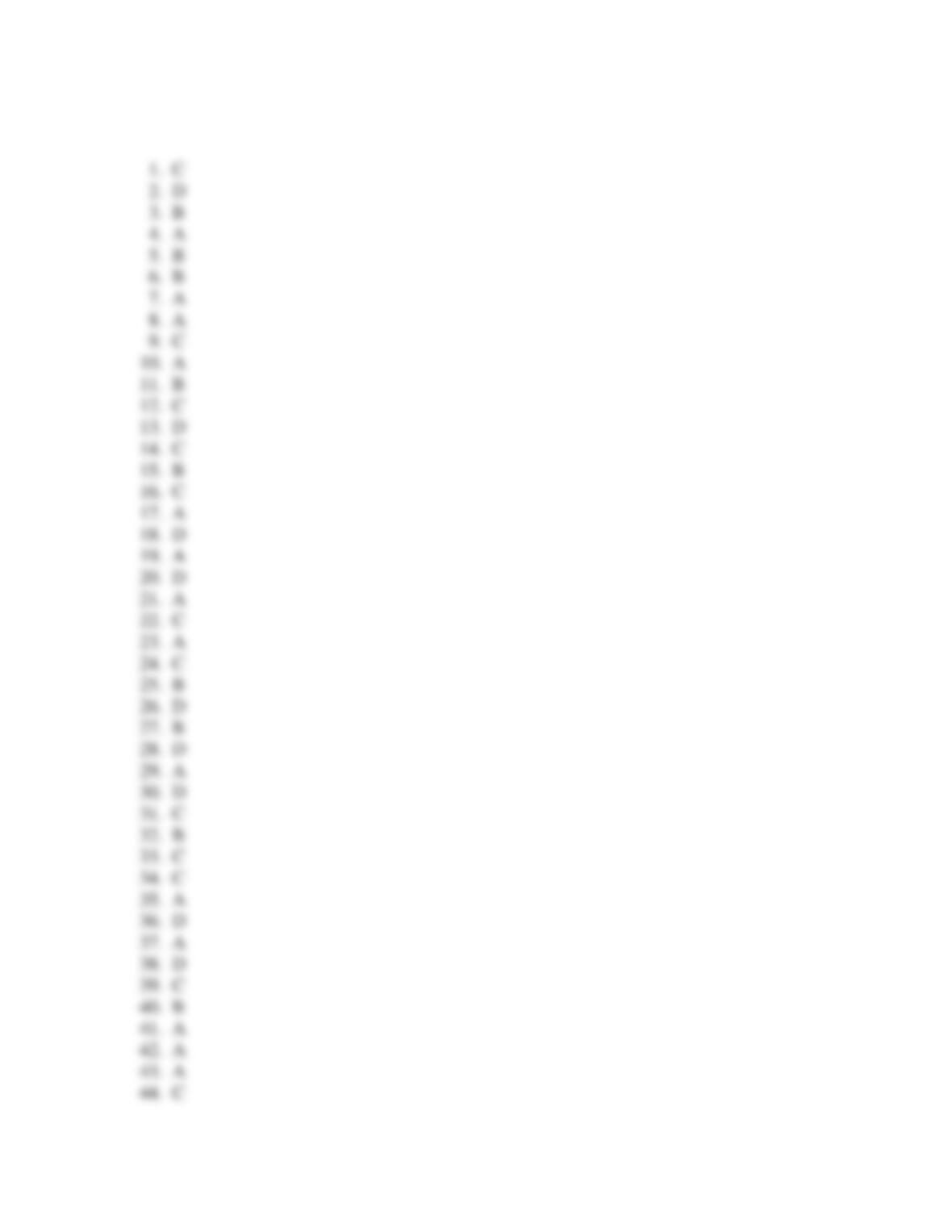
(Figure: The Monopolist IV) Use Figure: The Monopolist IV. Assume this monopolist
has no fixed costs. If this monopolist profit-maximizes, it will produce _____ units and
charge a price equal to _____. Its profit will be _____, its consumer surplus will be
_____, and the deadweight loss is _____.
Figure: The Monopolist IV
A)
50; $30; $1,200; $600; $100
B)
35; $65; $1,225; $612.50; $612.50
C)
100; $65; $1,500; $615.50; $1,000
D)
70; $35; $1,225; $615.50; $615.50
Answer Key
Page 72
45.
C
46.
D
47.
A
48.
D
49.
C
50.
C
51.
B
52.
D
53.
A
54.
A
55.
A
56.
D
57.
D
58.
C
59.
B
60.
A
61.
A
62.
A
63.
A
64.
D
65.
D
66.
C
67.
B
68.
D
69.
A
70.
C
71.
D
72.
C
73.
A
74.
D
75.
C
76.
C
77.
C
78.
A
79.
B
80.
D
81.
B
82.
A
83.
C
84.
B
85.
B
86.
A
87.
D
88.
A
89.
C
90.
A
Page 73
91.
C
92.
C
93.
B
94.
C
95.
C
96.
B
97.
B
98.
C
99.
A
100.
B
101.
B
102.
C
103.
A
104.
A
105.
B
106.
C
107.
C
108.
C
109.
A
110.
B
111.
B
112.
D
113.
D
114.
A
115.
D
116.
C
117.
B
118.
D
119.
A
120.
C
121.
C
122.
C
123.
C
124.
C
125.
B
126.
C
127.
C
128.
D
129.
C
130.
A
131.
D
132.
D
133.
C
134.
A
135.
A
136.
D
Page 74
137.
B
138.
A
139.
B
140.
A
141.
A
142.
B
143.
C
144.
B
145.
C
146.
B
147.
C
148.
D
149.
B
150.
A
151.
A
152.
C
153.
C
154.
D
155.
A
156.
A
157.
C
158.
A
159.
A
160.
D
161.
B
162.
A
163.
D
164.
B
165.
C
166.
B
167.
B
168.
C
169.
A
170.
C
171.
B
172.
B
173.
B
174.
C
175.
D
176.
C
177.
A
178.
A
179.
C
180.
A
181.
A
182.
D
Page 75
183.
A
184.
C
185.
B
186.
A
187.
D
188.
A
189.
D
190.
D
191.
A
192.
C
193.
D
194.
C
195.
A
196.
C
197.
B
198.
D
199.
C
200.
C
201.
D
202.
A
203.
D
204.
A
205.
B
206.
C
207.
C
208.
D
209.
A
210.
B
211.
C
212.
A
213.
B
214.
C
215.
D
216.
B
217.
D
218.
B
219.
D
220.
D
221.
C
222.
B
223.
C
224.
D
225.
A
226.
D
227.
B
228.
A
Page 76
229.
B
230.
A
231.
A
232.
A
233.
C
234.
B
235.
A
236.
A
237.
A
238.
A
239.
B
240.
B
241.
A
242.
A
243.
A
244.
A
245.
B
246.
B
247.
A
248.
A
249.
B
250.
B
251.
A
252.
B
253.
B
254.
B
255.
B
256.
A
257.
A
258.
B
259.
A
260.
A
261.
B
262.
B
263.
A
264.
A
265.
B
266.
A
267.
A
268.
B
269.
B
270.
A
271.
B
272.
A
273.
B
274.
A
Page 77
275.
B
276.
A
277.
B
278.
B
279.
A
280.
B
281.
A
282.
B
283.
A
284.
A
285.
B
286.
A
287.
B
288.
A
289.
290.
291.
292.
293.
294.
295.
296.
297.
298.
299.
A
300.
D
301.
D
302.
C
303.
C
304.
B
305.
B
306.
C
307.
A
308.
A
309.
A
310.
D
311.
C
312.
C
313.
C
314.
B
315.
D
316.
D
317.
A
318.
B
319.
A
320.
B
Page 78
321.
B
322.
B
323.
B
324.
C
325.
A
326.
B
327.
B
328.
B