Page 41
190.
Many hotel chains offer discounts to senior citizens. This is an example of _____ that is
_____ in the United States.
A)
market power; illegal
B)
single-price monopoly power; legal
C)
price discrimination; illegal
D)
price discrimination; legal
191.
If a monopolist can engage in perfect price discrimination:
A)
it produces at the socially efficient level.
B)
consumer surplus is maximized.
C)
producer surplus is minimized.
D)
the government will impose fines on the monopolist.
Use the following to answer question 192:
192.
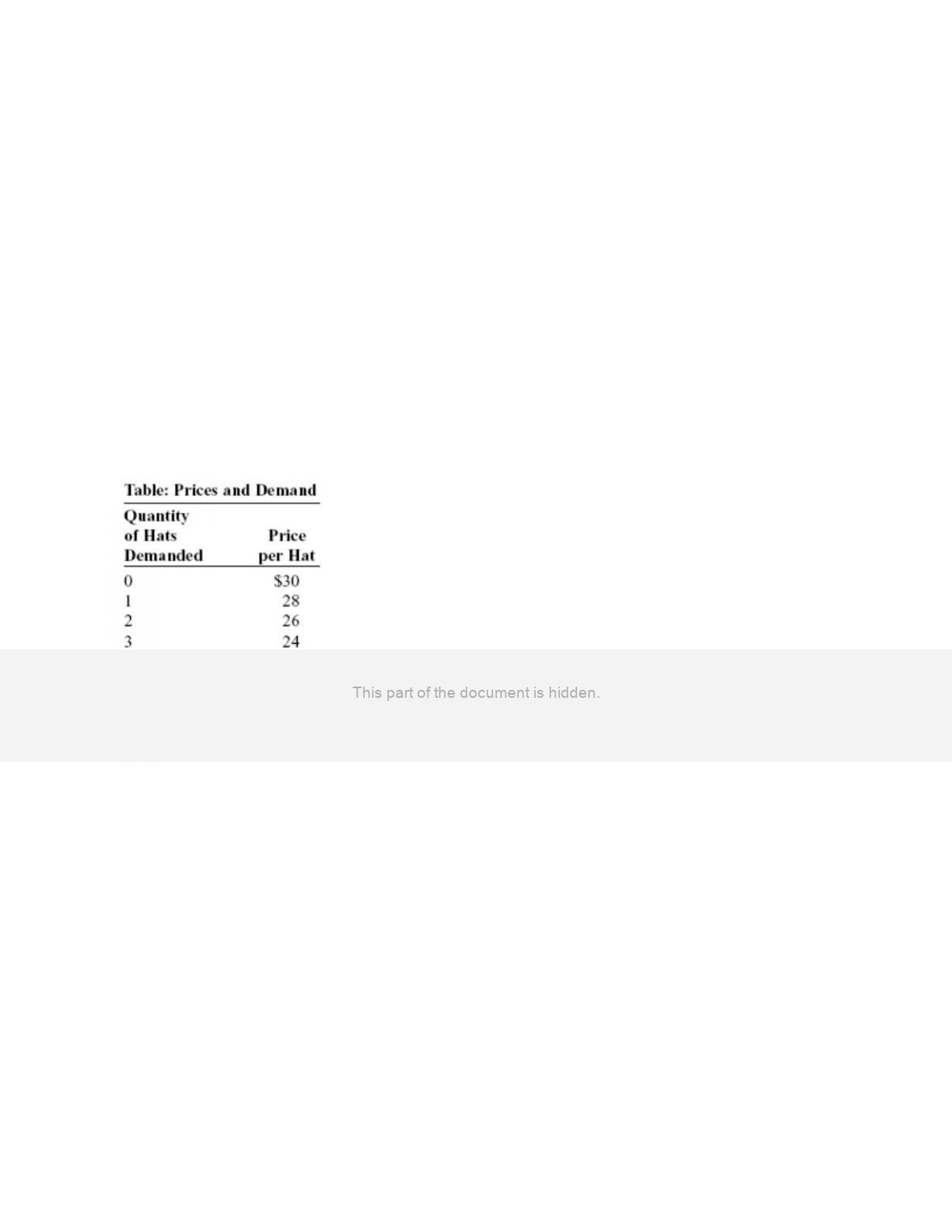
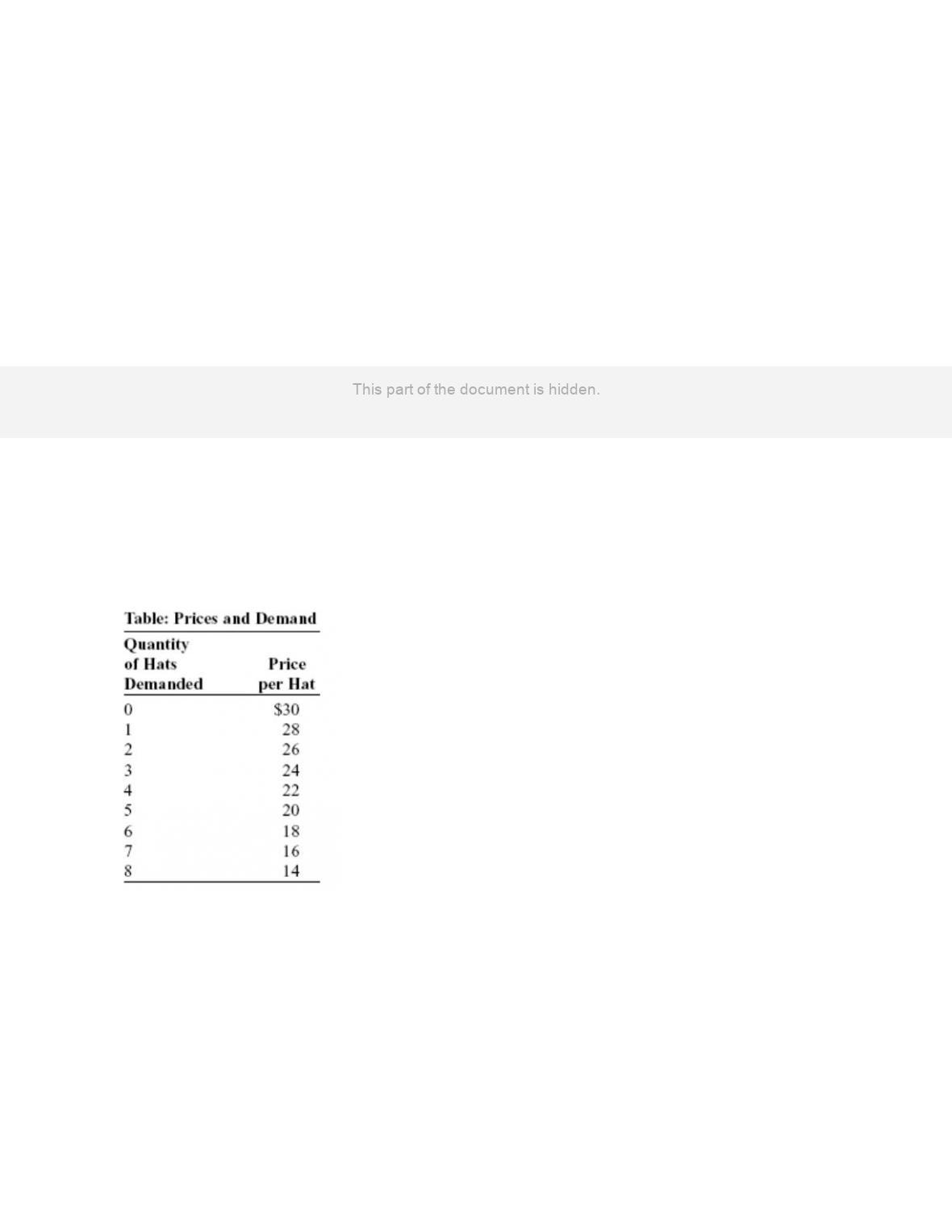
(Table: Prices and Demand) Use Table: Prices and Demand. Professor Dumbledore has
a monopoly on magic hats. The marginal cost of producing a hat is $18. Suppose
Dumbledore can perfectly price-discriminate. How many hats will he produce?
A)
3
B)
4
C)
5
D)
6
Page 42
193.
Sadia wants to practice price discrimination in her bakery. Which strategy should Sadia
NOT use?
A)
discounts for people who buy a large volume of bread
B)
higher prices for people who buy bread on the day it is baked and lower prices for
people who place advance orders
C)
an annual fee for customers who want to shop at a discount in her store
D)
the same price for all consumers for freshly baked goods
194.
The strategy that is NOT an example of price discrimination is:
A)
discounts for senior citizens at the movies.
B)
discounts for families with young children at motels.
C)
generally lower prices at Walmart than at Target.
D)
cheaper air fares if the traveler stays over a Saturday.
195.
Which strategy is NOT an example of price discrimination?
A)
a Fourth of July sale
B)
a coupon in the newspaper offering a 10% discount on a product
C)
a higher price for front row seats at a concert than for seats at the back
D)
a lower price charged to the grandfather who bought his airline ticket to Chicago
three weeks in advance and will stay over a Saturday night than to the
businesswoman who bought her ticket the day of the flight and will not stay over
Saturday night
Use the following to answer questions 196-203:
Figure: PPV

Page 43
196.
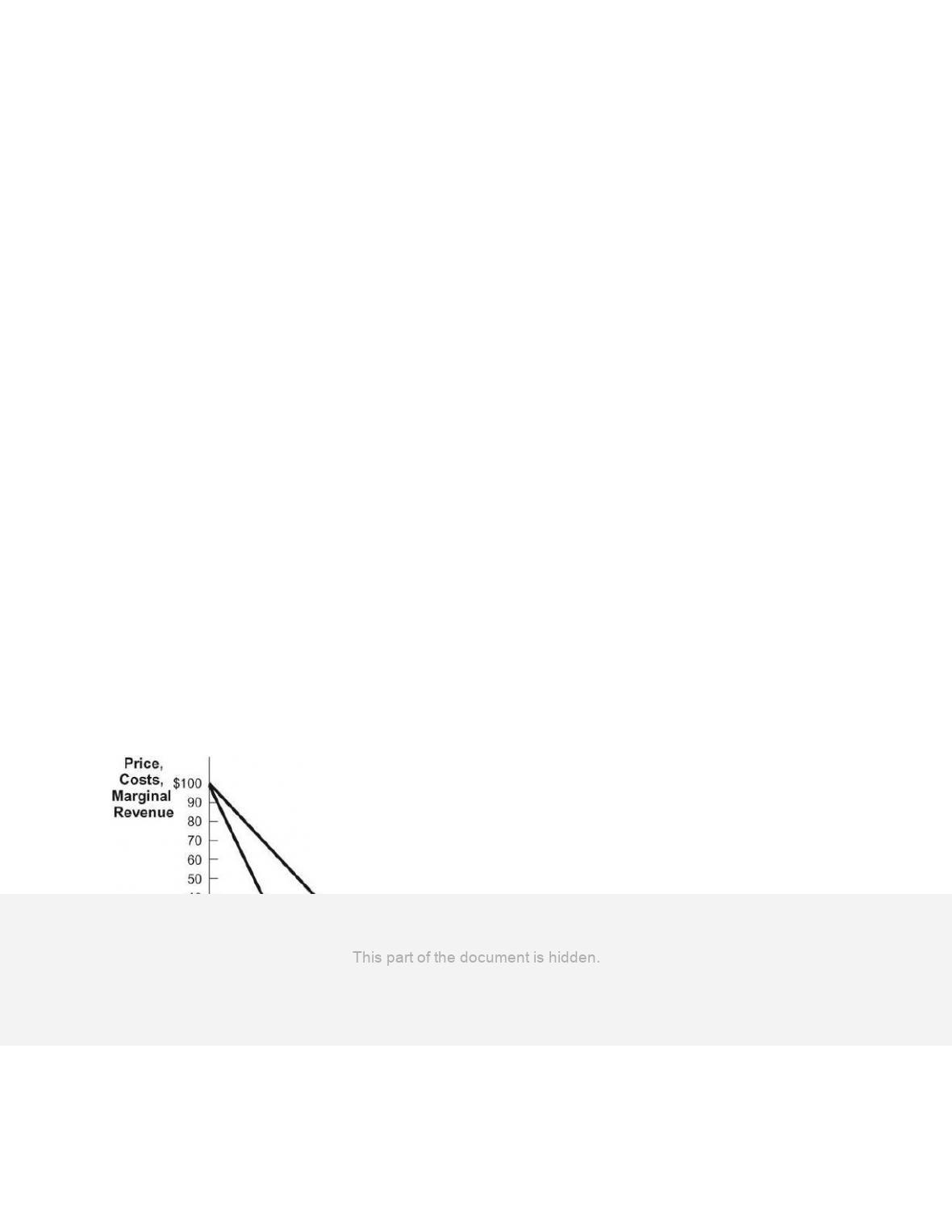
(Figure: PPV) Use Figure: PPV. The figure shows the demand and marginal revenue for
a pay-per-view football game on cable TV. Assume that the marginal cost and average
cost are a constant $40. If the cable company is a single-price monopoly, to maximize
profit it will sell _____ subscriptions and charge _____ per subscription.
A)
8; $20
B)
6; $40
C)
3; $70
D)
2; $80
197.
(Figure: PPV) Use Figure: PPV. The figure shows the demand and marginal revenue for
a pay-per-view football game on cable TV. Assume that the marginal cost and average
cost are a constant $40. If the cable company is a single-price monopoly and maximizes
profit, consumer surplus will be:
A)
$0.
B)
$45.
C)
$70.
D)
$90.
198.
(Figure: PPV) Use Figure: PPV. The figure shows the demand and marginal revenue for
a pay-per-view football game on cable TV. Assume that the marginal cost and average
cost are a constant $40. If the cable company is a single-price monopoly and maximizes
profit, producer surplus will be:
A)
$0.
B)
$45.
C)
$70.
D)
$90.
199.
(Figure: PPV) Use Figure: PPV. The figure shows the demand and marginal revenue for
a pay-per-view football game on cable TV. Assume that the marginal cost and average
cost are a constant $40. If the cable company is a single-price monopoly and maximizes
profit, deadweight loss will be:
A)
$0.
B)
$45.
C)
$60.
D)
$90.

Page 44
200.
(Figure: PPV) Use Figure: PPV. The figure shows the demand and marginal revenue for
a pay-per-view football game on cable TV. Assume that the marginal cost and average
cost are a constant $40. If the cable company practices perfect price discrimination, then
it will sell _____ subscriptions.
A)
10
B)
8
C)
6
D)
0
201.
(Figure: PPV) Use Figure: PPV. The figure shows the demand and marginal revenue for
a pay-per-view football game on cable TV. Assume that the marginal cost and average
cost are a constant $40. If the cable company practices perfect price discrimination,
consumer surplus will be:
A)
$180.
B)
$100.
C)
$40.
D)
$0.
202.
(Figure: PPV) Use Figure: PPV. The figure shows the demand and marginal revenue for
a pay-per-view football game on cable TV. Assume that the marginal cost and average
cost are a constant $40. If the cable company practices perfect price discrimination,
producer surplus will be:
A)
$180.
B)
$100.
C)
$40.
D)
$0.
203.
(Figure: PPV) Use Figure: PPV. The figure shows the demand and marginal revenue for
a pay-per-view football game on cable TV. Assume that the marginal cost and average
cost are a constant $40. If the cable company practices perfect price discrimination,
deadweight loss will be:
A)
$180.
B)
$100.
C)
$40.
D)
$0.
Page 45
Use the following to answer questions 204-206:
Figure: A Rock Climbing Shoe Monopoly
204.
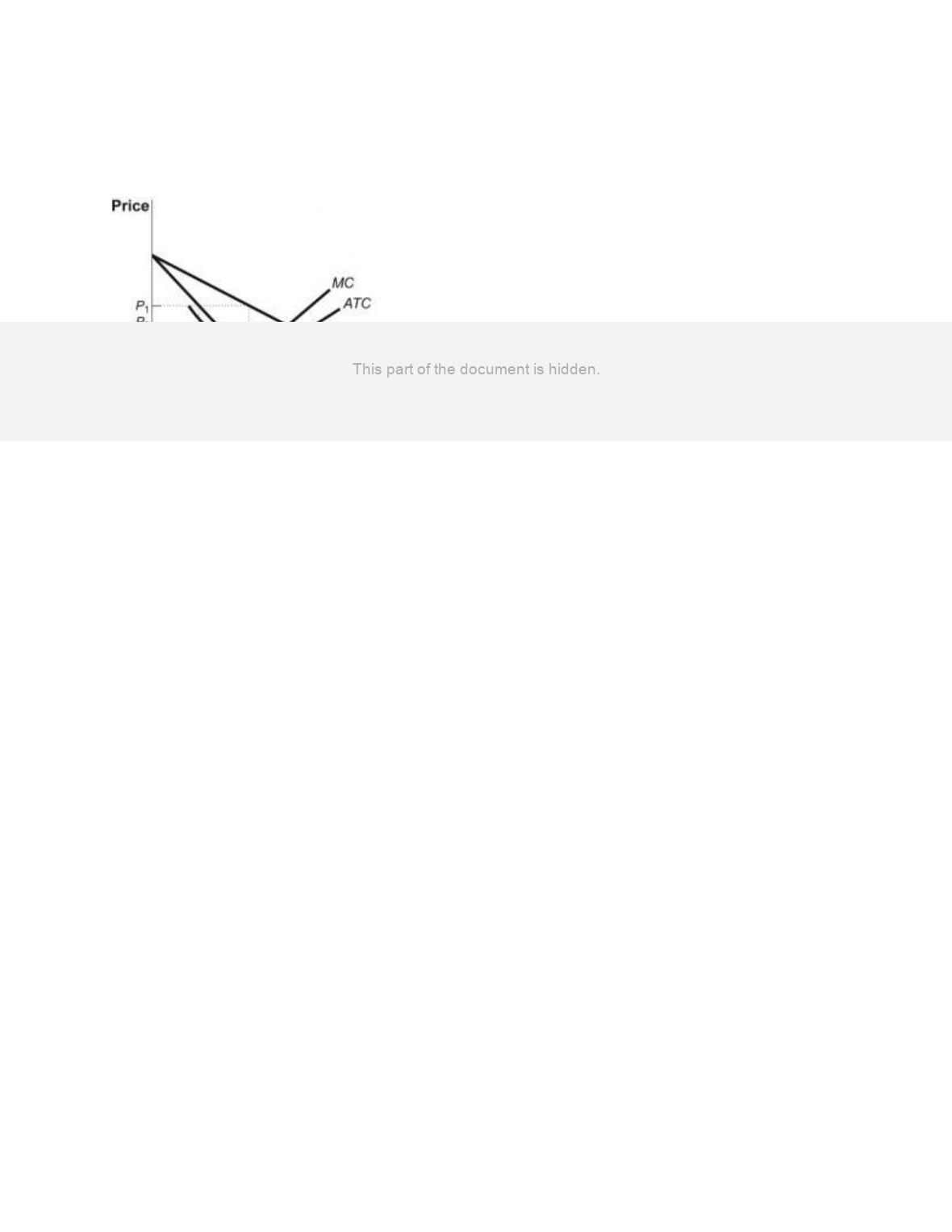
(Figure: A Rock Climbing Shoe Monopoly) Use Figure: A Rock Climbing Shoe
Monopoly. If the firm acts to maximize profit, the firm will sell _____ pairs of shoes at
_____ per pair.
A)
Q2; P1
B)
Q2; P5
C)
Q3; P2
D)
Q4; P3
205.
(Figure: A Rock Climbing Shoe Monopoly) Use Figure: A Rock Climbing Shoe
Monopoly. If the firm acts to maximize profit, the firm will earn profit equal to:
A)
(P1 – P5) × Q2.
B)
(P1 – P4) × Q2.
C)
(P4 – P5) × Q2.
D)
(P2 – P3) × Q3.
206.
(Figure: A Rock Climbing Shoe Monopoly) Use Figure: A Rock Climbing Shoe
Monopoly. If the firm is regulated such that it earns zero economic profit, the firm will
sell _____ pairs of shoes at a price of _____ per pair.
A)
Q1; P1
B)
Q2; P1
C)
Q4; P3
D)
Q3; P2
Page 46
Use the following to answer questions 207-210:
207.
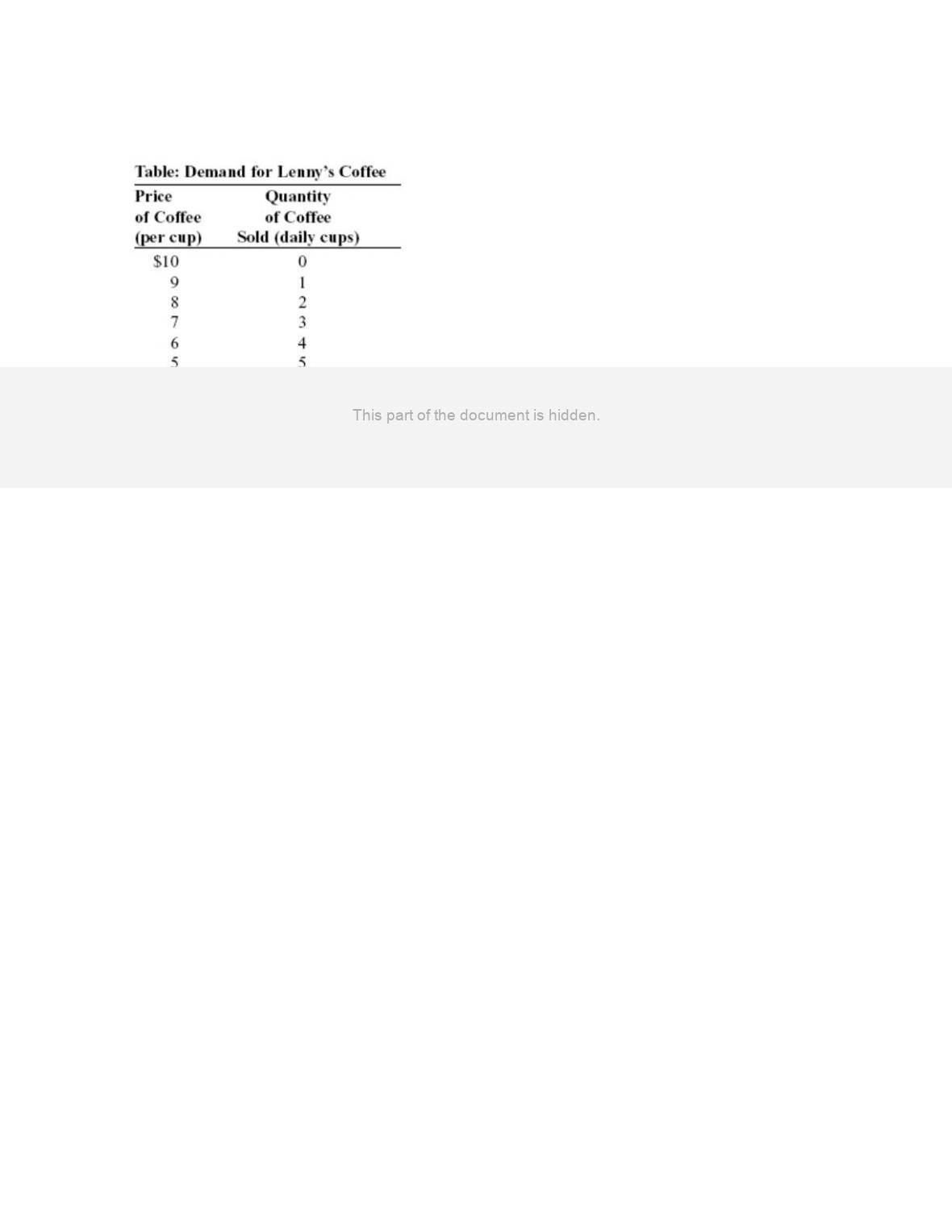
(Table: Demand for Lenny’s Coffee) Use Table: Demand for Lenny’s Coffee. Lenny’s
Café is the only source of coffee for hundreds of miles in any direction. If Lenny
increases the quantity sold from 5 cups to 6, his marginal revenue will be:
A)
$4.
B)
$24.
C)
–$1.
D)
$5.
208.
(Table: Demand for Lenny’s Coffee) Use Table: Demand for Lenny’s Coffee. Lenny’s
Café is the only source of coffee for hundreds of miles in any direction. Lenny is selling
2 cups of coffee. If he lowers the price and sells 3 cups of coffee, the _____ effect will
dominate the _____ effect, and total revenue will _____.
A)
quantity; price; decrease
B)
price; quantity; increase
C)
price; quantity; decrease
D)
quantity; price; increase
Page 47
209.
(Table: Demand for Lenny’s Coffee) Use Table: Demand for Lenny’s Coffee. Lenny’s
Café is the only source of coffee for hundreds of miles in any direction. If Lenny’s
marginal cost of selling coffee is a constant $2, his profit-maximizing level of output is
_____ cups at _____ per cup.
A)
4; $6
B)
8; $3
C)
5; $5
D)
3; $7
210.
(Table: Demand for Lenny’s Coffee) Use Table: Demand for Lenny’s Coffee. Lenny’s
Café is the only source of coffee for hundreds of miles in any direction. If Lenny’s
marginal cost of selling coffee is a constant $2 and he has no fixed costs, and the
government forces Lenny to charge a price that eliminates deadweight loss, Lenny will
charge _____ per cup and sell _____ cups.
A)
$0; 10
B)
$2; 8
C)
$4; 6
D)
$5; 5
Use the following to answer questions 211-219:
211.
(Table: Prices and Demand) Use Table: Prices and Demand. The New Orleans Saints
have a monopoly on Saints logo hats. The marginal cost of producing a hat is $18. The
Saints should produce _____ hats and charge _____ to maximize its profits.
A)
1; $28
B)
2; $26
C)
3; $24
D)
4; $22

Page 48
212.
(Table: Prices and Demand) The New Orleans Saints have a monopoly on Saints logo
hats. The marginal cost of producing a hat is $18. If the Saints increase the number of
hats they sell from 4 to 5, their total revenue changes from _____ to _____.
A)
$88; $100
B)
$22; $20
C)
$88; $80
D)
$110; $100
213.
(Table: Prices and Demand) The New Orleans Saints have a monopoly on Saints logo
hats. The marginal cost of producing a hat is $18. If the Saints increase the number of
hats they sell from 4 to 5, the quantity effect is a(n) _____ in total revenue of _____.
A)
decrease; $20
B)
increase; $20
C)
decrease; $8
D)
increase; $8
214.
(Table: Prices and Demand) The New Orleans Saints have a monopoly on Saints logo
hats. The marginal cost of producing a hat is $18. If the Saints increase the number of
hats they sell from 4 to 5, the price effect is a(n) _____ in total revenue of _____.
A)
decrease; $20
B)
increase; $20
C)
decrease; $8
D)
increase; $8
215.
(Table: Prices and Demand) The New Orleans Saints have a monopoly on Saints logo
hats. The marginal cost of producing a hat is $18. If the Saints increase the number of
hats they sell from 4 to 5, marginal revenue is:
A)
$20.
B)
$22.
C)
$8.
D)
$12.

Page 49
216.
(Table: Prices and Demand) Use Table: Prices and Demand. The New Orleans Saints
have a monopoly on Saints logo baseball hats. The Saints sell at most 1 hat to each
customer, and the table shows each customer’s willingness to pay. The marginal cost of
producing a hat is $18, and there are no fixed costs. How much is the Saints’ profit at the
profit-maximizing output?
A)
$24
B)
$18
C)
$12
D)
$30
217.
(Table: Prices and Demand) Use Table: Prices and Demand. The New Orleans Saints
have a monopoly on Saints logo hats. The marginal cost of producing a hat is $18. How
much is consumer surplus at the Saint’s profit-maximizing output?
A)
$24
B)
$18
C)
$12
D)
$9
218.
(Table: Prices and Demand) Use Table: Prices and Demand. The New Orleans Saints
have a monopoly on Saints logo hats. The marginal cost of producing a hat is $18. How
much is producer surplus at the Saint’s profit-maximizing output?
A)
$24
B)
$18
C)
$12
D)
$9
219.
(Table: Prices and Demand) Use Table: Prices and Demand. The New Orleans Saints
have a monopoly on Saints logo hats. The marginal cost of producing a hat is $18. How
much is deadweight loss at the Saint’s profit-maximizing output?
A)
$24
B)
$18
C)
$12
D)
$9
Page 50
Use the following to answer questions 220-233:
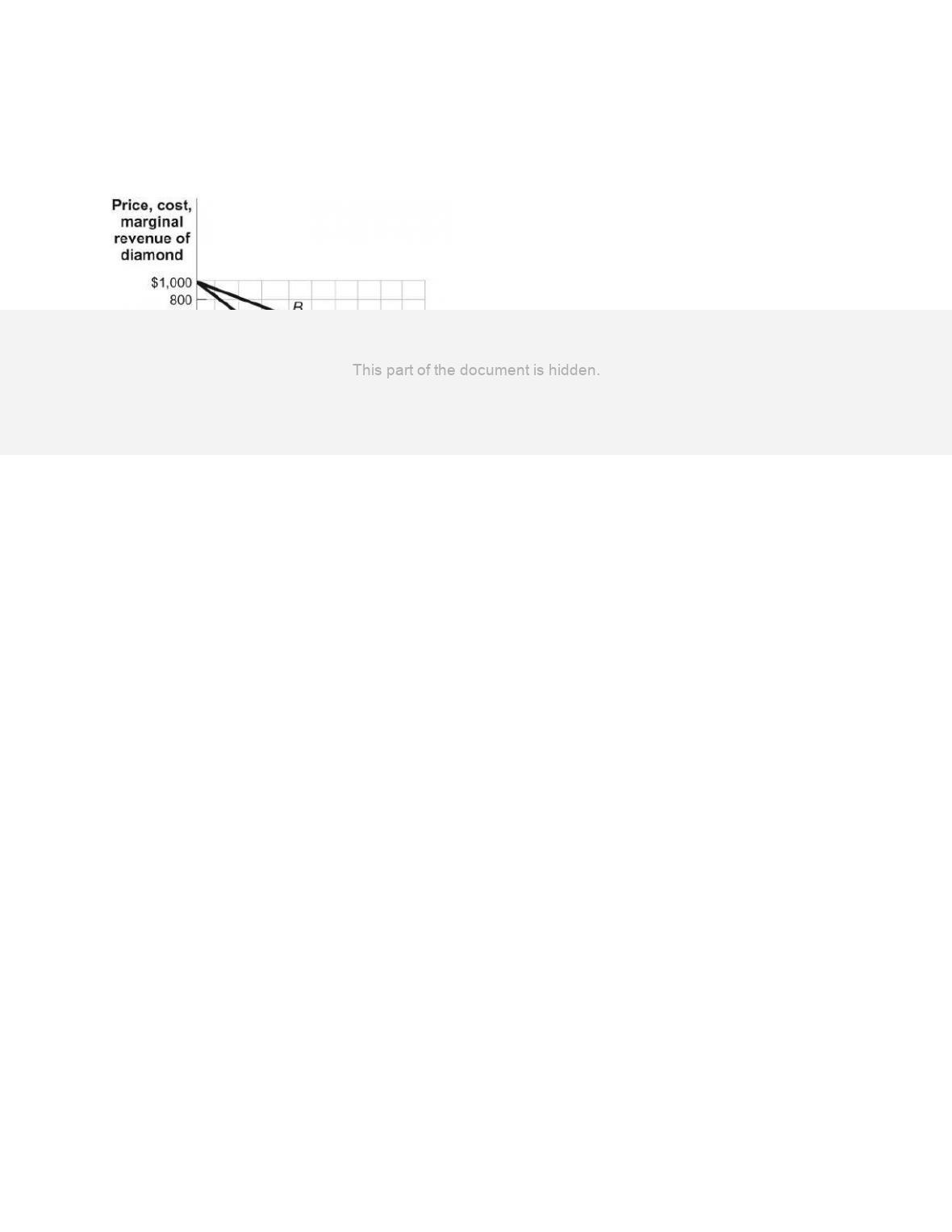
Figure: The Profit-Maximizing Output and Price
220.
(Figure: The Profit-Maximizing Output and Price) Use Figure: The Profit-Maximizing
Output and Price. Assume there are no fixed costs and AC = MC. At the
profit-maximizing quantity of production for the monopolist, total revenue is _____,
total cost is _____, and profit is _____.
A)
$600; $200; $400
B)
$1,600; $3,200; $1,600
C)
$4,800; $3,200; $1,600
D)
$4,800; $1,600; $3,200
221.
(Figure: The Profit-Maximizing Output and Price) Use Figure: The Profit-Maximizing
Output and Price. Under perfect competition, the price of the good would be _____ and
_____ units would be produced.
A)
$600; 8
B)
$200; 8
C)
$200; 16
D)
$600; 16
222.
(Figure: The Profit-Maximizing Output and Price) Use Figure: The Profit-Maximizing
Output and Price. Assume that there are no fixed costs and AC = MC = $200. The
profit-maximizing output for a monopolist is:
A)
0.
B)
8.
C)
16.
D)
20.

Page 51
223.
(Figure: The Profit-Maximizing Output and Price) Use Figure: The Profit-Maximizing
Output and Price. Assume that there are no fixed costs and AC = MC = $200. The
profit-maximizing price for a monopolist is:
A)
$800.
B)
$200.
C)
$600.
D)
$1,000.
224.
(Figure: The Profit-Maximizing Output and Price) Use Figure: The Profit-Maximizing
Output and Price. Assume that there are no fixed costs and AC = MC = $200. At the
profit-maximizing output and price for a monopolist, consumer surplus is:
A)
$0.
B)
$600.
C)
$1,000.
D)
$1,600.
225.
(Figure: The Profit-Maximizing Output and Price) Use Figure: The Profit-Maximizing
Output and Price. Assume that there are no fixed costs and AC = MC = $200. At the
profit-maximizing output and price for a monopolist, producer surplus is:
A)
$3,200.
B)
$6,400.
C)
$1,000.
D)
$1,600.
226.
(Figure: The Profit-Maximizing Output and Price) Use Figure: The Profit-Maximizing
Output and Price. Assume that there are no fixed costs and AC = MC = $200. At the
profit-maximizing output and price for a monopolist, deadweight loss is:
A)
$3,200.
B)
$6,400.
C)
$1,000.
D)
$1,600.
227.
(Figure: The Profit-Maximizing Output and Price) Use Figure: The Profit-Maximizing
Output and Price. Assume that there are no fixed costs and AC = MC = $200. At the
profit-maximizing output and price for a monopolist, total surplus is:
A)
$3,200.
B)
$4,800
C)
$1,000.
D)
$1,600.

Page 52
228.
(Figure: The Profit-Maximizing Output and Price) Use Figure: The Profit-Maximizing
Output and Price. Assume that there are no fixed costs and AC = MC = $200. At the
profit-maximizing output and price for a perfectly competitive industry, economic profit
for the firms in the industry is:
A)
$0.
B)
$200.
C)
$1,600.
D)
$3,200.
229.
(Figure: The Profit-Maximizing Output and Price) Use Figure: The Profit-Maximizing
Output and Price. Assume that there are no fixed costs and AC = MC = $200. If this
were a perfectly competitive industry, consumer surplus would be:
A)
$0.
B)
$6,400.
C)
$1,600.
D)
$3,200.
230.
(Figure: The Profit-Maximizing Output and Price) Use Figure: The Profit-Maximizing
Output and Price. Assume that there are no fixed costs and AC = MC = $200. If this
were a perfectly competitive industry, producer surplus would be:
A)
$0.
B)
$200.
C)
$1,600.
D)
$3,200.
231.
(Figure: The Profit-Maximizing Output and Price) Use Figure: The Profit-Maximizing
Output and Price. Assume that there are no fixed costs and AC = MC = $200. If this
were a perfectly competitive industry, deadweight loss would be:
A)
$0.
B)
$200.
C)
$1,600.
D)
$3,200.
232.
(Figure: The Profit-Maximizing Output and Price) Use Figure: The Profit-Maximizing
Output and Price. Assume that there are no fixed costs and AC = MC = $200. If this
were a perfectly competitive industry, total surplus would be:
A)
$6,400.
B)
$1,600.
C)
$3,200.
D)
$4,800.
Page 53
233.
(Figure: The Profit-Maximizing Output and Price) Use Figure: The Profit-Maximizing
Output and Price. Assume that there are no fixed costs and AC = MC = $200. The
monopolist who can perfectly price discriminate will produce an output of _____
diamonds.
A)
0
B)
6
C)
16
D)
20
234.
Of the four market structures, the only one that is characterized by product
differentiation is oligopoly.
A)
True
B)
False
235.
A producer is a monopoly if it is the sole supplier of a good that has no close substitutes.
A)
True
B)
False
236.
A monopoly increases price by limiting the quantity supplied to a market.
A)
True
B)
False
237.
To maintain profits in the long run, a monopoly must be protected by barriers to the
entry of other firms into the industry.
A)
True
B)
False
238.
A monopoly may continue to make economic profits in the long run because of the
barriers to entry in its industry.
A)
True
B)
False
239.
The government can reduce the inefficiency associated with a monopoly through a
system of patents and copyrights.
A)
True
B)
False
Page 54
240.
A natural monopoly has small fixed costs, which allows it to produce at lower cost than
can potential competitors.
A)
True
B)
False
241.
Suppose a monopolist reduces its price in an effort to expand output. If the price effect
equals the quantity effect, then the marginal revenue will be zero.
A)
True
B)
False
242.
The marginal revenue curve for a monopolist is always less than the price because of the
price effect.
A)
True
B)
False
243.
If a firm has market power, the marginal revenue curve always lies below the demand
curve.
A)
True
B)
False
244.
A monopoly can choose the price or it can choose the quantity, but it cannot choose
price and quantity independent of each other.
A)
True
B)
False
245.
A monopoly’s short-run supply curve is upward sloping because of diminishing
marginal returns.
A)
True
B)
False
246.
A monopoly’s short-run supply curve is its marginal cost curve above the minimum
average variable cost.
A)
True
B)
False
Page 55
247.
A monopoly’s short-run marginal cost is constant at $10. This implies that its average
variable cost is also constant and equal to $10.
A)
True
B)
False
248.
A profit-maximizing monopoly will never set price in the inelastic region of the demand
curve.
A)
True
B)
False
249.
Monopoly is inefficient because some consumer surplus is transferred to producer
surplus.
A)
True
B)
False
250.
Compared with perfect competition, monopoly produces a net welfare gain for society.
A)
True
B)
False
251.
Consumer surplus in monopoly is smaller than it is in the same industry operating under
perfect competition.
A)
True
B)
False
252.
Producer surplus in monopoly is smaller than it is in the same industry operating under
perfect competition.
A)
True
B)
False
253.
Deadweight loss in monopoly is smaller than it is in the same industry operating under
perfect competition.
A)
True
B)
False
254.
When regulating a natural monopoly, the government always sets a price ceiling where
marginal cost intersects the demand curve.
A)
True
B)
False
Page 56
255.
When a natural monopoly is regulated to charge a price equal to average total cost,
consumer surplus increases, but total surplus decreases.
A)
True
B)
False
256.
When a natural monopoly is regulated to charge a price equal to average total cost,
producer surplus decreases, but total surplus increases.
A)
True
B)
False
257.
A natural monopoly has increasing returns to scale so that a large producer has a
relatively low average total cost.
A)
True
B)
False
258.
Usually when a monopoly that isn’t a natural monopoly is broken up, the losses to the
producer outweigh the gains to consumers.
A)
True
B)
False
259.
The advantage of public ownership of a monopoly is that prices can be based on
efficiency and total surplus, rather than profit maximization.
A)
True
B)
False
260.
A disadvantage of public ownership of a monopoly is that publicly owned firms have
relatively little incentive to keep costs low or offer high-quality products.
A)
True
B)
False
261.
A monopolist that charges each customer a different price based on the customer’s
individual willingness to pay is called a single-price monopolist.
A)
True
B)
False
Page 57
262.
Monopolists are engaging in price discrimination when they charge all customers the
same price.
A)
True
B)
False
263.
Price discrimination can never occur in perfect competition.
A)
True
B)
False
264.
Price discrimination may occur in monopoly.
A)
True
B)
False
265.
Price discrimination can never occur in oligopoly.
A)
True
B)
False
266.
Although price discrimination never occurs in perfect competition, it may occur in
monopolistic competition.
A)
True
B)
False
267.
To practice price discrimination, the producer must have some control over the price of
the product.
A)
True
B)
False
268.
A monopolist who practices price discrimination can increase sales but can never
increase profits above the level that would result from a single price being set (using the
intersection of marginal revenue and marginal cost).
A)
True
B)
False
269.
For a monopolist to practice price discrimination successfully, its customers must all
have the same willingness to pay for the good.
A)
True
B)
False
Page 58
270.
To increase profits with price discrimination, different groups of an oligopolist’s
customers must respond differently to prices of the good.
A)
True
B)
False
271.
When a monopolist practices price discrimination, consumer surplus will be higher than
the consumer surplus in a single-price monopoly.
A)
True
B)
False
272.
When a monopolist practices price discrimination, producer surplus will be higher than
it is in a single-price monopoly.
A)
True
B)
False
273.
When a monopolist practices price discrimination, the monopolist’s profits will be lower
than it is in a single-price monopoly.
A)
True
B)
False
274.
When a monopolist practices price discrimination as opposed to setting a single price,
the monopolist increases its profits by capturing consumer surplus.
A)
True
B)
False
275.
When a monopolist practices price discrimination as opposed to setting a single price,
the monopolist increases its profits by decreasing producer surplus.
A)
True
B)
False
276.
When a monopolist practices price discrimination as opposed to setting a single price,
deadweight loss decreases.
A)
True
B)
False
Page 59
277.
When a monopolist practices price discrimination as opposed to setting a single price,
efficiency decreases.
A)
True
B)
False
278.
When a monopolist practices price discrimination as opposed to setting a single price,
the monopolist sells less but increases profits.
A)
True
B)
False
279.
When a monopolist practices price discrimination as opposed to setting a single price,
the monopolist sells more and increases profits.
A)
True
B)
False
280.
An oligopoly that engages in price discrimination will charge higher prices to customers
with the most elastic demand.
A)
True
B)
False
281.
An oligopoly that engages in price discrimination will charge higher prices to customers
with the most inelastic demand.
A)
True
B)
False
282.
Children’s price elasticity of demand for hot chocolate is 0.5. Adults’ price elasticity of
demand for hot chocolate is 1.5. If the concession stand selling the hot chocolate wants
to practice price discrimination, it should charge higher prices to adults.
A)
True
B)
False
283.
Children’s price elasticity of demand for hot chocolate is 0.5. Adults’ price elasticity of
demand for hot chocolate is 1.5. If the concession stand selling the hot chocolate wants
to practice price discrimination, it should charge higher prices to children.
A)
True
B)
False