146.
(Table: Coke and Pepsi Advertising Game) Use Table: Coke and Pepsi Advertising
Game. The soft-drink industry is dominated by Coca-Cola and Pepsi, and each firm
spends a lot of money on advertising. Suppose each firm is considering a costly
television commercial during halftime of the Super Bowl. The table shows the payoff
matrix of profits that each firm would receive from their advertising decision, given the
advertising decision of their rival. Profits in each cell of the payoff matrix are given as
(Coke, Pepsi). If both firms expect to play this game repeatedly (every year for the
foreseeable future) and they use a tit-for-tat strategy, in equilibrium, Coke _____ and
Pepsi _____.
A)
advertises; does not advertise
B)
does not advertise; advertises
C)
does not advertise; does not advertise
D)
advertises; advertises
147.
Market power in the United States was often gained in the latter part of the nineteenth
century by:
A)
forming trusts.
B)
the growth of competition.
C)
international arrangements with Russian and Japanese firms.
D)
opening up more industries to international trade.
148.
Attempts by the federal government to prevent the exercise of monopoly power in the
United States are known as _____ policy.
A)
stabilization
B)
antitrust
C)
fiscal
D)
government
149.
Antitrust policy refers to government:
A)
attempts to prevent the acquisition of monopoly power.
B)
attempts to encourage the exercise of monopoly power.
C)
encouragement of collusion in the marketplace.
D)
attempts to limit private enterprise.
150.
The FIRST law designed to curb monopoly power in the United States was the _____
Act.
A)
Sherman Antitrust
B)
Clayton
C)
Federal Trade Commission
D)
Robinson–Patman
Page 42
151.
A major application of the Sherman Antitrust Act was in _____ against _____.
A)
1880; the Ford Motor Company
B)
1889; Bell
C)
1911; Standard Oil
D)
1889; Bell and Standard Oil
152.
The field of law that attempts to limit the ability of oligopolists to collude and restrict
competition is called:
A)
antitrust policy.
B)
product safety policy.
C)
fuel-efficiency standards.
D)
excise tax policy.
153.
One of the earliest actions of antitrust policy was the breakup of:
A)
the Standard Oil Company.
B)
Bell Telephone.
C)
Microsoft.
D)
IBM.
154.
Oligopoly first became an issue in the United States when:
A)
the Sons of Liberty dumped the East India Company’s tea into Boston Harbor in
1773.
B)
the Emancipation Proclamation was issued in 1863.
C)
the growth of railroads made possible a national market for goods in the second
half of the nineteenth century.
D)
Google purchased Motorola Mobility in 2011.
155.
A formal agreement to limit production and raise prices leads to:
A)
a cartel.
B)
perfect competition.
C)
monopolistic competition.
D)
oligopoly.
156.
Cartels became illegal in the United States in:
A)
1776.
B)
1890.
C)
1929.
D)
1982.
Page 43
157.
A trust:
A)
is a government agency that regulates natural monopolies.
B)
is the new organization that is formed when two firms merge.
C)
occurs when shareholders of the major companies in an industry turn over their
shares to a board of trustees who then control all of the companies.
D)
is another name for a large insurance company.
158.
The FIRST trust in the United States was established by _____ in the _____ industry.
A)
AT&T; communications
B)
Walt Disney; entertainment
C)
Amtrak; transportation
D)
Standard Oil; petroleum
159.
The purpose of the trusts established in the United States in the late 1800s was to:
A)
engage in monopoly pricing.
B)
promote international trade.
C)
promote competition in the transportation industry.
D)
limit the involvement of government in providing health care.
160.
The purpose of antitrust policy is to:
A)
limit pollution.
B)
provide access to affordable health care for uninsured Americans.
C)
prevent the exercise of monopoly power.
D)
control inflation and interest rates.
161.
The 1890 law intended to prevent the establishment of more monopolies and to break up
existing ones in the United States was the _____ Act.
A)
Taft-Hartley
B)
Sherman Antitrust
C)
Affordable Care
D)
Federal Trade Commission
162.
The government agency in the United States that reviews proposed mergers of firms in
the same industry and prohibits mergers that it believes will reduce competition is the:
A)
Commerce Department.
B)
Federal Reserve.
C)
Labor Department
D)
Department of Justice.
Page 44
163.
Which factor would make it difficult for oligopolists to collude?
A)
few firms
B)
few buyers
C)
similar costs of production
D)
a homogeneous product
164.
Which factor would make it difficult for Georgia peach suppliers to collude?
A)
only a few suppliers
B)
each supplier having the same costs
C)
buyers of peaches having very little bargaining power since peaches are
homogeneous
D)
only a few buyers of peaches
165.
The airline industry often engages in price wars. This means that firms often _____
prices until profits _____.
A)
raise; are maximized
B)
lower; are maximized
C)
lower; approach zero
D)
raise; approach zero
166.
Airlines are prone to price wars because:
A)
most fliers choose airlines on the basis of schedule and price.
B)
airline pricing is easy to understand.
C)
airlines have the same costs.
D)
airlines operate close to capacity.
167.
Tacit collusion is difficult if:
A)
there are many firms in the industry.
B)
the firms in the industry are producing differentiated products.
C)
firms have common interests.
D)
the oligopolists are selling to many small firms.
168.
Tacit collusion is relatively easy for oligopolists if:
A)
they are producing many different products.
B)
there are only a few firms in the industry.
C)
they are selling their product to only a few large buyers.
D)
barriers to entry into the industry are low.
Page 45
169.
As the number of firms in an oligopoly decreases:
A)
barriers to entry are likely to shrink.
B)
firms are less likely to engage in tacit collusion.
C)
firms are more likely to engage in tacit collusion.
D)
it becomes more difficult for the oligopoly to restrict output.
170.
If the several companies in the tobacco industry produce similar products but have very
different marginal costs:
A)
they are less likely to engage in tacit collusion than firms with similar costs.
B)
they are more likely to engage in tacit collusion than firms with similar costs.
C)
prices for tobacco products are more likely to be near the monopoly level than in
an industry whose firms have similar costs.
D)
output of tobacco products is more likely to be near the monopoly level than in an
industry whose firms have similar costs.
171.
Microsoft sets prices for its new line of computers, and Dell and HP follow. This
practice is known as:
A)
antitrust pricing.
B)
price extortion.
C)
price leadership.
D)
kinked demand behavior.
172.
Price leadership occurs if:
A)
smaller firms in an industry silently agree to charge the same price as the largest
firm.
B)
two or more firms in an industry agree to fix the price at a given level.
C)
competition among a large number of small firms generates a stable market price.
D)
competition among a large number of small firms generates similar but slightly
different prices.
173.
As a New York business owner who does a lot of flying, you are keenly aware of even
small changes in airfare from New York to Chicago. You have flown this route long
enough to know that each airline is essentially a perfect substitute for the others. You
notice that every time the largest airline changes the price, smaller airlines follow, but
the smaller airlines are always priced slightly below the fare of the largest airline. This
industry could BEST be described as one with:
A)
price wars.
B)
nonprice competition.
C)
cartel behavior.
D)
price leadership.
Page 46
174.
Nonprice competition is more prevalent in an oligopoly when there is/are:
A)
a Nash equilibrium.
B)
complex products.
C)
tacit collusion.
D)
no product differentiations.
175.
In the past, most of the cars sold in the United States were produced by the Big Three
auto companies. General Motors would announce its prices for the new model year first,
and then the other companies would match it. This practice was an example of:
A)
price leadership.
B)
noncooperative behavior.
C)
a kinked demand model.
D)
a cartel.
176.
The Orlando, Florida, theme park industry tends to follow a price leadership model.
This means that:
A)
each theme park sets its own price and operating hours independent of what other
parks do.
B)
Disney often sets a price and rival theme parks then follow with similar if not
identical prices.
C)
Disney often sets prices only to be undercut by rival firms who prefer to engage in
price wars.
D)
firms use explicit written agreements to charge identical prices.
177.
A situation in which one firm sets the price and other firms in the industry match it is
known as:
A)
a Nash equilibrium.
B)
price leadership.
C)
Cournot competition.
D)
price competition.
178.
Which example is MOST likely to be observed when firms engage mainly in nonprice
competition?
A)
actively encouraging the sale of generic as opposed to brand-name products
B)
advertising and product differentiation
C)
discounts offered through coupons
D)
low interest rates for financing the purchase of big-ticket items
Page 47
179.
An attempt by a firm to convince buyers that its product is different from the products of
other firms in the industry is:
A)
tacit collusion.
B)
product differentiation.
C)
antitrust policy.
D)
price leadership.
180.
The effect of product differentiation is to:
A)
start a price war.
B)
reduce prices to the noncooperative level.
C)
reduce the intensity of competition among the firms in the oligopoly.
D)
increase the intensity of competition among the firms in the oligopoly.
181.
The practice of one company tacitly setting prices for the industry as a whole is:
A)
tacit collusion.
B)
product differentiation.
C)
antitrust policy.
D)
price leadership.
182.
Advertising is an example of:
A)
tacit collusion.
B)
nonprice competition.
C)
antitrust policy.
D)
price leadership.
183.
_____ occurs if Ford offers rebates on its most popular truck and Chevrolet follows.
A)
Tacit collusion
B)
Nonprice competition
C)
Antitrust policy
D)
Price leadership
184.
_____ occurs if Coke hires Lebron James to make a commercial and Pepsi follows by
hiring Peyton Manning for its commercial.
A)
Tacit collusion
B)
Nonprice competition
C)
Antitrust policy
D)
Price leadership
Page 48
Use the following to answer questions 185-189:
185.
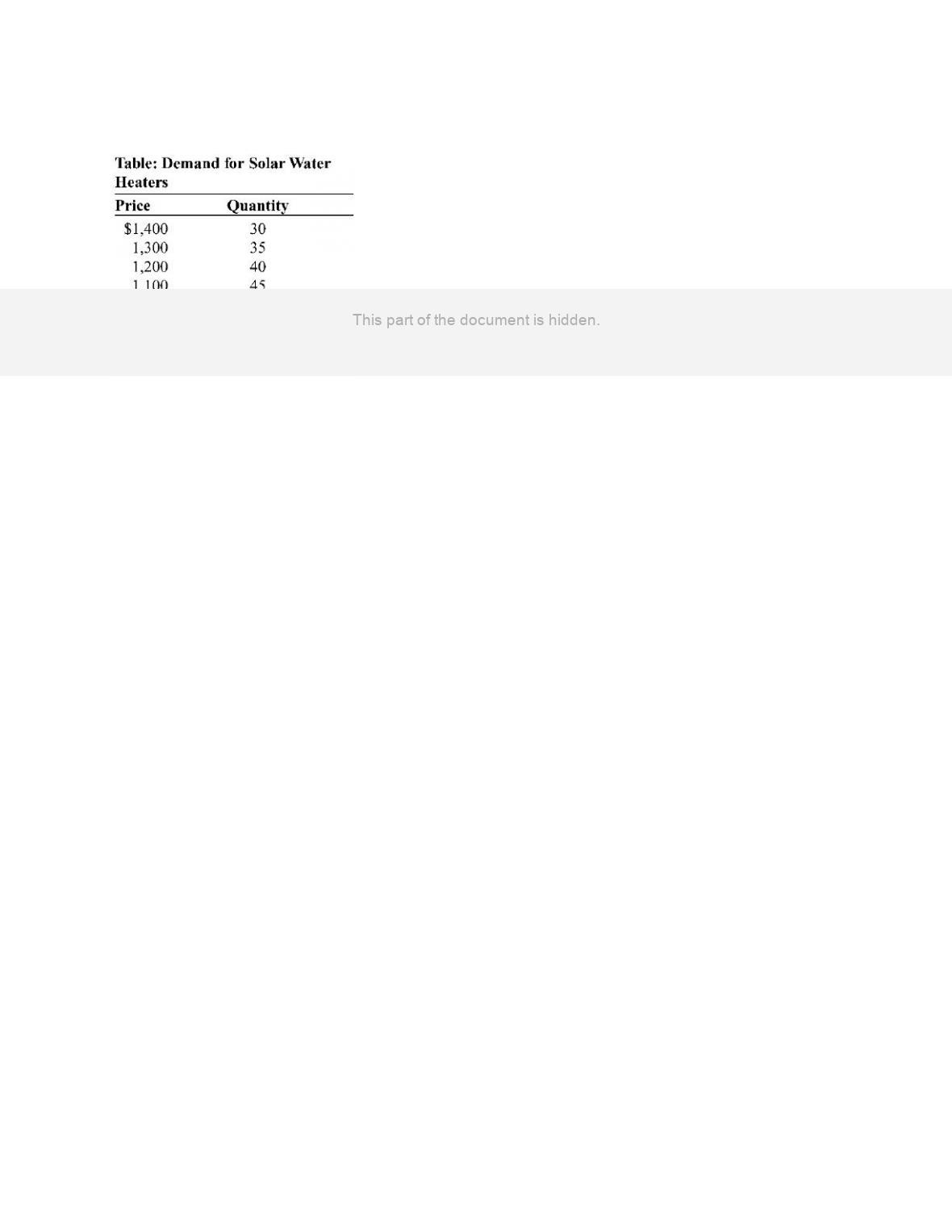
(Table: Demand for Solar Water Heaters) Use Table: Demand for Solar Water Heaters.
The marginal cost of producing solar water heaters is zero, and only two firms, Rheem
and Calefi, produce them. Suppose they agree to produce only 25 water heaters each. By
how much does Rheem’s profit rise if it cheats on the agreement and produces 30 water
heaters?
A)
$3,000
B)
$2,700
C)
$2,000
D)
$5,000
186.
(Table: Demand for Solar Water Heaters) Use Table: Demand for Solar Water Heaters.
The marginal cost of producing solar water heaters is zero, and only two firms, Rheem
and Calefi, produce them. Suppose they agree to produce only 25 water heaters each. If
Rheem cheats on the agreement and produces 30 water heaters, what is the price effect
for Rheem?
A)
–$1,000
B)
–$2,500
C)
$2,000
D)
$1,000
187.
(Table: Demand for Solar Water Heaters) Use Table: Demand for Solar Water Heaters.
The marginal cost of producing solar water heaters is zero, and only two firms, Rheem
and Calefi, produce them. Suppose they agree to produce only 25 water heaters each. If
Rheem cheats on the agreement and produces 30 water heaters, what is the quantity
effect for Rheem?
A)
$1,000
B)
$4,500
C)
$2,000
D)
$9,000
Page 49
188.
(Table: Demand for Solar Water Heaters) Use Table: Demand for Solar Water Heaters.
The marginal cost of producing solar water heaters is zero, and only two firms, Rheem
and Calefi, produce them. If Rheem and Calefi get into a price war, the equilibrium
price in the market will be:
A)
$0.
B)
$700.
C)
$800.
D)
$1,000.
189.
(Table: Demand for Solar Water Heaters) Use Table: Demand for Solar Water Heaters.
The marginal cost of producing solar water heaters is zero, and only two firms, Rheem
and Calefi, produce them. If they agree to collude, what price will the cartel charge and
how many water heaters will the cartel sell?
A)
$1,000; 50
B)
$1,100; 45
C)
$900; 55
D)
$800; 60
190.
The term imperfect competition is used to refer to both oligopoly and monopolistic
competition.
A)
True
B)
False
191.
If the Baltimore furniture market had only a few sellers, it would be considered an
oligopoly.
A)
True
B)
False
192.
In the U.S. economy, oligopoly is rare.
A)
True
B)
False
193.
Cartels are illegal in the United States.
A)
True
B)
False
Page 50
194.
One of the most inefficient ways for duopolists to earn a profit is to engage in collusion
or form a cartel.
A)
True
B)
False
195.
The fact that the price effect for an oligopolist is less than the price effect for a
monopolist helps explain why firms are likely to cheat on a cartel agreement.
A)
True
B)
False
196.
Suppose all of the firms in an industry form a cartel and succeed in raising the price to
the monopoly level by reducing output. Any single firm will find that it can increase its
profits by cheating on the cartel agreement.
A)
True
B)
False
197.
Oligopolists will earn zero profits unless they can collude.
A)
True
B)
False
198.
Each firm in a cartel has an incentive to break its word and produce more than the
agreed quantity.
A)
True
B)
False
199.
A Nash equilibrium results when each player chooses the action that maximizes his or
her payoff given the actions of other players.
A)
True
B)
False
200.
A strategy of tit-for-tat involves playing cooperatively at first, then doing whatever the
other player did the previous period.
A)
True
B)
False
Page 51
201.
The noncooperative equilibrium of a prisoners’ dilemma game can be avoided if the
game is played repeatedly and firms engage in strategic behavior.
A)
True
B)
False
202.
A situation in which each firm acts to raise the profits of its rivals (and of itself) without
any formal agreement between firms is known as tacit collusion.
A)
True
B)
False
203.
Until 1890, trusts in which firms in an industry agreed to limit production and raise
prices were legal in the United States.
A)
True
B)
False
204.
Antitrust legislation was first passed in the United States in 1776.
A)
True
B)
False
205.
Oligopoly first became an issue in the United States in the second half of the nineteenth
century, when the growth of railroads allowed for a national market for goods.
A)
True
B)
False
206.
Cartels were legal in the United States until 1890.
A)
True
B)
False
207.
The purpose of the nineteenth-century cartels was to increase production and encourage
price competition.
A)
True
B)
False
208.
A trust is a government agency that enforces laws limiting the power of oligopolies.
A)
True
B)
False
Page 52
209.
A trust is the organization that is formed when two large companies merge.
A)
True
B)
False
210.
A trust is formed when shareholders of the major companies in an industry place their
shares in the hands of a board of trustees who control the companies and act as a single
firm that can engage in monopoly pricing.
A)
True
B)
False
211.
The first trust in the United States was established in 1881 by lawyers at John D.
Rockefeller’s Standard Oil Company.
A)
True
B)
False
212.
The purpose of the trusts established in the United States in the late 1800s was to
decrease government spending and the size of the federal budget deficit.
A)
True
B)
False
213.
The purpose of antitrust policy is to prevent the exercise of monopoly power.
A)
True
B)
False
214.
The law enacted in 1890 to break up existing monopolies and prevent the formation of
new ones was the Glass-Steagall Act.
A)
True
B)
False
215.
The law enacted in 1890 to break up existing monopolies and prevent the formation of
new ones was the Sherman Antitrust Act.
A)
True
B)
False
Page 53
216.
The government agency in the United States that reviews proposed mergers of firms in
the same industry and prohibits mergers that it believes will reduce competition is the
Office of Management and Budget.
A)
True
B)
False
217.
The government agency in the United States that reviews proposed mergers of firms in
the same industry and prohibits mergers that it believes will reduce competition is the
Department of Justice.
A)
True
B)
False
218.
Until recently, most advanced countries except the United States did not have policies
against price fixing.
A)
True
B)
False
219.
The breakup of Microsoft in 2005 was one of the first applications of antitrust policy in
the United States.
A)
True
B)
False
220.
The breakup of Standard Oil in 1911 was one of the first applications of antitrust policy
in the United States.
A)
True
B)
False
221.
For approximately the past 20 years, the European Union has enforced antitrust policies
for its member countries.
A)
True
B)
False
222.
The purpose of the Sherman Antitrust Act was to encourage the establishment of
monopolies to replace trusts.
A)
True
B)
False
Page 54
223.
Suppose that Walmart buys fresh roses from several hundred small backyard gardeners
in California. These gardeners are very likely to be able to engage successfully in tacit
collusion.
A)
True
B)
False
224.
Tacit collusion is most likely to occur if there are only a few firms in the industry.
A)
True
B)
False
225.
Tacit collusion is relatively less likely to occur in an industry with 3 firms than it is in an
industry with 10 firms.
A)
True
B)
False
226.
If there are many firms in an industry, there is little incentive for firms to engage in tacit
collusion because a smaller proportion of the units of the product sold are affected by
the price effect if a firm increases output.
A)
True
B)
False
227.
Oligopoly firms that produce only cement are less likely to collude than firms in a cell
phone oligopoly.
A)
True
B)
False
228.
Tacit collusion is likely to occur when firms have different market shares.
A)
True
B)
False
229.
Suppose an oligopoly is composed of four firms. One firm has a 50% market share;
another firm, 35%; another, 10%; and the fourth, 5%. It will be easier for this industry to
engage in tacit collusion than it would for an oligopoly each of whose four firms has
25% of the market.
A)
True
B)
False
Page 55
230.
Until recently, most other advanced countries did not have policies that prohibited price
fixing.
A)
True
B)
False
231.
A price war occurs when tacit collusion breaks down and aggressive price competition
causes prices to collapse.
A)
True
B)
False
232.
In a price war, firms in an oligopoly often push prices up to the monopoly level.
A)
True
B)
False
233.
Oligopolistic firms often choose not to compete on price.
A)
True
B)
False
234.
To limit competition, oligopolists often practice product differentiation.
A)
True
B)
False
235.
In the 1960s and 1970s, General Motors often set prices for the new model year and
Ford and Chrysler would follow. This was a form of tacit collusion known as price
leadership.
A)
True
B)
False
236.
An attempt by a firm to convince buyers that its product is different from the products of
other firms in the industry is tacit collusion.
A)
True
B)
False
237.
An attempt by a firm to convince buyers that its product is different from the products of
other firms in the industry is an example of cooperative behavior.
A)
True
B)
False
Page 56
238.
An attempt by a firm to convince buyers that its product is different from the products of
other firms in the industry is product differentiation.
A)
True
B)
False
239.
Price leadership is an attempt by a firm to convince buyers that its product is different
from the products of other firms in the industry.
A)
True
B)
False
240.
The effect of product differentiation is to decrease each firm’s market share.
A)
True
B)
False
241.
The effect of product differentiation is to increase price competition.
A)
True
B)
False
242.
The effect of product differentiation is to increase the firm’s market power.
A)
True
B)
False
243.
If Coke is able to use product differentiation successfully, some customers may be
willing to pay more for a Coke than for another very similar soda.
A)
True
B)
False
244.
The pattern of behavior in which one company tacitly sets prices for the industry as a
whole is known as product differentiation.
A)
True
B)
False
245.
The pattern of behavior in which one company tacitly sets prices for the industry as a
whole is known as price leadership.
A)
True
B)
False
Page 57
246.
Advertising is an example of price leadership.
A)
True
B)
False
247.
Advertising is an example of product differentiation.
A)
True
B)
False
248.
If Delta offers free drinks and snacks on its flights and Southwest follows, they are
engaging in tacit collusion.
A)
True
B)
False
249.
If Delta offers free drinks and snacks on its flights and Southwest follows, they are
engaging in price leadership.
A)
True
B)
False
250.
If Delta offers free drinks and snacks on its flights and Southwest follows, they are
engaging in nonprice competition.
A)
True
B)
False
251.
Across most industries, oligopoly is far more common than is either perfect competition
or monopoly.
A)
True
B)
False
Page 58
252.
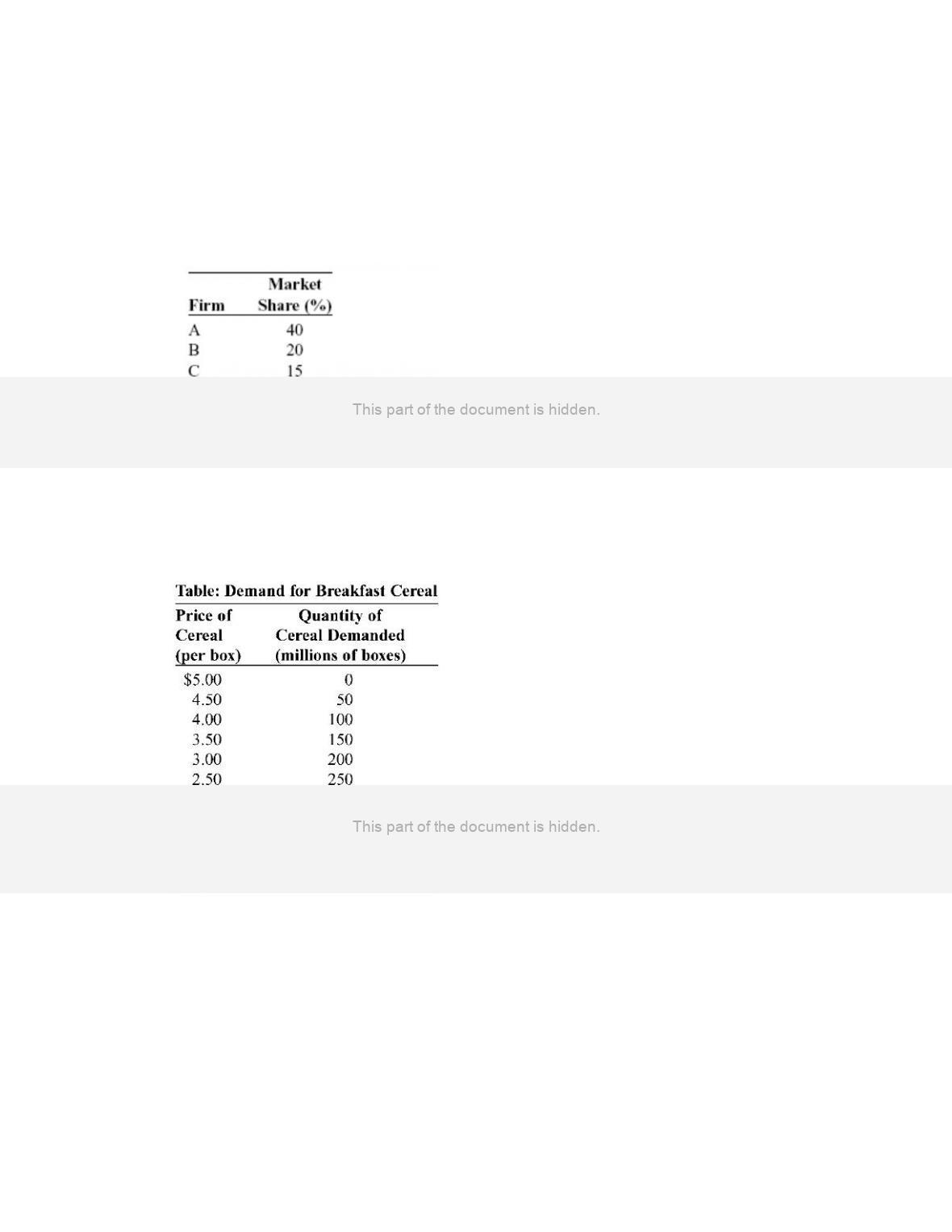
Suppose an industry is composed of seven producers with market shares given in the
table below.
A) Compute the Herfindahl–Hirschman index (HHI) for this market.
B) If firms B and C merge, how will this affect the HHI, all else being equal?
C) Instead, if firm A splits into two equal-sized competing firms, how would this affect
the HHI, all else being equal?
Support your answers with specific calculations. Do your results make sense?
253.
(Table: Demand for Breakfast Cereal) Use Table: Demand for Breakfast Cereal.
Suppose that the marginal cost of producing cereal is zero.
A) If General Mills is the sole producer of breakfast cereal, how many boxes will the
firm produce, what price will be charged, and how much revenue will be earned?
B) Now assume that Kellogg enters the market, and the industry is now a duopoly with
two equal-sized firms. If these firms agree to split the monopoly output equally, how
much revenue will each firm earn under the agreement?
C) If General Mills can cheat on this agreement by producing 50 million more boxes
of cereal without punishment, will it? Analyze the price effect and quantity effect for
General Mills of producing 1 million more boxes.