Page 41
166.
Monopolistically competitive firms produce less than the output at which average total
cost is minimized in the long run. As a result, there is:
A)
irrational capacity.
B)
excess capacity.
C)
product differentiation.
D)
zero economic profit.
167.
The excess capacity in monopolistic competition may be viewed as:
A)
the cost of product diversity.
B)
efficient.
C)
the reason P = MR = MC in monopolistic competition.
D)
the advantage of monopolistic competition over monopoly.
168.
Because monopolistically competitive firms charge a price that is greater than marginal
cost:
A)
monopolistic competition is efficient.
B)
monopolistic competition is inefficient.
C)
the marginal benefit to society of an additional unit of output is below its marginal
cost.
D)
monopolistic competition is inefficient and the marginal benefit to society of an
additional unit of output is below its marginal cost.
169.
Which statement is TRUE?
A)
Monopolistic competition and perfect competition are both inefficient.
B)
Monopolistic competition is efficient because of product differentiation.
C)
The inefficiency of monopolistic competition is arguably a small price to pay for
the wide range of product choices it offers.
D)
The inefficiency of monopolistic competition is a result of advertising expenses.
170.
In long-run equilibrium, a firm in monopolistic competition is similar to a monopoly
because it:
A)
earns no economic profit.
B)
charges a price equal to marginal cost.
C)
charges a price greater than marginal cost.
D)
charges a price equal to average total cost.
Page 42
171.
The problem of wasteful duplication in monopolistic competition is due to:
A)
excess capacity.
B)
a lack of physical and human capital.
C)
barriers to entry.
D)
the lack of close substitutes for products produced by monopolistically competitive
firms.
172.
Excess capacity is a problem in monopolistic competition because, if there were fewer
firms in the industry:
A)
there would be more choices for consumers.
B)
average total costs would be higher and profits would be lower.
C)
average total costs would be lower and the prices paid by consumers could be
lower.
D)
there would be less need for government regulation.
173.
Which statement is TRUE of firms in both perfect competition and monopolistic
competition?
A)
The long-run price is equal to marginal revenue, marginal cost, and average total
cost.
B)
Long-run economic profits are equal to zero.
C)
The long-run level of output is at the point where average total cost is minimized.
D)
Price is equal to marginal cost, ensuring that the efficient level of output is
produced.
174.
In long-run equilibrium in perfect competition, marginal cost is:
A)
greater than price.
B)
equal to price.
C)
less than price.
D)
related to price but not in a predictable way.
175.
In long-run equilibrium in monopolistic competition, marginal cost is:
A)
greater than price.
B)
equal to price.
C)
less than price.
D)
related to price but not in a predictable way.

Page 43
176.
In long-run equilibrium in perfect competition, price is:
A)
greater than average total cost.
B)
equal to average total cost at an output below the point where average total cost is
minimized.
C)
equal to average total cost at its minimum.
D)
equal to average total cost at an output above the point where average total cost is
minimized.
177.
In long-run equilibrium in monopolistic competition, price is:
A)
greater than average total cost.
B)
equal to average total cost at an output below where average total cost is
minimized.
C)
equal to average total cost at its minimum.
D)
equal to average total cost at an output above where average total cost is
minimized.
178.
Which scenario is likely to provide the LEAST amount of economic usefulness?
A)
NFL player Peyton Manning is shown throwing a football in a toothpaste
commercial.
B)
An online advertisement is posted at Cars.com for a 2005 Volvo S60 with 60,000
miles, a sunroof, and heated leather seats.
C)
An actor in a television commercial is describing the benefits and side effects of a
new arthritis medication.
D)
A radio commercial for a local restaurant is announcing special prices during any
college football broadcast.
179.
Which advertising slogan provides information to potential buyers?
A)
“Coffee Palace—Stop and smell the coffee!”
B)
“Karaoke Maker wants you to just sing it!”
C)
“Bee’s Beachside Restaurant is the only restaurant on the beach for 50 miles.”
D)
“The Happy Hotel wants you to be happy!”
180.
Some economists think that advertising is a waste of resources because:
A)
rational consumers end up spending too little on brand names.
B)
consumers may buy things they do not need.
C)
advertising creates excess capacity.
D)
advertising leads to lower costs for goods and services.

Page 44
181.
Monopolistic competitors often hire a celebrity spokesperson to advertise their product.
One reason such advertising works is that:
A)
celebrities are better informed about the relative merits of different products than
are the rest of us.
B)
consumers assume that the celebrity has researched the product and that the claims
being made on his or her behalf are true.
C)
the fact that a firm is willing to pay the large fees associated with celebrity
advertising signals to consumers that it is a major company and that it is therefore
likely to have a reliable product.
D)
celebrities encourage other firms to enter the industry.
182.
Budweiser is a widely recognized brand name. During the Super Bowl each year, this
beer company has many of the most successful ads. Which statement is TRUE about
advertising for Budweiser?
A)
It is designed to increase the demand for Budweiser.
B)
It decreases the costs of supplying Budweiser.
C)
It guarantees customers that Budweiser tastes better than do other beers.
D)
It is designed to increase excess capacity.
183.
Which statement about advertising is TRUE?
A)
There is no role for advertising in perfect competition.
B)
Firms in monopolistic competition and oligopoly use advertising without the
expectation of increasing profit.
C)
Advertising has costs but few if any benefits.
D)
Advertising is critical in the long run but not the short run.
184.
Critics of advertising argue that it:
A)
tends to make markets more perfect.
B)
leads to low-cost mass production.
C)
results in higher prices to consumers.
D)
encourages competition through new-product advertising.
185.
Those who are critical of advertising argue that it:
A)
tends to make markets behave more like perfectly competitive markets.
B)
leads to a shortage of high-cost, high-quality goods.
C)
results in higher prices to consumers.
D)
encourages competition through price comparison.
Page 45
186.
Defenders of advertising argue that it:
A)
seeks to persuade, rather than inform, buyers.
B)
provides education and information about products.
C)
facilitates the concentration of monopoly power.
D)
encourages artificial product differentiation.
187.
Advertising is an economically productive activity and NOT a waste of resources
because it:
A)
increases sales.
B)
can convey information about the product.
C)
can signal that firms are desperate for customers.
D)
can decrease the costs of production.
188.
Among the drawbacks of brand names is the fact that they:
A)
may encourage the consumption of expensive substitutes for generic items.
B)
provide some assurance of consistency of quality.
C)
convey information about the nature of the product.
D)
indicate that the seller is engaged in repeated interaction with its customers.
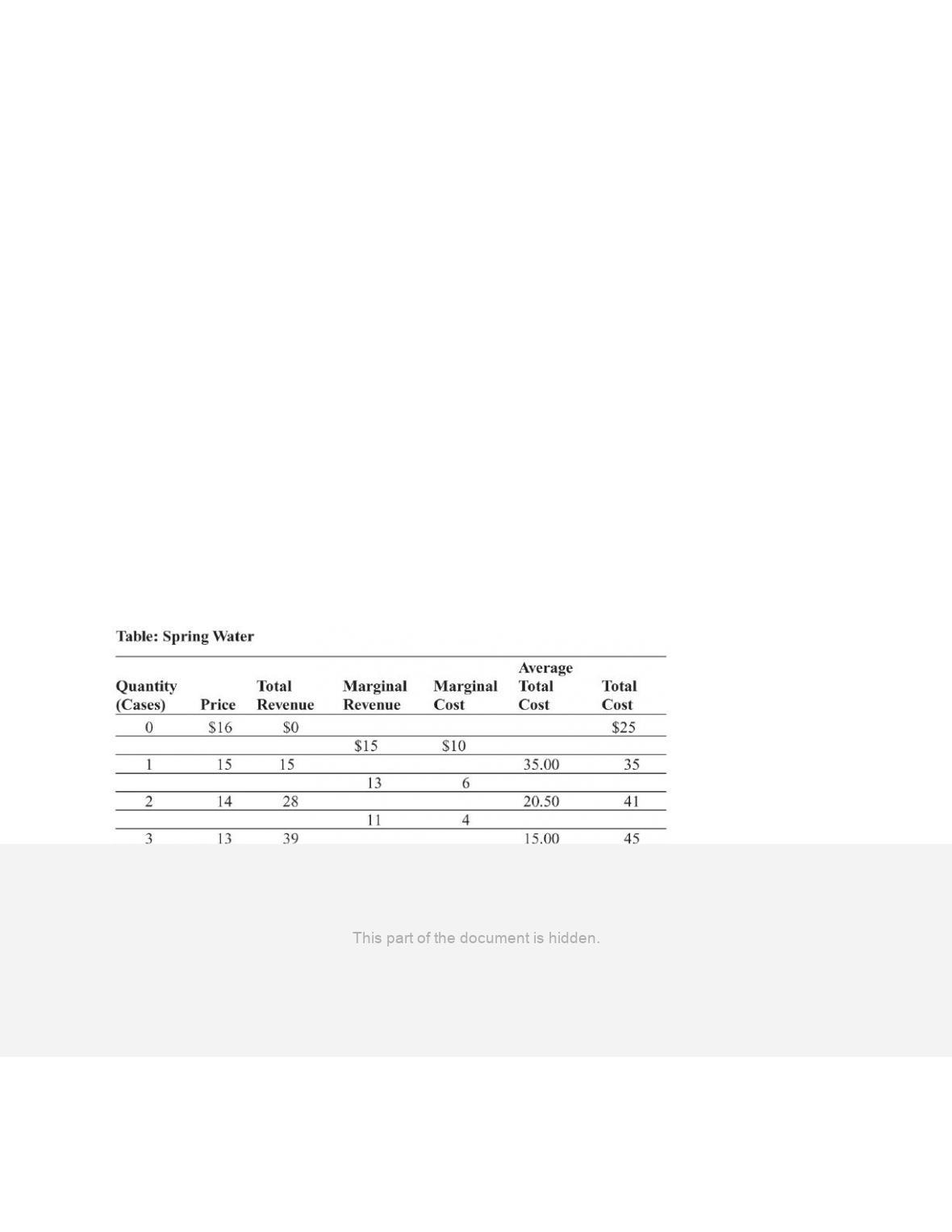
Use the following to answer questions 189-194:
Page 46
189.
Table: Spring Water. The table shows the demand and cost data for a firm in a
monopolistically competitive industry producing drinking water from underground
springs. The profit-maximizing output is _____ cases.
A)
5
B)
6
C)
7
D)
8
190.
Table: Spring Water. The table shows the demand and cost data for a firm in a
monopolistically competitive industry producing drinking water from underground
springs. The profit-maximizing price is:
A)
$16.
B)
$3.
C)
$5.
D)
$10.
191.
Table: Spring Water. The table shows the demand and cost data for a firm in a
monopolistically competitive industry producing drinking water from underground
springs. At the profit-maximizing output, profit is:
A)
$9.00.
B)
$10.00.
C)
$60.00.
D)
$7.00.
192.
Table: Spring Water. The table shows the demand and cost data for a firm in a
monopolistically competitive industry producing drinking water from underground
springs. At the profit-maximizing output, profit per unit is:
A)
$1.17.
B)
$8.83.
C)
$10.00.
D)
$11.75.
193.
Table: Spring Water. The table shows the demand and cost data for a firm in a
monopolistically competitive industry producing drinking water from underground
springs. If the industry were in perfect competition, the profit-maximizing output would
be _____ cases.
A)
6
B)
5
C)
7
D)
8
Page 47
194.
Table: Spring Water. The table shows the demand and cost data for a firm in a
monopolistically competitive industry producing drinking water from underground
springs. If the industry were in perfect competition, the profit-maximizing price in the
long run would be:
A)
$10.00.
B)
$6.50.
C)
$8.38
D)
$8.29
195.
Shops that sell live bait to people in Alabama may be monopolistically competitive if
there is product differentiation and differentiation by location.
A)
True
B)
False
196.
The hamburger industry has some differentiation and many firms, suggesting that the
hamburger industry is more oligopolistic than it is monopolistically competitive.
A)
True
B)
False
197.
Gas stations are not monopolistically competitive because everyone knows the gasoline
is the same, regardless of where it is purchased.
A)
True
B)
False
198.
Tacit collusion is not feasible in monopolistic competition because of the large number
of competing firms.
A)
True
B)
False
199.
As product differentiation increases, the price elasticity of demand falls and the firm
increases its market power.
A)
True
B)
False
200.
Monopolistic competition is unique among the four market structures in that it is the
only one that is always characterized by product differentiation.
A)
True
B)
False
Page 48
201.
Monopolistic competition is often found in service industries.
A)
True
B)
False
202.
Competition limits the price a monopolistically competitive firm can set.
A)
True
B)
False
203.
If the Boston doughnut market is monopolistically competitive and the firms are earning
short-run profits, consumers in Boston will see less diversity in the doughnuts offered
over time.
A)
True
B)
False
204.
In monopolistic competition, the primary source of product differentiation is price
competition.
A)
True
B)
False
205.
The best way for firms in monopolistic competition to gain market power is to engage in
tacit collusion.
A)
True
B)
False
206.
Firms in monopolistic competition can gain some market power by engaging in product
differentiation.
A)
True
B)
False
207.
Economics textbooks are an example of product differentiation by type and style.
A)
True
B)
False
208.
Competition among sellers in monopolistic competition means that all of the firms in
the industry will produce the same product.
A)
True
B)
False
Page 49
209.
The fact that firms in a monopolistically competitive industry are competing for a
limited market is called competition among sellers.
A)
True
B)
False
210.
Value in diversity refers to the idea that, by providing a variety of differentiated choices,
firms in monopolistic competition provide a gain to consumers.
A)
True
B)
False
211.
A monopolistically competitive firm will earn maximum profit if it produces at the
lowest possible average total cost.
A)
True
B)
False
212.
The conditions for profit maximization and the analysis of short-run equilibrium are
identical for monopoly and for a monopolistically competitive firm.
A)
True
B)
False
213.
Short-run equilibrium in monopolistic competition differs from that of monopoly
because the monopolistic competitor can make losses in the short run, while in a
monopoly, profits will always be zero or positive.
A)
True
B)
False
214.
Toby operates a small deli in a monopolistically competitive restaurant industry. In
long-run equilibrium, the profit-maximizing price of the three-meat sandwich is $3.
Price also equals his average total cost. Toby’s minimum average total cost is less than
$3.
A)
True
B)
False
215.
In long-run equilibrium, monopolistic competitors produce at the minimum point on the
average total cost curve.
A)
True
B)
False
Page 50
216.
A monopolistically competitive firm may have positive or negative profits in the short
run but will have zero profits in the long run.
A)
True
B)
False
217.
Firms in monopolistic competition and in perfect competition have excess capacity.
A)
True
B)
False
218.
Since a monopolistically competitive firm has the same long-run profits as a perfectly
competitive firm, both types of industries are efficient.
A)
True
B)
False
219.
Since a monopolistic competitor charges a price higher than marginal cost, there is a
deadweight loss associated with monopolistic competition.
A)
True
B)
False
220.
All advertising is clearly a waste of resources.
A)
True
B)
False
221.
Only irrational consumers are affected by advertising.
A)
True
B)
False
222.
Advertising is more likely to occur in perfect competition than in monopolistic
competition.
A)
True
B)
False
223.
A wheat farmer is more likely to advertise than is a restaurant that sells fast food
hamburgers.
A)
True
B)
False

Page 51
224.
Only firms with some market power will gain from individually advertising their
product.
A)
True
B)
False
225.
A brand name may be valuable because it differentiates a company’s products in the
minds of consumers.
A)
True
B)
False
226.
Relying on brand names will always lead consumers to the best consumption choices if
they buy the brand name, rather than a cheaper substitute.
A)
True
B)
False
227.
Brand names offer some assurance that the seller has a reputation to protect and hopes
to be engaged in repeated transactions with its customers.
A)
True
B)
False
228.
A brand name is owned by a particular firm, and it distinguishes that firm’s products
from those of its competitors.
A)
True
B)
False
229.
Monopolistic competition shares some characteristics with perfect competition and
monopoly. Explain where these market structures are similar and where they differ.
230.
A university town has many clothing retailers. Some of the stores sell sweatshirts and
T-shirts to college students, and other stores sell suits, sport coats, and business casual
wear to college professors. How are these retail stores differentiating the products that
they sell?
231.
Your friend Stan owns a coffee shop in a monopolistically competitive industry. One
day, Stan tells you (an economist) that he is earning an economic profit and is setting his
price equal to his marginal cost. Is Stan producing the profit-maximizing amount of
coffee? What should he do?