
Page 21
102.
(Table: Demand and Total Cost) Use Table: Demand and Total Cost. Lenoia runs a
natural monopoly firm producing electricity for a small mountain village. The table
shows Lenoia’s demand and total cost of producing electricity. The profit-maximizing
quantity of electricity for her to produce is _____ megawatts.
A)
2
B)
3
C)
4
D)
5
103.
(Table: Demand and Total Cost) Use Table: Demand and Total Cost. Lenoia runs a
natural monopoly firm producing electricity for a small mountain village. The table
shows Lenoia’s demand and total cost of producing electricity. The maximum profit
Lenoia can make is:
A)
$225.
B)
$425.
C)
$400.
D)
$1,800.
104.
If a monopoly has a linear demand curve and is producing at the profit-maximizing level
of output, at that level of output, demand is:
A)
price-elastic.
B)
price-inelastic.
C)
perfectly price-inelastic.
D)
price unit-elastic.
105.
In 1999, a judge declared that Microsoft was a monopolist. Assuming that Microsoft has
a linear demand curve and that it is maximizing its profits at its current level of output,
we may conclude that, if Microsoft were to increase its price, its total revenue would:
A)
rise.
B)
fall.
C)
remain unchanged.
D)
There is insufficient information to make a determination.
Page 22
Use the following to answer questions 106-109:
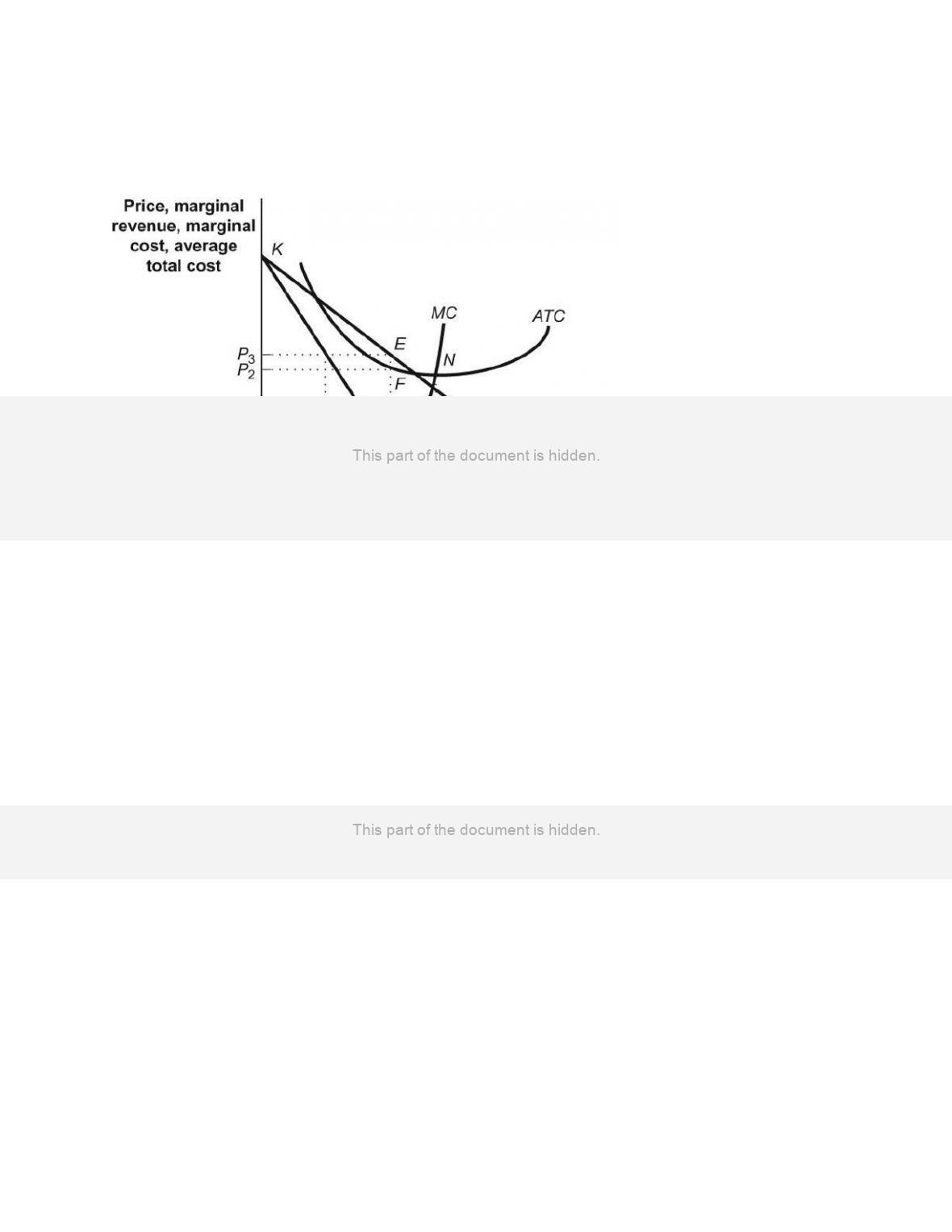
Figure: Computing Monopoly Profit
106.
(Figure: Computing Monopoly Profit) Use Figure: Computing Monopoly Profit. The
profit-maximizing price is _____ and will generate total economic profit of _____.
A)
P2; EF
B)
P3; the rectangle P1P2FG
C)
P3; the rectangle P2P3EF
D)
P3; EF
107.
(Figure: Computing Monopoly Profit) Use Figure: Computing Monopoly Profit.
Producing at point N would:
A)
result in MR = MC.
B)
result in positive economic profits.
C)
never be profit-maximizing since, at this output, MR < 0 and MC > 0.
D)
result in the firm breaking even.
108.
(Figure: Computing Monopoly Profit) Use Figure: Computing Monopoly Profit. At the
profit-maximizing output, total cost is:
A)
P10QG.
B)
P30QE.
C)
P20QF.
D)
FQ2.
Page 23
109.
(Figure: Computing Monopoly Profit) Use Figure: Computing Monopoly Profit. To
obtain maximum profits, the monopoly should produce the output determined by point:
A)
G.
B)
N.
C)
H.
D)
K.
Use the following to answer questions 110-115:
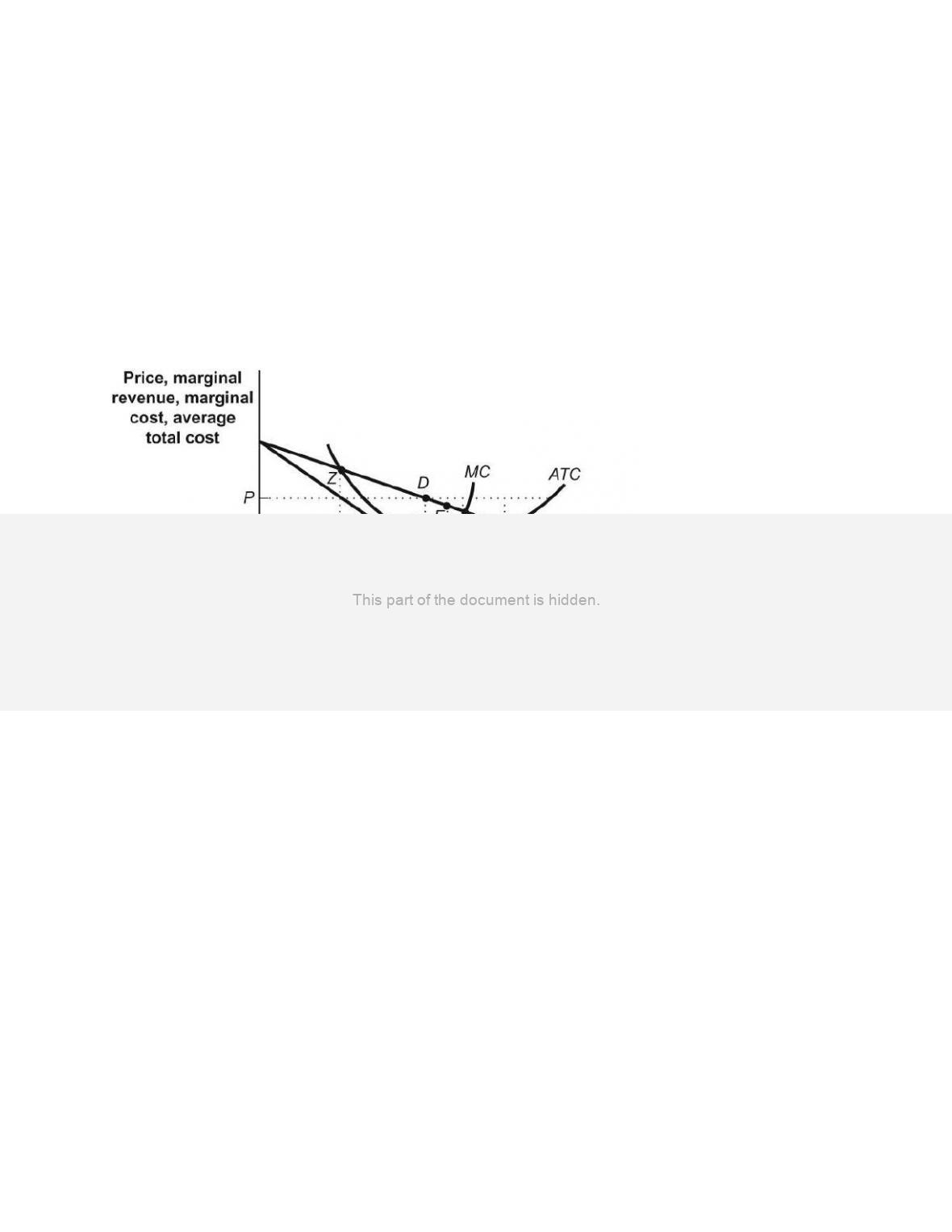
Figure: Monopoly Model
110.
(Figure: Monopoly Model) Use Figure: Monopoly Model. The profit-maximizing
quantity is at point:
A)
W.
B)
J.
C)
K.
D)
L.
111.
(Figure: Monopoly Model) Use Figure: Monopoly Model. The profit-maximizing price
is:
A)
Z.
B)
P.
C)
S.
D)
I.
Page 24
112.
(Figure: Monopoly Model) Use Figure: Monopoly Model. When the firm is in
equilibrium (that is, maximizing its economic profit), its total cost is the area of
rectangle:
A)
0PDJ.
B)
0IHJ.
C)
IPDH.
D)
0SBJ.
113.
(Figure: Monopoly Model) Use Figure: Monopoly Model. When the firm is in
equilibrium (that is, maximizing its economic profit), its total revenue is the area of
rectangle:
A)
SPDB.
B)
IPDH.
C)
0SBJ.
D)
0PDJ.
114.
(Figure: Monopoly Model) Use Figure: Monopoly Model. When the firm is in
equilibrium (that is, maximizing its economic profit), its profit is the area of rectangle:
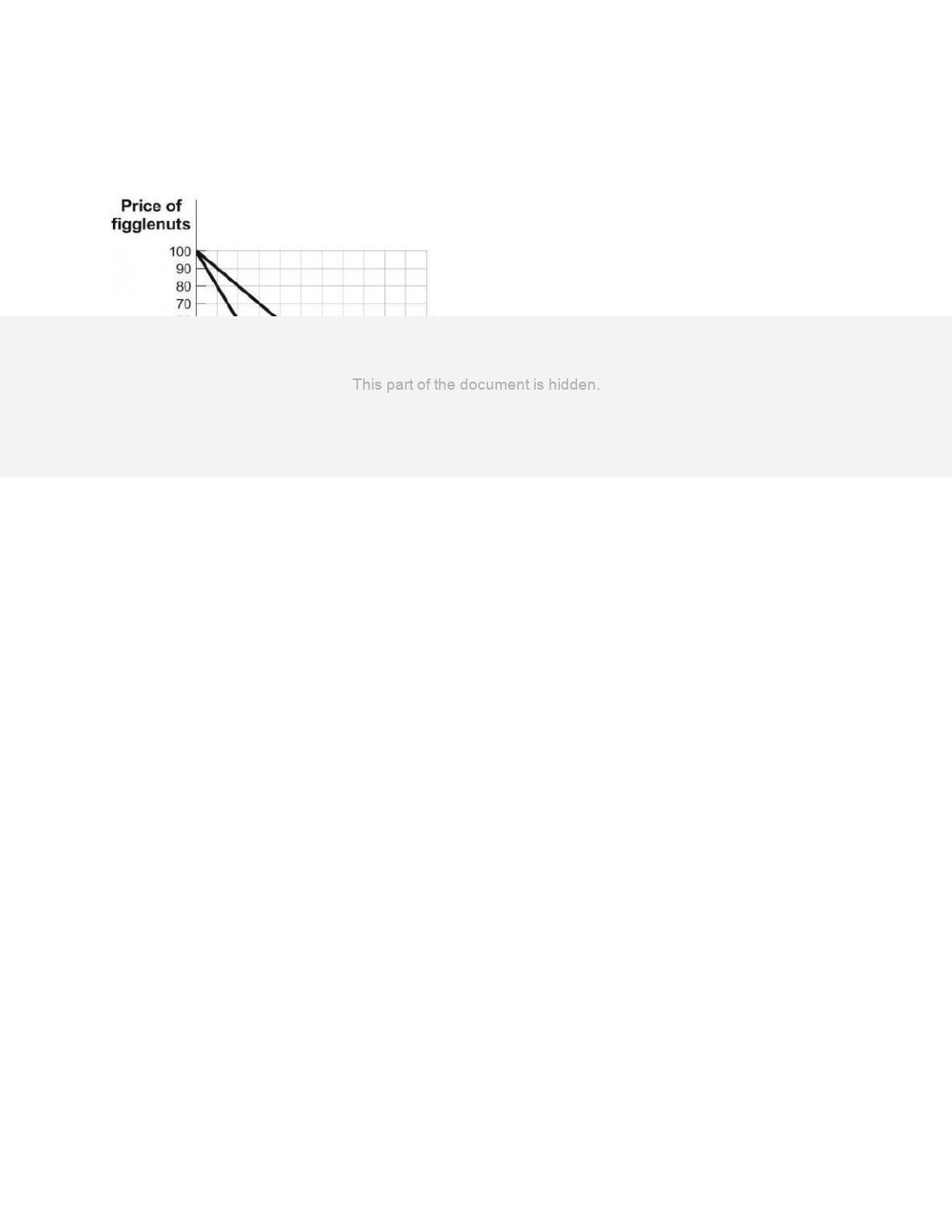
A)
SPDB.
B)
IPDH.
C)
ISBH.
D)
0PDJ.
115.
(Figure: Monopoly Model) Use Figure: Monopoly Model. When the firm is in
equilibrium (that is, maximizing its economic profit), its total cost is the area of
rectangle _____ and its total revenue is the area of rectangle _____.
A)
0PDJ; SPDB
B)
0IHJ; IPDH
C)
IPDH; 0SBJ
D)
0SBJ; 0PDJ
116.
Suppose the GoSports pennant monopoly is broken up and the pennant industry
becomes perfectly competitive. We would expect the _____ surplus to increase and
_____ surplus to decrease after the breakup.
A)
producer; consumer and total
B)
consumer; producer and total
C)
consumer and total; producer
D)
producer and total; consumer
Page 25
117.
If the government allowed only one airline to serve the entire U.S. market, there would
be a _____ loss associated with _____ output in the airline industry.
A)
marginal; reduced
B)
deadweight; reduced
C)
total; increased
D)
deadweight; increased
118.
In contrast with perfect competition, a monopoly:
A)
produces more at a lower price.
B)
produces where MR > MC.
C)
may have lower economic profits in the long run.
D)
produces less at a higher price.
119.
In monopoly:
A)
a basic condition for efficiency is violated because P > MC.
B)
consumers are confronted with a price that is lower than marginal cost.
C)
consumers will buy more of the good than is economically efficient.
D)
consumers are confronted with a price that is lower than average total cost.
120.
The pricing in monopoly prevents some mutually beneficial trades. The value of these
unrealized mutually beneficial trades is called:
A)
sunk costs.
B)
opportunity costs.
C)
deadweight loss.
D)
inequity.
121.
Which statement is TRUE?
A)
Monopolies produce too much and charge too much from the standpoint of
efficiency.
B)
Monopolies usually are economically efficient because they have economic profits
with which to work.
C)
Monopolies produce too little and charge too much from the standpoint of
efficiency.
D)
Monopolies cause an efficiency problem but are not associated with a deadweight
loss.
Page 26
122.
Suppose a perfectly competitive market is suddenly transformed into one that operates
as a monopoly market. We would expect price to _____, output to _____, consumer
surplus to _____, producer surplus to _____, and deadweight loss to _____.
A)
rise; fall; rise; rise; fall
B)
rise; fall; fall; fall; rise
C)
rise; fall; fall; rise; rise
D)
fall; rise; rise; fall; fall
123.
Suppose a perfectly competitive industry is suddenly transformed into a monopoly
industry. We can assume that monopoly output will be _____ than will the competitive
output and that _____.
A)
higher; deadweight loss will emerge
B)
lower; consumer surplus will increase
C)
lower; deadweight loss will emerge
D)
higher; consumer surplus will decrease
124.
When a monopoly maximizes profit, the loss of surplus by consumers is _____ the
monopolist’s gain in profit.
A)
less than
B)
equal to
C)
more than
D)
sometimes more than and sometimes less than
Use the following to answer questions 125-130:
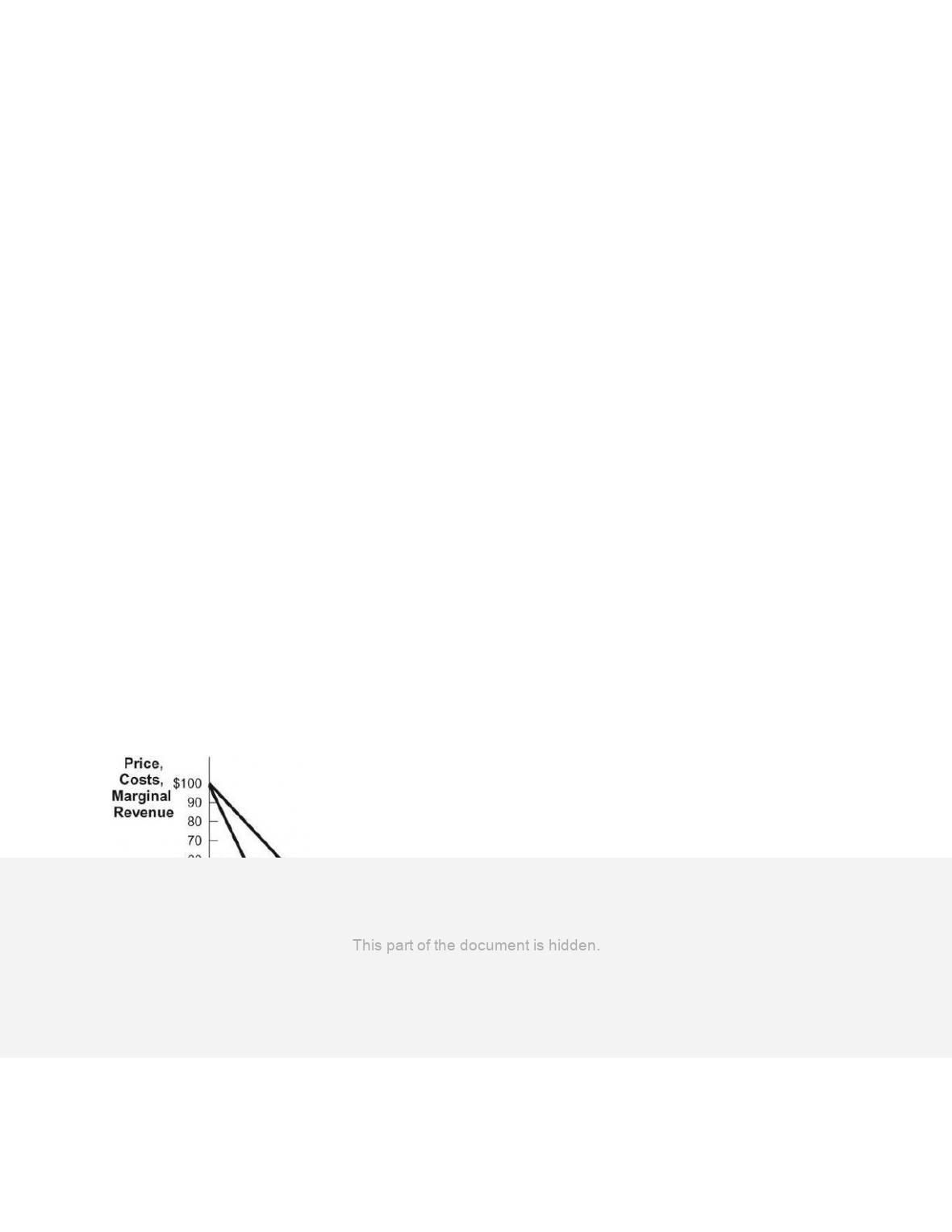
Figure: PPV
Page 27
125.
(Figure: PPV) Use Figure: PPV. The figure shows the demand and marginal revenue for
a pay-per-view football game on cable TV. Assume that the marginal cost and average
cost are a constant $20. If the cable company is a monopoly, how much will it produce?
A)
2
B)
4
C)
6
D)
8
126.
(Figure: PPV) Use Figure: PPV. The figure shows the demand and marginal revenue for
a pay-per-view football game on cable TV. Assume that the marginal cost and average
cost are a constant $20. If the cable company is a monopoly, what price will it charge?
A)
$20
B)
$40
C)
$60
D)
$100
127.
(Figure: PPV) Use Figure: PPV. The figure shows the demand and marginal revenue for
a pay-per-view football game on cable TV. Assume that the marginal cost and average
cost are a constant $20. If the cable company is a monopoly, how much consumer
surplus is there when the monopolist maximizes profit?
A)
$20
B)
$40
C)
$80
D)
$160
128.
(Figure: PPV) Use Figure: PPV. The figure shows the demand and marginal revenue for
a pay-per-view football game on cable TV. Assume that the marginal cost and average
cost are a constant $20. If the cable company is a monopoly, how much producer
surplus is there when the monopolist maximizes profit?
A)
$0
B)
$20
C)
$80
D)
$160
Page 28
129.
(Figure: PPV) Use Figure: PPV. The figure shows the demand and marginal revenue for
a pay-per-view football game on cable TV. Assume that the marginal cost and average
cost are a constant $20. If the cable company is a monopoly, how much deadweight loss
is there when the monopolist maximizes profit?
A)
$0
B)
$20
C)
$80
D)
$160
130.
(Figure: PPV) Use Figure: PPV. The figure shows the demand and marginal revenue for
a pay-per-view football game on cable TV. Assume that the marginal cost and average
cost are a constant $20. If the cable company is a monopoly, how much total surplus is
there when the monopolist maximizes profit?
A)
$240
B)
$160
C)
$100
D)
$320
Use the following to answer questions 131-140:
131.
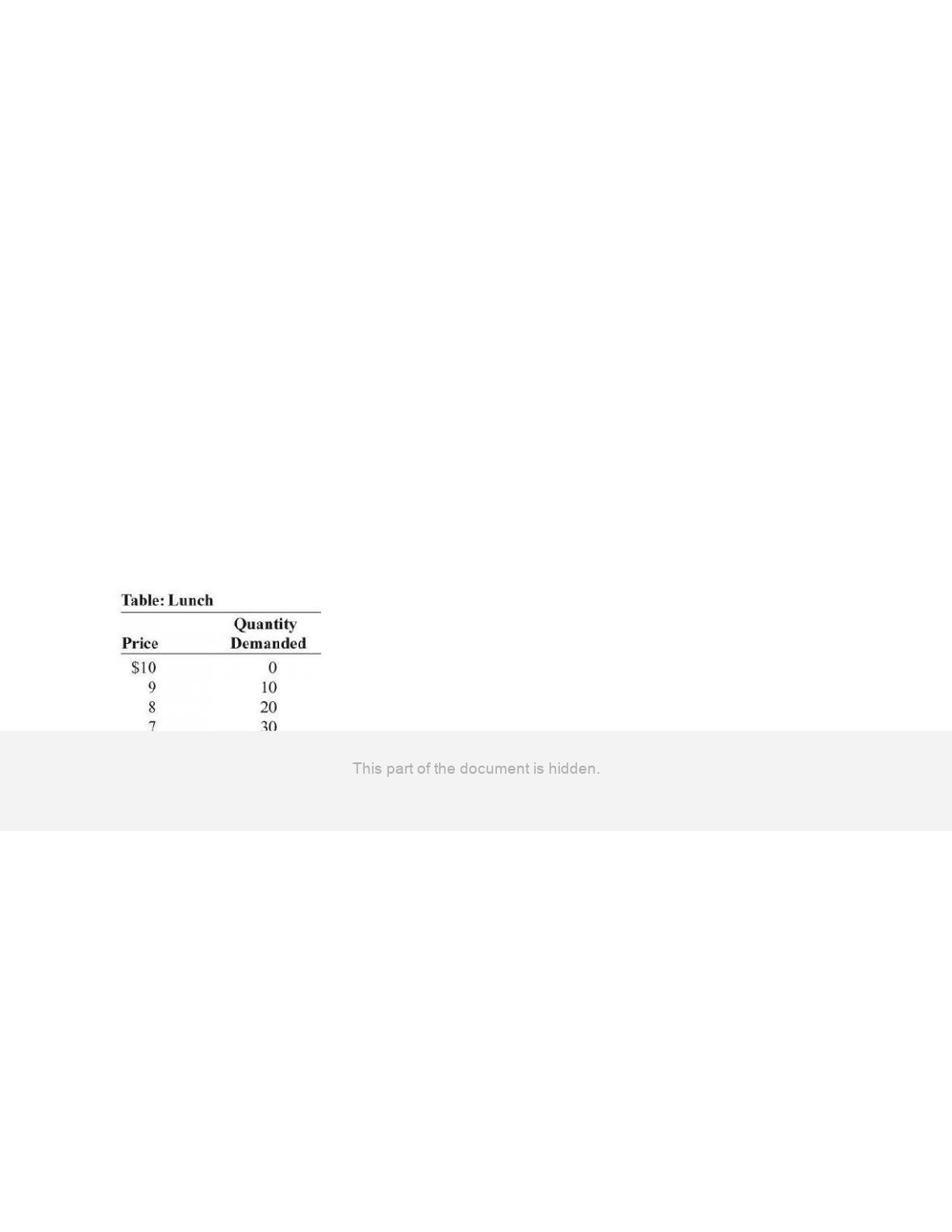
(Table: Lunch) Use Table: Lunch. This table shows market demand for picnic lunches
for people taking all-day rafting trips on the river. Joe has a firm providing this service,
and his marginal cost and average cost for each lunch are a constant $4. If Joe is one of
many firms in a competitive industry, how many lunches will the market produce in the
long run?
A)
0
B)
20
C)
40
D)
60
Page 29
132.
(Table: Lunch) Use Table: Lunch. This table shows market demand for picnic lunches
for people taking all-day rafting trips on the river. Suppose that the marginal cost and
average cost of each lunch are a constant $4 for all firms in the market. If Joe owns one
of many firms in a competitive industry, what price will he charge for a lunch in the
long run?
A)
$10
B)
$8
C)
$6
D)
$4
133.
(Table: Lunch) Use Table: Lunch. This table shows market demand for picnic lunches
for people taking all-day rafting trips on the river. Suppose that the marginal cost and
average cost of each lunch are a constant $4 for all firms in the market. What is
consumer surplus in this market in the long run?
A)
$4
B)
$10
C)
$180
D)
$360
134.
(Table: Lunch) Use Table: Lunch. This table shows market demand for picnic lunches
for people taking all-day rafting trips on the river. Suppose that the marginal cost and
average cost of each lunch are a constant $4 for all firms in the market. What is
producer surplus in this market in the long run?
A)
$0
B)
$4
C)
$180
D)
$360
135.
(Table: Lunch) Use Table: figure Lunch. This table shows market demand for picnic
lunches for people taking all-day rafting trips on the river. Suppose that the marginal
cost and average cost of each lunch are a constant $4 for all firms in the market. What is
deadweight loss in this market in the long run?
A)
$0
B)
$4
C)
$180
D)
$360

Page 30
136.
(Table: Lunch) Use Table: Lunch. This table shows market demand for picnic lunches
for people taking all-day rafting trips on the river. Joe has a firm providing this service,
and his marginal cost and average cost for each lunch are a constant $4. If Joe is a
monopolist, how many lunches will he produce in the long run?
A)
0
B)
10
C)
20
D)
30
137.
(Table: Lunch) Use Table: Lunch. This table shows market demand for picnic lunches
for people taking all-day rafting trips on the river. Joe has a firm providing this service,
and his marginal cost and average cost for each lunch are a constant $4. If Joe is a
monopolist, what price will he charge for a lunch in the long run?
A)
$9
B)
$7
C)
$5
D)
$3
138.
(Table: Lunch) Use Table: Lunch. This table shows market demand for picnic lunches
for people taking all-day rafting trips on the river. Joe has a firm providing this service,
and his marginal cost and average cost for each lunch are a constant $4. If Joe is a
monopolist, what is consumer surplus in the long run?
A)
$45
B)
$90
C)
$180
D)
$360
139.
(Table: Lunch) Use Table: Lunch. This table shows market demand for picnic lunches
for people taking all-day rafting trips on the river. Joe has a firm providing this service,
and his marginal cost and average cost for each lunch are a constant $4. If Joe is a
monopolist, what is producer surplus in the long run?
A)
$45
B)
$90
C)
$180
D)
$360
Page 31
140.
(Table: Lunch) Use Table: Lunch. This table shows market demand for picnic lunches
for people taking all-day rafting trips on the river. Joe has a firm providing this service,
and his marginal cost and average cost for each lunch are a constant $4. If Joe is a
monopolist, what is deadweight loss in the long run?
A)
$45
B)
$90
C)
$180
D)
$360
141.
In general, economists are critical of monopoly where there is/are:
A)
no natural monopoly.
B)
a natural monopoly.
C)
only a few firms.
D)
persistent economies of scale.
142.
Public policies toward monopoly in the United States often consist of:
A)
laws outlawing all of them.
B)
the regulation of natural monopolies.
C)
government takeover if monopoly profit exceeds a certain level.
D)
forcing monopoly industries to become perfectly competitive.
143.
Amtrak is a publicly owned company that provides rail service. This means that
Amtrak’s prices tend to be _____ than if it were a private company, and the quality of
service tends to be _____ than if it were a private company.
A)
higher; worse
B)
higher; better
C)
lower; worse
D)
lower; better
144.
In an industry characterized by extensive economies of scale:
A)
small companies are more profitable than are large companies.
B)
large companies are more profitable than are small companies.
C)
small and large companies are equally profitable.
D)
small companies will drive out large companies.
Page 32
145.
A natural monopoly is one that:
A)
monopolizes a natural resource such as a mineral spring.
B)
is based on control of something occurring in nature (such as diamonds).
C)
has increasing returns to scale over the entire relevant range of output.
D)
typically has low fixed costs, making it easy and “natural” for it to shut out
competitors.
146.
One government policy for dealing with natural monopoly is to:
A)
impose a price floor to eliminate the deadweight loss.
B)
impose a price ceiling to reduce economic profit.
C)
break it up into smaller firms.
D)
impose fines on the monopolist.
147.
The natural monopoly:
A)
would incur an economic profit if regulated to produce where price is less than
marginal cost.
B)
would incur an economic profit if regulated to charge a price equal to average total
cost.
C)
generates more consumer surplus than would an unregulated monopolist if
regulated to produce where price equals average total cost.
D)
generates more consumer surplus than would an unregulated monopolist if
regulated to produce where marginal cost equals marginal revenue.
148.
If the regulation of a monopoly results in a price equal to marginal cost but the price is
below average total cost:
A)
the firm can still make an economic profit.
B)
the firm will earn only a zero economic profit.
C)
efficiency in allocation will be less.
D)
the firm will need subsidies to stay in business.
149.
In the short run, if a monopoly is forced to charge a price equal to marginal cost:
A)
output will fall.
B)
the deadweight loss will decrease.
C)
consumer surplus will decrease.
D)
other firms will enter the industry.
Page 33
Use the following to answer questions 150-153:
Figure: Demand, Revenue, and Cost Curves
150.
(Figure: Demand, Revenue, and Cost Curves) Use Figure: Demand, Revenue, and Cost
Curves. Figglenuts-R-Us is a monopolist in the figglenut market. Figglenuts-R-Us will
sell _____ figglenuts and set a price of _____ to maximize profits.
A)
70; $65
B)
100; $50
C)
120; $40
D)
150; $46
151.
(Figure: Demand, Revenue, and Cost Curves) Use Figure: Demand, Revenue, and Cost
Curves. Figglenuts-R-Us is a monopolist in the figglenut market. If the government
wanted to regulate Figglenuts-R-Us such that the entire deadweight loss would be
eliminated in the short run, it would impose a price ceiling of:
A)
$40.
B)
$46.
C)
$50.
D)
$65.
152.
(Figure: Demand, Revenue, and Cost Curves) Use Figure: Demand, Revenue, and Cost
Curves. Figglenuts-R-Us is a monopolist in the figglenut market. If the government
wanted to regulate Figglenuts-R-Us such that it would minimize the deadweight loss
while allowing the firm to break even, it would impose a price ceiling of:
A)
$40.
B)
$46.
C)
$50.
D)
$65.
Page 34
153.
(Figure: Demand, Revenue, and Cost Curves) Use Figure: Demand, Revenue, and Cost
Curves. Figglenuts-R-Us is a monopolist in the figglenut market. If the government
regulated the figglenut market by setting a price ceiling of $40, Figglenuts-R-Us might:
A)
produce 60 figglenuts to maximize profits.
B)
produce 120 figglenuts in the long run to maximize profits.
C)
exit in the long run.
D)
increase the price to $60.
154.
The practice of charging different prices to different customers for the same good or
service, even though the cost of supplying those customers is the same, is:
A)
privatization.
B)
monopolization.
C)
output competition.
D)
price discrimination.
155.
Price discrimination is the practice of:
A)
charging different prices to buyers of the same good.
B)
paying different prices to suppliers of the same good.
C)
equating price to marginal cost.
D)
equating price to marginal revenue.
156.
The practice of selling the same product at different prices to different consumers,
without corresponding differences in costs, is:
A)
price discrimination.
B)
privatizing.
C)
monopolizing.
D)
output prioritizing.
157.
If a firm wants to charge different customers different prices, it must be:
A)
a price taker.
B)
in perfect competition.
C)
a price setter.
D)
operating in the long run only.
Page 35
158.
_____ is the practice of selling _____ product(s) at different prices to different
consumers, without corresponding differences in costs.
A)
Price discrimination; the same
B)
Privatizing; the same
C)
Monopolizing; similar
D)
Price fixing; different
159.
The market structure in which price discrimination CANNOT occur is:
A)
perfect competition.
B)
monopolistic competition.
C)
oligopoly.
D)
monopoly.
160.
Price discrimination can occur if:
A)
there are many firms in the industry, all producing the same identical good.
B)
producers are price takers.
C)
all consumers have the same willingness to pay for the good.
D)
the market structure is monopolistic competition.
161.
When price discrimination occurs, the producer’s profit is _____ if the producer charges
each customer the same profit-maximizing price where marginal revenue equals _____
cost.
A)
the same as; marginal
B)
greater than; marginal
C)
less than; marginal
D)
the same as; average total
162.
A monopolist or an imperfectly competitive firm practices price discrimination
primarily to:
A)
increase profits.
B)
expand plant size.
C)
lower total costs.
D)
reduce marginal costs.
163.
To engage in price discrimination, a firm must be:
A)
a price taker.
B)
one of many firms in an industry.
C)
unable to identify consumers whose elasticities differ.
D)
a price setter and able to identify consumers whose elasticities differ.

Page 36
164.
The MAIN reason a monopoly engages in price discrimination is that:
A)
it wants to discriminate against a particular ethnic group.
B)
doing so increases its profits.
C)
it wants to discourage potential competitors.
D)
by charging a lower price to some people, it may succeed in discouraging efforts to
regulate it.
165.
When a monopolist practices price discrimination, compared with a single-price
monopolist, consumer surplus will:
A)
remain the same.
B)
increase.
C)
decrease.
D)
increase initially and then return to its original level.
166.
When a monopolist practices price discrimination, compared with a single-price
monopolist, producer surplus will:
A)
remain the same.
B)
increase.
C)
decrease.
D)
increase initially and then return to its original level.
167.
When a monopolist practices price discrimination, compared with a single-price
monopolist, monopoly profits will:
A)
remain the same.
B)
increase.
C)
decrease.
D)
increase initially and then return to their original level.
168.
When a monopolist practices price discrimination, compared with a single-price
monopolist, deadweight loss will:
A)
remain the same.
B)
increase.
C)
decrease.
D)
increase initially and then return to its original level.
169.
Price discrimination leads to a _____ price for consumers with a _____ demand.
A)
higher; less elastic
B)
higher; more elastic
C)
higher; perfectly elastic
D)
lower; less elastic
Page 37
170.
Price discrimination leads to a _____ price for consumers with a _____ demand.
A)
higher; more elastic
B)
higher; perfectly elastic
C)
lower; more elastic
D)
lower; less elastic
171.
Price-discriminating firms will impose a price structure that offers customers with a
_____ demand a _____ price and offers customers with a(n) _____ demand a _____
price.
A)
less elastic; lower; more elastic; higher
B)
less elastic; higher; more elastic; lower
C)
lower; higher; higher; lower
D)
seasonal; lower; unchanging; higher
172.
Because tourist demand for airline flights is relatively _____, small _____ in ticket price
will result in relatively _____ in additional tourists.
A)
inelastic; reductions; small increases
B)
elastic; reductions; large increases
C)
inelastic; increases; small decreases
D)
elastic; increases; small increases
173.
A price-discriminating firm will adjust prices so that customers with more _____
demand pay _____ customers with _____ elastic demand.
A)
inelastic; less than; less
B)
elastic; less than; less
C)
elastic; the same as; more
D)
elastic; more than; less
174.
The city bus system charges lower fares to senior citizens than to other passengers.
Assuming that this pricing strategy increases the profits of the bus system, we can
conclude that senior citizens must have a _____ demand for bus service than do other
passengers.
A)
greater
B)
lower
C)
more elastic
D)
less elastic

Page 38
175.
The municipal swimming pool charges lower entrance fees to local residents than to
nonresidents. Assuming that this pricing strategy increases the profits of the pool, we
can conclude that nonresidents must have a _____ demand for swimming at the pool
than do residents.
A)
greater
B)
lower
C)
more elastic
D)
less elastic
176.
To practice effective price discrimination, a monopolist must be able to:
A)
estimate its own production and cost functions.
B)
avoid charging too low a price.
C)
prevent the resale of goods among groups of buyers.
D)
calculate the income level of each buyer in the market.
177.
To maximize profits, an airline will offer _____ prices to customers with _____
demand.
A)
higher; inelastic
B)
higher; elastic
C)
lower; inelastic
D)
the lowest; the least
178.
Because business travelers’ demand for airline flights is relatively _____, large increases
in price will result in relatively _____ decreases in additional business travelers.
A)
price-inelastic; small
B)
price-elastic; large
C)
price-inelastic; large
D)
price-elastic; small
179.
A firm that can price-discriminate should adjust prices so that customers with _____
demand pay _____ prices than/as do those with _____ demand.
A)
price-inelastic; lower; elastic
B)
price-inelastic; the same; elastic
C)
price-elastic; lower; inelastic
D)
price-elastic; higher; inelastic

Page 39
180.
Amtrak charges lower fares to students than to its other passengers. This pricing strategy
increases Amtrak’s profits. From this information, we can conclude that students must
have a _____ demand for Amtrak train service than do other passengers.
A)
more price-elastic
B)
lower
C)
greater
D)
less price-elastic
181.
A community college charges lower tuition fees to town residents than to nonresidents.
This pricing strategy increases the profits of the community college. Using this
information, we can conclude that nonresidents must have a _____ demand for
attending the community college than do residents.
A)
less price-elastic
B)
greater
C)
lower
D)
more price-elastic
182.
Suppose the price elasticity of demand for coffee at the Coffee Barn equals 1.71 for
women and 0.55 for men. A successful price discrimination strategy would lead to
_____ prices for men and _____ prices for women _____.
A)
lower; lower; in any circumstances
B)
lower; higher; in any circumstances
C)
lower; higher; as long as men can’t resell drinks to women
D)
higher; lower; as long as women can’t resell drinks to men
183.
Suppose a monopoly can separate its customers into two groups. If the monopoly
practices price discrimination, it will charge the lower price to the group with:
A)
the higher price elasticity of demand.
B)
the lower price elasticity of demand.
C)
the fewer close substitutes.
D)
The answer cannot be determined with the information given.
184.
A Japanese steel firm sells steel in the United States and in Japan. Since the United
States buys steel from a number of sources, the U.S. demand for Japanese steel is more
price-elastic than is the Japanese demand for Japanese steel. If the Japanese steel firm
wishes to maximize its profits, it should:
A)
charge the same price in both countries (after adjusting for transportation costs).
B)
charge a higher price in the United States and a lower price in Japan; otherwise, it
would be accused of unfair trade practices.
C)
charge a lower price in the United States and a higher price in Japan.
D)
figure out which market is more profitable and sell only in that market.
Page 40
185.
Airlines that engage in price discrimination charge higher prices to business travelers
because their _____ is more _____ than that of other travelers.
A)
demand; elastic
B)
demand; inelastic
C)
supply; elastic
D)
supply; inelastic
186.
Airlines that engage in price discrimination charge lower prices to vacation travelers
because their _____ is more _____ than that of other travelers.
A)
demand; elastic
B)
demand; inelastic
C)
supply; elastic
D)
supply; inelastic
187.
Suppose the elasticity of demand for tickets to Broadway shows is 2.0 for men and 0.3
for women. To use price discrimination to increase profits, the producers should charge
higher prices to _____ because their demand is more _____.
A)
men; elastic than that of women
B)
men; inelastic than that of women
C)
women; elastic than that of men
D)
women; inelastic than that ofmen
188.
Suppose the elasticity of demand for tickets to Broadway shows is 2.0 for men and 0.3
for women. To use price discrimination to increase profits, the producers should charge
lower prices to _____ because their demand is more _____.
A)
men; elastic than that of women
B)
men; inelastic than that of women
C)
women; elastic than that of men
D)
women; inelastic than that of men
189.
Which statement is NOT an example of price discrimination?
A)
Students receive a discount at the ice cream store when they show their college ID
cards.
B)
Women receive free admission to a nightclub, while men must pay a cover charge.
C)
A country club requires members to pay annual dues, but members receive
discounted prices to golf (relative to nonmembers).
D)
Street vendors increase the price of umbrellas when it is raining.