Page 1
Name: __________________________ Date: _____________
1.
Which example is considered a nonexcludable good?
A)
health care
B)
national defense
C)
education
D)
ice cream
2.
Which example BEST fits the characteristics of a private good?
A)
a professor giving a lecture in a large classroom
B)
an ice-cream cone
C)
fire protection
D)
disease prevention
3.
A(n) _____ is excludable and rival in consumption.
A)
private good
B)
artificially scarce good
C)
public good
D)
common resource
4.
When Joe watches a movie on Netflix, his viewing is _____ in consumption because
other people _____ able to watch the movie at the same time as Joe does.
A)
nonrival; are
B)
rival; are
C)
rival; are not
D)
nonrival; are not
5.
A good is MOST likely to be artificially scarce if:
A)
it is nonexcludable and nonrival.
B)
the seller is a monopolist.
C)
it is nonexcludable but rival.
D)
it is excludable but nonrival.
6.
Which good is MOST likely a common resource?
A)
the Super Bowl
B)
a public park
C)
a pair of pants
D)
the fire department
Page 2
7.
Which good is MOST likely an artificially scarce good?
A)
a ticket to a boxing match
B)
pay-per-view of a boxing match
C)
health care
D)
the police department
8.
Television programs are nonrival because:
A)
the supplier cannot prevent consumption by people who do not pay for it.
B)
more than one person can consume the same unit of the good at the same time.
C)
individuals ignore the effect of their use on the amount of the resource remaining
for others.
D)
the market suffers from inefficiently low consumption.
9.
Clean water in a river is nonexcludable because:
A)
it is not possible to prevent consumption by people who do not pay for it.
B)
more than one person can consume the same unit of the good at the same time.
C)
individuals ignore the effect their use has on the amount of the resource remaining
for others.
D)
consumption is inefficiently low.
10.
Which good BEST fits the characteristics of a private good?
A)
national defense
B)
clean water
C)
a pizza
D)
police protection
11.
A private good is _____ in consumption.
A)
excludable and rival
B)
nonexcludable and nonrival
C)
excludable and nonrival
D)
nonexcludable and rival
12.
Which good is MOST likely a public good?
A)
the Internet
B)
an amusement park
C)
a pair of pants
D)
fire protection from the fire department in a town
Page 3
13.
A(n) _____ is nonexcludable and nonrival in consumption.
A)
private good
B)
artificially scarce good
C)
public good
D)
common resource
14.
A public good is a good or service for which exclusion is _____ and that is _____ in
consumption.
A)
possible; rival
B)
possible; nonrival
C)
not possible; rival
D)
not possible; nonrival
15.
A private good is a good or service for which exclusion is _____ and that is _____ in
consumption.
A)
possible; rival
B)
possible; nonrival
C)
not possible; rival
D)
not possible; nonrival
16.
A common resource is a good or service for which exclusion is _____ and that is _____
in consumption.
A)
possible; rival
B)
possible; nonrival
C)
not possible; rival
D)
not possible; nonrival
17.
An artificially scarce good is a good or service for which exclusion is _____ and that is
_____ in consumption.
A)
possible; rival
B)
possible; nonrival
C)
not possible; rival
D)
not possible; nonrival
18.
Whether or not they pay for them, people cannot be excluded from receiving the
benefits of _____, but they can be excluded from the benefits of _____.
A)
private goods; public goods and common resources
B)
public goods; private goods and common resources
C)
common resources; public goods and private goods
D)
either public goods or common resources; private goods
Page 4
19.
The BEST example of a public good is:
A)
a court of law.
B)
clothing.
C)
food.
D)
a state university.
20.
The BEST example of a private good is:
A)
an automobile.
B)
public education.
C)
national defense.
D)
law enforcement.
21.
The BEST example of a public good is:
A)
legal services.
B)
national defense.
C)
a municipal library.
D)
cable television programming.
22.
The BEST example of an artificially scarce good is:
A)
legal services.
B)
national defense.
C)
a municipal library.
D)
cable television programming.
23.
The BEST example of a common resource(s) is/are:
A)
public education.
B)
a football match.
C)
fish to catch in a local public lake.
D)
cable television programming.
24.
Fish in a public lake are common resources because the private market _____ prevent
consumption by people who do not pay for access to fish. Further, the same fish _____
be consumed more than once.
A)
can; can
B)
cannot; cannot
C)
can; cannot
D)
cannot; can
Page 5
25.
An electronic book is an artificially scarce good because the private market _____
prevent consumption by people who do not pay for it. Further, the same e-book _____
be consumed by more than one person at the same time.
A)
can; can
B)
cannot; cannot
C)
can; cannot
D)
cannot; can
26.
If a good has a marginal cost of production of zero and an inefficiently low level of
consumption, the good must be a(n):
A)
private good.
B)
public good.
C)
common resource.
D)
artificially scarce good.
27.
If the market produces an efficient level of a good, then we know that the good must be
_____ and _____ in consumption.
A)
nonexcludable; nonrival
B)
nonexcludable; rival
C)
excludable; nonrival
D)
excludable; rival
28.
Although most citizens have access to police protection, they also take measures, such
as putting locks on their doors, to protect themselves. For most citizens, police
protection is a(n) _____ good, while self-protection is a(n) _____ good.
A)
public; private
B)
public; artificially scarce
C)
private; private
D)
artificially scarce; common resource
29.
Which example is considered a private good?
A)
traffic lights
B)
mountain bike trails in a national forest
C)
a fast-food cheeseburger
D)
cell phone service

Page 6
30.
Stephanie stops at a gas station to fill up the tank of her car. The unleaded gasoline in
her tank is BEST described as a(n):
A)
private good.
B)
public good.
C)
artificially scarce good.
D)
common resource.
31.
DeVonda owns a music store. One night, vandals broke her store’s front window.
DeVonda called the police, and the police investigated the crime. The police services
that DeVonda used are BEST described as a(n):
A)
private good.
B)
public good.
C)
artificially scarce good.
D)
common resource.
32.
Josh has an iPhone, and he frequently downloads songs from iTunes. He pays a small
price for each download, but downloading a song does not remove it from the iTunes
inventory, which is available for other buyers. The iTunes service is BEST described as
a(n):
A)
private good.
B)
public good.
C)
artificially scarce good.
D)
common resource.
33.
Bluefin tuna travel in schools throughout the world’s oceans. Fishing boats from many
nations harvest bluefin tuna as the schools migrate through their national waters. The
schools of bluefin tuna are BEST described as a(n):
A)
private good.
B)
public good.
C)
artificially scarce resource.
D)
common resource.
34.
As a big music fan, you want to attend a weekend blues festival in your town. The
purchase of a wristband gives you and thousands of other fans access to the very large
outdoor concert pavilion, where you all fit comfortably. The blues festival is a good that
has the characteristics of being:
A)
rival and excludable.
B)
nonrival and excludable.
C)
rival and nonexcludable.
D)
nonrival and nonexcludable.
Page 7
35.
Public goods differ from common resources in that, while both are _____, public goods
are _____, while common resources are _____.
A)
nonrival in consumption; excludable; nonexcludable
B)
excludable; nonrival in consumption; rival in consumption
C)
nonexcludable; nonrival in consumption; rival in consumption
D)
rival in consumption; nonexcludable; excludable
36.
The BEST example of a good that is excludable in consumption is:
A)
a park.
B)
an ocean.
C)
a bicycle.
D)
national defense.
37.
When comparing the characteristics of common resources and artificially scarce goods,
we find that:
A)
they are both nonrival in consumption.
B)
they are both excludable.
C)
artificially scarce goods are rival in consumption (while common resources are not)
and common resources are excludable (while artificially scarce goods are not).
D)
common resources are rival in consumption (while artificially scarce goods are not)
and artificially scarce goods are excludable (while common resources are not).
38.
National defense and clean air are similar in that both are _____, but they differ in that
clean air is _____, while national defense is not.
A)
rival in consumption; excludable
B)
nonrival in consumption; excludable
C)
excludable; rival in consumption
D)
nonexcludable; rival in consumption
39.
National defense and e-books are similar in that both are _____, but they differ in that
national defense is _____, while e-books are _____.
A)
rival in consumption; excludable; nonexcludable
B)
nonrival in consumption; nonexcludable; excludable
C)
excludable; rival in consumption; nonrival in consumption
D)
nonexcludable; nonrival in consumption; rival in consumption
Page 8
40.
An artificially scarce good is similar to a public good in that it is _____, but it is also
similar to a private good in that it is _____.
A)
nonrival in consumption; nonexcludable
B)
nonrival in consumption; excludable
C)
excludable; nonrival in consumption
D)
nonexcludable; rival in consumption
41.
An e-book is similar to a published book in that it is _____, but it is also similar to
national defense in that it is _____.
A)
rival in consumption; nonexcludable
B)
nonrival in consumption; excludable
C)
excludable; nonrival in consumption
D)
nonexcludable; rival in consumption
42.
A software program is similar to an apple in that it is _____, but it is also similar to
public safety in that it is _____.
A)
rival in consumption; nonexcludable
B)
nonrival in consumption; excludable
C)
excludable; nonrival in consumption
D)
nonexcludable; rival in consumption
43.
If left to the private market, the amount of police protection provided in a city would be
_____ than it is now, and free riders would pay _____ for police protection.
A)
more; more
B)
more; nothing
C)
less; nothing
D)
less; a higher price
44.
For a good to be efficiently provided by the private market, it must be:
A)
rival in consumption and nonexcludable.
B)
nonrival in consumption and excludable.
C)
a common resource.
D)
rival in consumption and excludable.
45.
An individual is MOST likely to be a free rider when a good is:
A)
private.
B)
nonexcludable.
C)
nonrival.
D)
artificially scarce.

Page 9
46.
The free-rider problem is a direct result of:
A)
the inability to exclude nonpayers.
B)
marginal-cost pricing.
C)
full-cost pricing.
D)
horizontally summed supply curves.
47.
The tendency of people or firms to consume a public good without paying for it is called
the free-_____ problem.
A)
cost
B)
rider
C)
goods
D)
market
48.
When the market does NOT result in an efficient allocation of scarce resources,
economists say that there has been:
A)
market dropout.
B)
normative economics.
C)
market disincentives.
D)
market failure.
49.
An inefficient allocation of resources will occur when:
A)
decision makers are faced with the full costs and benefits of their actions.
B)
there are clearly defined property rights.
C)
no alternative would increase the welfare of society.
D)
decision makers are not faced with the full benefits and costs of their choices.
50.
When the allocation of resources in a free market environment is such that a different
allocation would increase society’s welfare, economists say:
A)
market failure has occurred.
B)
the efficiency condition is met.
C)
decision makers have faced the full marginal benefits and marginal costs of their
decisions.
D)
producers have maximized total cost.
51.
If a good is subject to the free-rider problem and an inefficiently low level of production
when left to the private market, the good must be a(n):
A)
private good.
B)
public good.
C)
illegal good
D)
artificially scarce good.
Page 10
52.
If a good is subject to the free-rider problem and an inefficiently high level of
consumption, the good must be a(n):
A)
private good.
B)
public good.
C)
common resource.
D)
artificially scarce good.
53.
You work in an office and one of your coworkers has announced his retirement. You
have offered to purchase the retirement gift, so you place a collection jar in the lunch
room for anonymous donations to help pay for the gift. After a week, you find very little
money in the jar, so you end up paying for a large share of the retirement gift. You are
the victim of the _____ problem.
A)
common resource
B)
private good
C)
overuse of a common resource
D)
free-rider
54.
Most neighborhood streets are illuminated at night by streetlights. The streetlights are
_____ and _____. Therefore, they are likely to be _____ by the competitive market.
A)
nonrival; nonexcludable; underprovided
B)
nonrival; nonexcludable; overprovided
C)
rival; excludable; efficiently provided
D)
nonrival; excludable; underprovided
55.
The tendency of people to avoid paying for a good’s benefits when the benefits can be
obtained for free is called the free-_____ problem.
A)
cost
B)
rider
C)
goods
D)
market
56.
The free-rider problem refers to:
A)
the situation in the Old West when land was largely unfenced and riders had
unfettered access to private range land.
B)
qualifications, or riders, that clients do not request, but which lawyers tend to
include in contracts anyway.
C)
a variation on the saying “There’s no such thing as a free lunch,” which is replaced
by “There’s no such thing as a free ride.”
D)
lack of incentive for consumers to pay for a nonexcludable good.
Page 11
57.
For nonrival goods like pay-per-view television programs, the private market will lead
to _____ from a social perspective.
A)
production of too much of the good
B)
consumption of too much of the good
C)
consumption of too little of the good
D)
outsourcing its production
58.
For a nonexcludable good like national defense, the private market will lead to _____ of
the good.
A)
too much production
B)
too much consumption
C)
too little production
D)
the efficient level of consumption
59.
A public good is _____ and _____ in consumption.
A)
excludable; rival
B)
nonexcludable; nonrival
C)
excludable; nonrival
D)
nonexcludable; rival
60.
A key feature of a public good is:
A)
overproduction in the private market.
B)
rival consumption.
C)
payment through charitable contributions.
D)
nonexclusion.
61.
Public goods are NOT sold in efficient quantities in the private marketplace because:
A)
once supplied to a buyer, they can be made available at no cost to someone else.
B)
the more one person has, the less another person has.
C)
they are usually so costly that only the wealthy can afford them.
D)
they are usually very poor-quality goods.
62.
Which example is considered a public good?
A)
school attendance
B)
national defense
C)
cigarettes
D)
a flu shot
Page 12
63.
A public good is a good:
A)
whose consumption is nonexcludable and nonrival.
B)
for which the marginal cost of adding another consumer is high.
C)
that the market will usually provide efficiently.
D)
whose consumption is rival.
64.
For a public good, nonpayers _____ excluded from obtaining the benefits of the good.
A)
can be
B)
are automatically
C)
usually are
D)
cannot be
65.
The best example of a good whose consumption is NOT excludable is:
A)
a yard.
B)
a house.
C)
a bicycle.
D)
national defense.
66.
Which example best illustrates a good whose consumption is NOT excludable?
A)
clothing
B)
ice cream
C)
a taco
D)
clean air
67.
Volunteer fire departments are good examples of the _____ provision of _____.
A)
private; private goods
B)
public; common resources
C)
private; public goods
D)
public; artificially scarce goods
68.
In the United Kingdom, most public television programming is paid for by a yearly
license fee assessed on every household. Television detection vans go through
neighborhoods to detect unlicensed households and keep them from viewing without
paying. This is a good example of the _____ provision of _____.
A)
public; private goods
B)
public; goods that are made artificially excludable in consumption
C)
public; common resources
D)
private; artificially scarce goods

Page 13
69.
Since the public safety that a police force provides is _____ in consumption, the
efficient price _____.
A)
rival; is zero
B)
nonrival; is zero
C)
rival; equals marginal social benefit
D)
nonrival; equals marginal social benefit
70.
For which type of goods is the marginal social benefit necessarily greater than the
marginal private benefit?
A)
public goods
B)
common resources
C)
artificially scarce goods
D)
private goods
71.
No individual is willing to pay to provide the efficient level of a public good since the:
A)
marginal cost of production is zero.
B)
good will be nonrival and thus underconsumed.
C)
individual’s marginal benefit is less than the marginal social benefit.
D)
marginal benefit of allowing one more individual to consume the good is zero.
72.
Public goods should be produced up to the point at which the marginal cost of
production equals:
A)
the maximum price any individual is willing to pay for that unit.
B)
the sum of the individual marginal benefits from all consumers of that unit.
C)
zero, which is the marginal cost of allowing another individual to consume the
good.
D)
the highest marginal benefit from any individual consumer of the good.
73.
Suppose the town of Falls Valley has a mosquito problem. After a bad summer, the
town accountants explain that the marginal cost of providing one more treatment for
mosquito control is $100,000. The town should provide the additional mosquito control
only if the marginal:
A)
benefit for any individual citizen is at least $100,000.
B)
benefits for all individual citizens adds up to at least $100,000.
C)
social cost of mosquito control is more than $100,000.
D)
social cost of mosquito control is less than $100,000.
Page 14
Use the following to answer questions 74-76:
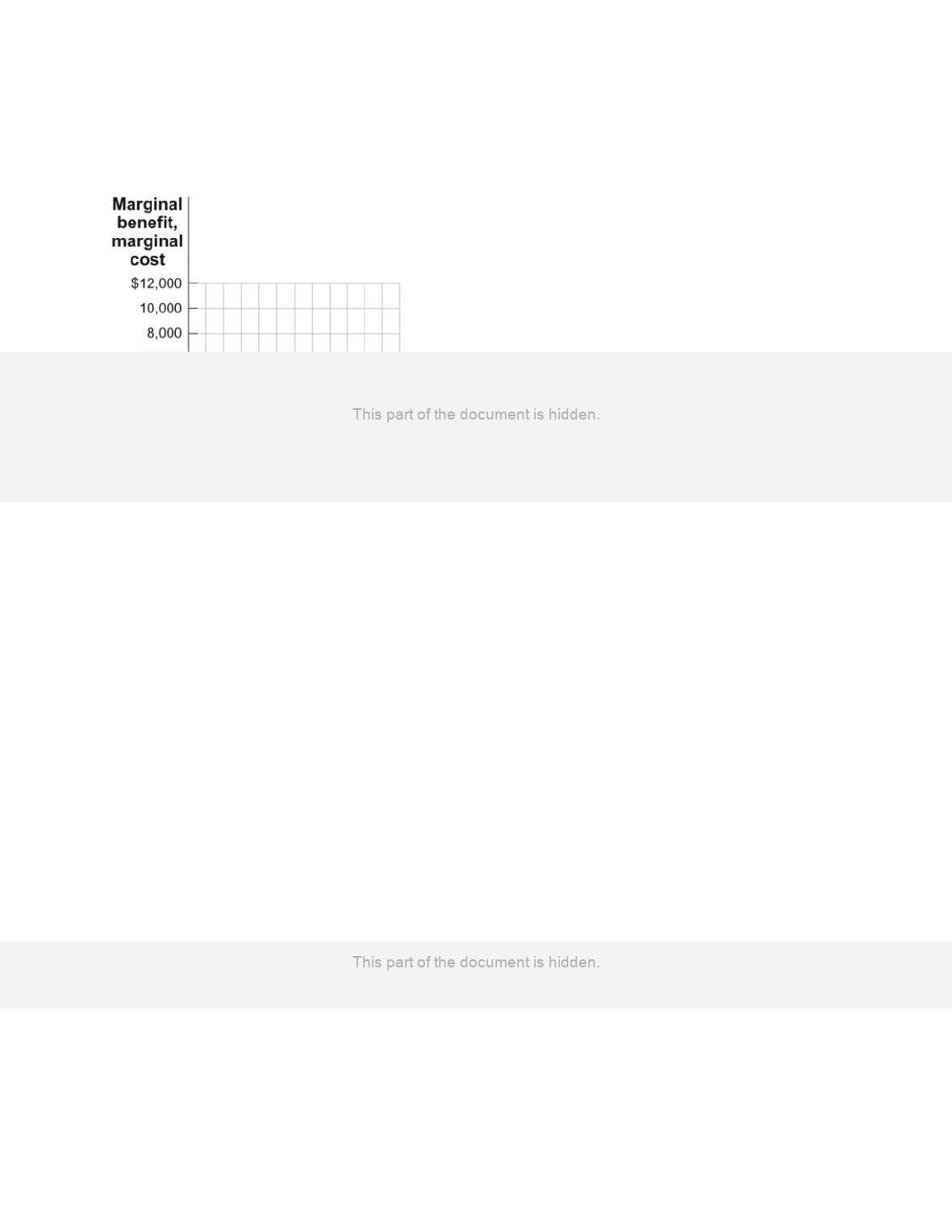
Figure: Traffic Lights in Plymouth
74.
(Figure: Traffic Lights in Plymouth) Use Figure: Traffic Lights in Plymouth. Plymouth
has 1,000 residents. Each of the residents has the same individual marginal benefit per
traffic light. Without government intervention, the town will have _____ traffic lights.
A)
0
B)
4
C)
8
D)
12
75.
(Figure: Traffic Lights in Plymouth) Use Figure: Traffic Lights in Plymouth. Plymouth
has 1,000 residents. Each of the residents has the same individual marginal benefit per
traffic light. If the government provides traffic lights, the socially efficient quantity is:
A)
0.
B)
4.
C)
8.
D)
12.
76.
(Figure: Traffic Lights in Plymouth) Use Figure: Traffic Lights in Plymouth. Plymouth
has 1,000 residents. Each of the residents has the same individual marginal benefit per
traffic light. If the town’s population doubles and the new residents share the identical
individual marginal benefit of the existing residents, the socially efficient quantity of
traffic lights will:
A)
stay the same.
B)
fall.
C)
rise.
D)
fall to zero.
Page 15
Use the following to answer questions 77-79:
77.
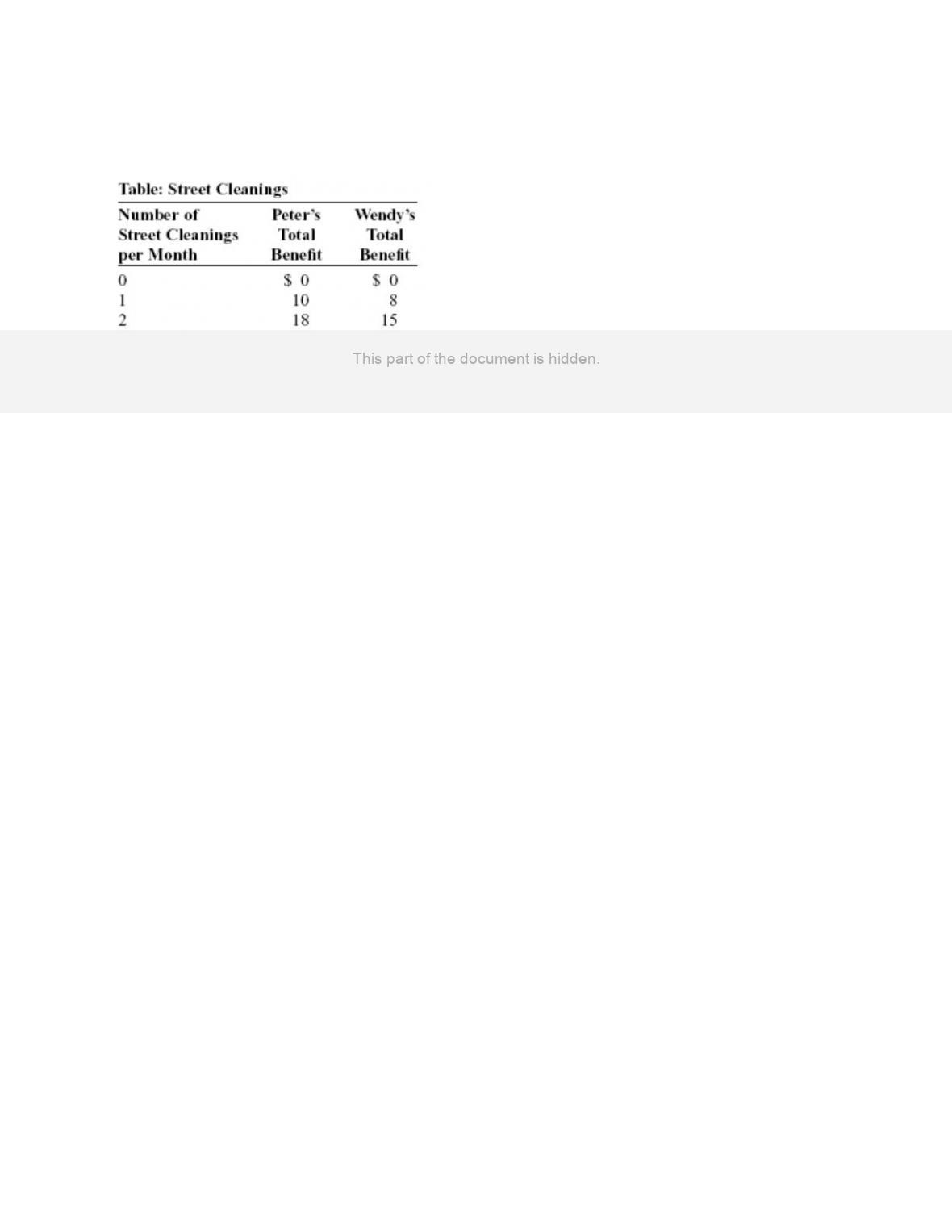
(Table: Street Cleanings) Use Table: Street Cleanings. What is the marginal social
benefit for Peter and Wendy together when the number of street cleanings per month
increases from 4 to 5?
A)
$30
B)
$60
C)
$6
D)
$15
78.
(Table: Street Cleanings) Use Table: Street Cleanings. Increasing the number of street
cleanings per month from _____ would yield a marginal social benefit (for Peter and
Wendy together) equal to $12.
A)
1 to 2
B)
2 to 3
C)
3 to 4
D)
4 to 5
79.
(Table: Street Cleanings) Use Table: Street Cleanings. Suppose that the marginal cost of
each street cleaning is $18. Which statement is TRUE?
A)
If the city decided to clean the streets only once per month, Peter would be willing
to pay the entire cost of the cleaning.
B)
If the city decided to clean the streets only once per month, Wendy would be
willing to pay the entire cost of the cleaning.
C)
If Wendy and Peter were the only people in society, the efficient number of street
cleanings would be one per month.
D)
If Wendy and Peter were the only people in society, the efficient number of street
cleanings would be at least two per month.
Page 16
80.
Consider an economy with just two citizens. If Sanjay’s marginal benefit from an hour
of mosquito control efforts is $10 and Anjali’s marginal benefit is $25, then the optimal
number of hours of a public good like mosquito control occurs when the marginal cost
of an additional hour of mosquito control is:
A)
$25.00.
B)
$17.50.
C)
$10.00.
D)
$35.00.
Use the following to answer questions 81-84:
81.
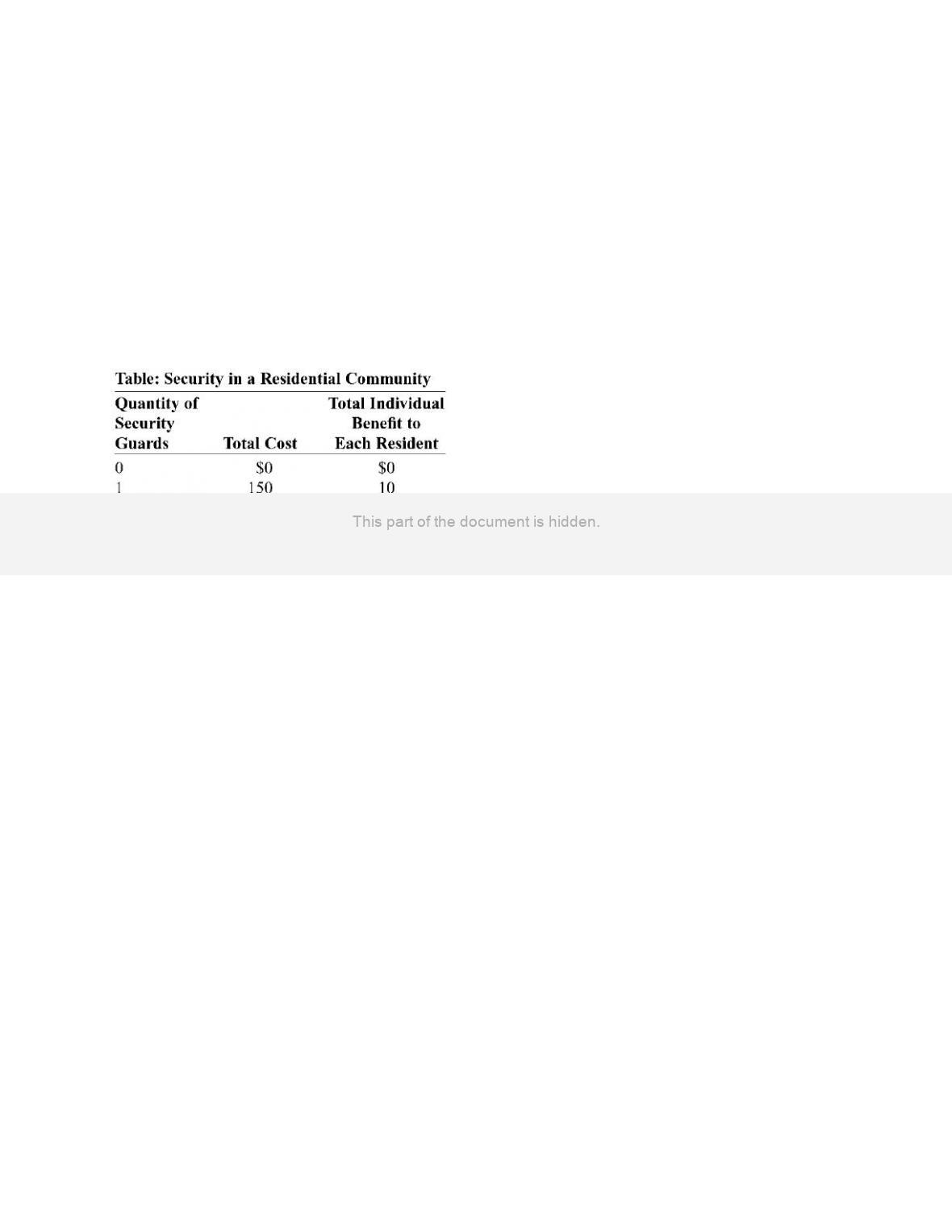
(Table: Security in a Residential Community) Use Table: Security in a Residential
Community. Suppose that the residential community has 100 residents. The marginal
cost of hiring the second security guard is _____, and the marginal social benefit is
_____.
A)
$150; $200
B)
$450; $1,800
C)
$150; $600
D)
$450; $600
82.
(Table: Security in a Residential Community) Use Table: Security in a Residential
Community. Suppose that the residential community has 100 residents. The marginal
cost of hiring the third security guard is _____, and the marginal social benefit is _____.
A)
$150; $200
B)
$450; $1,800
C)
$150; $600
D)
$450; $600
Page 17
83.
(Table: Security in a Residential Community) Use Table: Security in a Residential
Community. Suppose that the residential community has 100 residents. The marginal
cost of hiring the fourth security guard is _____, and the marginal social benefit is
_____.
A)
$150; $200
B)
$150; $100
C)
$150; $600
D)
$600; $1,900
84.
(Table: Security in a Residential Community) Use Table: Security in a Residential
Community. Suppose that the residential community has 100 residents. The efficient
number of security guards is:
A)
0.
B)
2.
C)
3.
D)
4.
Use the following to answer questions 85-88:
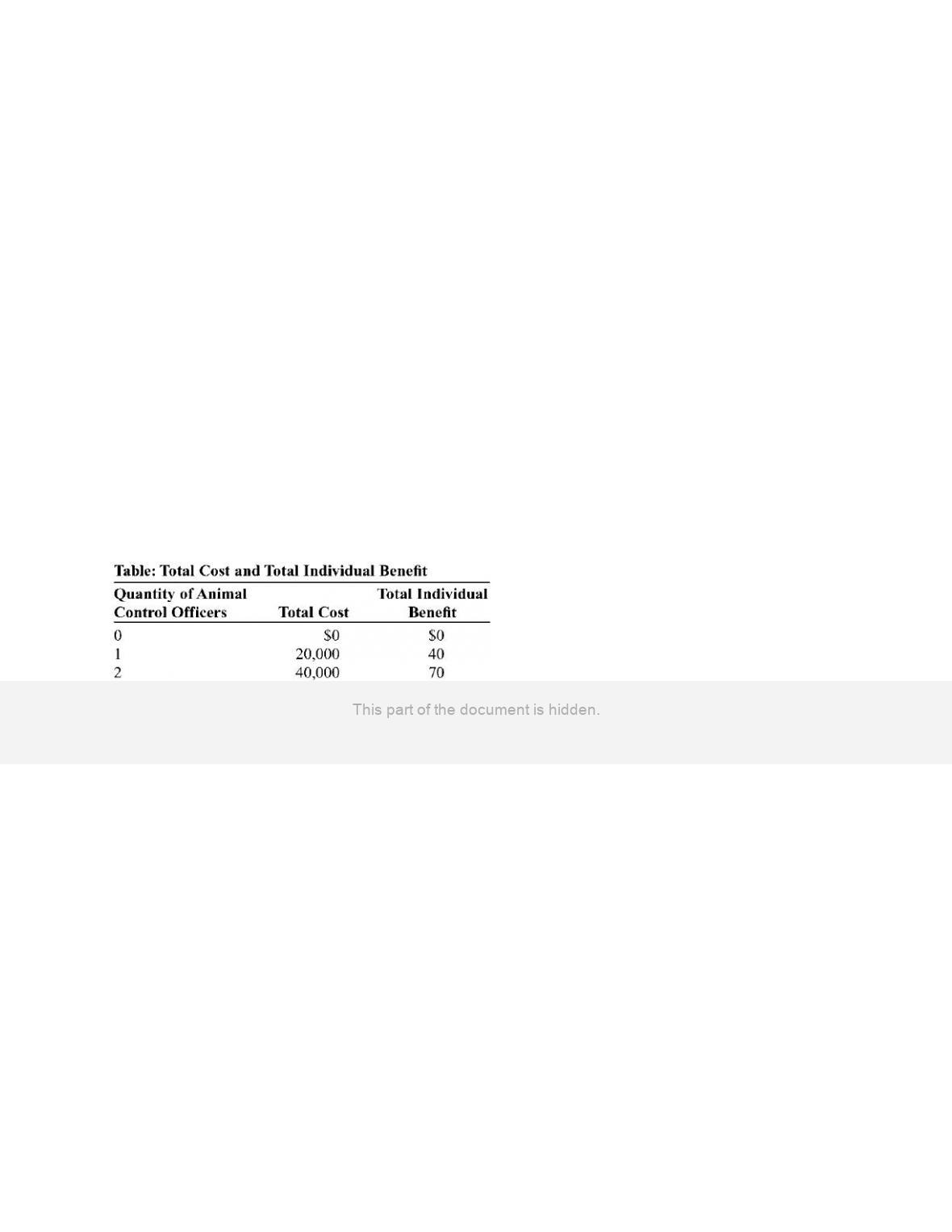
85.
(Table: Total Cost and Total Individual Benefit) Use Table: Total Cost and Total
Individual Benefit. If there are 1,000 residents and they all have the same total
individual benefit, as shown in the table, what is the total social benefit of three animal
control officers?
A)
$10
B)
$9,000
C)
$10,000
D)
$90,000

Page 18
86.
(Table: Total Cost and Total Individual Benefit) Use Table: Total Cost and Total
Individual Benefit. If there are 1,000 residents and they all have the same total
individual benefit, as shown in the table, what is the marginal social benefit of the fourth
animal control officer?
A)
$10
B)
$9,000
C)
$10,000
D)
$90,000
87.
(Table: Total Cost and Total Individual Benefit) Use Table: Total Cost and Total
Individual Benefit. If an individual resident were to decide about hiring and paying for
animal control officers on his or her own, how many officers would that resident hire?
A)
0
B)
1
C)
3
D)
5
88.
(Table: Total Cost and Total Individual Benefit) Use Table: Total Cost and Total
Individual Benefit. Assume there are 1,000 residents and they all have the same total
individual benefit, as shown in the table. If the residents acted together, how many
officers would they hire?
A)
0
B)
1
C)
3
D)
5
89.
A characteristic of public goods is that:
A)
people pay for them in proportion to the benefits received.
B)
the costs of producing them are less than if they were private goods.
C)
their benefits cannot be withheld from anyone, regardless of whether a person pays
for them.
D)
they are produced only by the private sector, not by the public sector.
90.
Some public goods would not be provided without government intervention because the
marginal cost of the good:
A)
exceeds an individual’s marginal benefit.
B)
is less than an individual’s marginal benefit.
C)
would equal an individual’s marginal benefit.
D)
would need to be maximized.
Page 19
91.
Public goods should be provided to the point at which the marginal cost of production
equals:
A)
the maximum price any individual is willing to pay for that unit.
B)
the highest marginal benefit from any individual consumer of the good.
C)
zero.
D)
the sum of the individual marginal benefits from all consumers of that unit.
92.
No individual is willing to pay for the efficient quantity of a public good because the
marginal benefit to an individual _____ the marginal social benefit.
A)
equals
B)
exceeds
C)
is less than
D)
may be equal to or greater than
93.
To maximize society’s welfare, the government should produce a public good up to the
point at which the marginal social benefit _____ the marginal social cost.
A)
equals
B)
exceeds
C)
is less than
D)
is equal to or greater than
Use the following to answer questions 94-100:
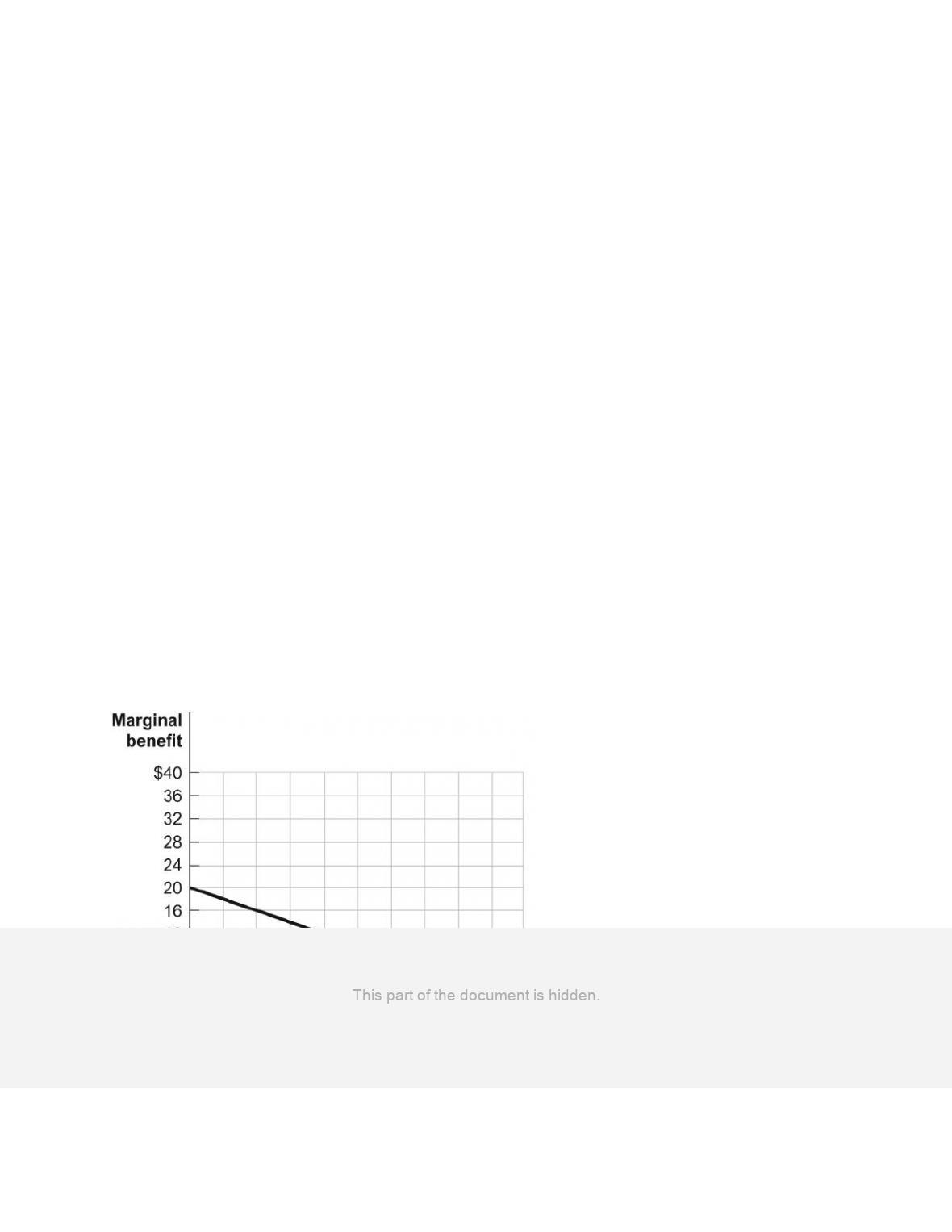
Figure: An Individual’s Marginal Benefit from a Public Good

Page 20
94.
(Figure: An Individual’s Marginal Benefit from a Public Good) Use Figure: An
Individual’s Marginal Benefit from a Public Good. Assume that two individuals will
share consumption of a public good; each individual has the marginal benefit curve
shown in the figure. What is the marginal social benefit from four units of the public
good?
A)
$0
B)
$8
C)
$16
D)
$32
95.
(Figure: An Individual’s Marginal Benefit from a Public Good) Use Figure: An
Individual’s Marginal Benefit from a Public Good. Assume that two individuals will
share consumption of a public good; each individual has the marginal benefit curve
shown in the figure. What is the total social benefit from four units of the public good?
A)
$16
B)
$60
C)
$140
D)
$200
96.
(Figure: An Individual’s Marginal Benefit from a Public Good) Use Figure: An
Individual’s Marginal Benefit from a Public Good. Assume that two individuals will
share consumption of a public good; each individual has the marginal benefit curve
shown in the figure. If the marginal cost of the good is $24, how many units of the
public good will be provided by the private market?
A)
0
B)
8
C)
12
D)
16
97.
(Figure: An Individual’s Marginal Benefit from a Public Good) Use Figure: An
Individual’s Marginal Benefit from a Public Good. Assume that two individuals will
share consumption of a public good; each individual has the marginal benefit curve
shown in the figure. If the marginal cost of the good is $24, how many units of this
public good would maximize society’s welfare?
A)
0
B)
8
C)
12
D)
16