Page 21
70.
(Table: Choice with Uncertainty) Use Table: Choice with Uncertainty. Suppose that the
probability that the sitcom does not make it to television is 30%, that it makes it to
television but is not the most viewed show in its time slot is 50%, and that it makes it to
television and is the most viewed show in its time slot is 20%. Given this information,
Norman, as a utility maximizer:
A)
should keep his teaching job.
B)
should quit his teaching job and go to Hollywood.
C)
will be indifferent between leaving and staying because his expected income is the
same whether he stays a teacher or moves to Hollywood.
D)
will be indifferent between leaving and staying because his expected total utility is
the same whether he stays a teacher or moves to Hollywood.
71.
(Scenario: Choosing Insurance) Use Scenario: Choosing Insurance. For $2,000, the
Ramirez family can buy insurance that will cover the full cost of repairs. If family
members are risk-averse and want to maximize their expected utility, they will:
Scenario: Choosing Insurance
The Ramirez family owns three cars and is considering buying insurance to cover the
cost of repairs. They face two possible states: in state 1, their cars need no repairs and
their income available for purchasing other goods and services is $50,000; in state 2,
their cars need $10,000 worth of repairs and their income available for purchasing other
goods and services is reduced to $40,000. The probability of repairs is 10%, while the
probability of no repairs is 90%.
A)
buy the insurance.
B)
be indifferent between buying and not buying the insurance since their expected
income for purchasing other goods and services is $48,000 regardless of what they
do.
C)
buy the insurance as long as the utility of having a certain income of $48,000 to
buy goods and services other than car repairs is higher than the utility associated
with their expected income without insurance.
D)
self-insure.
Page 22
72.
(Scenario: Choosing Insurance) Use Scenario: Choosing Insurance. For $1,000, the
Ramirez family can buy insurance that will cover the full cost of repairs. If family
members are risk-averse and want to maximize their expected utility, they will:
Scenario: Choosing Insurance
The Ramirez family owns three cars and is considering buying insurance to cover the
cost of repairs. They face two possible states: in state 1, their cars need no repairs and
their income available for purchasing other goods and services is $50,000; in state 2,
their cars need $10,000 worth of repairs and their income available for purchasing other
goods and services is reduced to $40,000. The probability of repairs is 10%, while the
probability of no repairs is 90%.
A)
buy the insurance.
B)
be indifferent between buying and not buying the insurance since their expected
income for purchasing other goods and services is $49,000, regardless of what they
do.
C)
buy the insurance as long as the utility of having a certain income of $48,000 to
buy goods and services other than car repairs is higher than the utility associated
with their expected income without insurance.
D)
self-insure.
73.
(Scenario: Choosing Insurance) Use Scenario: Choosing Insurance. The premium on a
fair insurance policy for the Ramirez family will be:
Scenario: Choosing Insurance
The Ramirez family owns three cars and is considering buying insurance to cover the
cost of repairs. They face two possible states: in state 1, their cars need no repairs and
their income available for purchasing other goods and services is $50,000; in state 2,
their cars need $10,000 worth of repairs and their income available for purchasing other
goods and services is reduced to $40,000. The probability of repairs is 10%, while the
probability of no repairs is 90%.
A)
$0.
B)
$900.
C)
$1,000.
D)
$2,000.
Page 23
74.
(Scenario: Choosing Insurance) Use Scenario: Choosing Insurance. For $900, the
Ramirez family can buy insurance that will cover the full cost of repairs. If family
members are risk-averse and maximize their expected utility, they will:
Scenario: Choosing Insurance
The Ramirez family owns three cars and is considering buying insurance to cover the
cost of repairs. They face two possible states: in state 1, their cars need no repairs and
their income available for purchasing other goods and services is $50,000; in state 2,
their cars need $10,000 worth of repairs and their income available for purchasing other
goods and services is reduced to $40,000. The probability of repairs is 10%, while the
probability of no repairs is 90%.
A)
buy the insurance.
B)
be indifferent between buying and not buying the insurance since their expected
income for purchasing other goods and services is $49,100, regardless of what they
do.
C)
not buy the insurance, since buying it does not increase their expected income for
purchasing other goods and services.
D)
self-insure.
Use the following to answer questions 75-77:
75.
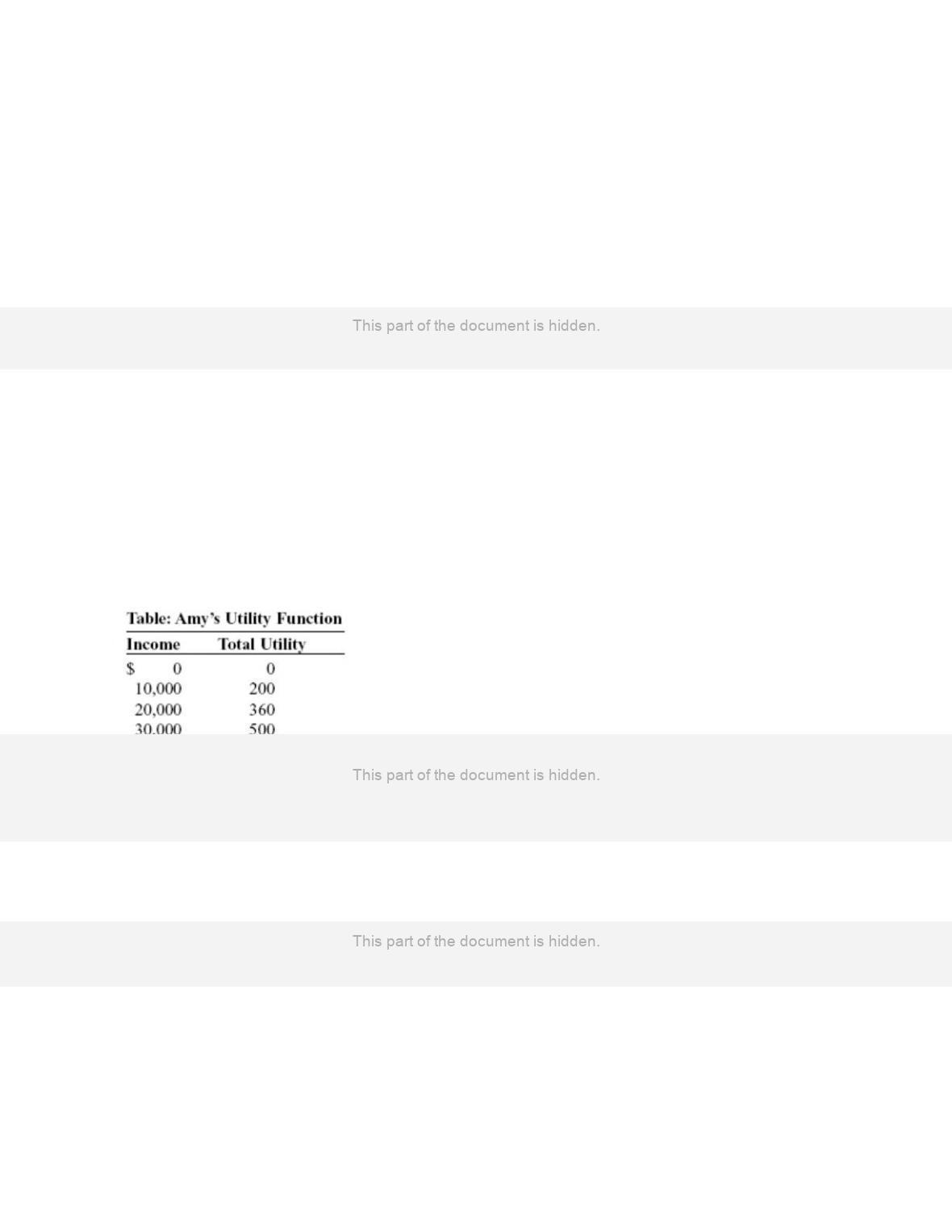
(Table: Amy’s Utility Function) Use Table: Amy’s Utility Function. Amy is an
entrepreneur with income of $40,000. Amy is considering development of a new
product. The probability that her new product earns Amy $30,000 in additional income
is 0.5, and the probability that Amy incurs a reduction of $10,000 from her current
income is 0.5. Amy’s expected income after developing her new product is:
A)
$45,000.
B)
$35,000.
C)
$50,000.
D)
$60,000.
Page 24
76.
(Table: Amy’s Utility Function) Use Table: Amy’s Utility Function. Amy is an
entrepreneur with current income equal to $40,000. Amy is considering development of
a new product. The probability that her new product earns Amy $30,000 in additional
income is 0.5, and the probability that Amy incurs a reduction of $10,000 from her
current income is also 0.5. Amy’s expected utility after developing her new product is
_____ utils.
A)
1,360
B)
860
C)
500
D)
680
77.
(Table: Amy’s Utility Function) Use Table: Amy’s Utility Function. Amy is an
entrepreneur with current income equal to $40,000. Amy is considering development of
a new product. The probability that her new product earns Amy $10,000 in additional
income is 0.5, and the probability that Amy incurs a reduction of $10,000 from her
current income is also 0.5. Suppose Amy can buy a fair insurance policy that will
compensate her for any losses. Amy’s premium will be _____, her guaranteed income
will be _____, and her expected utility will be _____ utils.
A)
$5,000; $10,000; 200
B)
$10,000; $30,000; 500
C)
$10,000; $40,000; 620
D)
$30,000; $50,000; 720
78.
Consider the marginal utility of income curves of Hank, Babe, Barry, and Willie. Hank’s
is constant; Babe’s is slightly diminishing; Barry’s is strongly diminishing; and Willie’s
is upward sloping. All else equal, which of these individuals will be most risk-averse?
A)
Hank
B)
Babe
C)
Barry
D)
Willie
79.
In an efficient allocation of risk:
A)
all risk is eliminated.
B)
those who are most willing to bear risk, bear it.
C)
all risk is diversified.
D)
all insurance premiums are equal to the expected value of the claims.

Page 25
80.
Mary and Bob are trying to decide how much auto insurance to buy. They share the
same expectations of an accident, with the same dollar loss. They also have the same
income levels. However, Mary would rather buy very little insurance, while Bob would
rather buy much more insurance. This suggests that:
A)
Bob is more risk-averse than is Mary.
B)
Mary is more risk-averse than is Bob.
C)
Bob is risk-averse and Mary is risk-loving.
D)
Mary is risk-averse and Bob is risk-loving.
81.
The total amount of funds that potentially could be paid out by an insurance company is
the:
A)
sum of all premiums collected.
B)
sum of all deductibles received from claims.
C)
capital at risk.
D)
company’s liabilities.
82.
Suppose that the wealth of buyers in the insurance market falls. We would expect
insurance premiums to _____ as the _____ curve shifts _____.
A)
rise; supply; left
B)
fall; supply; right
C)
fall; demand; left
D)
rise; demand; right
83.
Barcelona and Los Angeles are similar, except Barcelona has a good public
transportation system and Los Angeles does not. Auto insurance will probably be more
expensive in _____ since the _____ for insurance is _____.
A)
Barcelona; demand; higher than it is in Los Angeles
B)
Barcelona; supply; lower than it is in Los Angeles
C)
Los Angeles; demand; higher than it is in Barcelona
D)
Los Angeles; supply; lower than it is in Barcelona
84.
An efficient market for risk, such as an insurance market, is MOST likely to exist:
A)
when there is a level playing field so that all participants have approximately the
same wealth and the same degree of risk aversion.
B)
when the sellers of insurance are risk-averse but the purchasers are not.
C)
when there are significant differences between individuals’ wealth levels and
attitudes toward risk.
D)
in the presence of private, or asymmetric, information.
Page 26
85.
Which statement describes a principle of the insurance industry?
A)
Trade in risk can produce mutual gains.
B)
Diversification can increase risk.
C)
Deductibles add to the problem of moral hazard.
D)
Adverse selection should be used to reduce insurance costs.
86.
People who want to reduce the risk they face may pay other people who are less
sensitive to risk to take on some of their risk. As a result:
A)
a market for risk is illegal.
B)
trade in risk reduces mutual gains.
C)
total risk increases.
D)
people who are willing to accept more risk will purchase from people who are less
willing.
87.
The funds that an insurance company may have to pay out are known as the:
A)
fair premium.
B)
capital at risk.
C)
total premium.
D)
deductible.
88.
Which statement is TRUE if the insurance market is efficient?
A)
The deductibles eliminate moral hazard.
B)
Society as a whole engages in less risky behavior.
C)
It transfers risk from those who most want to get rid of it to those least bothered by
the risk.
D)
Premiums are always kept to the level of a fair insurance policy.
89.
If those who are most willing to bear risk end up bearing it, then we say that the
insurance market is:
A)
experiencing adverse selection.
B)
efficient.
C)
equitable.
D)
showing signs of moral hazard.
90.
As the premium for an insurance policy rises, there is a(n) _____ in the _____
insurance.
A)
decrease; demand for
B)
increase; supply of
C)
decrease; quantity demanded of
D)
decrease; supply of
Page 27
91.
As the premium for an insurance policy falls, there is an increase in the _____
insurance.
A)
demand for
B)
supply of
C)
quantity demanded of
D)
quantity supplied of
92.
Why might the supply curve of insurance policies shift to the right?
A)
The wealth of the sellers of insurance increases.
B)
Premiums increase.
C)
Risk aversion increases.
D)
Diversification increases.
93.
Assume that flood insurance premiums are determined in the competitive market.
Suppose that devastating floods along the Mississippi River have increased the degree
of risk aversion among the insurance investors in this market. The _____ insurance
shifts _____, leading to a(n) _____ in equilibrium premiums and a(n) _____ in the
quantity of insurance bought and sold.
A)
supply of; rightward; decrease; increase
B)
demand for; leftward; decrease; decrease
C)
supply of; leftward; increase; decrease
D)
demand for; rightward; increase; increase
94.
We would consider a tornado and a CEO scandal that hit a construction company on the
same day as _____ events.
A)
independent
B)
dependent
C)
premium
D)
probable
95.
Suppose that the probability of a major theft at a hotel is 1%, while the probability of an
earthquake hitting the hotel is 2.3%. The probability that both would occur on the same
day is therefore:
A)
0.00023%.
B)
0.0023%.
C)
0.023%.
D)
2.3%.
96.
(Scenario: Buying Shares) Use Scenario: Buying Shares. The probability that Geordie
will sustain a loss (i.e., that his investment at the end of the year will be worth less than
$1,000) is _____% if he invests $1,000 in either Apple or Microsoft and _____% if he
invests $500 apiece in Apple and in Microsoft.
Scenario: Buying Shares
Geordie is considering buying shares in two companies, Apple and Microsoft. If he
invests $1,000 in Apple, there is a 40% probability that his investment will be worth
only $800 and a 60% probability that it will be worth $1,200 at the end of a year. If he
invests $500 in Apple, there is a 40% probability that his investment will be worth $400
and a 60% probability that it will be worth $600 at the end of a year. The corresponding
numbers for investment in Microsoft are identical.
A)
40; 40
B)
40; 16
C)
80; 20
D)
40; 80
97.
(Scenario: Buying Shares) Use Scenario: Buying Shares. The probability that Geordie
will make a gain is _____% if he invests $1,000 in either Apple or Microsoft. The
probability that he will make a gain is _____% if he invests $500 apiece in Apple and in
Microsoft.
Scenario: Buying Shares
Geordie is considering buying shares in two companies, Apple and Microsoft. If he
invests $1,000 in Apple, there is a 40% probability that his investment will be worth
only $800 and a 60% probability that it will be worth $1,200 at the end of a year. If he
invests $500 in Apple, there is a 40% probability that his investment will be worth $400
and a 60% probability that it will be worth $600 at the end of a year. The corresponding
numbers for investment in Microsoft are identical.
A)
60; 60
B)
60; 84
C)
76; 24
D)
60; 36
98.
The strategy of reducing or eliminating risks by taking a small share in many
independent events or by taking advantage of the predictability associated with large
numbers of independent events is known as:
A)
floating.
B)
specializing.
C)
pooling.
D)
screening.
99.
Which pair of events is NOT independent?
A)
You forget your umbrella; it rains.
B)
There is a heat wave; demand for ice increases.
C)
You didn’t study last night; there is a quiz in your economics class.
D)
You don’t clean your apartment; you have unexpected company.
100.
On any particular day, the probability that it will rain is 25% and that you will be sick is
10%. The probability that both happen on the same day is _____%.
A)
0.25
B)
1
C)
2.5
D)
17.5
101.
(Scenario: Diversification) Use Scenario: Diversification. If Morris invests all of his
money in the sunglass company, what is his expected gain or loss?
Scenario: Diversification
Morris is considering investing $10,000 in a sunglass company or a rain poncho
company. If it is a rainy year and he invests only in the sunglass company, he will lose
$5,000. However, if it is a rainy year and he invests only in the rain poncho company,
he will earn $10,000. If it is a sunny year and he invests only in the sunglass company,
he will earn $10,000; if he invests only in the rain poncho company, he will lose $5,000
in a sunny year. There is a 50% chance of a sunny year and a 50% chance of a rainy
year.
A)
a loss of $2,500
B)
to break even
C)
a gain of $2,500
D)
a gain of $10,000
102.
(Scenario: Diversification) Use Scenario: Diversification. If Morris invests all of his
money in the rain poncho company, what is his expected gain or loss?
Scenario: Diversification
Morris is considering investing $10,000 in a sunglass company or a rain poncho
company. If it is a rainy year and he invests only in the sunglass company, he will lose
$5,000. However, if it is a rainy year and he invests only in the rain poncho company,
he will earn $10,000. If it is a sunny year and he invests only in the sunglass company,
he will earn $10,000; if he invests only in the rain poncho company, he will lose $5,000
in a sunny year. There is a 50% chance of a sunny year and a 50% chance of a rainy
year.
A)
a loss of $2,500
B)
to break even
C)
a gain of $2,500
D)
a gain of $10,000
103.
(Scenario: Diversification) Use Scenario: Diversification. If Morris invests half of his
money in the sunglass company and half in the rain poncho company, what is his
expected gain or loss?
Scenario: Diversification
Morris is considering investing $10,000 in a sunglass company or a rain poncho
company. If it is a rainy year and he invests only in the sunglass company, he will lose
$5,000. However, if it is a rainy year and he invests only in the rain poncho company,
he will earn $10,000. If it is a sunny year and he invests only in the sunglass company,
he will earn $10,000; if he invests only in the rain poncho company, he will lose $5,000
in a sunny year. There is a 50% chance of a sunny year and a 50% chance of a rainy
year.
A)
a loss of $2,500
B)
to break even
C)
a gain of $2,500
D)
a gain of $10,000
104.
(Scenario: Diversification) Use Scenario: Diversification. If Morris invests half of his
money in the sunglass company and half in the rain poncho company, he will earn
_____ in a sunny year and _____ in a rainy year.
Scenario: Diversification
Morris is considering investing $10,000 in a sunglass company or a rain poncho
company. If it is a rainy year and he invests only in the sunglass company, he will lose
$5,000. However, if it is a rainy year and he invests only in the rain poncho company,
he will earn $10,000. If it is a sunny year and he invests only in the sunglass company,
he will earn $10,000; if he invests only in the rain poncho company, he will lose $5,000
in a sunny year. There is a 50% chance of a sunny year and a 50% chance of a rainy
year.
A)
$2,500; $0
B)
$1,250; $1,250
C)
–$2,500; $2,500
D)
$2,500; $2,500
105.
If an insurance company insured 100,000 cars across the state against theft, which
statement would NOT be true?
A)
The insurance company would be fairly certain of the number of cars that will be
stolen.
B)
The insurance company would be pooling risks.
C)
The insurance company would know with a fair amount of certainty the expected
payoff on the insurance policies.
D)
The insurance company must assume that very few cars will be stolen.
106.
An individual can almost eliminate risk by taking a small share in many independent
events or by taking advantage of the predictability associated with large numbers of
independent events. This strategy is known as:
A)
specializing.
B)
floating.
C)
pooling.
D)
insuring.
107.
The strategy of investing in several assets so that any possible losses are independent
events is:
A)
diversification.
B)
private information.
C)
moral hazard.
D)
adverse selection.
Page 32
108.
Which pair of events is likely to be positively correlated?
A)
stock prices of computer companies and of tire companies
B)
hurricane damage in Florida and earthquake damage in California
C)
sales of ice cream and cars on a hot summer day
D)
a week-long power outage due to a large hurricane and battery sales
109.
Investors in agricultural corporations face many correlated financial risks. Which
example does NOT illustrate correlated risks for the agricultural industry?
A)
losses due to drought and changes in the exchange rate with the euro
B)
political events that can lead to fewer crop subsidies and fewer milk supports
C)
recessions and changes in availability of credit
D)
the spread of genetically modified crops and the presence of locusts
110.
If relevant events are _____, diversification will NOT reduce risk.
A)
positively correlated
B)
negatively correlated
C)
dependent
D)
independent
111.
Which factor is a limit to the ability of diversification to reduce risk?
A)
losses due to bad decision making
B)
key raw materials
C)
industrial life cycles
D)
economic losses from bad weather
112.
At the end of the 1980s, Lloyd’s of London was in severe financial trouble because of:
A)
a major recession in Western Europe and the United States.
B)
terror attacks by the IRA.
C)
asbestos claims.
D)
the war in Iraq.
113.
The opportunity to engage in pooling shifts the _____ curve of insurance to the right;
insurance companies will take on _____ risk and charge a _____ premium than without
pooling.
A)
supply; more; lower
B)
demand; more; lower
C)
supply; less; higher
D)
demand; less; higher
Page 33
114.
Asymmetric, or private, information:
A)
is an important explanation of the variation (or asymmetric performance) of
individuals on standardized tests.
B)
refers to personal information (e.g., regarding gender or ethnicity) that a person is
not obligated to reveal on a job application.
C)
is relevant for an economic transaction and is known only by some of the people
involved in the transaction.
D)
is protected by patents or copyrights.
115.
When some people know things that other people don’t know, there is _____; it can
_____ economic decisions.
A)
risk aversion; facilitate
B)
blind strategy; delay
C)
private information; distort
D)
blind trust; diversify
116.
A life insurance company will often require an applicant to submit to a brief physical
exam to assess that person’s basic level of health. This practice is a form of _____ to
lessen the problem of _____.
A)
diversification; moral hazard
B)
signaling; deductibles
C)
reputation; adverse selection
D)
screening; adverse selection
117.
The problem of adverse selection:
A)
occurs when sellers (who know more than buyers about the quality of the product)
deliberately select inferior products to sell.
B)
is also referred to as the moral hazard problem.
C)
can result in an overall increase in the gains from trade.
D)
occurs when an employer fires the wrong person.
118.
In which situation is adverse selection MOST likely to be a problem?
A)
buying tomatoes at the local farmers’ market
B)
hiring a new manager to work the night shift
C)
buying a new lawnmower
D)
buying a house directly from the previous owner
Page 34
119.
People faced with adverse selection use _____ to deal with it.
A)
screening
B)
signals
C)
reputation
D)
screening, signals, and reputation
120.
Which strategy is NOT used for dealing with adverse selection in the labor market?
A)
careful screening of an applicant
B)
examination of signals from an applicant
C)
obtaining reference letters from an applicant’s previous place of employment
D)
Openly asking candidates of any hidden work problems from their past.
121.
Companies offering life insurance often require a drug test to determine whether the
buyer is a smoker. A smoker must pay a higher premium. This is an example of:
A)
providing the buyer with a personal stake, a way of dealing with moral hazard.
B)
screening to deal with adverse selection.
C)
the demand curve shifting right because of an increase in risk.
D)
pooling of risk with others.
122.
In practice, insurance companies faced with adverse selection use _____ to deal with it.
A)
moral hazard
B)
deductibles
C)
signals
D)
co-pays
123.
Private information leads _____ to expect hidden problems in items offered for sale,
leading to _____ prices and to the best items being kept off the market.
A)
buyers; high
B)
buyers; low
C)
sellers; high
D)
sellers; low
124.
Rhonda would like a better bicycle, and she considers selling her old one by advertising
on the bulletin board in the student center. She decides against it because the used
bicycles listed on the board are underpriced. This example illustrates the problem of:
A)
adverse selection.
B)
moral hazard.
C)
positive correlation.
D)
risk aversion.
Page 35
125.
Sellers of used cars may have private information to which buyers are not privy. This
knowledge of private information does NOT lead to:
A)
lower prices for the cars.
B)
a shortage of used cars on the market.
C)
many mutually beneficial transactions not taking place.
D)
potential sellers willing to sell only at high prices.
126.
Used-car dealers will often advertise how long they have been in business as a means of
_____ their long-term _____.
A)
signaling; reputation
B)
screening; customers
C)
insuring; capital at risk
D)
revealing; moral hazard
127.
Moral hazard occurs when individuals:
A)
do not do what is in their own best interest.
B)
know more about acceptable business behavior than other people do.
C)
have an incentive to violate their morals.
D)
know more about their actions than other people do.
128.
Many people smoke and continue poor eating habits because they have health insurance.
This example illustrates:
A)
moral hazard.
B)
signaling.
C)
reputation.
D)
adverse selection.
129.
Moral hazard:
A)
occurs when incentives are distorted because an individual knows more about his
or her own actions than other people do.
B)
is a term used to describe the bonuses paid for particularly hazardous jobs (such as
firefighting).
C)
is a term used synonymously with value judgment.
D)
refers to the questionable morality of price gouging in hazardous times (e.g., in the
presence of famines or floods).
Page 36
130.
Solutions to moral hazard include:
A)
offering salespeople in stores a straight salary rather than a commission on sales.
B)
setting up many stores and restaurants that are part of a national chain as
franchises, with the owner undertaking quite a lot of risk.
C)
allowing property owners to over insure their buildings.
D)
diversification.
131.
Insurance companies deal with the problems of moral hazard by:
A)
always insuring buildings for their full replacement value.
B)
refusing to insure commercial properties against losses caused by fire.
C)
requiring a deductible to provide an incentive for insured individuals to take
reasonable precautions to avoid losses.
D)
charging extra in cases of adverse selection.
132.
Health insurance policies include deductibles:
A)
to minimize moral hazard.
B)
because, when it comes to health, most people are risk-averse.
C)
to minimize adverse selection.
D)
because many health insurance companies own hospitals.
133.
You insure your car against theft. Consequently, you rarely lock the car. This example
illustrates the problem of:
A)
adverse selection.
B)
moral hazard.
C)
positive correlation.
D)
risk aversion.
134.
The premium on insurance is often _____ to the deductible, allowing insurance
companies to _____ their customers.
A)
equal; pool
B)
directly related; signal
C)
equal; offer a fair premium to
D)
inversely related; screen
135.
Fire insurance policies include deductibles:
A)
because, when it comes to fire, most people are risk-averse.
B)
because it is too expensive to fully insure something against fire.
C)
to minimize moral hazard.
D)
to minimize adverse selection.
Page 37
136.
Insurance companies attempt to minimize moral hazard by imposing:
A)
premiums.
B)
capital at risk.
C)
adverse selection.
D)
deductibles.
137.
McDonald’s and other fast-food chains rely mainly on franchisees to operate the
restaurants to avoid the problem of:
A)
adverse selection.
B)
moral hazard.
C)
insurance.
D)
deductibles.
138.
By offering a menu of policies with different premiums and deductibles, insurance
companies can _____ their customers; for example, a low-risk customer will often buy
insurance with a lower _____ but a higher _____ than a high-risk customer.
A)
signal; deductible; premium
B)
signal; premium; deductible
C)
screen; deductible; premium
D)
screen; premium; deductible
139.
A random variable has a certain future value.
A)
True
B)
False
140.
The future price of one share of General Motors stock is a random variable.
A)
True
B)
False
141.
You go into a grocery store to buy a soft drink. You find that different brands or
varieties have different prices: for a one-liter bottle, Coke costs $1, Pepsi costs $0.95,
and ginger ale costs $1.05. The price of a one-liter bottle of a soft drink at your grocery
store is therefore a random variable.
A)
True
B)
False