Page 60
294.
Suppose that two police officers are identical in every way. One officer is employed in
Chicago, a metropolis of 5 million people, and the other officer is employed in Madison,
Indiana, a town of 25,000 people. Which officer is likely to receive the higher wage?
What is a likely source of this wage difference?
295.
John and Deanna are married, with two children. Both adults have college degrees, but
Deanna has chosen not to enter the labor force, while John has worked continuously for
10 years. Suppose Deanna gets a job with John’s employer. She is offered a salary that is
$15,000 below John’s. Is Deanna being discriminated against because she is a woman?
Support your answer.
296.
You overhear an economist refer to the price of leisure. What does this mean? How can
leisure have a price?
297.
The supply curves for goods and services are almost universally upward sloping. How is
it that labor supply can be downward sloping in certain cases?
298.
The competitive labor market for economists is in equilibrium. Suppose that more
college students decide to major in economics. How will this affect the labor market?
299.
While reading the local newspaper, you notice an article about a man who won a sizable
prize in the state lottery. This prize amounts to monthly payments for the rest of the
man’s life. The man is quoted as saying, “As soon as I receive that first lottery payment,
I will only work when I want to, rather than because I have to.” How would an
economist explain what has happened to this man’s labor supply curve?
300.
When a person becomes better educated and is able to produce a better product, the
person’s education is an improvement in:
A)
human capital.
B)
physical capital.
C)
land.
D)
labor.
Page 61
301.
When a person receives more education, his or her _____ has increased. When a firm
buys a new copy machine, it has purchased _____.
A)
human capital; physical capital
B)
labor; capital labor
C)
labor; capital
D)
human capital; land
302.
Alex’s boss notices that, with each adult education course Alex takes, he becomes a
more knowledgeable and efficient worker. This example illustrates:
A)
human capital development.
B)
derived demand.
C)
value of marginal product.
D)
income effects.
303.
Factors of production are different from inputs in that factors of production:
A)
can be used over and over again, but inputs cannot.
B)
can be used only once, whereas an input can be used over and over again.
C)
refer only to labor, while inputs refer to machinery.
D)
encompass only land and other natural factors, while inputs are ingredients.
304.
Derived demand for a factor of production means that:
A)
people demand factors just as they do goods.
B)
the demand for factors depends on what the factor can produce.
C)
the market derives a demand for factors regardless of what they produce.
D)
suppliers determine what will be produced.
305.
The factor distribution of income in the United States reflects that:
A)
land, labor, and capital are equally distributed.
B)
most people receive their income based on their labor contribution.
C)
most people receive their income based on their capital distribution.
D)
land provides most income to the population.
306.
In the United States, payments to labor account for roughly:
A)
70% of total income, a share that has not fluctuated much in the past 30 years.
B)
50% of total income, but the returns to land have been increasing.
C)
30% of total income, and this number is falling.
D)
90% of total income and can be broken down into human capital and physical
capital.

Page 62
307.
Firms will continue to hire workers as long as:
A)
they make a profit.
B)
the value of the marginal product is greater than the marginal cost of hiring labor.
C)
the wage is below the product price.
D)
there are no diminishing returns.
308.
Suppose that a firm sells a good for a perfectly competitive price of $5. The equilibrium
wage rate is $10. The first worker it hires produces five units. Two workers produce a
total of nine units. If it hires two workers, the value of marginal product for the second
worker is:
A)
$5.
B)
$45.
C)
$20.
D)
$10.
309.
Suppose that a firm sells a good for a perfectly competitive price of $5. The equilibrium
wage rate is $10. The first worker it hires produces five units. Two workers produce a
total of nine units. Given this information, the firm will:
A)
hire the first worker only.
B)
hire both the first and second workers.
C)
not hire either worker.
D)
hire only the second worker.
310.
The firm’s value of the marginal product of labor curve:
A)
is the firm’s demand curve for labor.
B)
is the industry’s demand curve for labor.
C)
is the same as the marginal cost curve for labor.
D)
slopes upward.
311.
The firm’s value of marginal product curve slopes downward:
A)
only if the firm is a perfect competitor in the product market.
B)
because of diminishing returns.
C)
only if the firm is a perfect competitor in the labor market.
D)
only if the firm is a perfect competitor in both the labor and product markets.
Page 63
312.
Although horses were once a very important factor of production, the development of
automobiles and other machinery reduced the demand for their use. This example
illustrates:
A)
technological progress shifting the demand for horses to the left.
B)
higher marginal costs for horses shifting demand for horses to the right.
C)
technological progress shifting the demand for horses to the right.
D)
higher marginal costs for horses having no impact on the demand for horses.
313.
In a given perfectly competitive labor market, the equilibrium wage:
A)
is the same for all workers in that labor market.
B)
is always greater than the value of marginal product.
C)
results in diminishing marginal product.
D)
causes some people to be unemployed.
314.
When each factor is paid an amount equal to the value of the marginal product of the
last unit of that factor employed in the factor market as a whole, this is:
A)
the marginal productivity theory of income distribution.
B)
diminishing marginal product.
C)
the factor distribution of income.
D)
the efficiency wage model.
315.
In the factor market for land, equilibrium rental prices will be _____ the value of
marginal product of land.
A)
less than
B)
equal to
C)
greater than
D)
unrelated to
Page 64
316.
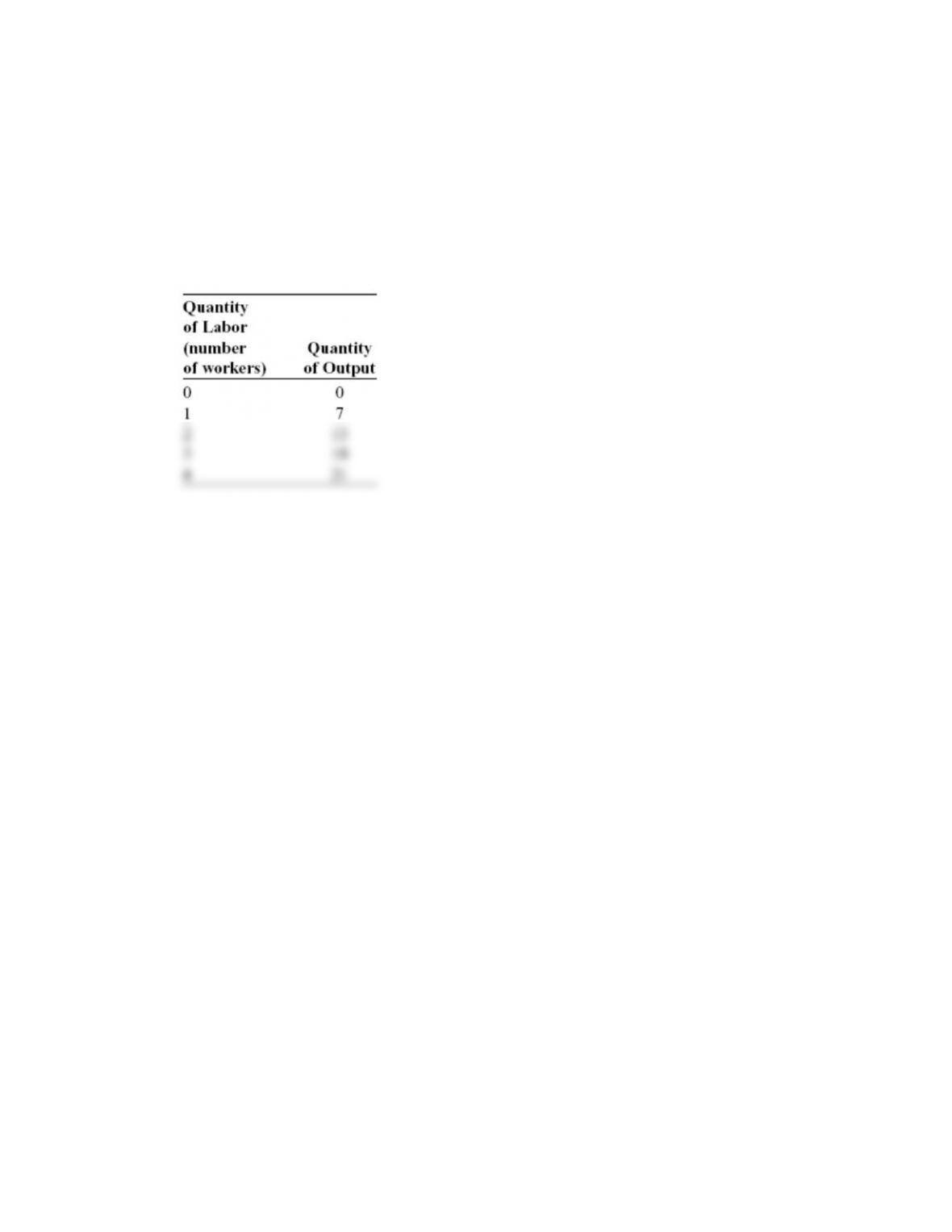
(Scenario: The Decision to Hire Labor) Use Scenario: The Decision to Hire Labor.
What is the value of the marginal product of the third worker to this firm?
Scenario: The Decision to Hire Labor
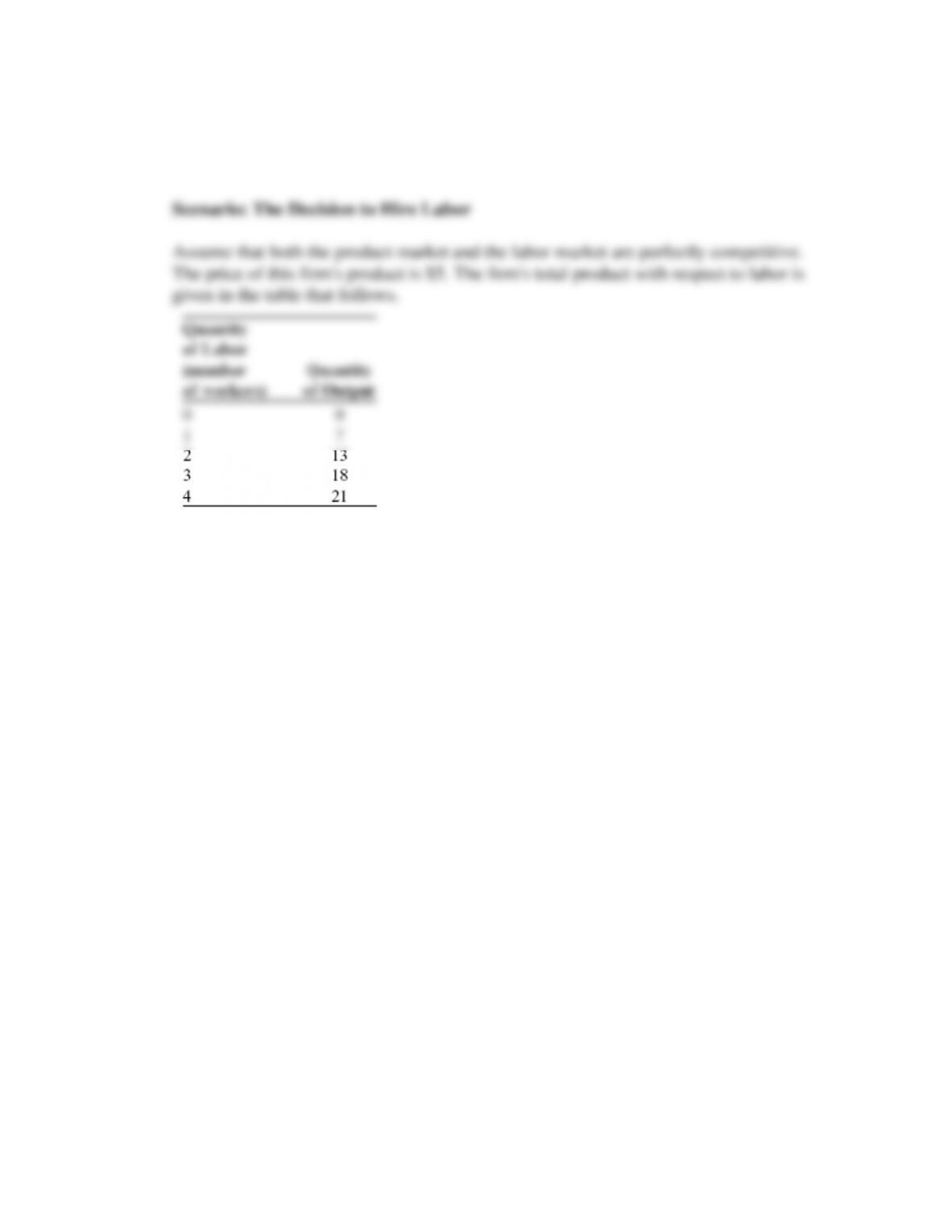
Assume that both the product market and the labor market are perfectly competitive.
The price of this firm’s product is $5. The firm’s total product with respect to labor is
given in the table that follows.
A)
$5
B)
$25
C)
$18
D)
$10
Page 65
317.
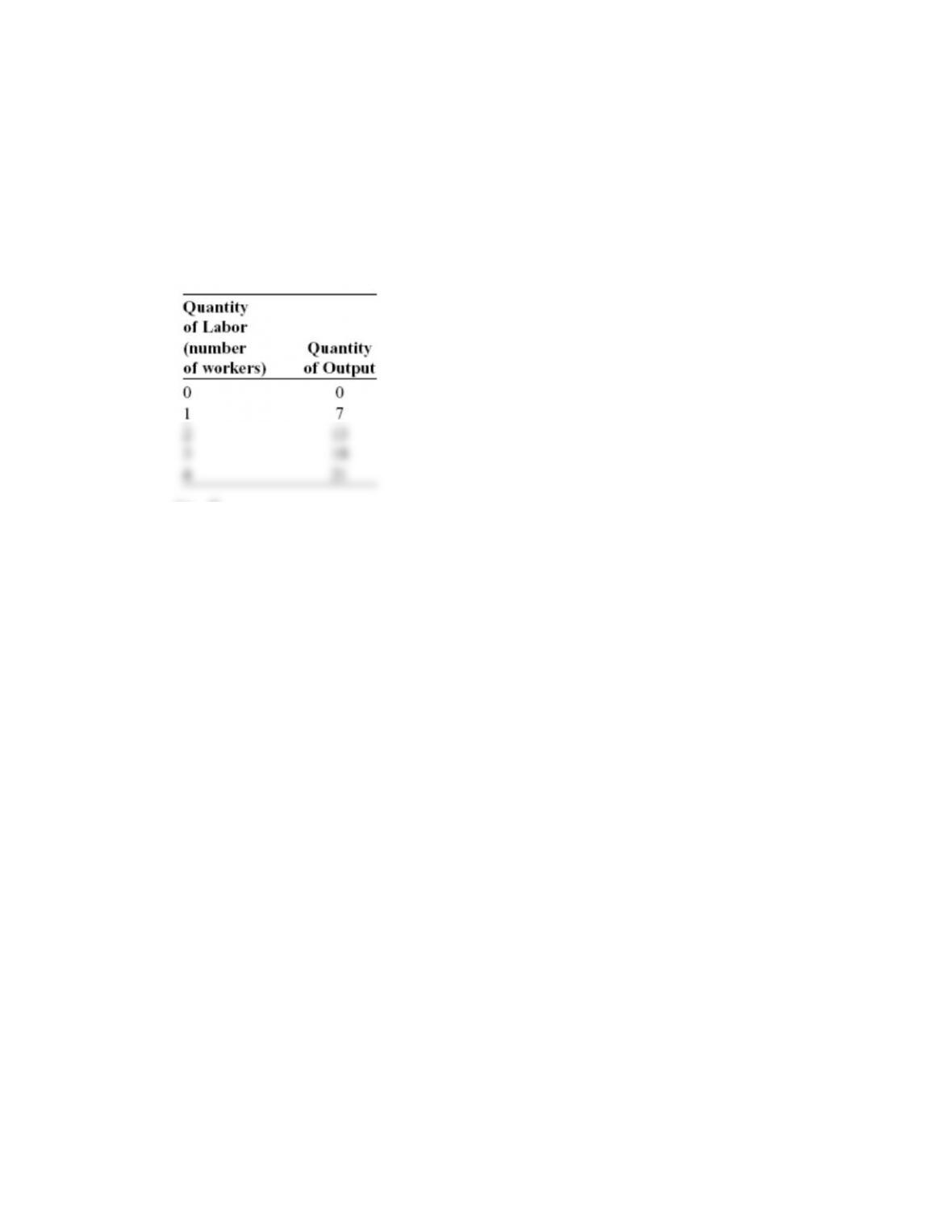
(Scenario: The Decision to Hire Labor) Use Scenario: The Decision to Hire Labor. The
marginal product of the fourth worker is:
Scenario: The Decision to Hire Labor
Assume that both the product market and the labor market are perfectly competitive.
The price of this firm’s product is $5. The firm’s total product with respect to labor is
given in the table that follows.
A)
7.
B)
21.
C)
3.
D)
15.
Page 66
318.
(Scenario: The Decision to Hire Labor) Use Scenario: The Decision to Hire Labor. If
this profit-maximizing firm hires two workers, what is a possible equilibrium wage rate
in the labor market?
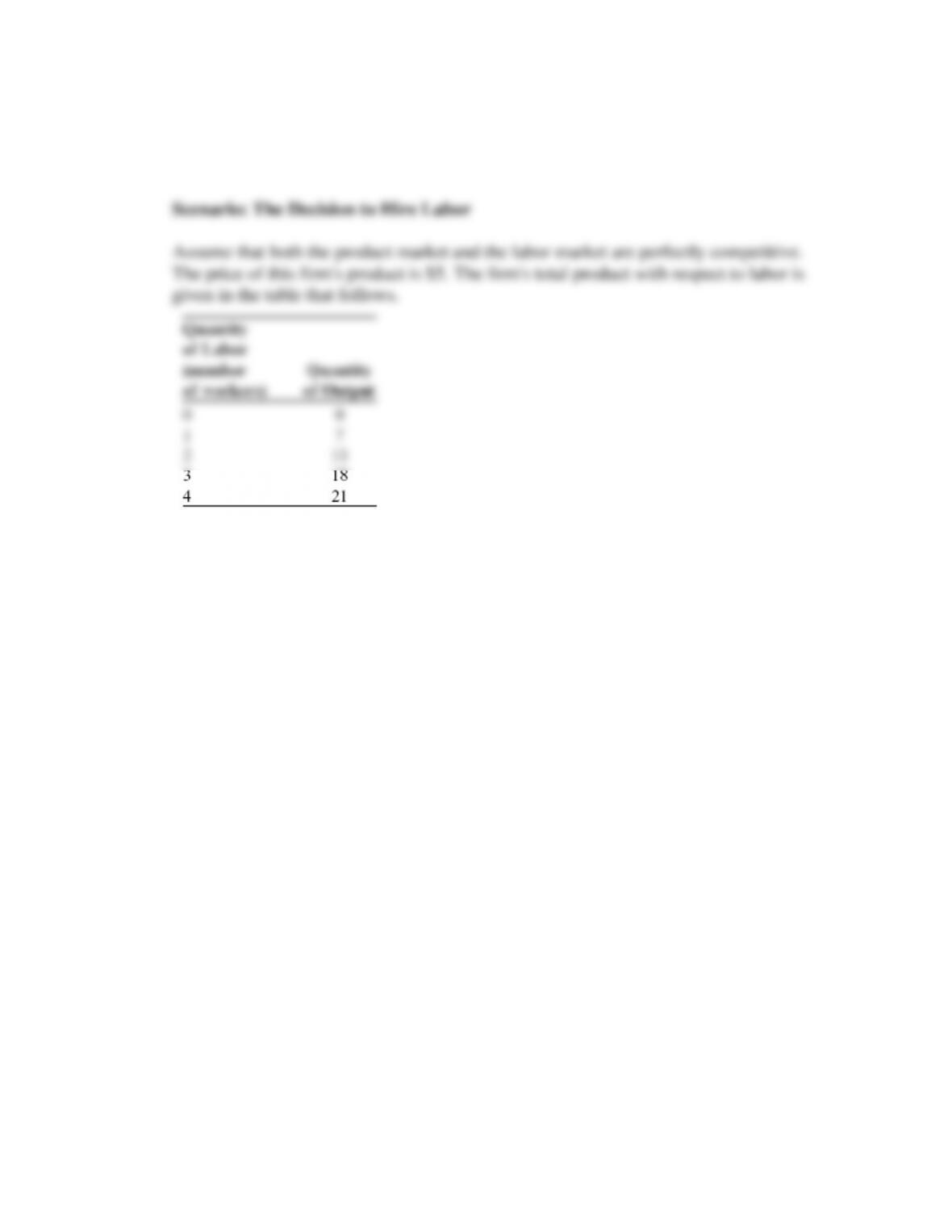
Scenario: The Decision to Hire Labor
Assume that both the product market and the labor market are perfectly competitive.
The price of this firm’s product is $5. The firm’s total product with respect to labor is
given in the table that follows.
A)
$30
B)
$5
C)
$13
D)
$6
Page 67
319.
(Scenario: The Decision to Hire Labor) Use Scenario: The Decision to Hire Labor. How
many workers will this perfectly competitive, profit-maximizing firm choose to hire if
the equilibrium wage is $30?
Scenario: The Decision to Hire Labor
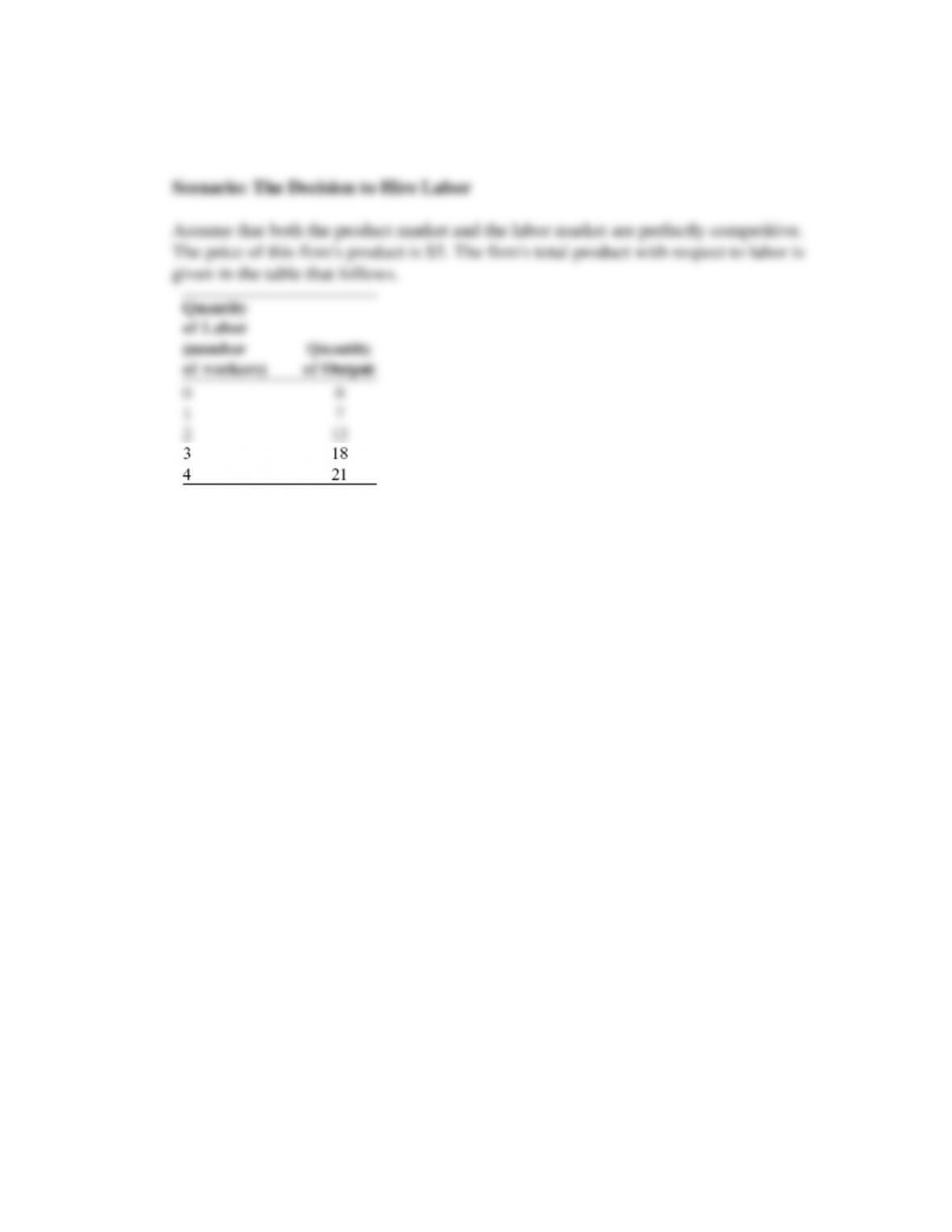
Assume that both the product market and the labor market are perfectly competitive.
The price of this firm’s product is $5. The firm’s total product with respect to labor is
given in the table that follows.
A)
1
B)
2
C)
3
D)
4
Page 68
320.
(Scenario: The Decision to Hire Labor) Use Scenario: The Decision to Hire Labor.
Holding everything else constant, if the demand for this firm’s product decreases:
Scenario: The Decision to Hire Labor
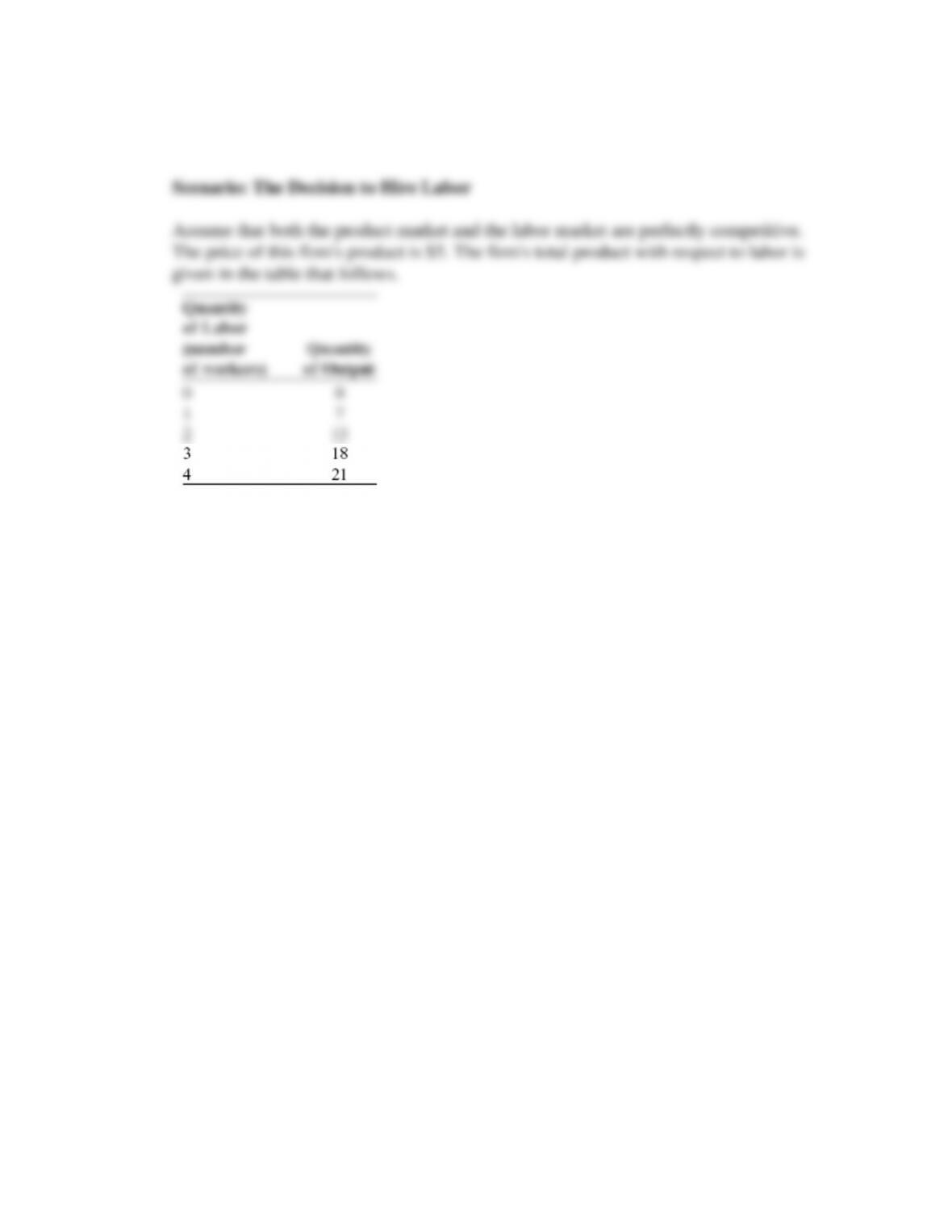
Assume that both the product market and the labor market are perfectly competitive.
The price of this firm’s product is $5. The firm’s total product with respect to labor is
given in the table that follows.
A)
its value of marginal product curve shifts to the right, and it will hire more workers.
B)
its value of marginal product curve shifts to the left, and it will hire more workers.
C)
its value of marginal product curve shifts to the left, and it will hire fewer workers.
D)
the firm will not change its hiring, since it is a perfectly competitive firm.
Page 69
321.
(Scenario: The Decision to Hire Labor) Use Scenario: The Decision to Hire Labor. This
firm experiences diminishing marginal product after it hires the _____ worker.
Scenario: The Decision to Hire Labor
Assume that both the product market and the labor market are perfectly competitive.
The price of this firm’s product is $5. The firm’s total product with respect to labor is
given in the table that follows.
A)
first
B)
second
C)
third
D)
fourth
322.
Large disparities in wages are often used as:
A)
evidence of the importance of profit maximization.
B)
a means to question the validity of the marginal productivity theory of income
distribution.
C)
evidence of diminishing returns.
D)
evidence to illustrate the absence of market failures in factor markets.
323.
People who have higher levels of human capital will tend to:
A)
work only in nonunion jobs.
B)
receive higher salaries than do those who have lower levels of human capital.
C)
earn salaries based on marginal costs of their labor.
324.
If a union is able to bargain for a wage that is higher than the equilibrium:
A)
all workers will earn a wage equal to their value of marginal product.
B)
some excess supply of labor or unemployment will generally result.
C)
compensating differentials will be erased.
D)
diminishing returns will not exist.
Page 70
325.
Time allocation refers to:
A)
how many hours an employer should hire a worker for.
B)
how many hours people choose to spend on different activities.
C)
how many hours unions will choose for their members to work.
D)
how different types of talents determine the wages people will earn.
326.
Leisure is considered a normal good since people:
A)
consume more of it all the time.
B)
cannot consume more, it being limited.
C)
consume more of it when their income rises.
D)
find it to be a luxury to take time off from their job.
327.
If a person’s marginal utility from an additional hour of leisure is less than the marginal
utility gained from goods bought with the wages earned from an additional hour of
labor, then this person should:
A)
continue to work the hours he or she is working.
B)
work less since he or she is working more than the optimal number of hours.
C)
work more since he or she is working less than the optimal number of hours.
D)
quit work since he or she is not earning enough to satisfy his or her time allocation.
328.
A person’s optimal labor supply choice:
A)
is similar to a person’s optimal consumption rule, but with consumption and leisure
as the “goods” in question.
B)
is not useful in determining how many hours a person should work.
C)
reveals little about a person’s labor–leisure choices.
D)
results in people working too much for too little pay.
329.
Within the labor–leisure framework, when an individual’s income effect is stronger than
the substitution effect from a wage increase, it means they have a(n):
A)
inverted U-shaped labor supply curve.
B)
labor supply curve that is upward sloping but from the origin.
C)
downward-sloping labor supply curve in the wage range in question.
D)
upward-sloping labor supply curve in the wage range in question.
330.
When a person receives a wage increase, changes in his or her labor supply depend on:
A)
a substitution effect and an income effect.
B)
a substitution effect only.
C)
an income effect only.
D)
diminishing marginal product.

Answer Key

Page 72
45.
B
46.
C
47.
A
48.
D
49.
B
50.
C
51.
D
52.
B
53.
B
54.
A
55.
C
56.
C
57.
B
58.
B
59.
C
60.
B
61.
B
62.
C
63.
A
64.
A
65.
C
66.
C
67.
C
68.
A
69.
A
70.
D
71.
A
72.
B
73.
A
74.
B
75.
A
76.
B
77.
D
78.
D
79.
B
80.
A
81.
A
82.
A
83.
D
84.
D
85.
C
86.
B
87.
A
88.
B
89.
D
90.
D

Page 73
91.
B
92.
A
93.
C
94.
B
95.
A
96.
B
97.
C
98.
B
99.
C
100.
B
101.
C
102.
D
103.
C
104.
C
105.
C
106.
B
107.
B
108.
B
109.
C
110.
C
111.
D
112.
B
113.
A
114.
A
115.
C
116.
D
117.
C
118.
C
119.
A
120.
C
121.
D
122.
D
123.
A
124.
D
125.
A
126.
C
127.
B
128.
B
129.
B
130.
A
131.
B
132.
C
133.
D
134.
B
135.
B
136.
A

Page 74
137.
D
138.
B
139.
A
140.
D
141.
C
142.
C
143.
D
144.
C
145.
C
146.
B
147.
D
148.
B
149.
B
150.
D
151.
C
152.
B
153.
B
154.
B
155.
C
156.
B
157.
A
158.
D
159.
A
160.
A
161.
B
162.
B
163.
A
164.
A
165.
D
166.
B
167.
B
168.
C
169.
D
170.
B
171.
B
172.
A
173.
C
174.
B
175.
D
176.
B
177.
C
178.
A
179.
A
180.
B
181.
A
182.
B

Page 75
183.
C
184.
C
185.
B
186.
A
187.
C
188.
C
189.
A
190.
B
191.
C
192.
B
193.
A
194.
A
195.
A
196.
D
197.
A
198.
D
199.
A
200.
B
201.
A
202.
B
203.
B
204.
B
205.
A
206.
A
207.
B
208.
B
209.
B
210.
B
211.
A
212.
A
213.
B
214.
A
215.
B
216.
A
217.
B
218.
A
219.
B
220.
A
221.
B
222.
B
223.
A
224.
A
225.
B
226.
A
227.
B
228.
A

Page 76
229.
B
230.
A
231.
B
232.
B
233.
B
234.
A
235.
B
236.
B
237.
A
238.
B
239.
A
240.
B
241.
A
242.
A
243.
B
244.
B
245.
A
246.
A
247.
B
248.
A
249.
A
250.
A
251.
B
252.
A
253.
B
254.
A
255.
A
256.
B
257.
A
258.
B
259.
A
260.
B
261.
A
262.
A
263.
B
264.
B
265.
B
266.
A
267.
A
268.
B
269.
A
270.
A
271.
B
272.
B
273.
A
274.
B

Page 77
275.
A
276.
B
277.
A
278.
B
279.
B
280.
A
281.
B
282.
B
283.
B
284.
B
285.
B
286.
B
287.
A
288.
B
289.
A
290.
291.
292.
293.
294.
295.
296.
297.
298.
299.
300.
A
301.
A
302.
A
303.
A
304.
B
305.
B
306.
A
307.
B
308.
C
309.
B
310.
A
311.
B
312.
A
313.
A
314.
A
315.
B
316.
B
317.
C
318.
A
319.
B
320.
C

Page 78
321.
A
322.
B
323.
B
324.
B
325.
B
326.
C
327.
C
328.
A
329.
C
330.
A