Page 1
Name: __________________________ Date: _____________
1.
Louis has invested $1,000 in the stock market. At the end of one year, there is a 30%
chance that his stock will be worth only $800 and a 70% chance that it will be worth
$1,200. The expected value of his stock at the end of one year is:
A)
$1,000.
B)
$1,080.
C)
$1,200.
D)
$1,160.
2.
Domingo has a total wealth of $500,000 composed of a house worth $100,000 and
$400,000 in cash. He keeps the cash in a safe deposit box, so that it is completely safe.
However, there is a 10% chance that his house will burn down by the end of the year
and be worth nothing and a 90% chance that nothing will happen to it. Without
insurance, the expected value of his end-of-year wealth is:
A)
$410,000.
B)
$450,000.
C)
$490,000.
D)
$485,000.
3.
Micah is considering turning pro before his senior year basketball season. If he turns
pro, Micah expects a pro contract worth $2 million in present value. If he does not turn
pro, there is a 50% chance an injury will prevent him from playing professionally and a
50% chance he will get a pro contract worth $4 million in present value. What is the
expected present value of Micah’s pro contract if he stays in college for his senior year?
A)
$3.5 million
B)
$5 million
C)
$2 million
D)
$0
4.
Amanda recently graduated from college, and she has a job offer with uncertain income:
there is a 70% probability that she will make $10,000 and a 30% probability that she
will make $70,000. The expected value of Amanda’s income is:
A)
$40,000.
B)
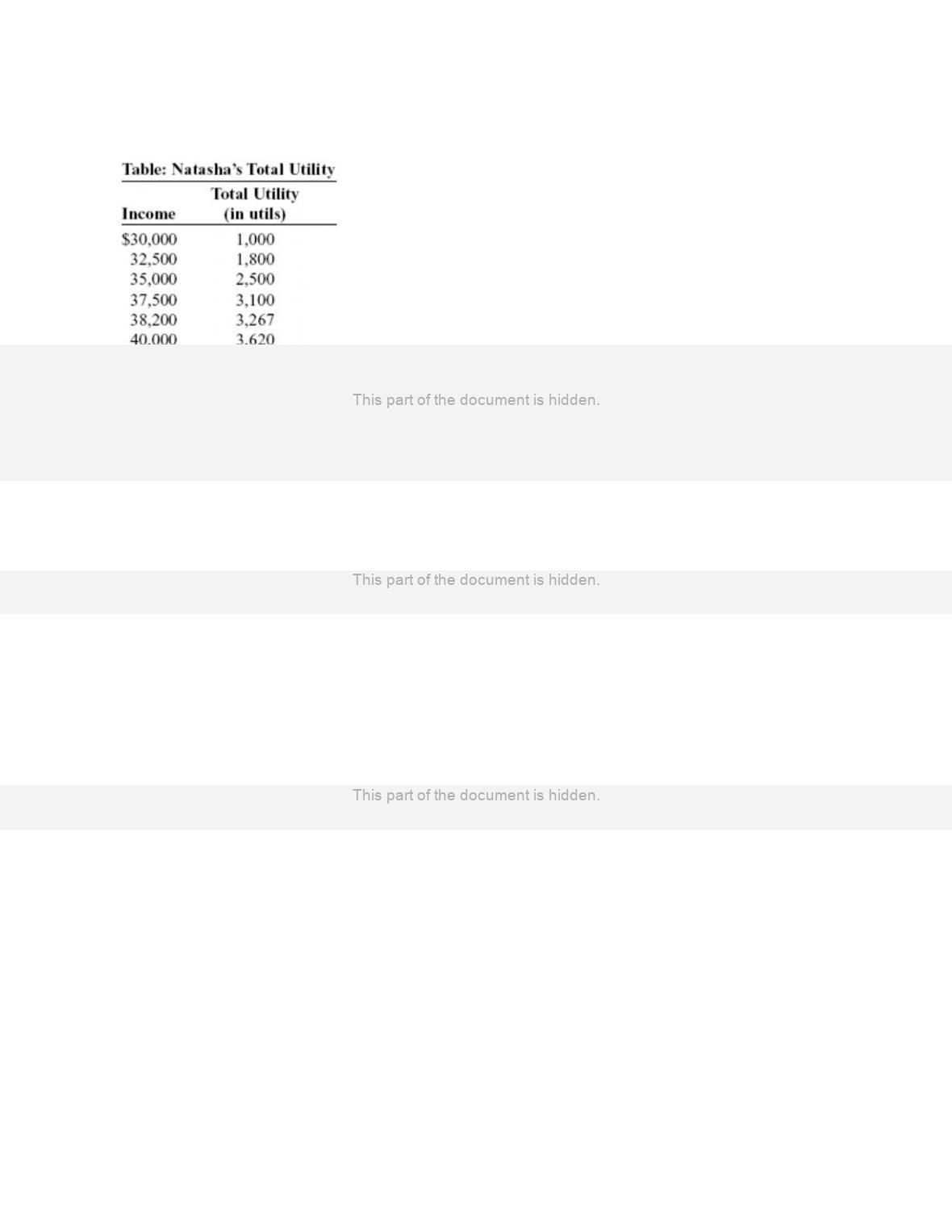
$21,000.
C)
$28,000.
D)
$10,000.
Page 2
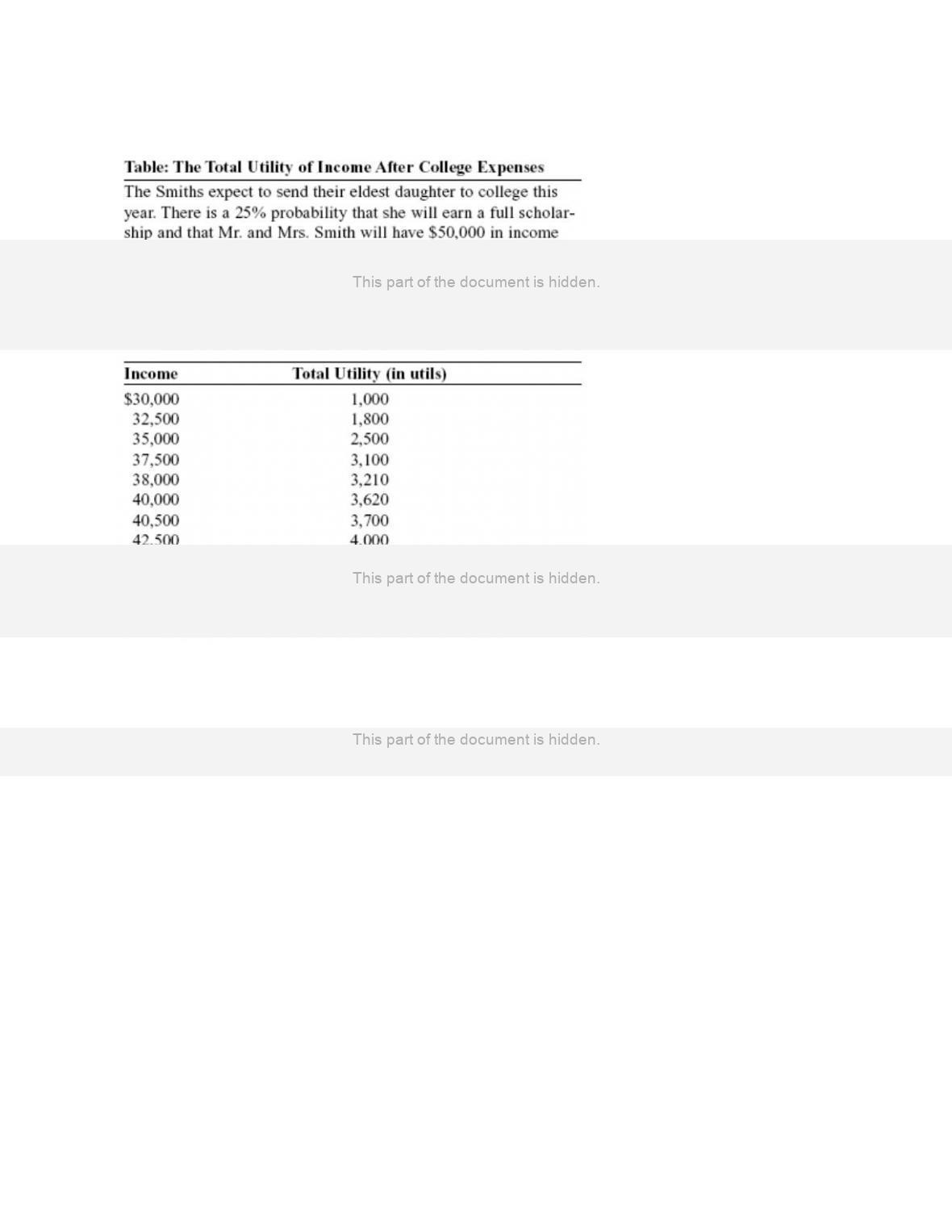
5.
A random variable:
A)
has an uncertain future value.
B)
has a constant value.
C)
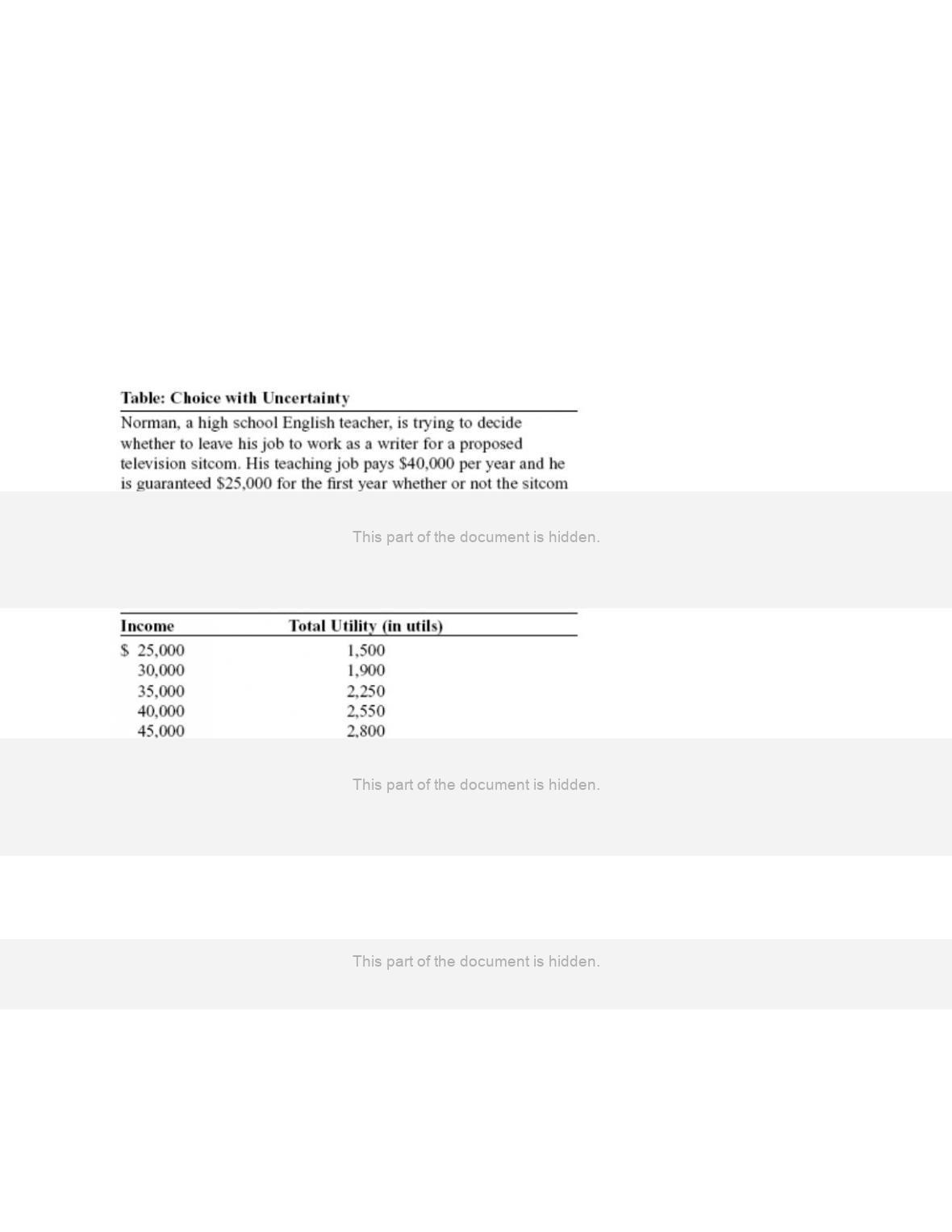
doesn’t exist in economics.
D)
is useless in economic decision making.
6.
The expected value of a random variable is:
A)
the most frequently occurring value of that variable.
B)
the most recent value of that variable.
C)
the weighted average of all possible values, where the weights on each possible
value correspond to the probability of that value occurring.
D)
impossible to determine.
7.
If there is a 25% probability that Joseph will earn $10 per hour at his job today and a
75% probability that he will earn $20 per hour today, his expected pay per hour is:
A)
$10.00.
B)
$15.00.
C)
$17.50.
D)
$20.00.
8.
If there is a 50% probability that Joseph will earn $10 per hour at his job today and a
50% probability that he will earn $20 per hour today, his expected pay per hour is:
A)
$10.00.
B)
$12.50.
C)
$15.00.
D)
$20.00.
9.
If a stock analyst believes there is a 25% probability that the stock price of Dymonatis
will be $30 at the end of the year, a 50% probability that it will be $40, and a 25%
probability that it will be $50, then the expected value of the stock at the end of the year
is:
A)
$30.
B)
$35.
C)
$40.
D)
$50.

Page 3
10.
If a stock analyst believes there is a 10% probability that the stock price of Dymonatis
will be $30 at the end of the year, a 50% probability that it will be $40, and a 40%
probability that it will be $50, then the expected value of the stock at the end of the year
is:
A)
$32.
B)
$38.
C)
$40.
D)
$43.
11.
Uncertainty about monetary outcomes is known as:
A)
financial risk.
B)
monetary risk.
C)
profitability risk.
D)
risk aversion.
12.
A friend of yours owes you $10, and he wants to flip a coin for double or nothing. If the
coin lands heads, he will pay you $20. If the coin lands tails up, he will pay you nothing.
As the coin is in midair, what is your expected value of this wager?
A)
$0
B)
$10
C)
$20
D)
$30
13.
You are about to have a meeting with your manager about a raise in your salary. You
are going to request an increase of $5,000, but you believe the probability of success to
be only 25%. You believe there is a 25% probability your boss will counter with a
$3,000 raise and a 25% probability that your boss will offer a $1,000 raise. Finally,
there is a 25% probability that you will receive no increase in your salary. What is the
expected value of the outcome of your meeting?
A)
$2,250
B)
$9,000
C)
$6,750
D)
$3,000
14.
Darnell pays $7,300 per year to an insurance company in return for its promise to pay
part of his family’s medical bills. The $7,300 is Darnell’s:
A)
risk.
B)
marginal utility.
C)
expected utility.
D)
premium.
Page 4
15.
A fair insurance policy is one whose premium is _____ the expected value of the claims.
A)
equal to
B)
greater than
C)
less than
D)
unrelated to
16.
Suppose that an individual is risk-averse. If this individual’s utility function is depicted
in a graph, with income measured on the horizontal axis and utils on the vertical axis,
the graph will be an upward-sloping:
A)
straight line through the origin.
B)
straight line with a positive vertical intercept.
C)
curve with a steadily increasing slope (i.e., a curve that is convex from below).
D)
curve with a steadily decreasing slope (i.e., a curve that is concave from below).
17.
Amanda recently graduated from college, and she has a job offer with uncertain income.
There is a 70% probability that she will make $10,000 and a 30% probability that she
will make $70,000. Suppose Amanda is offered another job with a certain income. All
else equal, if she has a constant marginal utility of income, she will accept the second
job offer only if it pays more than:
A)
$40,000.
B)
$28,000.
C)
$10,000.
D)
$21,000.
18.
Domingo has total wealth of $500,000 composed of a house worth $100,000 and
$400,000 in cash. He keeps the cash in a safe deposit box, so that it is completely safe.
However, there is a 10% chance that his house will burn down and be worth nothing and
a 90% chance that nothing will happen to it. Domingo buys insurance guaranteeing that
his house will be restored to its original condition should anything happen to it. The
insurance premium is $2,000. Consequently (assuming other things remain unchanged),
his future:
A)
expected wealth is $480,000.
B)
wealth is $500,000 for sure.
C)
expected wealth is $490,000.
D)
wealth is $498,000 for sure.

Page 5
19.
The Conduire family owns three cars and is considering buying insurance to cover the
cost of repairs. They face two possible states: state 1, in which their cars need no repairs
and their income available for purchasing other goods and services is equal to $50,000;
and state 2, in which their cars need $10,000 worth of repairs and their income available
for purchasing other goods and services is reduced to $40,000. The probability of
occurrence is 0.5 for each state. They can buy insurance that will cover the full cost of
repairs for $5,000. If the Conduires are risk-averse and maximize their expected utility,
they will:
A)
buy the insurance.
B)
be indifferent between buying and not buying the insurance since their expected
income for purchasing other goods and services is $45,000 regardless of what they
do.
C)
not buy the insurance since buying it does not increase their expected income for
purchasing other goods and services.
D)
put $10,000 in savings to pay for any required repairs and not buy insurance.
20.
The total utility of income curve for a risk-averse individual will be _____ with income.
A)
decreasing
B)
increasing at an increasing rate
C)
increasing at a constant rate
D)
increasing at a decreasing rate
21.
Individuals differ in risk aversion because of:
A)
adverse selection.
B)
moral hazard.
C)
differences in income or wealth.
D)
differences in their insurance.
22.
If an individual is risk-averse, then his or her total utility function must display _____
marginal utility.
A)
constant
B)
diminishing
C)
increasing
D)
either constant or diminishing, but not increasing,
23.
The marginal utility of income for a risk-averse individual will be:
A)
constant.
B)
diminishing.
C)
increasing.
D)
unknown; the answer depends on the value of income.
Page 6
24.
For most families, total utility does NOT:
A)
rise as income rises.
B)
rise less quickly as income rises.
C)
show increasing marginal utility.
D)
show diminishing marginal utility.
25.
For MOST families, the marginal utility of income is:
A)
increasing.
B)
constant.
C)
diminishing.
D)
unknown; the answer depends on the value of income.
26.
A fair insurance policy is one whose premium:
A)
is zero.
B)
allows the insurance company to profit.
C)
equals the expected value of the claims.
D)
is higher as the probability of a claim decreases.
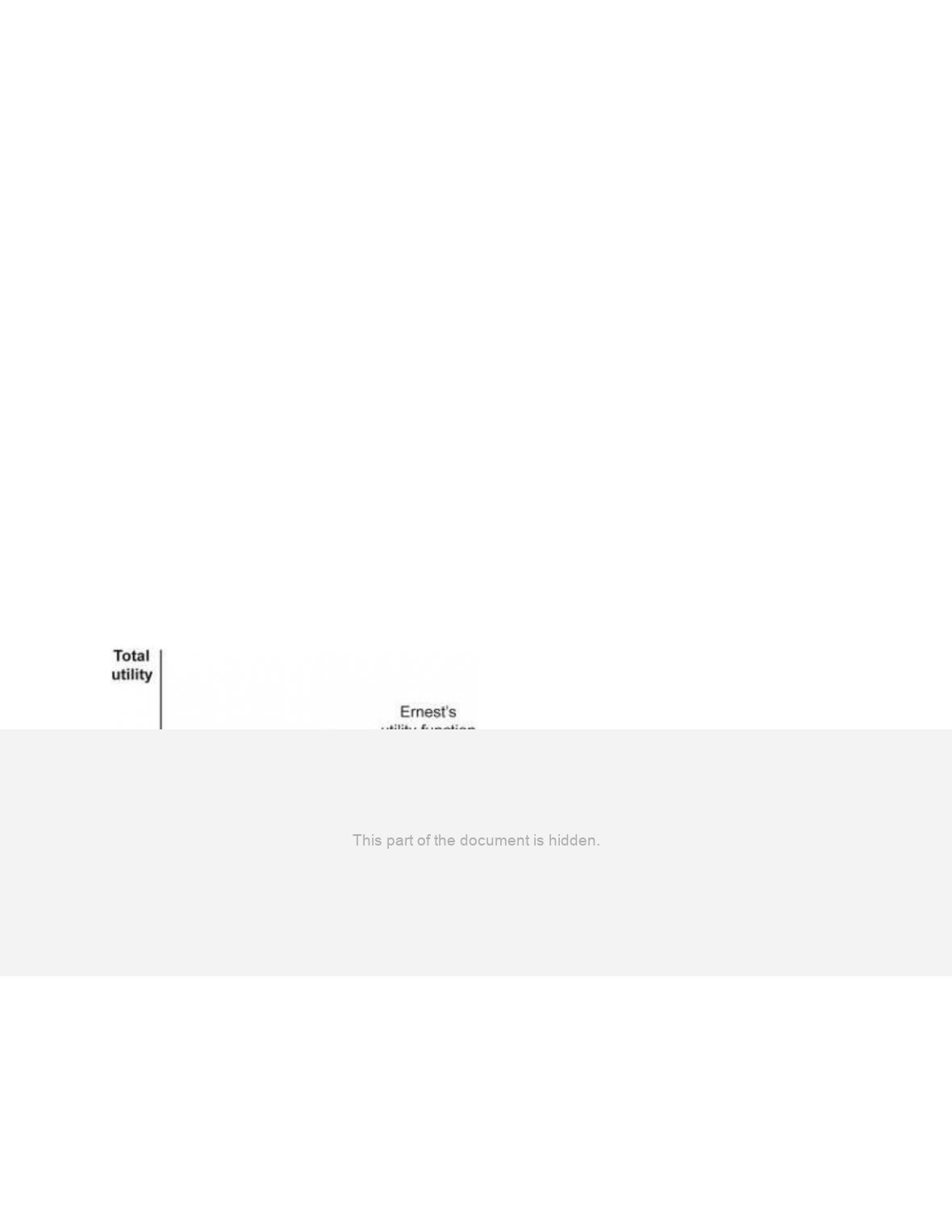
Use the following to answer questions 27-28:
Figure: Differences in Risk Aversion

Page 7
27.
(Figure: Differences in Risk Aversion) Use Figure: Differences in Risk Aversion.
Which statement is CORRECT?
A)
Ernest will gain more utility from insurance than will Salvatore.
B)
Salvatore will gain less utility from an increase in income than will Ernest but will
lose more utility than will Ernest from a fall in income.
C)
Ernest is more risk-averse than Salvatore.
D)
If either Ernest or Salvatore buys insurance, adverse selection will occur.
28.
(Figure: Differences in Risk Aversion) Use Figure: Differences in Risk Aversion. An
important reason that Ernest and Salvatore may differ in their aversion to risk is:
A)
the way their marginal utility is affected by income.
B)
their understanding of risk.
C)
their initial wealth holding or initial income level.
D)
the way their marginal utility is affected by income and their initial wealth holding
or initial income level.
29.
A person who is willing to pay an insurance premium to lessen financial risk is said to
be:
A)
a moral hazard.
B)
risk-loving.
C)
risk-averse.
D)
risk-neutral.
30.
Bikul has just started a great job and plans to buy a fancy car worth $100,000. Bikul is
risk-averse in money matters, but he likes to drive fast, so the probability that he wrecks
the car (a total loss of $100,000) is 0.10. The probability that he has no accidents is 0.90.
If an insurance company offers Bikul a fair insurance policy, the premium will be:
A)
$10,000.
B)
$90,000.
C)
$80,000.
D)
It is impossible to calculate a premium unless we know Bikul’s utility function.
31.
The premium for a(n) _____ insurance policy is equal to the expected value of the
claim.
A)
fair
B)
premium
C)
unfair
D)
diversification
Page 8
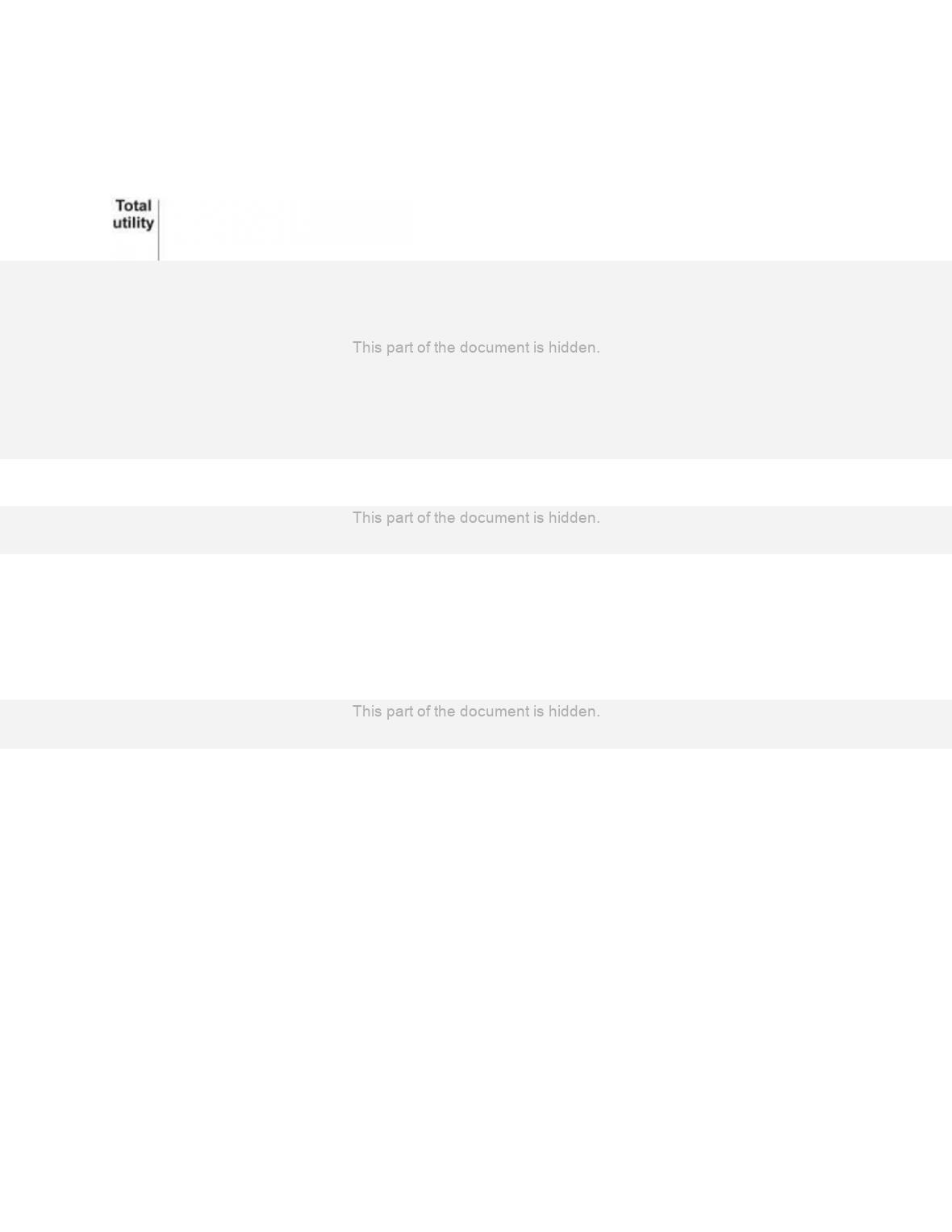
Use the following to answer questions 32-33:
Figure: Risk Aversion
32.
(Figure: Risk Aversion) Use Figure: Risk Aversion. Bob and Nancy have the same
income and the same total utility. Nancy is _____ risk-averse than is Bob because her
marginal utility curve is _____ than Bob’s.
A)
more; flatter
B)
more; steeper
C)
less; flatter
D)
less; steeper
33.
(Figure: Risk Aversion) Use Figure: Risk Aversion. Bob and Nancy have the same
income and total utility. Nancy will be willing to pay a _____ insurance premium than is
Bob because she is _____ risk-averse.
A)
higher; more
B)
lower; more
C)
lower; less
D)
higher; less
Page 9
Use the following to answer questions 34-35:
34.
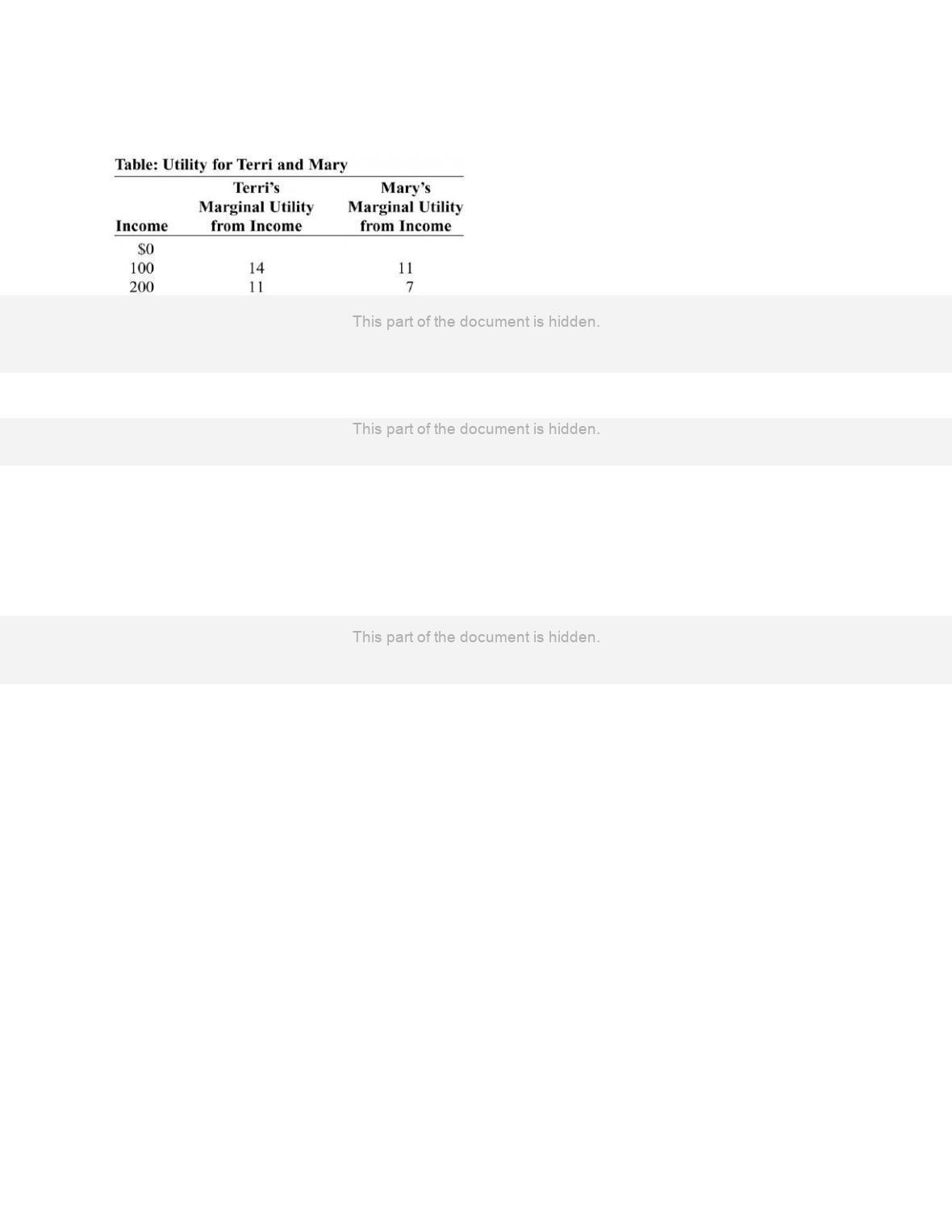
(Table: Utility for Terri and Mary) Use Table: Utility for Terri and Mary. Each has an
income of $300. _____ is more risk-averse because _____ has a _____ drop in total
utility if income were to fall by $100.
A)
Mary; Mary; larger
B)
Terri; Mary; larger
C)
Mary; Terri; smaller
D)
Terri; Terri; larger
35.
(Table: Utility for Terri and Mary) Use Table: Utility for Terri and Mary. Each has an
income of $300. If each were offered insurance to offset the risk of falling income,
_____ would pay a larger premium because she is the consumer with _____ risk
aversion.
A)
Terri; more
B)
Terri; less
C)
Mary; more
D)
Mary; less
36.
Risk-averse individuals are willing to pay a premium that is _____ their expected
claims.
A)
less than
B)
greater than or equal to
C)
equal to
D)
dependent on something other than
Page 10
37.
When faced with an insurance policy whose premium exceeds the expected value of the
claim:
A)
no one will buy it.
B)
only risk-tolerant individuals will buy it.
C)
risk-averse individuals will buy it as long as the utility associated with the
insurance is greater than the expected utility without the insurance.
D)
risk-averse individuals will buy it as long as the utility associated with the
insurance is less than the expected utility without the insurance.
38.
Which statement regarding a warranty is NOT true?
A)
It is a form of consumer insurance.
B)
Consumers may buy one, even if the cost of the warranty is greater than the
expected future claim paid by the manufacturer.
C)
It decreases the consumer’s expected utility from an item.
D)
It signals to consumers that the goods are of high quality.
Use the following to answer questions 39-41:
39.
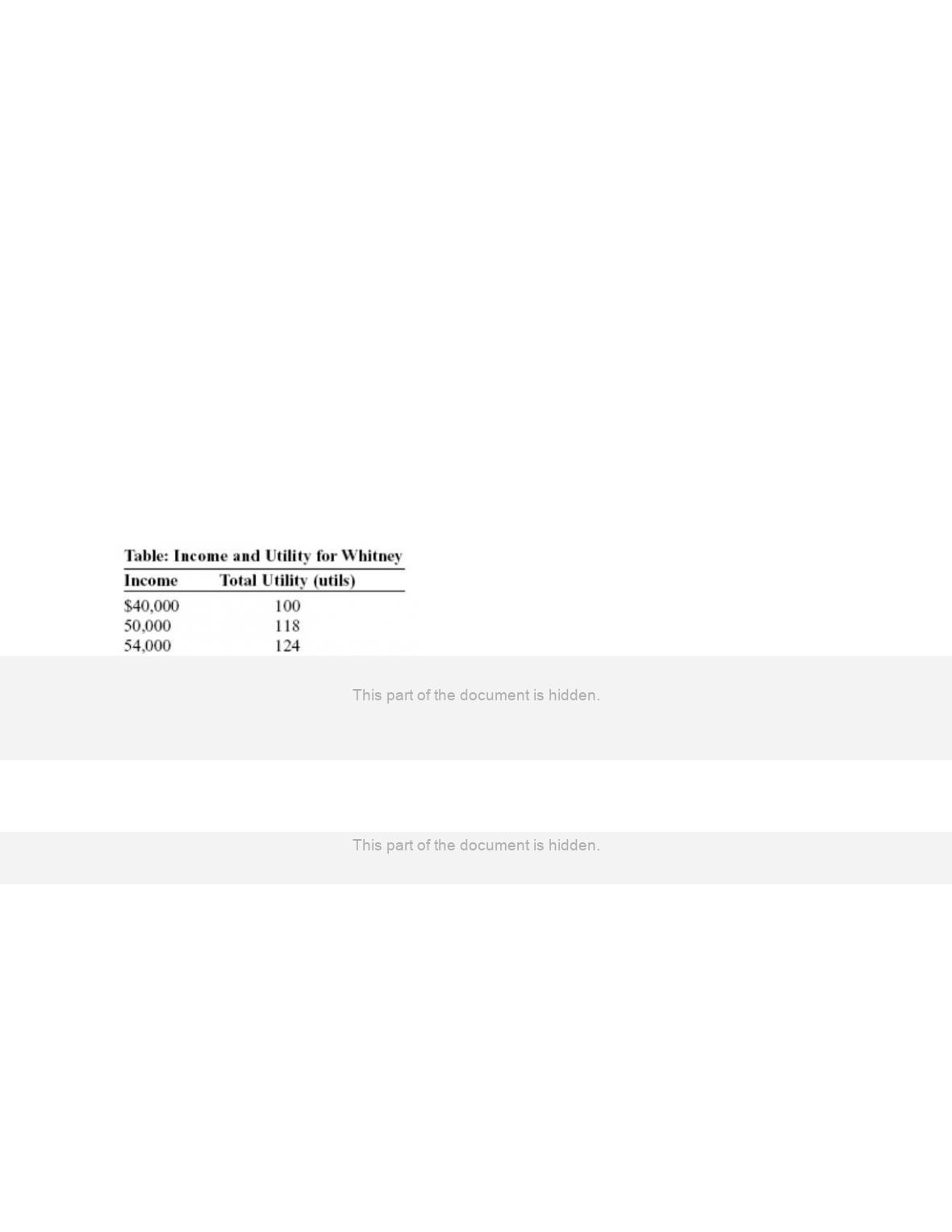
(Table: Income and Utility for Whitney) Use Table: Income and Utility for Whitney.
Whitney’s income next year is uncertain: there is a 40% probability she will make
$40,000 and a 60% probability she will make $80,000. What certain income leaves
Whitney as well off as her uncertain income?
A)
$64,000
B)
$60,000
C)
$54,000
D)
$50,000
Page 11
40.
(Table: Income and Utility for Whitney) Use Table: Income and Utility for Whitney.
Whitney’s income next year is uncertain: there is a 40% probability she will make
$40,000 and a 60% probability she will make $80,000. Whitney’s expected utility is
_____ utils.
A)
135
B)
124
C)
120
D)
130
41.
(Table: Income and Utility for Whitney) Use Table: Income and Utility for Whitney.
Whitney’s income next year is uncertain: there is a 40% probability she will make
$40,000 and a 60% probability she will make $80,000. The expected value of Whitney’s
income is:
A)
$64,000.
B)
$80,000.
C)
$40,000.
D)
$56,000.
Use the following to answer questions 42-43:
42.
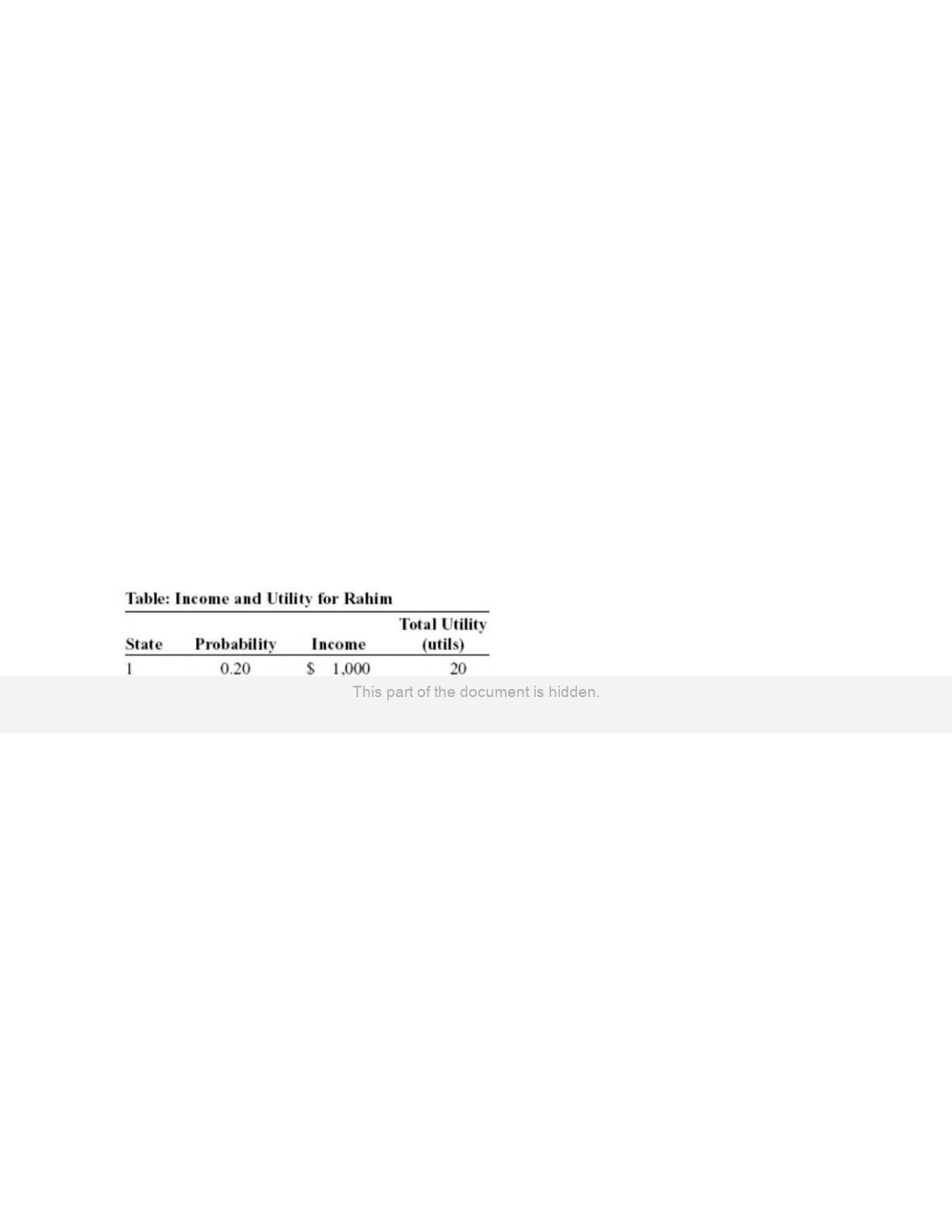
(Table: Income and Utility for Rahim) Use Table: Income and Utility for Rahim. The
expected value of Rahim’s income is:
A)
$221,000.
B)
$20,000.
C)
$110,000.
D)
$70,200.
43.
(Table: Income and Utility for Rahim) Use Table: Income and Utility for Rahim.
Rahim’s expected utility from income is _____ utils.
A)
3,500
B)
10,000
C)
3,104
D)
Utility cannot be determined from the information given.
Page 12
Use the following to answer questions 44-48:
44.
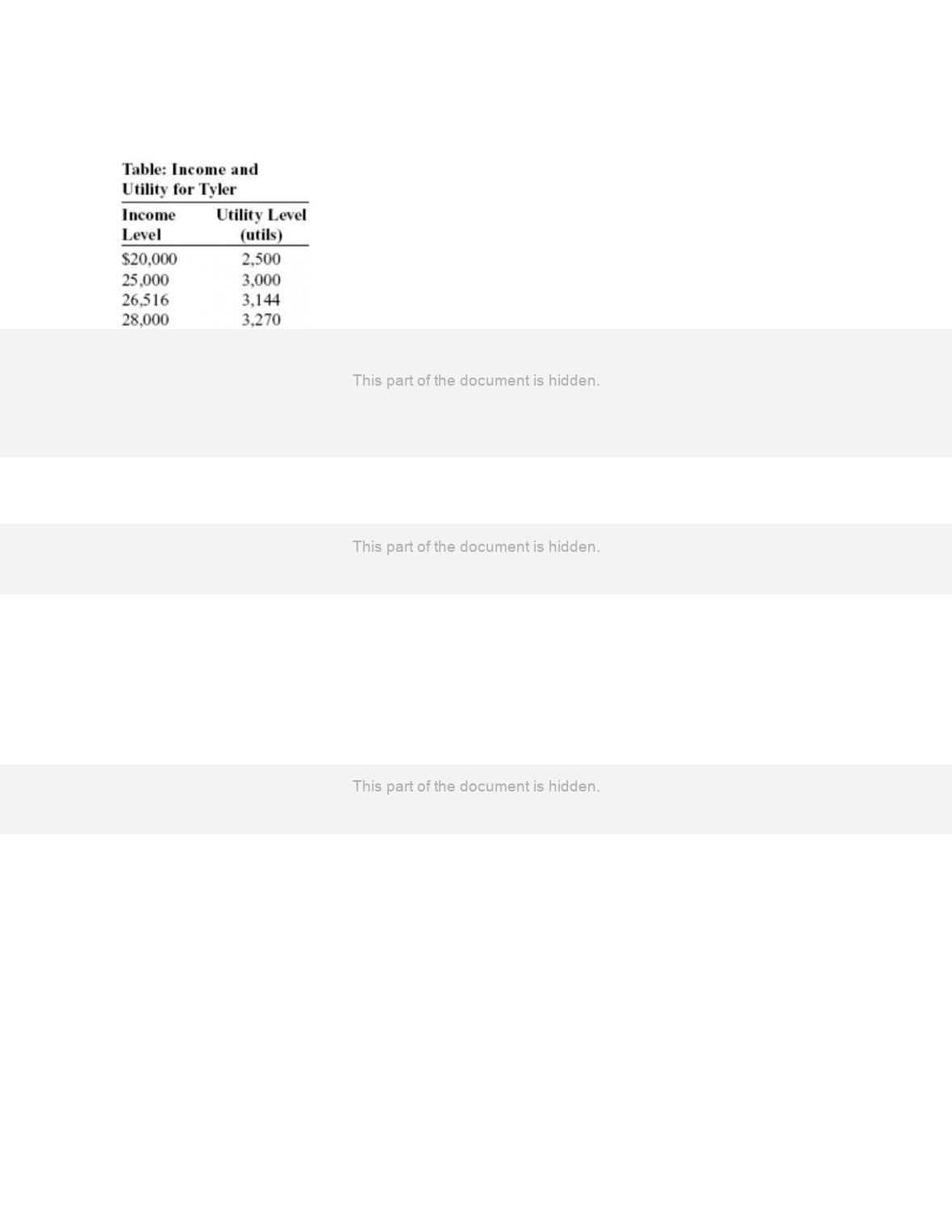
(Table: Income and Utility for Tyler) Use Table: Income and Utility for Tyler. The table
shows the utility Tyler receives at various income levels, but she does not know what
her income will be next year. There is a 40% chance her income will be $20,000, a 40%
chance her income will be $30,000, and a 20% chance her income will be $40,000. We
know that Tyler is risk-averse because:
A)
she would prefer $40,000, but there is a risk she will make only $20,000.
B)
her expected income is less than what she may actually earn.
C)
her expected income is more than what she may actually earn.
D)
she is subject to diminishing marginal utility from income.
45.
(Table: Income and Utility for Tyler) Use Table: Income and Utility for Tyler. The table
shows the utility Tyler receives at various income levels, but she does not know what
her income will be next year. There is a 40% chance her income will be $20,000, a 40%
chance her income will be $30,000, and a 20% chance her income will be $40,000.
What is her expected income?
A)
$28,000
B)
$29,000
C)
$30,000
D)
$31,000
46.
(Table: Income and Utility for Tyler) Use Table: Income and Utility for Tyler. The table
shows the utility Tyler receives at various income levels, but she does not know what
her income will be next year. There is a 40% chance her income will be $20,000, a 40%
chance her income will be $30,000, and a 20% chance her income will be $40,000.
What is her expected utility in utils?
A)
3,270
B)
3,144
C)
3,420
D)
3,480
47.
(Table: Income and Utility for Tyler) Use Table: Income and Utility for Tyler. The table
shows the utility Tyler receives at various income levels, but she does not know what
her income will be next year. There is a 40% chance her income will be $20,000, a 40%
chance her income will be $30,000, and a 20% chance her income will be $40,000.
What level of certain income matches her expected utility, given the uncertainty?
A)
$28,000
B)
$25,000
C)
$26,516
D)
$29,000
48.
(Table: Income and Utility for Tyler) Use Table: Income and Utility for Tyler. The table
shows the utility Tyler receives at various income levels, but she does not know what
her income will be next year. There is a 40% chance her income will be $20,000, a 40%
chance her income will be $30,000, and a 20% chance her income will be $40,000.
What is the maximum amount of insurance Tyler would be willing to pay to guarantee
an income of $28,000?
A)
$0
B)
$1,484
C)
$26,516
D)
$126
Page 14
Use the following to answer questions 49-54:
49.
(Table: Natasha’s Total Utility) Use Table: Natasha’s Total Utility. Natasha’s marginal
utility _____ as her income increases. The marginal utility of income between $30,000
and $32,500 is _____ utils per dollar, while it is _____ utils per dollar between $47,500
and $50,000.
A)
increases; 0.48; 0.64
B)
increases; 0.12; 0.36
C)
diminishes; 0.50; 0.25
D)
diminishes; 0.32; 0.04
50.
(Table: Natasha’s Total Utility) Use Table: Natasha’s Total Utility. Natasha earns
$50,000 per year but faces losing $20,000 of it if she is late with her work. If there is a
25% probability that Natasha will be late with her work and her income will then equal
$30,000, her expected income is:
A)
$32,500.
B)
$38,200.
C)
$40,500.
D)
$45,000.
Page 15
51.
(Table: Natasha’s Total Utility) Use Table: Natasha’s Total Utility. Natasha earns
$50,000 per year but faces losing $20,000 of it if she is late with her work. If there is a
25% probability that Natasha will be late with her work and her income will then equal
$30,000, her expected total utility is _____ utils.
A)
4,175
B)
3,700
C)
3,620
D)
3,259
52.
(Table: Natasha’s Total Utility) Use Table: Natasha’s Total Utility. Natasha earns
$50,000 per year but faces losing $20,000 of it if she is late with her work. If there is a
25% probability that Natasha will be late with her work and her income will equal
$30,000, what certain income leaves Natasha just as well off as her uncertain income?
A)
$37,500
B)
$38,200
C)
$40,500
D)
$42,500
53.
(Table: Natasha’s Total Utility) Use Table: Natasha’s Total Utility. Natasha earns
$50,000 per year but faces losing $20,000 of it if she is late with her work. If there is a
25% probability that Natasha will be late with her work and her income will equal
$30,000, To guarantee an income of $50,000, Natasha would be willing to pay _____
for insurance.
A)
$4,000
B)
$5,000
C)
$7,500
D)
$9,500
54.
(Table: Natasha’s Total Utility) Use Table: Natasha’s Total Utility. Natasha earns
$50,000 per year but faces losing $20,000 of it if she is late with her work. If there is a
25% probability that Natasha will be late with her work and her income will equal
$30,000, the premium for a fair insurance policy to eliminate the uncertainty in her
income would equal:
A)
$4,000.
B)
$5,000.
C)
$7,500.
D)
$9,500.
Page 16
Use the following to answer questions 55-61:
55.
(Table: The Total Utility of Income After College Expenses) Use Table: The Total
Utility of Income After College Expenses. The Smith family has _____ marginal utility
as income increases. The marginal utility of income between $32,500 and $35,000 is
_____ utils per dollar, while it is _____ utils per dollar between $45,000 and $47,500.
A)
increasing; 0.48; 0.64
B)
increasing; 0.12; 0.36
C)
diminishing; 0.28; 0.08
D)
diminishing; 0.40; 0.10
56.
(Table: The Total Utility of Income After College Expenses) Use Table: The Total
Utility of Income After College Expenses. The Smith family’s expected income after
tuition is:
A)
$32,500.
B)
$38,000.
C)
$40,000.
D)
$45,000.
Page 17
57.
(Table: The Total Utility of Income After College Expenses) Use Table: The Total
Utility of Income After College Expenses. The Smith family’s expected total utility is
_____ utils.
A)
4,175
B)
3,700
C)
3,620
D)
3,210
58.
(Table: The Total Utility of Income After College Expenses) Use Table: The Total
Utility of Income After College Expenses. What certain income after tuition leaves Mr.
and Mrs. Smith just as well off as their uncertain income after tuition?
A)
$37,500
B)
$38,000
C)
$40,500
D)
$42,500
59.
(Table: The Total Utility of Income After College Expenses) Use Table: The Total
Utility of Income After College Expenses. Mr. and Mrs. Smith would be willing to pay
as much as _____ for insurance to pay their daughter’s tuition and eliminate the
uncertainty in the family’s income after tuition.
A)
$12,000
B)
$10,000
C)
$8,000
D)
$5,000
60.
(Table: The Total Utility of Income After College Expenses) Use Table: The Total
Utility of Income After College Expenses. The premium for a fair insurance policy to
pay their daughter’s tuition and eliminate the uncertainty in the Smith family’s income
after tuition would equal:
A)
$12,000.
B)
$10,000.
C)
$8,000.
D)
$5,000.
Page 18
61.
(Table: The Total Utility of Income After College Expenses) Use Table: The Total
Utility of Income After College Expenses. The Smith family will choose to purchase
insurance:
A)
at any premium.
B)
at a premium for which the reduction in risk leaves the expected value of their
income after tuition the same.
C)
up to but not exceeding the point at which the premium is that of a fair insurance
policy.
D)
at a premium for which the reduction in risk is that of a fair insurance policy.
Use the following to answer questions 62-70:
62.
(Table: Choice with Uncertainty) Use Table: Choice with Uncertainty. Suppose that the
probability that the sitcom does not make it to television is 50%, that it makes it to
television but is not the most viewed show in its time slot is 30%, and that it makes it to
television and is the most viewed show in its time slot is 20%. Given this information,
Norman’s expected income is:
A)
$52,500.
B)
$47,500.
C)
$40,000.
D)
$37,500.
Page 19
63.
(Table: Choice with Uncertainty) Use Table: Choice with Uncertainty. Suppose that the
probability that the sitcom does not make it to television is 50%, that it makes it to
television but is not the most viewed show in its time slot is 30%, and that it makes it to
television and is the most viewed show in its time slot is 20%. Given this information,
Norman’s expected total utility is _____ utils.
A)
2,000
B)
2,150
C)
2,350
D)
2,650
64.
(Table: Choice with Uncertainty) Use Table: Choice with Uncertainty. Suppose that the
probability that the sitcom does not make it to television is 50%, that it makes it to
television but is not the most viewed show in its time slot is 30%, and that it makes it to
television and is the most viewed show in its time slot is 20%. Given this information,
Norman, as a utility maximizer:
A)
should keep his teaching job.
B)
should quit his teaching job and go to Hollywood.
C)
will be indifferent between leaving and staying because his expected income is the
same whether he stays a teacher or moves to Hollywood.
D)
will be indifferent between leaving and staying because his expected total utility is
the same whether he stays a teacher or moves to Hollywood.
65.
(Table: Choice with Uncertainty) Use Table: Choice with Uncertainty. Assume that the
probability that the sitcom does not make it to television is 60%, the probability that it
makes it to television but is not the most viewed show in its time slot is 30%, and the
probability that it makes it to television and is the most viewed show in its time slot is
10%. Norman’s expected income is:
A)
$52,500.
B)
$47,500.
C)
$40,000.
D)
$37,500.
66.
(Table: Choice with Uncertainty) Use Table: Choice with Uncertainty. Suppose that the
probability that the sitcom does not make it to television is 60%, the probability that it
makes it to television but is not the most viewed show in its time slot is 30%, and that
the probability that it makes it to television and is the most viewed show in its time slot
is 10%. Norman’s expected total utility is _____ utils.
A)
2,000
B)
2,150
C)
2,350
D)
2,650
Page 20
67.
(Table: Choice with Uncertainty) Use Table: Choice with Uncertainty. Suppose that the
probability that the sitcom does not make it to television is 60%, that it makes it to
television but is not the most viewed show in its time slot is 30%, and that it makes it to
television and is the most viewed show in its time slot is 10%. As a utility maximizer,
Norman:
A)
should keep his teaching job.
B)
should quit his teaching job and go to Hollywood.
C)
will be indifferent between leaving and staying because his expected income is the
same whether he stays a teacher or moves to Hollywood.
D)
will be indifferent between leaving and staying because his expected total utility is
the same whether he stays a teacher or moves to Hollywood.
68.
(Table: Choice with Uncertainty) Use Table: Choice with Uncertainty. Suppose that the
probability that the sitcom does not make it to television is 30%, that it makes it to
television but is not the most viewed show in its time slot is 50%, and that it makes it to
television and is the most viewed show in its time slot is 20%. Given this information,
Norman’s expected income is:
A)
$52,500.
B)
$47,500.
C)
$40,000.
D)
$37,500.
69.
(Table: Choice with Uncertainty) Use Table: Choice with Uncertainty. Suppose that the
probability that the sitcom does not make it to television is 30%, that it makes it to
television but is not the most viewed show in its time slot is 50%, and that it makes it to
television and is the most viewed show in its time slot is 20%. Given this information,
Norman’s expected total utility is _____ utils.
A)
2,000
B)
2,150
C)
2,350
D)
2,650