Archives: Quiz
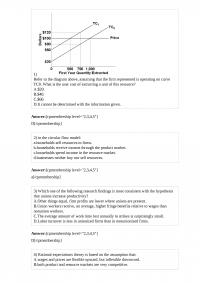
ECON E 748 Quiz 1
1) Refer to the diagram above, assuming that the firm represented is operating on curve TC0. What is the user cost of extracting a unit of this resource? A.$20. B.$40. C.$60. D.It cannot be determined with the information given. 2) […]
Economics 865 Midterm
1) To determine the velocity of money you would need to know: A.nominal GDP and real GDP. B.the money supply and the price level. C.nominal GDP and the money supply. D.nominal GDP and the interest rate. 2) since 1996, cash […]
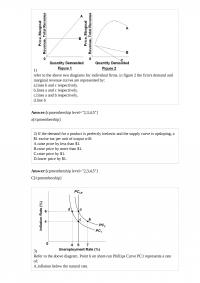
ECON A 213 Test
1) refer to the above two diagrams for individual firms. in figure 2 the firm’s demand and marginal revenue curves are represented by: a.lines b and c respectively. b.lines a and c respectively. c.lines a and b respectively. d.line b […]
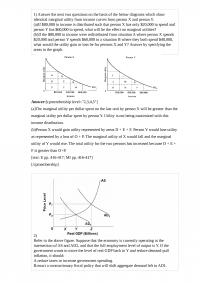
ECON E 539 Quiz 3
1) Answer the next two questions on the basis of the below diagrams which show identical marginal utility from income curves from person X and person Y. (a)If $80,000 in income is distributed such that person X has only $20,000 […]
ECON 783 Homework
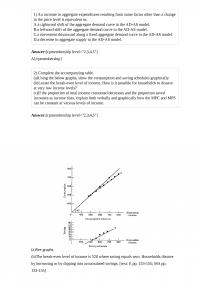
1) An increase in aggregate expenditures resulting from some factor other than a change in the price level is equivalent to: A.a rightward shift of the aggregate demand curve in the AD-AS model. B.a leftward shift of the aggregate demand […]
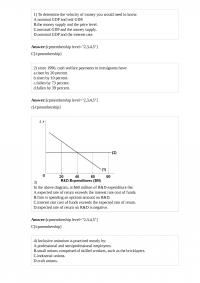
BUS 732 Quiz 1
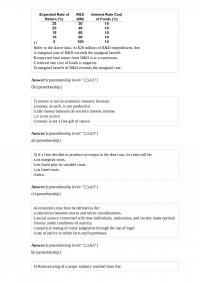
1) Refer to the above data. At $20 million of R&D expenditures, the: A.marginal cost of R&D exceeds the marginal benefit. B.expected total return from R&D is at a maximum. C.interest rate cost of funds is negative. D.marginal benefit of […]
ECON A 460 Test 1 1
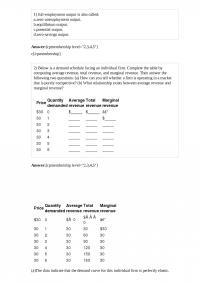
1) full-employment output is also called: a.zero-unemployment output. b.equilibrium output. c.potential output. d.zero-savings output. 2) Below is a demand schedule facing an individual firm. Complete the table by computing average revenue, total revenue, and marginal revenue. Then answer the following […]
ECB 283 Midterm 2
1) The wide imitation and spread of an innovation is called: A.innovation. B.invention. C.creative destruction. D.diffusion. 2) the presence of market failures implies that: a.money is not an effective tool for exchange in a market system. b.there is an active […]
ECON A 581
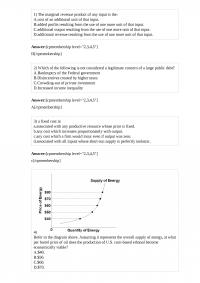
1) The marginal revenue product of any input is the: A.cost of an additional unit of that input. B.added profits resulting from the use of one more unit of that input. C.additional output resulting from the use of one more […]
ECON A 576
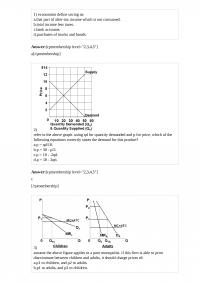
1) economists define saving as: a.that part of after-tax income which is not consumed. b.total income less taxes. c.bank accounts. d.purchases of stocks and bonds. 2) refer to the above graph. using qd for quantity demanded and p for price, […]
ECON E 458 Homework
1) The equilibrium interest rate: A.affects both the size of total output and its composition. B.falls when the demand for loanable funds increases. C.determines the composition of R&D spending but not its total amount. D.increases when the expected rate of […]
ECON E 616 Test
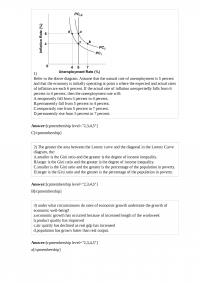
1) Refer to the above diagram. Assume that the natural rate of unemployment is 5 percent and that the economy is initially operating at point a where the expected and actual rates of inflation are each 6 percent. If the […]
ECON 106
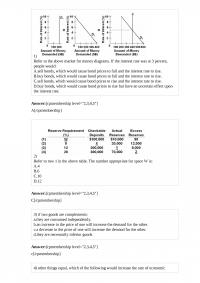
1) Refer to the above market for money diagrams. If the interest rate was at 3 percent, people would: A.sell bonds, which would cause bond prices to fall and the interest rate to rise. B.buy bonds, which would cause bond […]
ECON A 151 Midterm 1
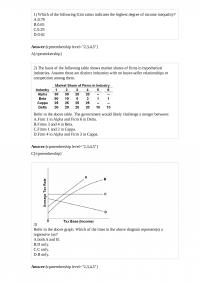
1) Which of the following Gini ratios indicates the highest degree of income inequality? A.0.78 B.0.65 C.0.29 D.0.42 2) The basis of the following table shows market shares of firms in hypothetical industries. Assume these are distinct industries with no […]
ECON A 167 Quiz 3
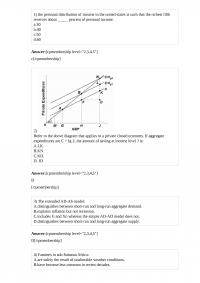
1) the personal distribution of income in the united states is such that the richest fifth receives about _____ percent of personal income. a.30 b.40 c.50 d.60 2) Refer to the above diagram that applies to a private closed economy. […]
ECON 344 Quiz 1
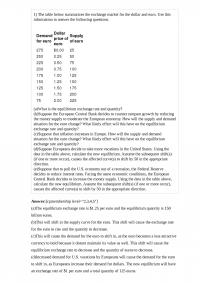
1) The table below summarizes the exchange market for the dollar and euro. Use this information to answer the following questions. (a)What is the equilibrium exchange rate and quantity? (b)Suppose the European Central Bank decides to counter rampant growth by […]
ECB 604 Test
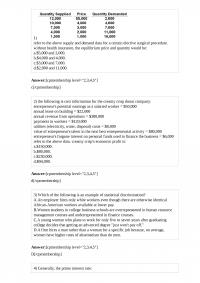
1) refer to the above supply and demand data for a certain elective surgical procedure. without health insurance, the equilibrium price and quantity would be: a.$5,000 and 2,000. b.$4,000 and 4,000. c.$3,000 and 7,000. d.$2,000 and 11,000. 2) the following […]
MicroEconomic 678 Quiz 2
1) when an economy is operating under conditions of full employment, the production of more of commodity a will mean the production of less of commodity b because: a.of the law of increasing opportunity costs. b.economic wants are insatiable. c.resources […]
Economics 266 Quiz 2
1) For which of the following income-maintenance programs is aggregate spending the greatest? A.Medicare B.Social Security C.unemployment compensation D.TANF 2) which of the following definitions is correct? a.accounting profit + economic profit = normal profit. b.economic profit – accounting profit […]
ECON 483 Quiz 3
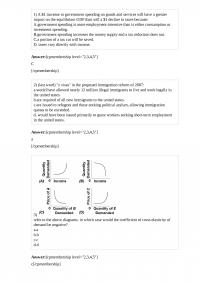
1) A $1 increase in government spending on goods and services will have a greater impact on the equilibrium GDP than will a $1 decline in taxes because: A.government spending is more employment-intensive than is either consumption or investment spending. […]
ECB 546 Midterm 2
1) Public choice theorists point out that the political process: A.differs from the marketplace in that voters and congressional representatives often face limited and bundled choices. B.is less prone to failure than is the marketplace. C.is a much fairer way […]
ECB 565
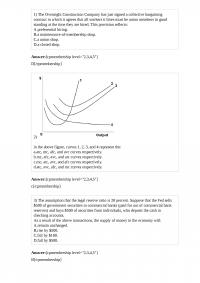
1) The Overnight Construction Company has just signed a collective bargaining contract in which it agrees that all workers it hires must be union members in good standing at the time they are hired. This provision reflects: A.preferential hiring. B.a […]
ECB 850 Quiz 1
1) the federal government requires automobile manufacturers to install pollution control equipment. this is an illustration of the: a.intrusion problem. b.production of public goods. c.internalization of external benefits. d.internalization of external costs. 2) the illinois central railroad once asked the […]
ECON A 383 Quiz
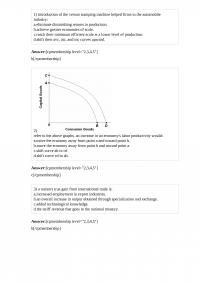
1) introduction of the verson stamping machine helped firms in the automobile industry: a.eliminate diminishing returns in production. b.achieve greater economies of scale. c.reach their minimum efficient scale at a lower level of production. d.shift their avc, atc, and mc […]
MicroEconomic 882 Quiz
1) Conspiracies to fix prices are: A.illegal under the Clayton Act. B.illegal under the Celler-Kefauver Act. C.per se violations of the antitrust laws. D.more tolerated by government today than two or three decades ago. 2) the two general types of […]
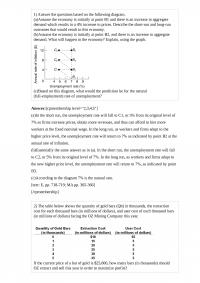
BUS 375 Test 2
1) Answer the questions based on the following diagram. (a)Assume the economy is initially at point B1 and there is an increase in aggregate demand which results in a 4% increase in prices. Describe the short-run and long-run outcomes that […]
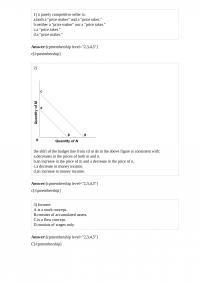
Economics 616 Test 2
1) a purely competitive seller is: a.both a “price maker” and a “price taker.” b.neither a “price maker” nor a “price taker.” c.a “price taker.” d.a “price maker.” 2) the shift of the budget line from cd to ab in […]
ECON A 528 Quiz
1) which of the following is least likely to be considered economic immigration? a.bob migrates to canada to improve his access to health care. b.manuela migrates to the united states to open an authentic italian cooking school. c.myklos migrates to […]
ECB 432 Test 1
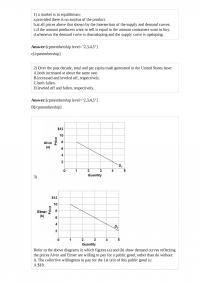
1) a market is in equilibrium: a.provided there is no surplus of the product. b.at all prices above that shown by the intersection of the supply and demand curves. c.if the amount producers want to sell is equal to the […]
ECB 818 Quiz 3
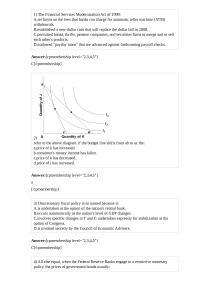
1) The Financial Services Modernization Act of 1999: A.set limits on the fees that banks can charge for automatic teller machine (ATM) withdrawals. B.established a new dollar coin that will replace the dollar bill in 2008. C.permitted banks, thrifts, pension […]
ECON A 178 Midterm 2
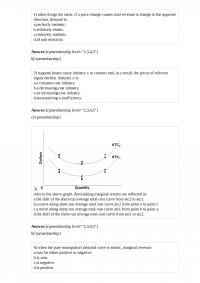
1) other things the same, if a price change causes total revenue to change in the opposite direction, demand is: a.perfectly inelastic. b.relatively elastic. c.relatively inelastic. d.of unit elasticity. 2) suppose losses cause industry x to contract and, as a […]
ECB 822
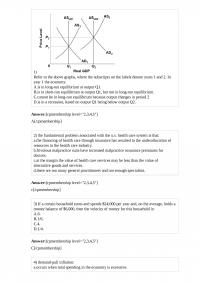
1) Refer to the above graphs, where the subscripts on the labels denote years 1 and 2. In year 1 the economy: A.is in long-run equilibrium at output Q1. B.is in short-run equilibrium at output Q1, but not in long-run […]
ECON E 345 Homework
1) which of the following will most likely cause backflows? a.poor information that leads a migrant to overestimate the net benefits of migration. b.high moving costs. c.falling wages in a migrant’s origin nation. d.high levels of skill transferability. 2) a […]
BUS 551
1) Unions might support a higher minimum wage because: A.their constitutions obligate them to do so. B.they feel a higher minimum wage will lower labor’s tax payments for welfare programs. C.a higher minimum wage makes less-skilled workers less substitutable for […]
Economics 102 Final
1) preferred provider organizations (ppos): a.charge a fixed amount per member, hire many of their own physicians, and provide health services only to members. b.require that their members give up the right to file medical malpractice suits. c.are illegal in […]
Economics 341
1) which of the following statements is correct? a.supply is more elastic in the short run than in the long run. b.demand is more elastic in the short run than in the long run. c.demand is more elastic when a […]
Economics 416 Midterm 1
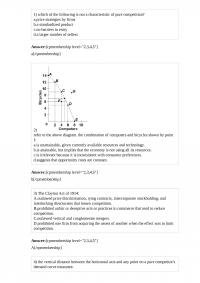
1) which of the following is not a characteristic of pure competition? a.price strategies by firms b.a standardized product c.no barriers to entry d.a larger number of sellers 2) refer to the above diagram. the combination of computers and bicycles […]
MicroEconomic 412 Final
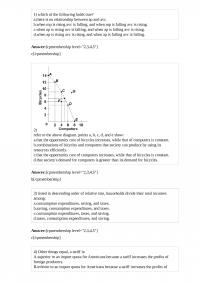
1) which of the following holds true? a.there is no relationship between ap and avc. b.when mp is rising avc is falling, and when mp is falling avc is rising. c.when ap is rising avc is falling, and when ap […]
ECON 447 Midterm 2
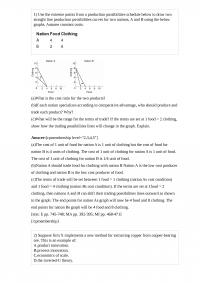
1) Use the extreme points from a production possibilities schedule below to draw two straight line production possibilities curves for two nations, A and B using the below graphs. Assume constant costs. (a)What is the cost ratio for the two […]
ECON A 373
1) Discrimination: A.affects the distribution of domestic output and income, but not its total size. B.is shown as some point outside of an economy’s production possibilities curve. C.places the economy at some point inside of its production possibilities curve. D.affects […]
ECON A 789 Midterm 2
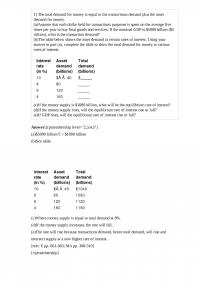
1) The total demand for money is equal to the transactions demand plus the asset demand for money. (a)Assume that each dollar held for transactions purposes is spent on the average five times per year to buy final goods and […]
ECON 809
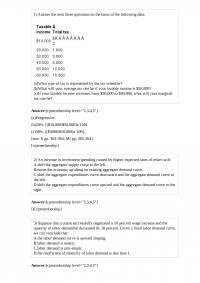
1) Answer the next three questions on the basis of the following data: (a)What type of tax is represented by the tax schedule? (b)What will your average tax rate be if your taxable income is $50,000? (c)If your taxable income […]
ECB 825 Homework
1) the presence of discouraged workers: a.increases the size of the labor force, but does not affect the unemployment rate. b.reduces the size of the labor force, but does not affect the unemployment rate. c.may cause the official unemployment rate […]
ECON 634 Midterm 1
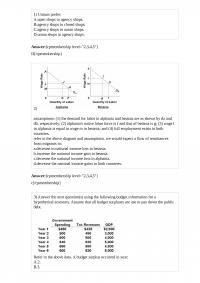
1) Unions prefer: A.open shops to agency shops. B.agency shops to closed shops. C.agency shops to union shops. D.union shops to agency shops. 2) assumptions: (1) the demand for labor in alphania and betania are as shown by da and […]
ECB 699
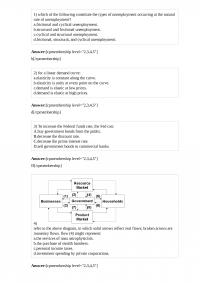
1) which of the following constitute the types of unemployment occurring at the natural rate of unemployment? a.frictional and cyclical unemployment. b.structural and frictional unemployment. c.cyclical and structural unemployment. d.frictional, structural, and cyclical unemployment. 2) for a linear demand curve: […]
BUS 604 Midterm 2
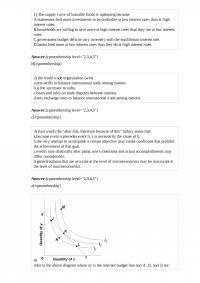
1) The supply curve of loanable funds is upsloping because: A.businesses find more investments to be profitable at low interest rates than at high interest rates. B.households are willing to save more at high interest rates than they are at […]
MicroEconomic 264 Quiz 1
1) if a demand for a product is elastic, the value of the price elasticity coefficient is: a.zero. b.greater than one. c.equal to one. d.less than one. 2) proponents of economic growth say that pollution: a.is an inevitable by-product of […]
ECON A 272 Quiz 2
1) Small innovative firm X that has developed a new product, accepts an offer to be acquired by a larger firm. As it relates to new technology, this behavior or outcome is known as a: A.fast-second strategy. B.limit pricing. C.zero-sum […]
Economics 823 Test
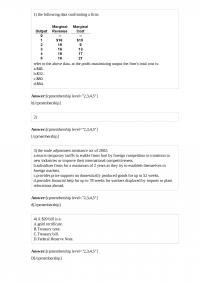
1) the following data confronting a firm: refer to the above data. at the profit-maximizing output the firm’s total cost is: a.$48. b.$32. c.$80. d.$64. 2) Answer: 3) the trade adjustment assistance act of 2002: a.enacts temporary tariffs to enable […]
MicroEconomic 383
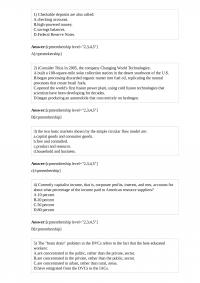
1) Checkable deposits are also called: A.checking accounts. B.high-powered money. C.savings balances. D.Federal Reserve Notes. 2) (Consider This) In 2005, the company Changing World Technologies: A.built a 100-square-mile solar collection station in the desert southwest of the U.S. B.began processing […]