
1) For which of the following income-maintenance programs is aggregate spending the
greatest?
A.Medicare
B.Social Security
C.unemployment compensation
D.TANF
2) which of the following definitions is correct?
a.accounting profit + economic profit = normal profit.
b.economic profit – accounting profit = explicit costs.
c.economic profit = accounting profit – implicit costs.
d.economic profit – implicit costs = accounting profits.
3) In moving from a private closed economy to a mixed closed economy in the
aggregate expenditures model, government spending must be:
A.added to saving.
B.added to consumption and gross investment.
C.subtracted from consumption and gross investment.
D.added to gross investment and saving.
4) Suppose an employer is biased against African-Americans. If his discrimination
coefficient is $2, the employer will:
A.randomly hire African-American and white workers if the actual
African-American-white wage differential is more than $2.
B.randomly hire African-American and white workers if the actual
African-American-white wage differential is less than $2.
C.hire only African-Americans if the actual African-American-white wage differential
is less than $2.
D.hire only whites if the actual African-American-white wage differential is less than
$2.
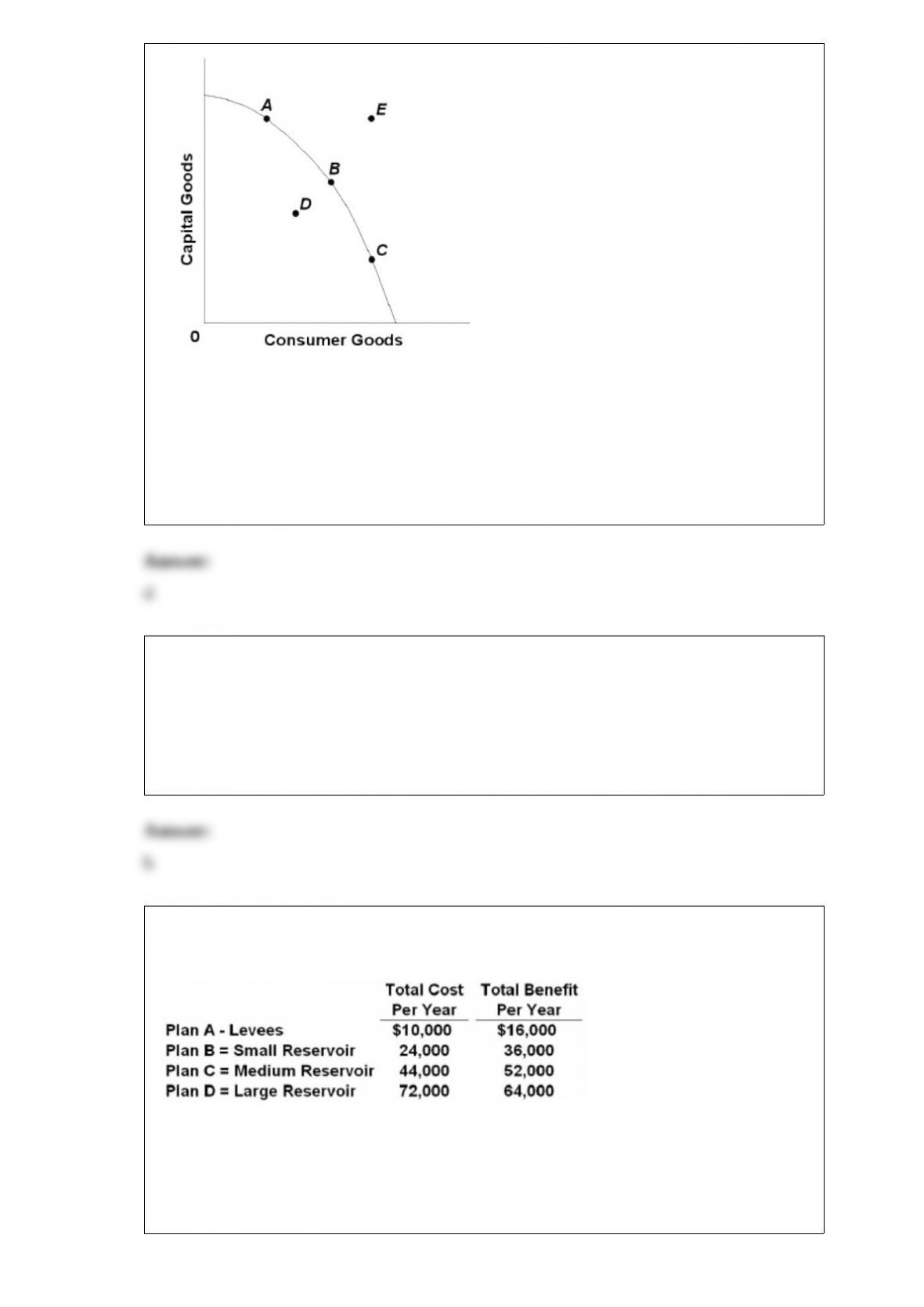
5)
refer to the above domestic production possibilities curve for karalex. the gain to
karalex from specialization and international trade is represented by a move from:
a.a to b
b.c to a
c.c to d
d.b to e
6) a nondiscriminating monopolist:
a.will never produce in the output range where marginal revenue is positive.
b.will never produce in the output range where demand is inelastic.
c.will never produce in the output range where demand is elastic.
d.may produce where demand is either elastic or inelastic, depending on the level of
production costs.
7) The following data are for a series of increasingly extensive flood control projects:
Refer to the above data. Plan C entails:
A.marginal benefits in excess of marginal costs.
B.fewer spillovers than either Plan A or Plan B.
C.an overallocation of resources to flood control.
D.an underallocation of resources to flood control.

8) kara was out jogging and despite being tired, decided to run one more mile. based on
her actions, economists would conclude that kara:
a.must be an avid runner.
b.decided that the marginal benefit of running one more mile would outweigh the cost
of the additional mile.
c.decided that the marginal cost of running one more mile would outweigh the benefit
of the additional mile.
d.was not very tired, so the marginal cost of the extra mile was very low.
9) If MPa/Pa = MPb/Pb and MRPa/Pa = MRPb/Pb>1, this firm is:
A.producing its output with the least costly combination of resources, but is not
producing the profit-maximizing output.
B.maximizing profits, but failing to minimize costs.
C.neither maximizing profits nor minimizing costs.
D.combining resources a and b so as to minimize costs and maximize profits.
10) Insurance companies require male drivers under age 25 to pay higher insurance
rates than female drivers under age 25. Craig Raymond, however, is a safer driver than
the average female driver under age 25. Craig’s higher insurance rate reflects:
A.monopoly power.
B.statistical discrimination.
C.the insurance firm’s taste for discrimination.
D.human-capital discrimination.
11) Some economists claim that unions reduce economic efficiency by:
A.providing a voice mechanism for workers.
B.insisting that promotions be based on ability rather than seniority.
C.imposing restrictions on the kinds of jobs workers may perform.
D.increasing worker turnover.
12) Explain the impact of each of the following upon commercial bank reserves: (a) the
Federal Reserve sells government bonds in the open market to private buyers; (b) the
commercial banks reduce their indebtedness to the Federal Reserve Banks; (c) the
Treasury makes a number of large disbursements in accelerating space research.
13) Answer the question on the basis of the following marginal product data for
resources a and b. The output of these independent resources sells in a purely
competitive market at $1 per unit.
Refer to the above data. Assume now that the prices of a and b are $15 and $20
respectively. To maximize profits what combination of a and b should the employer
hire?
A.3 of a and 5 of b
B.5 of a and 7 of b
C.7 of a and 7 of b
D.6 of a and 2 of b
14) Research for industrially advanced countries indicates that:
A.the more independent the central bank, the lower the average annual rate of inflation.
B.the more independent the central bank, the higher the average annual rate of inflation.
C.there is no relationship between the degree of independence of a country’s central
bank and its inflation rate.
D.the more independent the central bank, the higher the average annual rate of
unemployment.
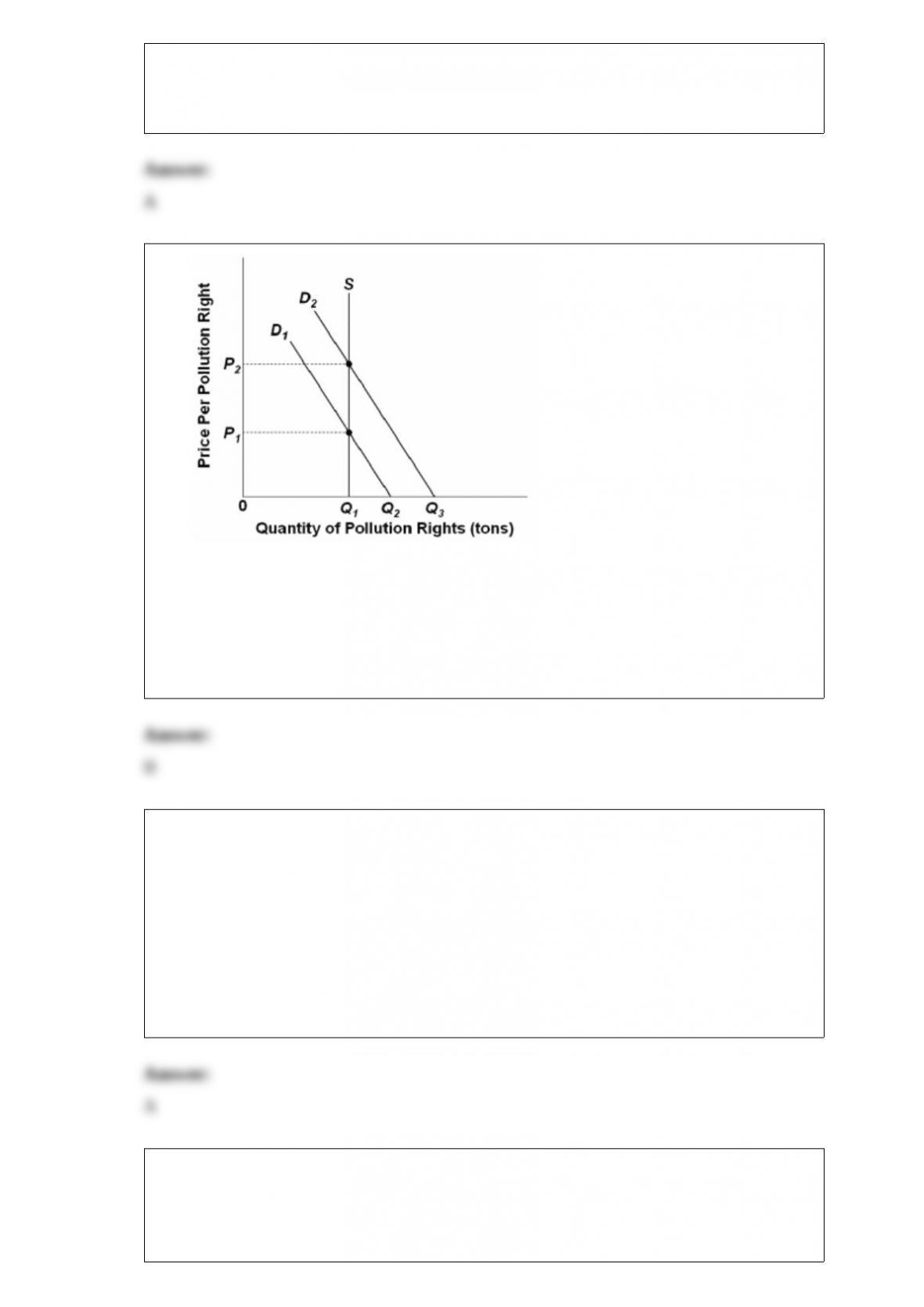
15)
Refer to the above diagram of a market for pollution rights. Which of the following
would best explain the P1 to P2 increase in price of pollution rights?
A.implementation of improved technology for reducing pollution
B.an expansion of the number of firms
C.a subsidy of P1P2 to polluters
D.a shift of the supply curve of pollution rights from some point to the left of S to S
16) Economists who adhere to the laissez-faire antitrust perspective:
A.view competition as a long-run dynamic process in which firms battle for dominance
of markets but rarely can sustain such dominance once it is achieved.
B.believe the antitrust laws are as important today as they were when they were passed
in the early 1900s.
C.say that an industry’s structure, which is based on economies of scale, usually
predicts the behavior of the industry firms.
D.contend that large, dominant firms should be broken into smaller competitive firms
and then government should stand back and let competition prevail.
17) Which of the following is correct?
A.Although land has no production cost from society’s viewpoint, rental payments are
costs to individual producers.
B.Land rent is not a cost to either society or to individual producers.

C.Although land rent is a cost from society’s viewpoint, it is not a cost to individual
producers.
D.Land rent is a cost to both society and individual producers.
18) unemployment:
a.causes the production possibilities curve to shift outward.
b.can exist at any point on a production possibilities curve.
c.is illustrated by a point outside the production possibilities curve.
d.is illustrated by a point inside the production possibilities curve.
19) Where there is natural monopoly, government is most likely to implement:
A.social regulation.
B.antitrust policy.
C.industrial regulation.
D.an externality containment policy.