1) Unions prefer:
A.open shops to agency shops.
B.agency shops to closed shops.
C.agency shops to union shops.
D.union shops to agency shops.
2)
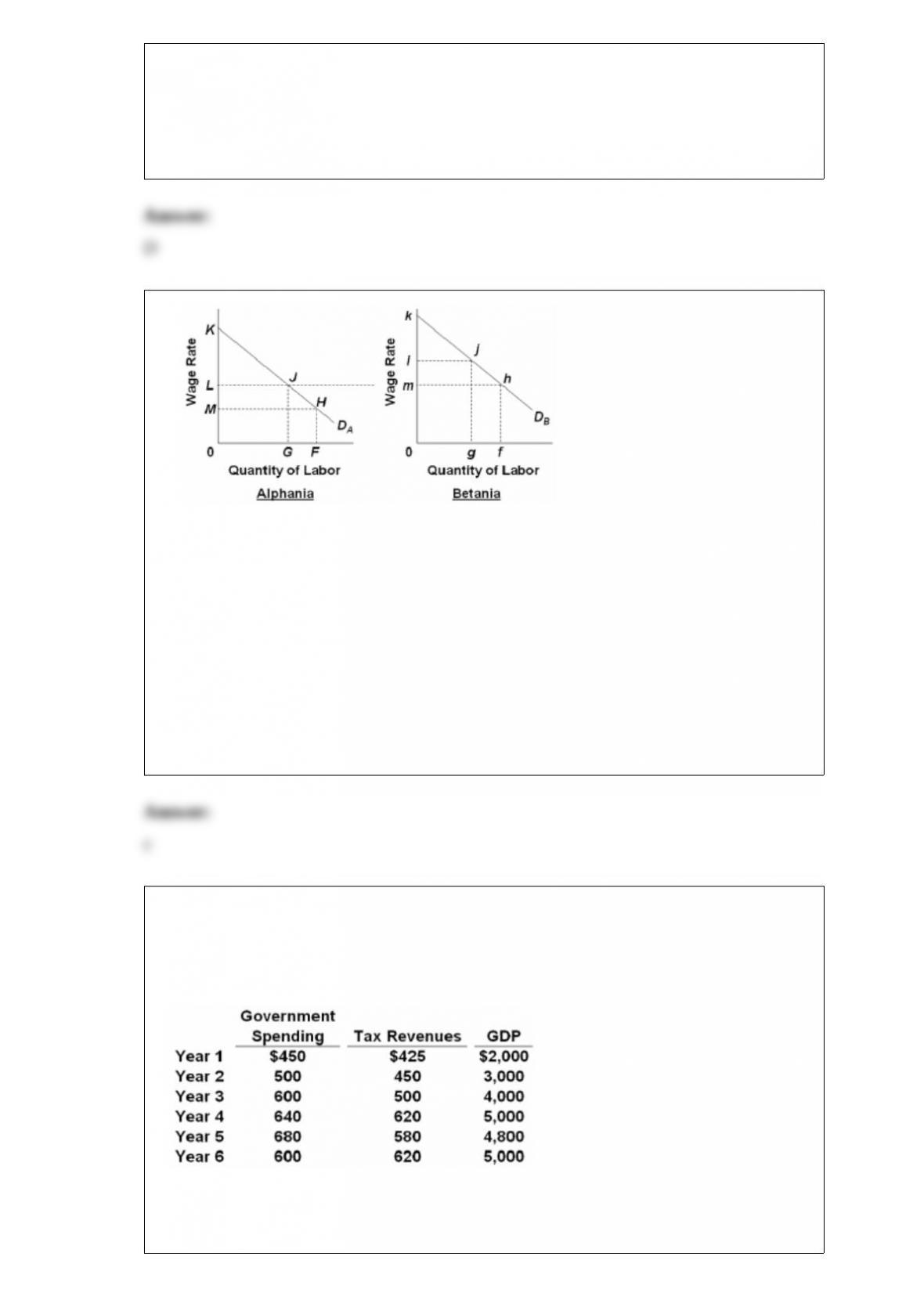
assumptions: (1) the demand for labor in alphania and betania are as shown by da and
db, respectively; (2) alphania’s native labor force is f and that of betania is g; (3) wage l
in alphania is equal to wage m in betania; and (4) full employment exists in both
countries.
refer to the above diagram and assumptions. we would expect a flow of remittances
from migrants to:
a.decrease in national income loss in betania.
b.increase the national income gain in betania.
c.decrease the national income loss in alphania.
d.decrease the national income gains in both countries.
3) Answer the next question(s) using the following budget information for a
hypothetical economy. Assume that all budget surpluses are use to pay down the public
debt.
Refer to the above data. A budget surplus occurred in year:
A.2.
B.3.

C.4.
D.6.
4)
refer to the above table. for these data the law of increasing opportunity costs is
reflected in the fact that:
a.the amount of consumer goods that must be sacrificed to get more capital goods
diminishes beyond a point.
b.larger and larger amounts of capital goods must be sacrificed to get additional units of
consumer goods.
c.the production possibilities data would graph as a straight downsloping line.
d.the economy’s resources are presumed to be scarce.
5) (last word) legislation proposed in 2007, if passed, would have:
a.increased funding to fence, monitor, and police the u.s.-mexico border.
b.increased fines for hiring illegal immigrants.
c.increased the emphasis on allowing immigrants based on education, skills, and
language proficiency.
d.done all of these.
6) a rightward shift in the demand curve for product c might be caused by:
a.an increase in income if c is an inferior good.
b.a decrease in income if c is a normal good.
c.a decrease in the price of a product that is a close substitute for c.
d.a decrease in the price of a product that is complementary to c.
7) Discretionary fiscal policy will stabilize the economy most when:
A.deficits are incurred during recessions and surpluses during inflations.
B.the budget is balanced each year.
C.deficits are incurred during inflations and surpluses during recessions.

D.budget surpluses are continuously incurred.
8) the fact that the major indicator of enterprise success in the soviet union and
pre-reform china was the quantity of output implied that:
a.product quality was neglected.
b.production costs were minimized.
c.product-mix met consumer needs.
d.technological advance was too rapid.
9) The main purpose of the antitrust laws is:
A.to encourage firms to produce where P > MC.
B.the elimination of both negative and positive externalities.
C.to prevent the monopolization of industries.
D.to regulate natural monopolies.
10) Since 1980 the difference between the earnings of college graduates and high
school graduates has:
A.fallen, thereby increasing income inequality.
B.increased, thereby increasing income inequality.
C.remained constant.
D.increased, thereby decreasing income inequality.
11) (consider this) european economists generally agree that:
a.high european rates of inflation reflect demand-pull rather than cost-push forces.
b.high european rates of poverty can be reduced by higher transfer payments.
c.high european unemployment rates have resulted from government policies and union
contracts that increase the costs of hiring and reduce the individual’s opportunity cost of
being unemployed.
d. european trade deficits stimulate the european economies.