1) The wide imitation and spread of an innovation is called:
A.innovation.
B.invention.
C.creative destruction.
D.diffusion.
2) the presence of market failures implies that:
a.money is not an effective tool for exchange in a market system.
b.there is an active role for government, even in a market system.
c.individuals and firms should strive to be self-sufficient rather than specialize.
d.command systems are superior to market systems in the allocation of resources.
3) strong property rights are important for modern economic growth because:
a.they allow governments to extract the gains from private citizens’ investments.
b.people are less likely to invest if they are fearful that others can take their returns on
investment without compensation.
c.they ensure an equitable distribution of income.
d.business cycle fluctuations will be smaller and less likely to disrupt investment
patterns.
4) An increase in taxes of a specific amount will have a smaller impact on the
equilibrium GDP than will a decline in government spending of the same amount
because:
A.the MPC is smaller in the private sector than it is in the public sector.
B.declines in government spending always tend to stimulate private investment.
C.disposable income will fall by some amount smaller than the tax increase.
D.some of the tax increase will be paid out of income that would otherwise have been
saved.
5) for economists, the word “utility” means:
a.versatility and flexibility.
b.rationality.
c.pleasure and satisfaction.
d.purposefulness.
6)
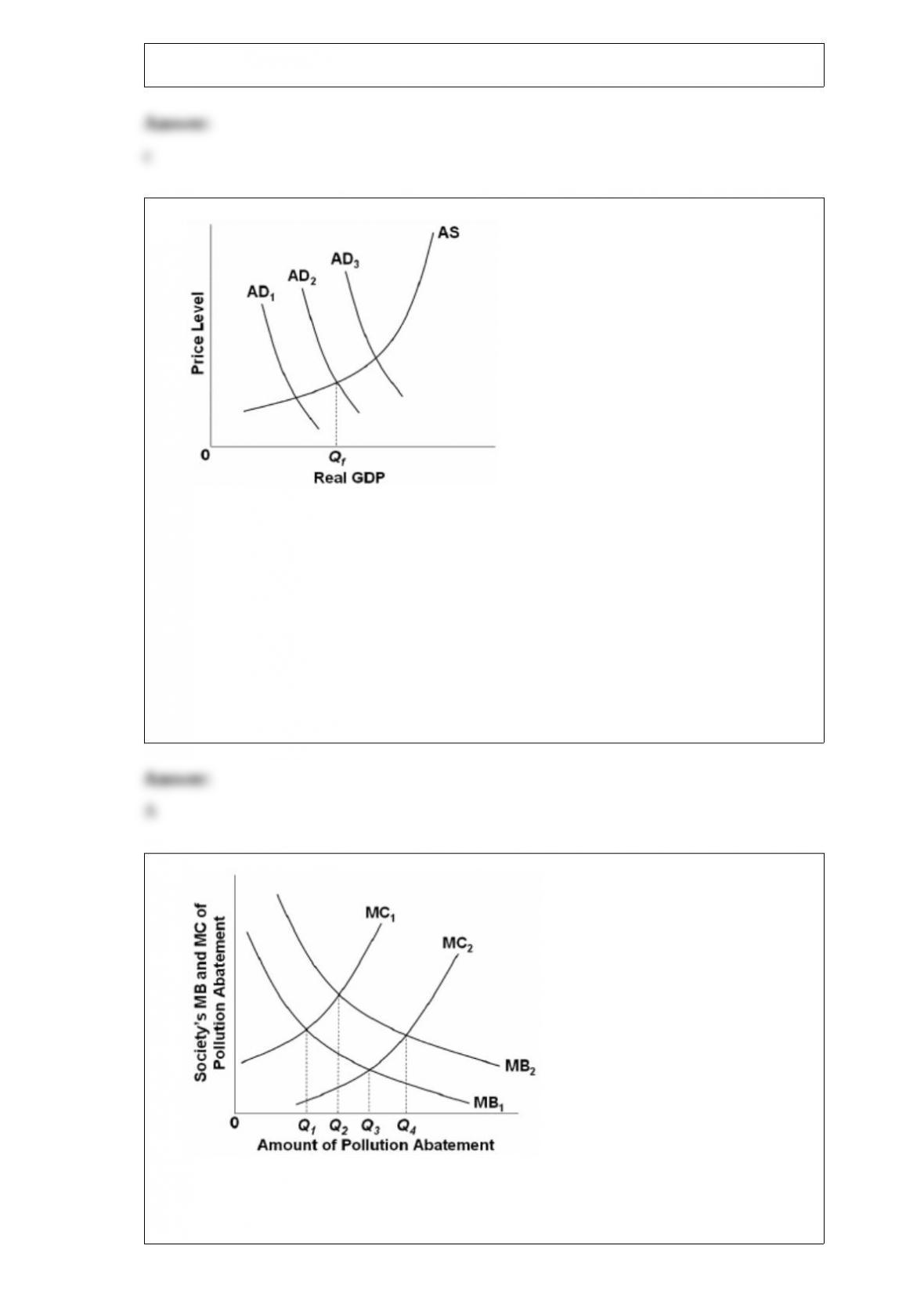
Refer to the above diagram, in which Qf is the full-employment output. If aggregate
demand curve AD2 describes the current situation, appropriate fiscal policy would be
to:
A.do nothing since the economy appears to be achieving full-employment real output.
B.increase taxes and reduce government spending to shift the aggregate demand curve
rightward from AD2 to AD3.
C.increase taxes on businesses to shift the aggregate supply curve rightward to reduce
the price level.
D.reduce taxes and increase government spending to shift the aggregate demand curve
from AD2 to AD1.
7)
Refer to the above diagram. From society’s perspective, if MB1 and MC2 are relevant:
A.Q2 represents too little pollution abatement.
B.Q1 represents too much pollution abatement.
C.Q2 represents an optimal amount of pollution abatement.
D.Q4 represents too little pollution abatement.
8) Independent unions:
A.have greater combined membership than the AFL-CIO.
B.are not affiliated with the AFL-CIO.
C.include the United Autoworkers and United Steelworkers.
D.have about the same combined membership as the AFL-CIO.
9) Assume Company X deposits $100,000 in cash in commercial Bank A. If no excess
reserves exist at the time this deposit is made and the reserve ratio is 20 percent, Bank A
can increase the money supply by a maximum of:
A.$50,000.
B.$180,000.
C.$80,000.
D.$500,000.
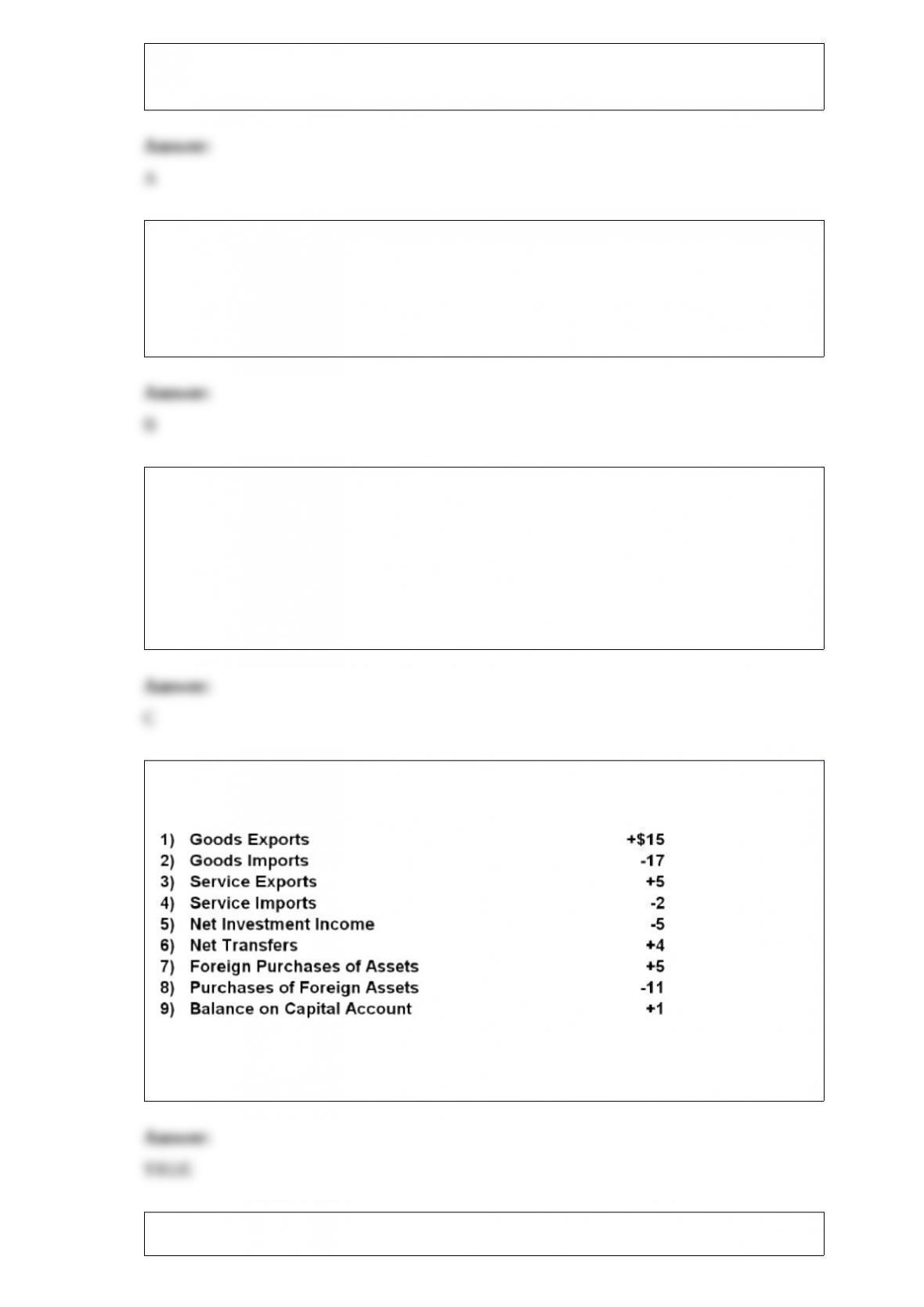
10) The following 2008 balance of payments statement for Transylvania. All figures are
in billions of dollars.
Refer to the above data. If Transylvania was on a system of freely floating exchange
rates, its balance of payments position would cause the international value of its
currency to depreciate.
11) recently a labor union argued that the standard of living of its members was falling.

a critic of the union argued that this could not possibly be true because the union had
been acquiring increases in the nominal incomes of its members through collective
bargaining. is the critic correct?
a.yes, because when you have a large nominal income your standard of living
automatically increases.
b.no, because real income may fall if prices increase more proportionately than the
increase in nominal income.
c.no, because real income may fall if prices increase less proportionately than the
increases in nominal income.
d.yes, because real income may fall if prices increase less proportionately than the
increases in nominal income.
12) the major purpose of medicare is to:
a.provide health care services to the aged.
b.provide health care services to those receiving public assistance.
c.contain rising health care costs.
d.make a basic health care package available to all americans.