1) which of the following constitute the types of unemployment occurring at the natural
rate of unemployment?
a.frictional and cyclical unemployment.
b.structural and frictional unemployment.
c.cyclical and structural unemployment.
d.frictional, structural, and cyclical unemployment.
2) for a linear demand curve:
a.elasticity is constant along the curve.
b.elasticity is unity at every point on the curve.
c.demand is elastic at low prices.
d.demand is elastic at high prices.
3) To increase the Federal funds rate, the Fed can:
A.buy government bonds from the public.
B.decrease the discount rate.
C.decrease the prime interest rate.
D.sell government bonds to commercial banks.
4)
refer to the above diagram, in which solid arrows reflect real flows; broken arrows are
monetary flows. flow (4) might represent:
a.the services of nasa astrophysicists.
b.the purchase of stealth bombers.
c.personal income taxes.
d.investment spending by private corporations.
5) In the last-half of the 1990s, Japan:
A.successfully used monetary policy to overcome recession.
B.had poor success using monetary policy to overcome recession.
C.abandoned monetary policy in favor of fiscal policy in fighting inflation.
D.successfully used monetary policy to reduce rapid inflation.
6) allocative efficiency is concerned with:
a.producing the combination of goods most desired by society.
b.achieving the full employment of all available resources.
c.producing every good with the least-cost combination of inputs.
d.reducing the concavity of the production possibilities curve.
7) Answer the next four questions based on the following data using year 1 as the base
year. All dollars are in billions.
(a)Find real income in year 4.
(b)What was the percentage rise in prices between years 1 and 3?
(c)What was the percentage rise in prices between years 2 and 4?
(d)What was the increase in real income from year 3 to year 4 in percentage?
8) An economist who favored expanded government would recommend:
A.tax cuts during recession and reductions in government spending during inflation.
B.tax increases during recession and tax cuts during inflation.
C.tax cuts during recession and tax increases during inflation.
D.increases in government spending during recession and tax increases during inflation.
9) To say that “the U.S. public debt is also a public credit” is to say that:
A.only interest payments on the public debt are an economic burden.
B.official figures understate the size of the public debt.
C.the bulk of the public debt is owned by U.S. citizens and institutions.
D.the public debt is equal to the land and buildings assets owned by the Federal
government.
10) Which of these pairs of financial institutions are most alike in terms of their main
lines of business?
A.commercial banks and thrifts.
B.insurance companies and mutual fund companies.
C.thrifts and securities firms.
D.pension fund companies and commercial banks.
11) in which of the following statements are the terms “demand” and “quantity
demanded” used correctly?
a.when the price of ice cream rose, the demand for both ice cream and ice cream
toppings fell.
b.when the price of ice cream rose, the quantity demanded of ice cream fell, and the
demand for ice cream toppings fell.
c.when the price of ice cream rose, the demand for ice fell, and the quantity demanded
of ice cream toppings fell.
d.none of these statements use the terms correctly.
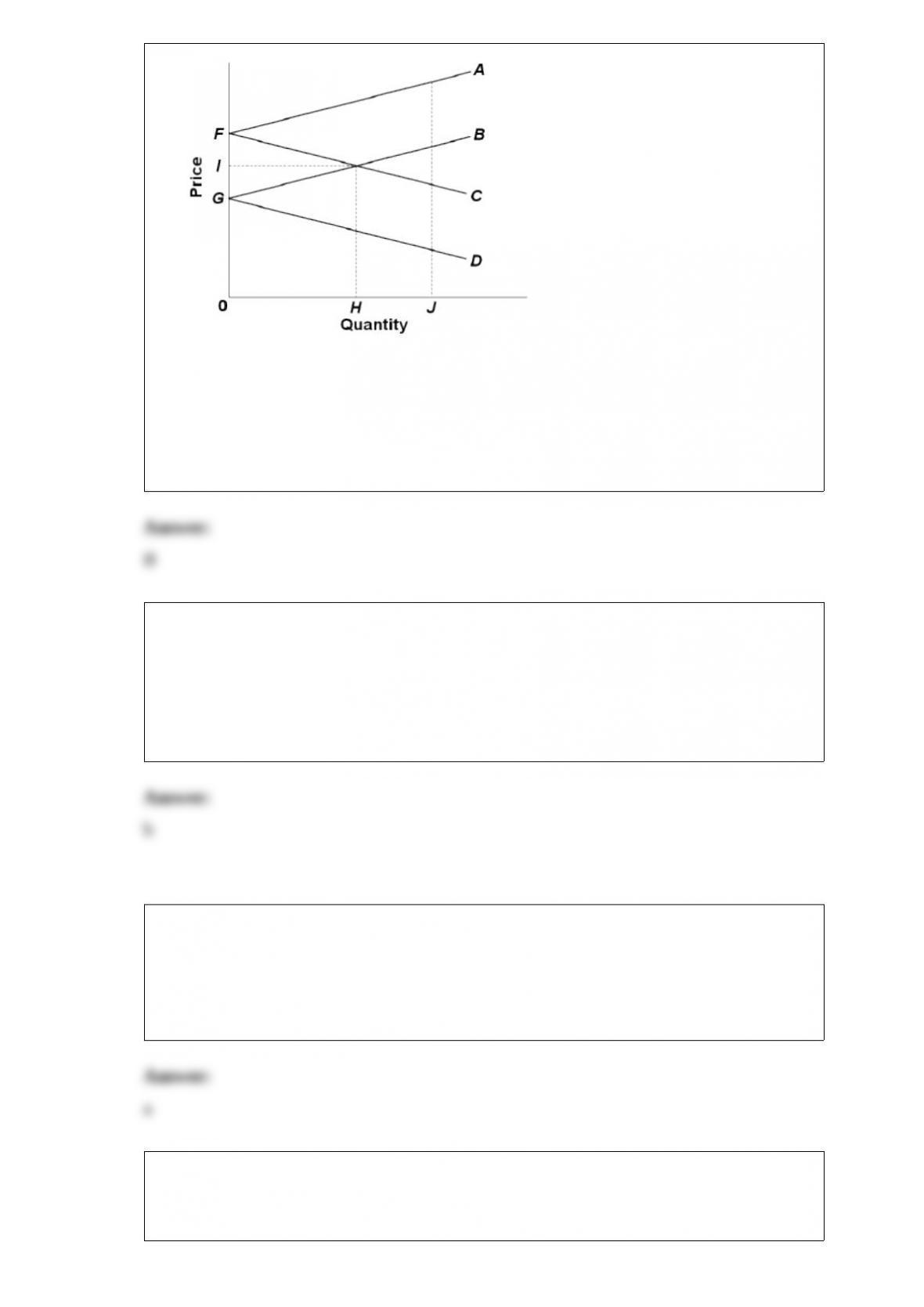
12)
Refer to the above diagram pertaining to two nations and a specific product. In
equilibrium, the nation represented by lines FA and FC will:
A.export H to the country represented by lines GB and GD
B.import H from the country represented by lines GB and GD
C.pay price F for its imports
D.receive price G for its exports
13) if the price of product x rises, then the resulting decline in the amount purchased
will:
a.necessarily increase the consumer’s total utility from his total purchases.
b.increase the marginal utility of this good.
c.increase the total utility from purchases of this good.
d.reduce the marginal utility of this good.
14) other things equal, if the price of a key resource used to produce product x falls, the:
a.product supply curve of x will shift to the right.
b.product demand curve of x will shift to the right.
c.product supply curve of x will shift to the left.
d.product demand curve of x will shift to the left.
15) unemployment involving a mismatch of the skills of unemployed workers and the
skills required for available jobs is called:
a.frictional unemployment.
b.structural unemployment.
c.cyclical unemployment.
d.compositional unemployment.
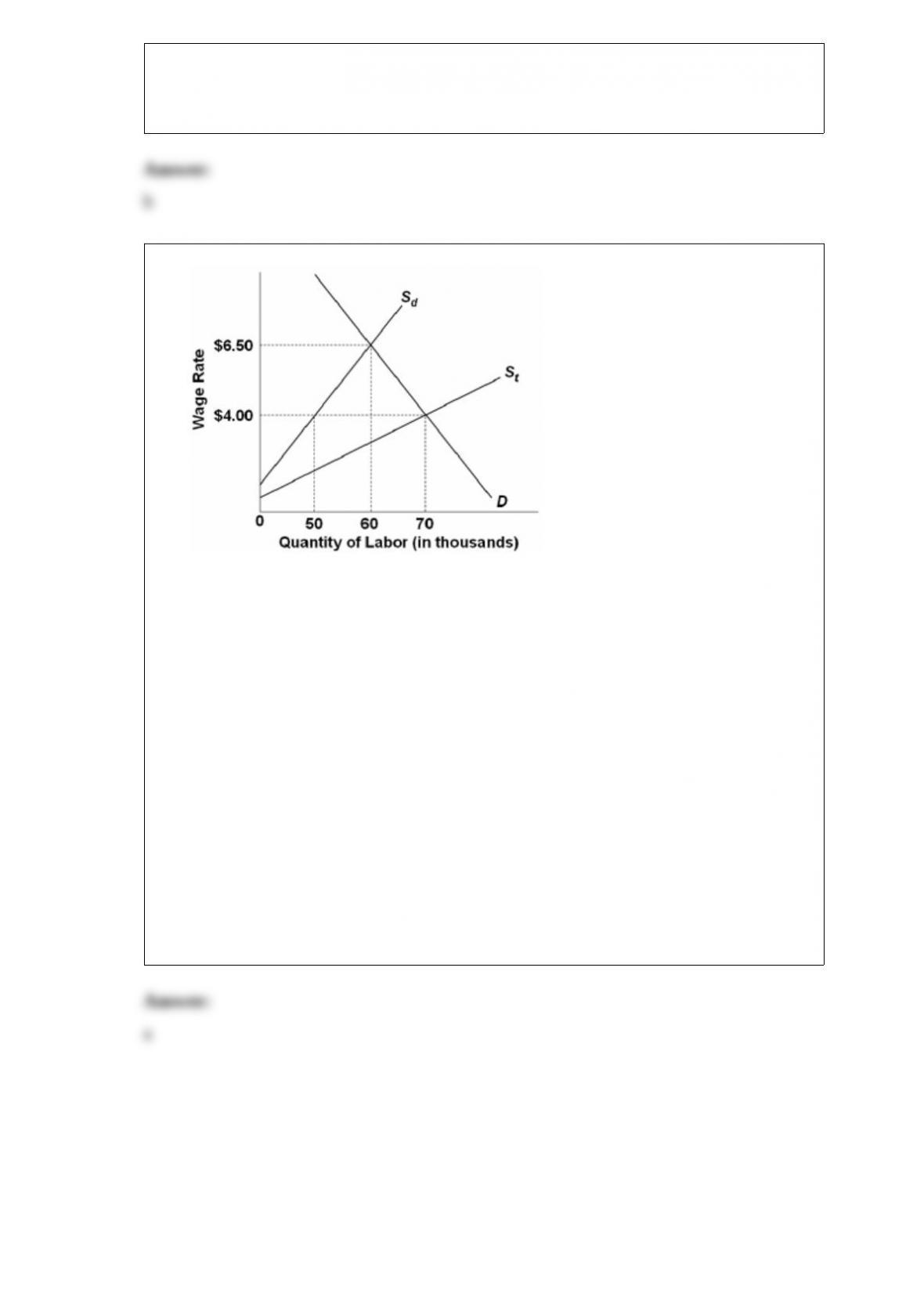
16)
assumptions: 1) employers in this market are willing and able to ignore minimum wage
laws; 2) sd represents the supply of domestically-born (and legal immigrant) workers;
3) st represents the total supply of workers in this labor market (sd plus illegal
immigrants); and 4) unless otherwise stated, illegal immigration is not effectively
blocked by the government.
refer to the above figure. assume initially that government does not effectively block
illegal immigration. if the government then finds a way to prevent all illegal immigrants
from working in this labor market:
a.10,000 domestically-born workers will gain employment at the expense of 20,000
illegal immigrants.
b.20,000 domestically-born workers will gain employment at the expense of 20,000
illegal immigrants.
c.10,000 domestically-born workers will gain employment at the expense of 70,000
illegal immigrants.
d.10,000 domestically-born workers will gain employment at the expense of 50,000
illegal immigrants.
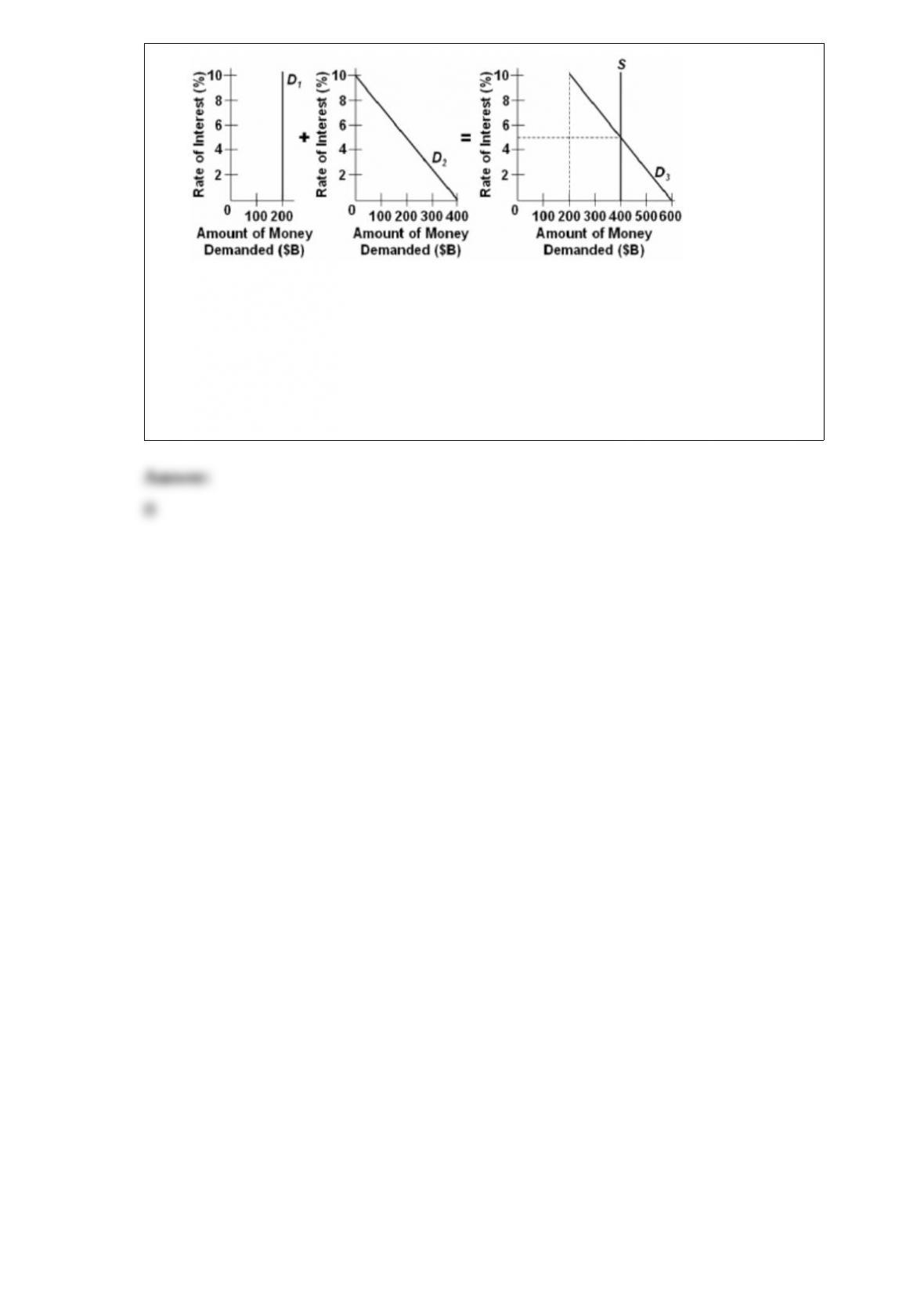
17)
Refer to the above market for money diagrams. If the interest rate was at 8 percent,
people would:
A.sell bonds, which would cause bond prices to fall and the interest rate to fall.
B.buy bonds, which would cause bond prices to rise and the interest rate to fall.
C.have insufficient liquidity, which would cause them to reduce their spending on
consumer goods.
D.buy bonds, which would cause bond prices to fall and the interest rate to rise.