1) which of the following holds true?
a.there is no relationship between ap and avc.
b.when mp is rising avc is falling, and when mp is falling avc is rising.
c.when ap is rising avc is falling, and when ap is falling avc is rising.
d.when ap is rising avc is rising, and when ap is falling avc is falling.
2)
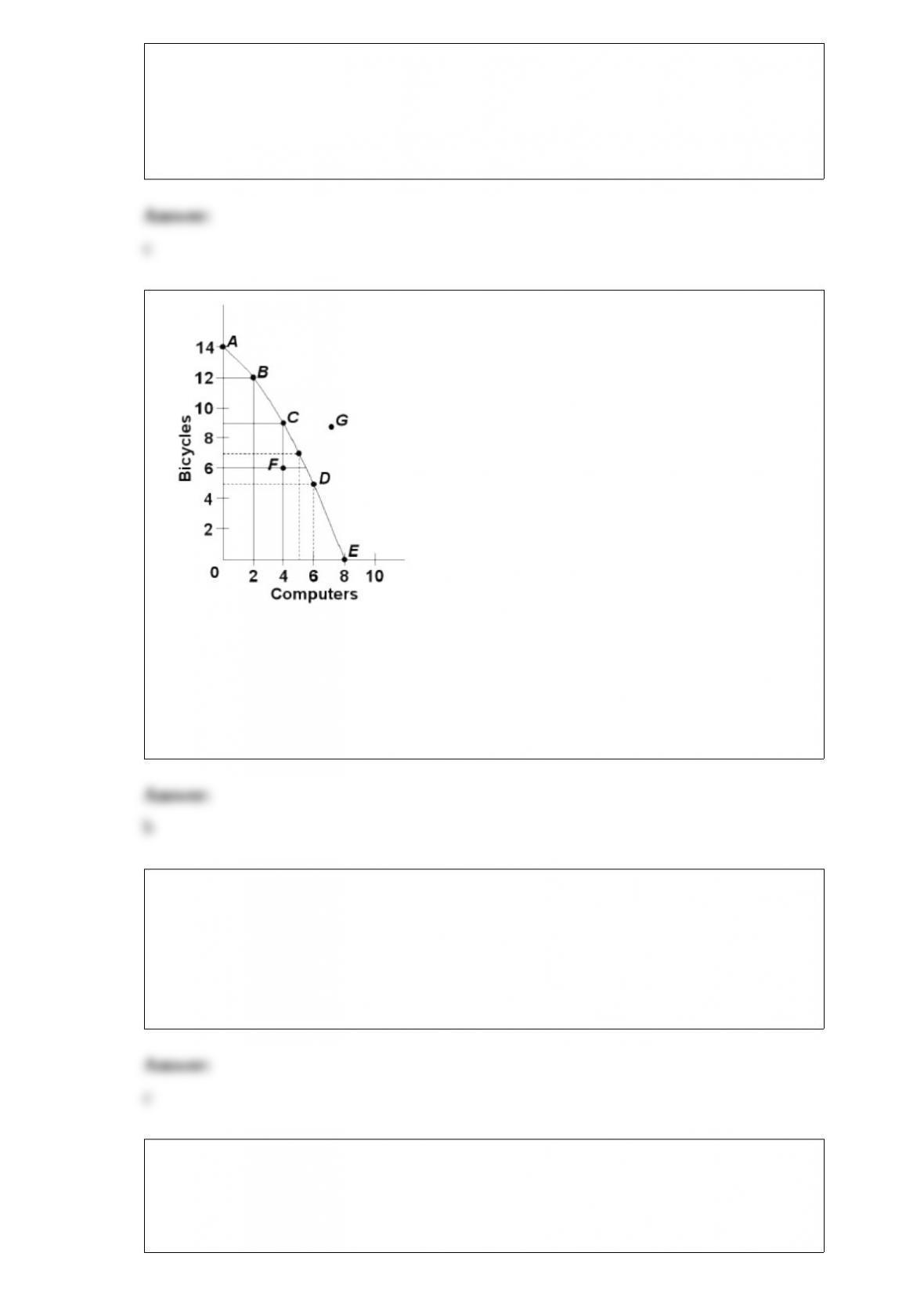
refer to the above diagram. points a, b, c, d, and e show:
a.that the opportunity cost of bicycles increases, while that of computers is constant.
b.combinations of bicycles and computers that society can produce by using its
resources efficiently.
c.that the opportunity cost of computers increases, while that of bicycles is constant.
d.that society’s demand for computers is greater than its demand for bicycles.
3) listed in descending order of relative size, households divide their total incomes
among:
a.consumption expenditures, saving, and taxes.
b.saving, consumption expenditures, and taxes.
c.consumption expenditures, taxes, and saving.
d.taxes, consumption expenditures, and saving.
4) Other things equal, a tariff is:
A.superior to an import quota for Americans because a tariff increases the profits of
foreign producers.
B.inferior to an import quota for Americans because a tariff increases the profits of

domestic producers.
C.superior to an import quota for Americans because a tariff generates revenue for the
United States Treasury.
D.inferior to an import quota for Americans because a tariff generates revenue for the
United States Treasury.
5) The price of a bond having no expiration date is originally $8,000 and has a fixed
annual interest payment of $800. A fall in the price of the bond by $3,000 will provide a
new buyer of the bond an interest rate of:
A.10 percent.
B.12 percent.
C.14 percent.
D.16 percent.
6) supporters of trade adjustment assistance claim that it benefits an economy because
it:
a.keeps domestic firms competitive in international markets.
b.increases political acceptance of trade barrier reductions.
c.raises the prices of imports competing with domestic firms.
d.does all of these.
7) Interest, rent, and corporate profits combined account for about what percentage of
the national income?
A.80 percent
B.55 percent
C.35 percent
D.20 percent
8)
Which of the following supports the contention that monopolistic competitors have a
strong incentive to engage in R&D?
A.Entry to monopolistic competitive industries is relatively easy and thus profit from
innovation is quickly competed away.
B.Most monopolistic competitive industries are decreasing cost industries.
C.The desire to differentiate products from competitors may motivate monopolistic
competitors to engage in R&D.
D.Monopolistic competitors have large retained earnings that are available to finance
R&D.
9)
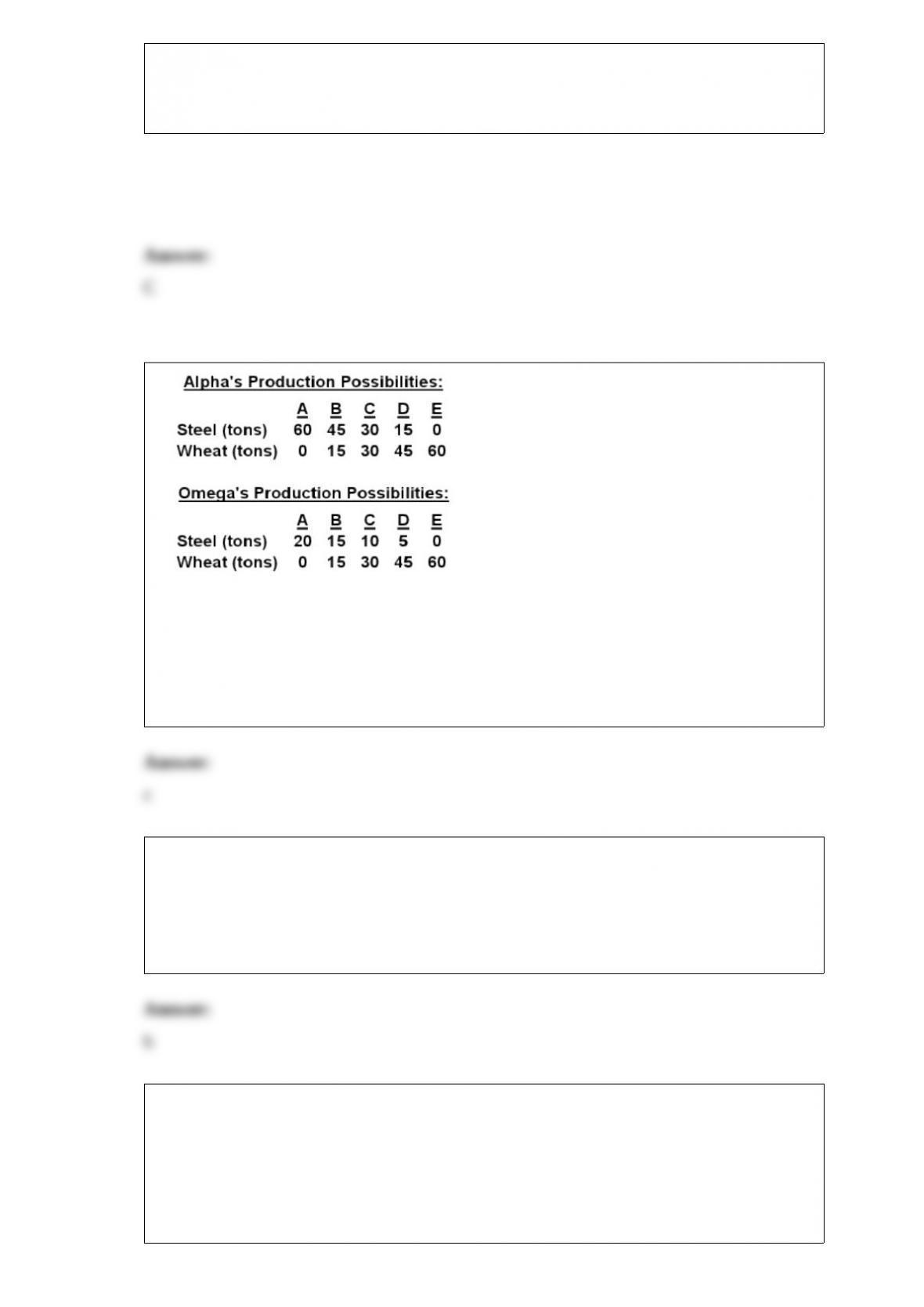
refer to the above data. the domestic opportunity cost of producing 1 ton of steel in
omega is:
a. ton of wheat.
b.2 tons of wheat.
c.3 tons of wheat.
d.5 tons of wheat.
10) the most important source of federal tax revenue is:
a.sales taxes.
b.personal income taxes.
c.corporate income taxes.
d.payroll taxes.
11) Which of the following lists of exchange rates is arranged in proper historical
order?
A.Bretton Woods system, gold standard, managed float
B.gold standard, managed float, Bretton Woods system
C.managed float, Bretton Woods system, gold standard
D.gold standard, Bretton Woods system, managed float
12) marginal utility is the:
a.sensitivity of consumer purchases of a good to changes in the price of that good.
b.change in total utility obtained by consuming one more unit of a good.
c.change in total utility obtained by consuming another unit of a good divided by the
change in the price of that good.
d.total utility associated with the consumption of a certain number of units of a good
divided by the number of units consumed.
13) Draw a graph that illustrates the dilemma of regulation for a natural monopoly. On
the graph, show the: (a) socially optimal price; (b) fair-return price; and (c)
profit-maximizing price for the unregulated monopolist.
14)
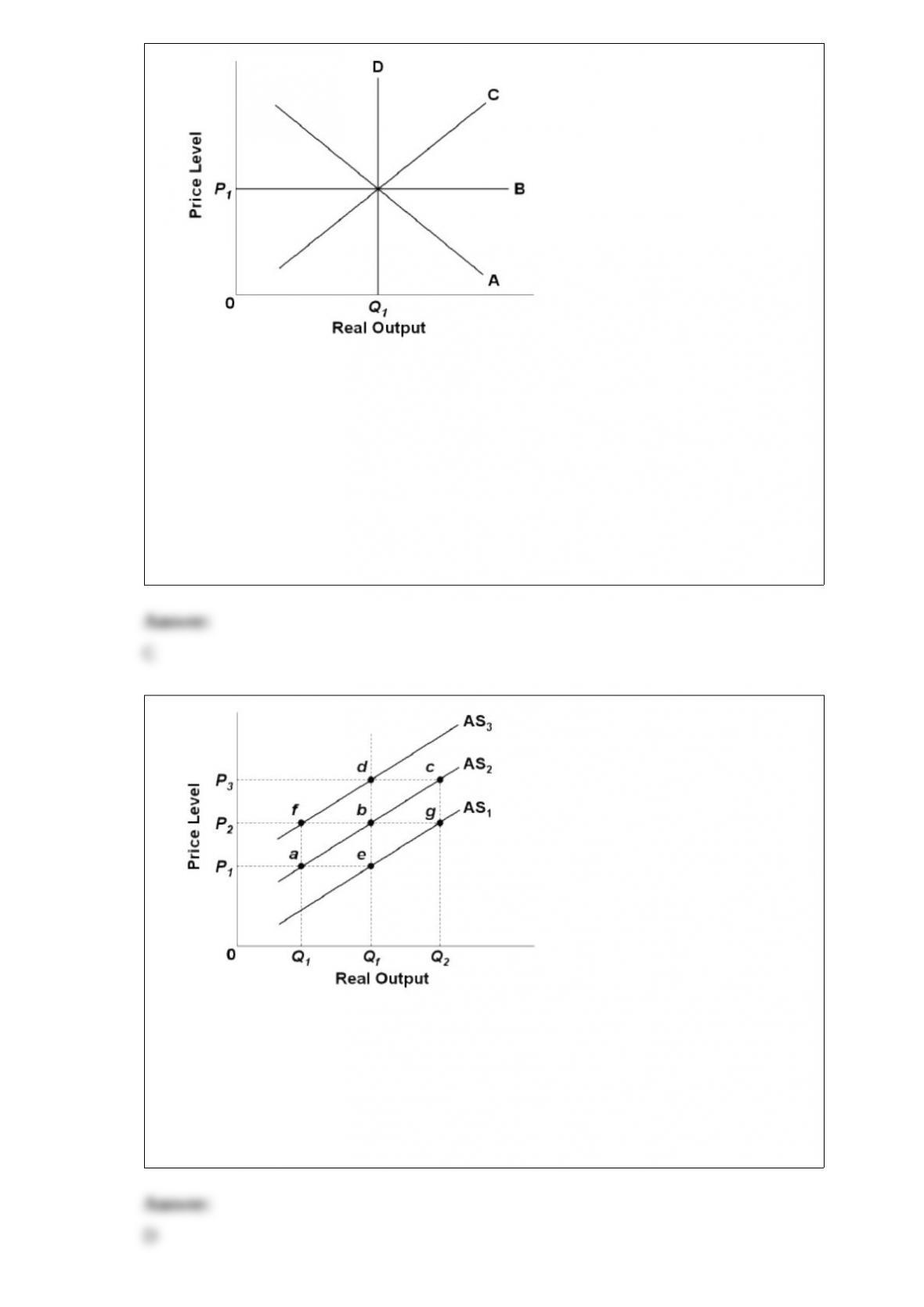
Refer to the above diagram and assume that prices and wages are flexible both upward
and downward in the economy. In the extended AD-AS model:
A.demand-pull inflation would involve a rightward shift of curve A, followed by a
rightward shift of curve C
B.cost-push inflation would involve a rightward shift of curve A, followed by a leftward
shift of curve C
C.recession would involve a leftward shift of curve A, followed by a rightward shift of
curve C
D.recession would involve a rightward shift of curve D, followed by leftward shifts of
curves A and C
15)
Refer to the above diagram. Assume that nominal wages initially are set on the basis of
the price level P2 and that the economy initially is operating at its full-employment
level of output Qf. In the short run, an increase in the price level from P2 to P3 will:
A.change aggregate supply from AS2 to AS3.
B.increase real output from Q1 to Q2.
C.change aggregate supply from AS2 to AS1.
D.increase real output from Qf to Q2.

16) Unions may increase productivity by:
A.providing an exit mechanism for workers.
B.increasing worker turnover so that younger workers are more likely to be employed.
C.reducing the amount of capital used per worker.
D.providing a voice mechanism for workers.
17) at the point where the demand and supply curves intersect:
a.the buying and selling decisions of consumers and producers are inconsistent with one
another.
b.the market is in disequilibrium.
c.there is neither a surplus nor a shortage of the product.
d.quantity demanded exceeds quantity supplied.
18) A contraction of the money supply:
A.increases the interest rate and decreases aggregate demand.
B.increases both the interest rate and aggregate demand.
C.lowers the interest rate and increases aggregate demand.
D. lowers both the interest rate and aggregate demand.