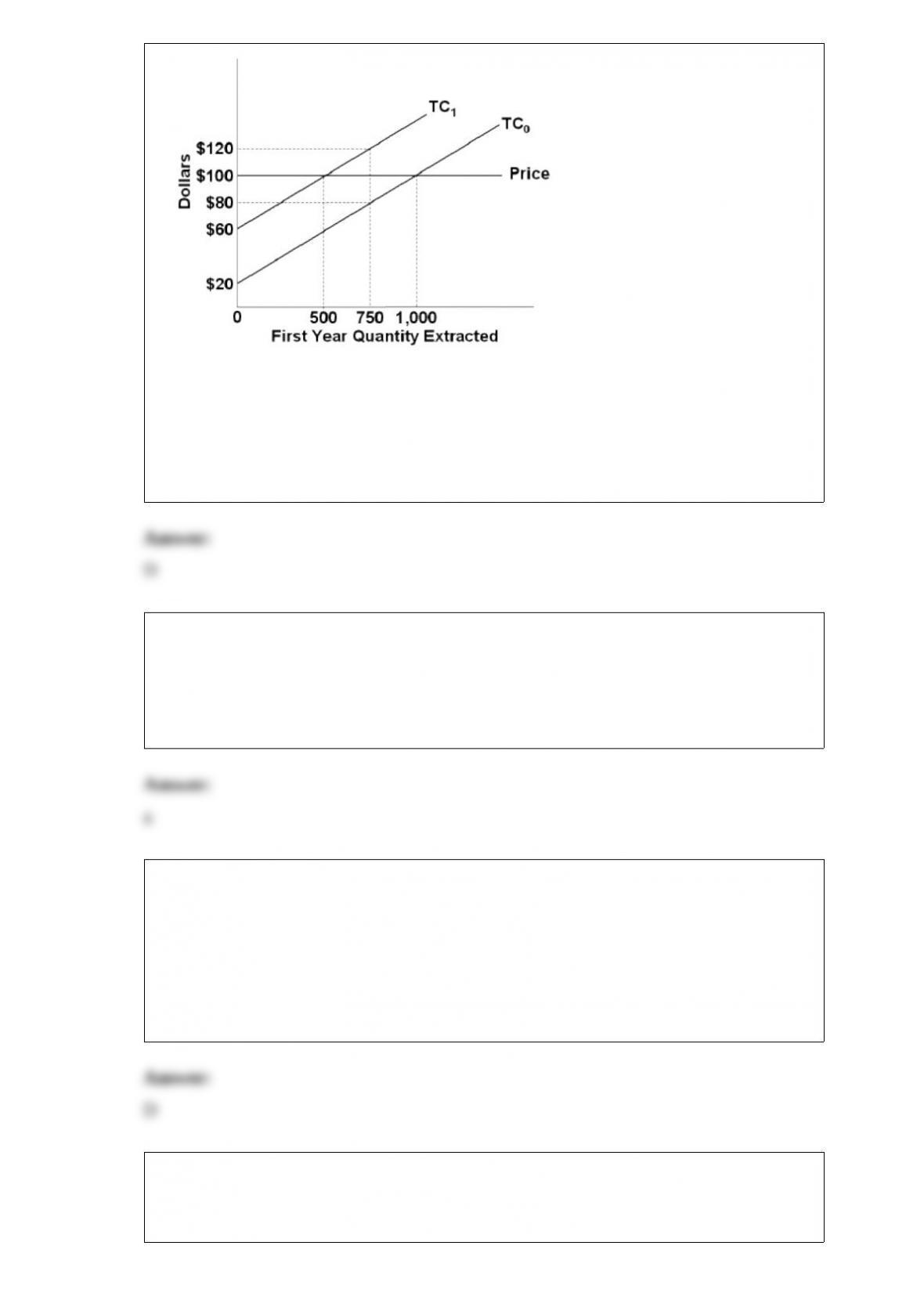
1)
Refer to the diagram above, assuming that the firm represented is operating on curve
TC0. What is the user cost of extracting a unit of this resource?
A.$20.
B.$40.
C.$60.
D.It cannot be determined with the information given.
2) in the circular flow model:
a.households sell resources to firms.
b.households receive income through the product market.
c.households spend income in the resource market.
d.businesses neither buy nor sell resources.
3) Which one of the following research findings is most consistent with the hypothesis
that unions increase productivity?
A.Other things equal, firm profits are lower where unions are present.
B.Union workers receive, on average, higher fringe benefits relative to wages than
nonunion workers.
C.The average amount of work time lost annually to strikes is surprisingly small.
D.Labor turnover is less in unionized firms than in nonunionized firms.
4) Rational expectations theory is based on the assumption that:
A.wages and prices are flexible upward, but inflexible downward.
B.both product and resource markets are very competitive.

C.product markets are competitive, but resource markets are monopolistic.
D.both product and resource markets are monopolistic.
5) The price of government bonds and the interest rate received by a bond buyer are:
A.positively related.
B.unrelated.
C.negatively related.
D. independent of Federal Reserve open-market operations.
6) When the elasticity coefficient for resource demand is less than one, resource
demand is:
A.inelastic.
B.elastic.
C.unit elastic.
D.infinitely elastic.
7) U.S. union membership has declined substantially in recent years. Which of the
following is not usually cited as a causal factor?
A.Most nonunion workers are in manufacturing industries.
B.Import competition has reduced or restrained the growth of employment in some
highly unionized industries.
C.Some industries and firms have migrated to the South.
D.Managerial opposition to unions has intensified.
8) Sales and excise taxes are levied on retailers, but retailers add these taxes to the
prices of their products. This illustrates the:
A.equal sacrifice theory of taxation.
B.shifting of taxes to consumers.
C.ability-to-pay principle of taxation.
D.benefits-received principle of taxation.

9) Actual investment is:
A.gross investment less replacement investment.
B.the ratio of planned investment to unintended increases in inventories.
C.unintended increases in inventories less planned investment.
D.planned investment plus unintended increases in inventories.
10) If nation X has a larger real per capita output than nation Y, then equal rates of
growth of per capita output will:
A.leave the absolute income gap unchanged.
B.decrease the absolute income gap.
C.increase the absolute income gap.
D.cause the nominal per capita outputs of both nations to increase faster than their real
per capita outputs.
11) A merger between a maker of household detergents and a fast food chain would be
an example of:
A.a horizontal merger.
B.an interlocking directorate.
C.a conglomerate merger.
D.a tying contract.