
1) Checkable deposits are also called:
A.checking accounts.
B.high-powered money.
C.savings balances.
D.Federal Reserve Notes.
2) (Consider This) In 2005, the company Changing World Technologies:
A.built a 100-square-mile solar collection station in the desert southwest of the U.S.
B.began processing discarded organic matter into fuel oil, replicating the natural
processes that create fossil fuels.
C.opened the world’s first fusion power plant, using cold fusion technologies that
scientists have been developing for decades.
D.began producing an automobile that runs entirely on hydrogen.
3) the two basic markets shown by the simple circular flow model are:
a.capital goods and consumer goods.
b.free and controlled.
c.product and resource.
d.household and business.
4) Currently capitalist income, that is, corporate profits, interest, and rent, accounts for
about what percentage of the income paid to American resource suppliers?
A.10 percent
B.20 percent
C.50 percent
D.80 percent
5) The “brain drain” problem in the DVCs refers to the fact that the best-educated
workers:
A.are concentrated in the public, rather than the private, sector.
B.are concentrated in the private, rather than the public, sector.
C.are concentrated in urban, rather than rural, areas.
D.have emigrated from the DVCs to the IACs.

6) large minimum efficient scale of plant combined with limited market demand may
lead to:
a.natural monopoly.
b.patent monopoly.
c.government franchise monopoly.
d.shared monopoly.
7) Individual commercial banks are limited in their ability to create money by lending
because:
A.lending is likely to result in the loss of reserves to other banks.
B.only the Treasury and the Federal Reserve Banks are authorized to create new money.
C.the Board of Governors prohibits bank lending when the result is an expansion of the
money supply.
D.banking is a highly competitive industry.
8) the world’s largest exporter (measured in total dollar volume) is:
a.the united states.
b.china
c.japan
d.germany.
9) Economic growth may hinge on whether individuals and institutions within a nation
want growth badly enough to change their traditional ways of doing things. This
statement refers to:
A.in-kind investment.
B.the capricious universe view.
C.human capital investment.
D.the will to develop.
10) which list provides, in order, examples of a private good, a public good, and a
quasi-public good?
a.national defense, a national park, an automobile
b.an automobile, national defense, a national park
c.a national park, an automobile, national defense
d.national defense, an automobile, a national park
11) Kara and Kyle are competing Sockeye Salmon fishers. Both have been allocated
ITQs that limit their catch to 2,000 tons of Sockeye Salmon each. Kara’s cost per ton is
$8; Kyle’s cost per ton is $12.
Refer to the information above. If the market price of Sockeye Salmon is $15 per ton,
and Kara and Kyle both catch their quota, their combined profit will be:
A.$6,000.
B.$14,000.
C.$20,000.
D.$30,000.
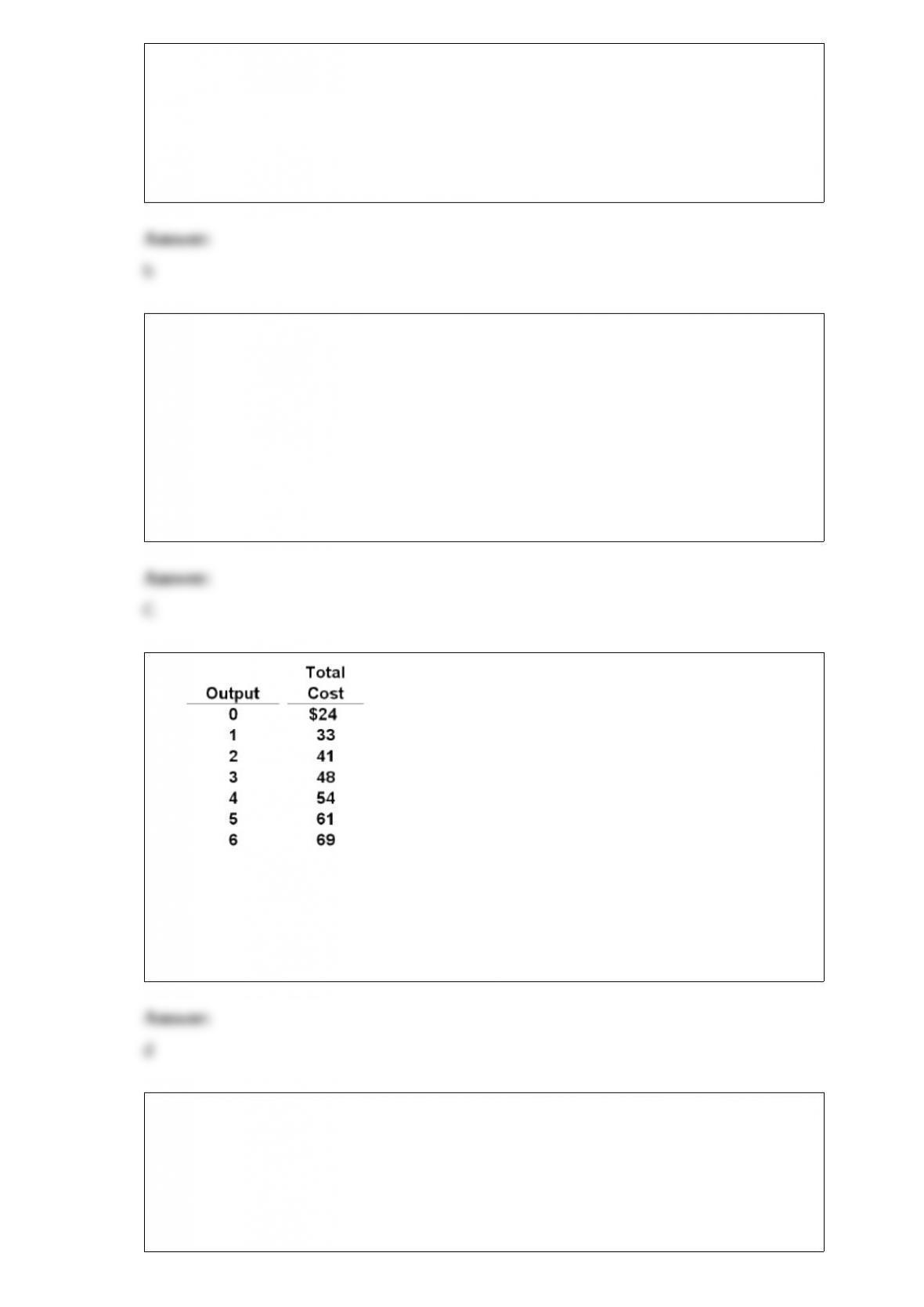
12)
refer to the above data. the average total cost of producing 3 units of output is:
a.$14.
b.$12.
c.$13.50.
d.$16.
13) For DVC per capita incomes to rise, birth rates must first be reduced. This
statement describes the:
A.human capital view of population growth.
B.traditional view of population growth.
C.capricious universe view.
D.demographic transition view of population growth.
14) Successful foreign aid programs:
A.enhance a DVCs resources and therefore shift its production possibilities curve to the
left.
B.enhance a DVCs resources and therefore shift its production possibilities curve to the
right.
C.move the DVC from a high investment-low consumption position to a low
investment-high consumption position on its stable production possibilities curve.
D.cause a DVCs exchange rate to depreciate.
15) between 1995 and 2007, the u.s. productivity rate:
a.was slightly negative, mainly because of record levels of employment growth.
b.picked up substantially compared to prior years, leading some economists to predict a
long-lasting resurgence of productivity growth.
c.slowed considerably relative to the high rates between 1990 and 1995.
d.reached record low levels for the united states’ economy, leading some economists to
talk of ‘secular stagnation.”
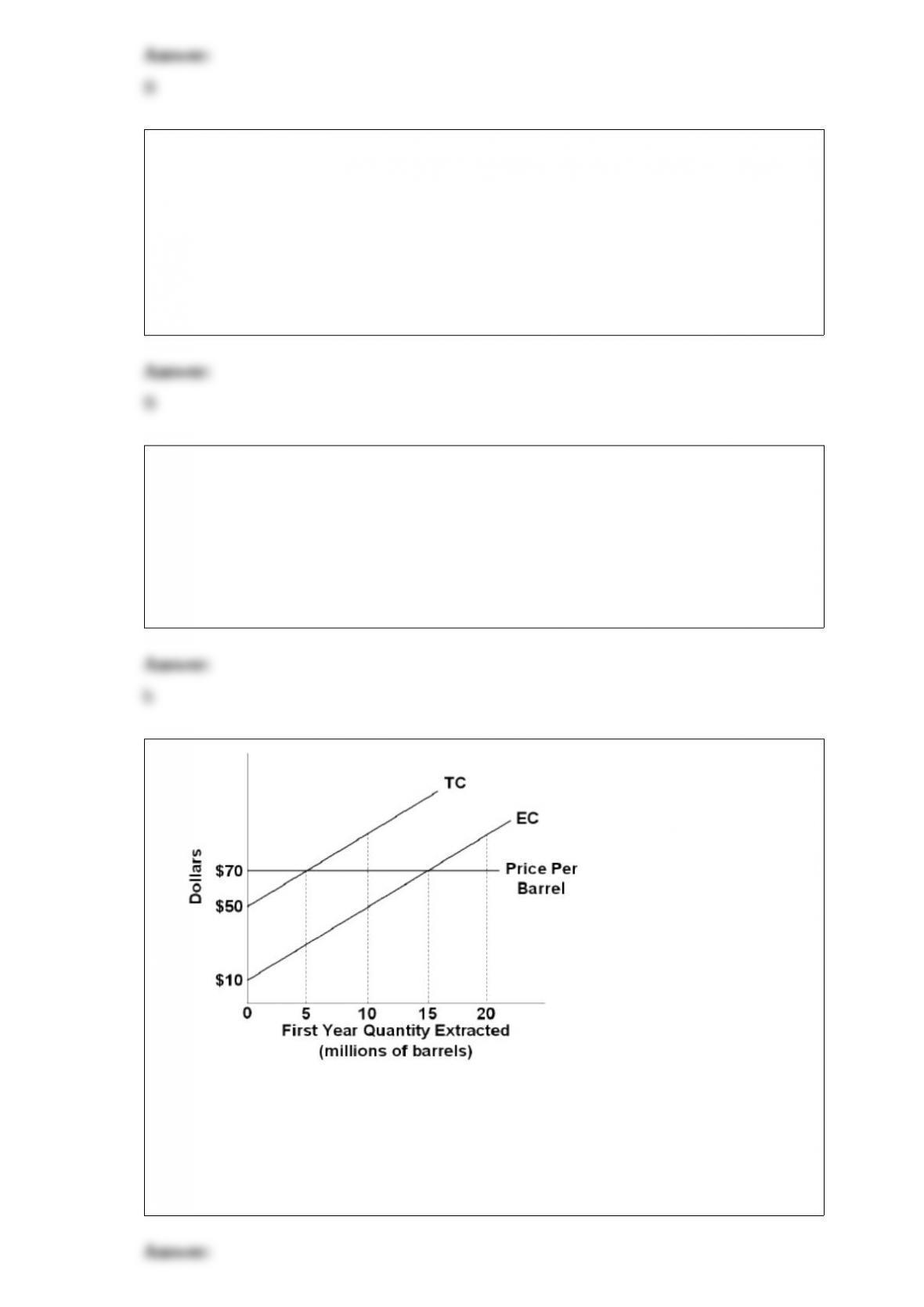
16)
Refer to the diagram above, representing Slippery Slope Oil Company. How many
million barrels should Slippery Slope extract and sell this year?
A.5.
B.10.
C.15.
D.It cannot be determined with the information given.

17) the diamond-water paradox arises because:
a.essential goods may be cheap while nonessential goods may be expensive.
b.the marginal utility of certain products increases, rather than diminishes.
c.essential goods are always higher priced than nonessential goods.
d.we sometimes fail to use money as a standard of value.
18) The principal-agent problem arises primarily because:
A.principals and agents share a common interest, leading to free-rider problems.
B.principals and agents are in an adversarial role, sharing no common interests.
C.principals pursue some of their own objectives that may conflict with the objectives
of the agents.
D.agents pursue some of their own objectives that may conflict with the objectives of
the principals.
19) Wage differentials can arise from:
A.both the demand-side and supply-side of labor markets.
B.the demand-side of labor markets only.
C.the supply-side of labor markets only.
D.neither the demand-side or supply-side of labor markets.