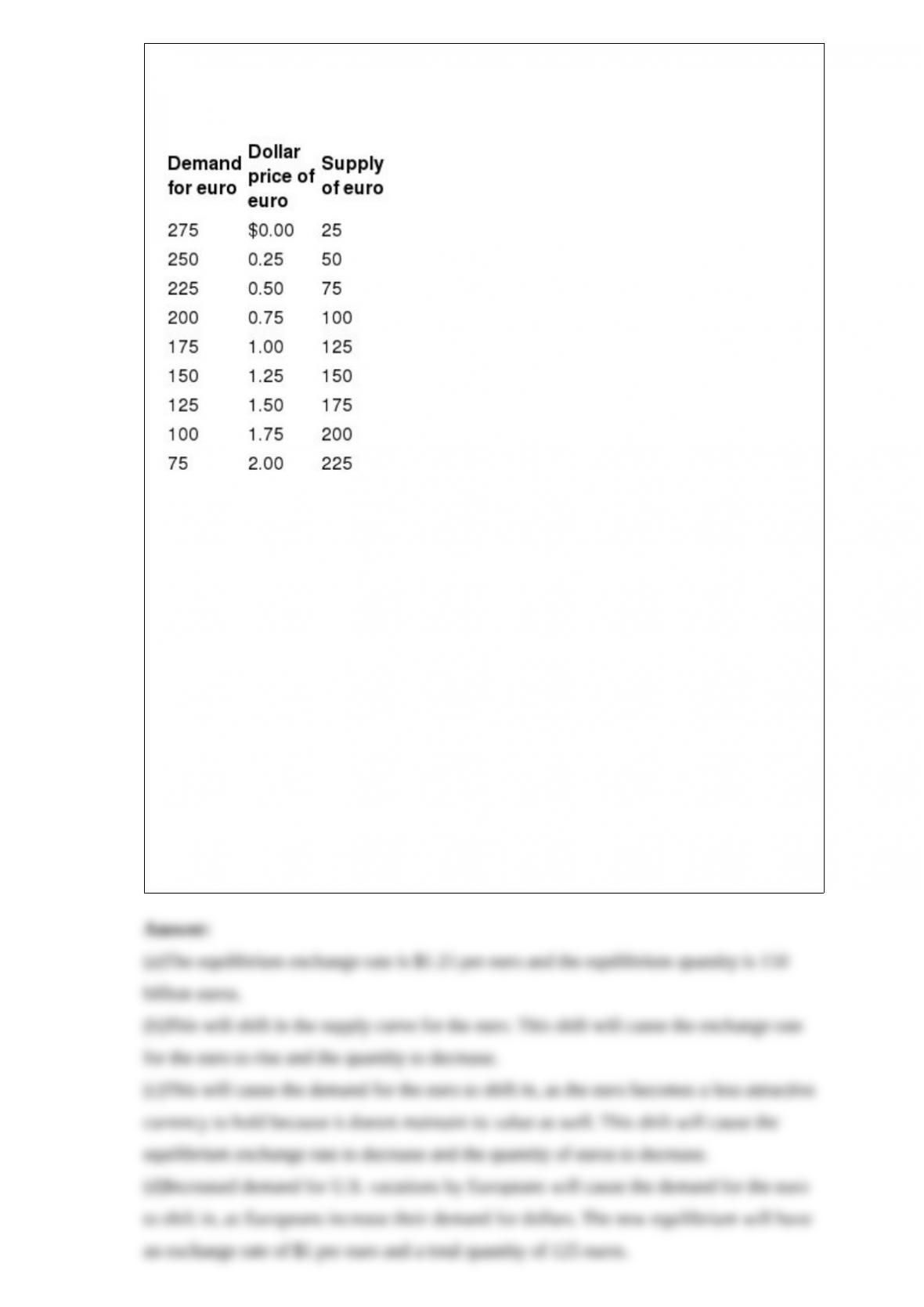
1) The table below summarizes the exchange market for the dollar and euro. Use this
information to answer the following questions.
(a)What is the equilibrium exchange rate and quantity?
(b)Suppose the European Central Bank decides to counter rampant growth by reducing
the money supply to moderate the European economy. How will the supply and demand
situation for the euro change? What likely effect will this have on the equilibrium
exchange rate and quantity?
(c)Suppose that inflation increases in Europe. How will the supply and demand
situation for the euro change? What likely effect will this have on the equilibrium
exchange rate and quantity?
(d)Suppose Europeans decide to take more vacations in the United States. Using the
data in the table above, calculate the new equilibrium. Assume the subsequent shift(s)
(if one or more occur), causes the affected curve(s) to shift by 50 in the appropriate
direction.
(e)Suppose that to pull the U.S. economy out of a recession, the Federal Reserve
decides to reduce interest rates. Facing the same economic conditions, the European
Central Bank decides to increase the money supply. Using the data in the table above,
calculate the new equilibrium. Assume the subsequent shift(s) (if one or more occur),
causes the affected curve(s) to shift by 50 in the appropriate direction.

2) For the firm, the major goal of profit sharing plans is to:
A.force workers to incur some of the business risk.
B.overcome the monopsony problem of having to pay higher wages to attract additional
workers.
C.overcome the principal-agent problem by better aligning the workers’ interests with
those of the firm.
D.reduce total compensation payments.
3) in 2005, the median age for u.s. immigrants who had lived in the united states for
less than a year was:
a.18.
b.25.
c.32.
d.45.
4) graphically, producer surplus is measured as the triangle:
a.under the demand curve and below the actual price.
b.under the demand curve and above the actual price.
c.above the supply curve and above the actual price.
d.above the supply curve and below the actual price.
5) a firm finds that at its mr = mc output, its tc = $1,000, tvc = $800, tfc = $200, and
total revenue is $900. this firm should:
a.shut down in the short run.
b.produce because the resulting loss is less than its tfc.

c.produce because it will realize an economic profit.
d.liquidate its assets and go out of business.
6) A rightward shift in the aggregate supply curve is best explained by an increase in:
A.business taxes.
B.productivity.
C.nominal wages.
D.the price of imported resources.
7) In the theory of comparative advantage, a good should be produced in that nation
where:
A.the production possibilities line lies further to the right than the trading possibilities
line.
B.its cost is least in terms of alternative goods that might otherwise be produced.
C.its absolute cost in terms of real resources used is least.
D.its absolute money cost of production is least.
8) The field of economics that analyzes government decision making, politics, and
elections is called:
A.public finance.
B.public choice theory.
C.collective economics.
D.political economy.
9) “Earmarks” refer to:
A.the additional votes that must be taken when a voting paradox occurs.
B.taxes that redistribute wealth or income from one income group to another.
C.authorized expenditures that benefit a narrow, specifically designated group, that are
included in more comprehensive spending legislation.
D.legislation focused on correcting negative externalities.
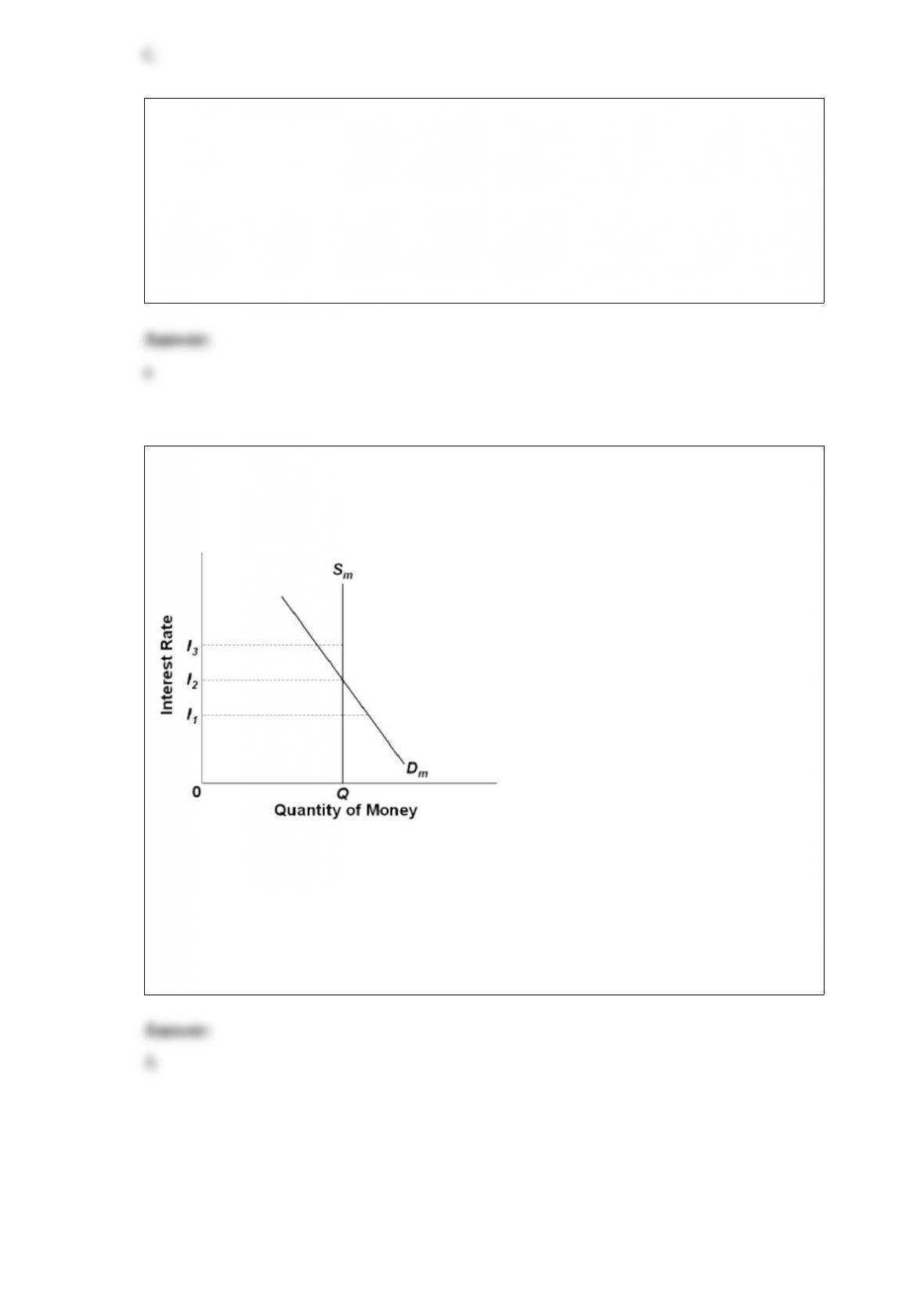
10) suppose that an economy’s labor productivity fell by 3 percent and its total
worker-hours remained constant between year 1 and year 2. we could conclude that this
economy’s:
a.real gdp declined.
b.capital stock increased.
c.production possibilities curve shifted outward.
d. actual production moved from one point to another on a fixed production possibilities
curve.
11) Answer the next question(s) on the basis of the following information for a bond
having no expiration date: bond price = $1000; bond fixed annual interest payment =
$100; bond annual interest rate = 10 percent.
Refer to the above information. If the price of this bond falls by $200, the interest rate
will:
A.rise by 2.5 percentage points.
B.rise by 5 percentage points.
C.fall by 2.5 percentage points.
D.fall by 5 percentage points.
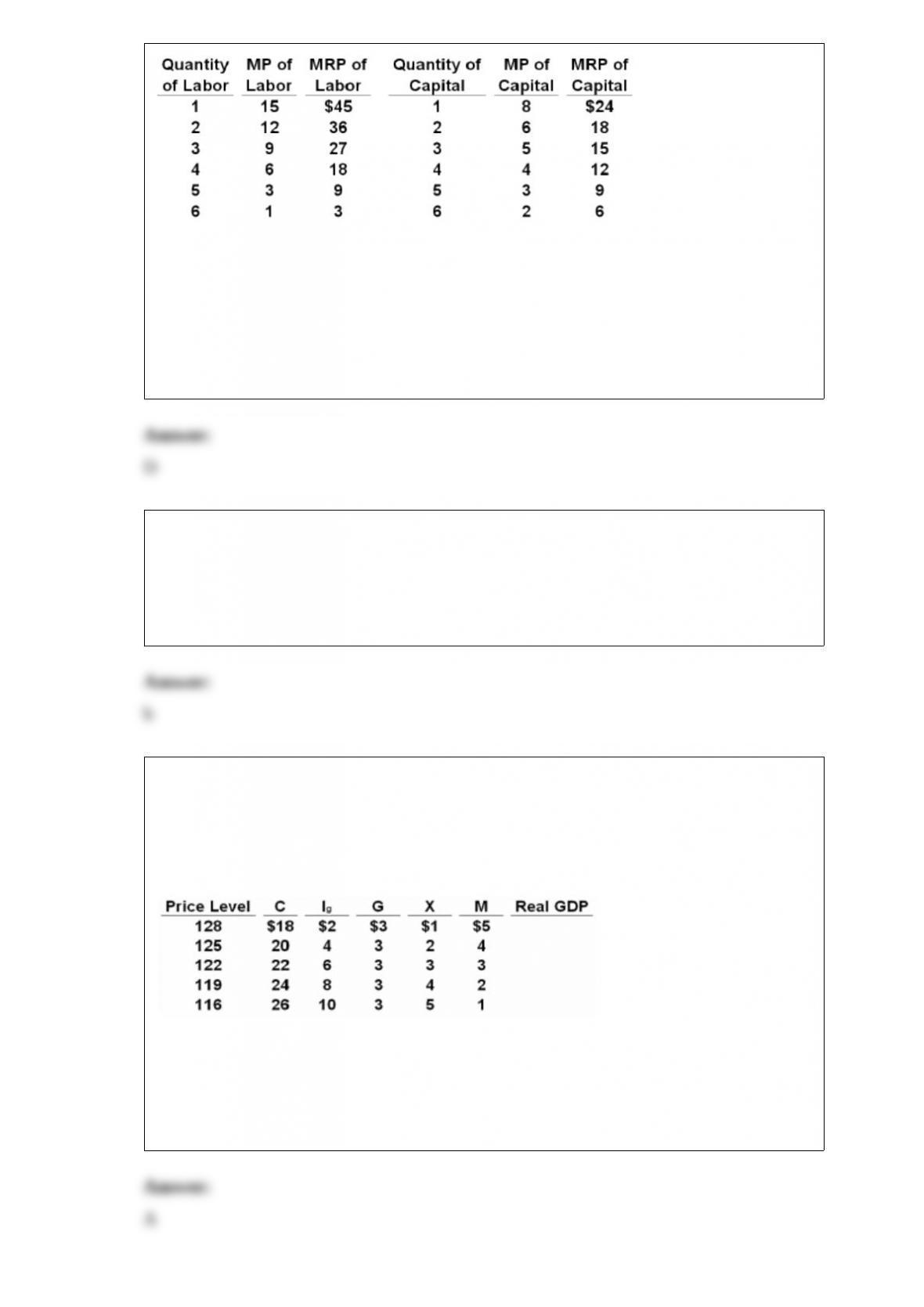
12) Refer to the above
data. If the prices of labor and capital are $9 and $15 respectively, and labor and capital
are the only inputs, at the profit-maximizing level of output the firm’s total costs will
be:
A.$106.
B.$126.
C.$47.
D.$90.
13) the short-run average total cost curve is u-shaped because:
a.average fixed costs decline continuously as output increases.
b.of increasing and diminishing returns.
c.of economies and diseconomies of scale.
d.minimum efficient scale is encountered.
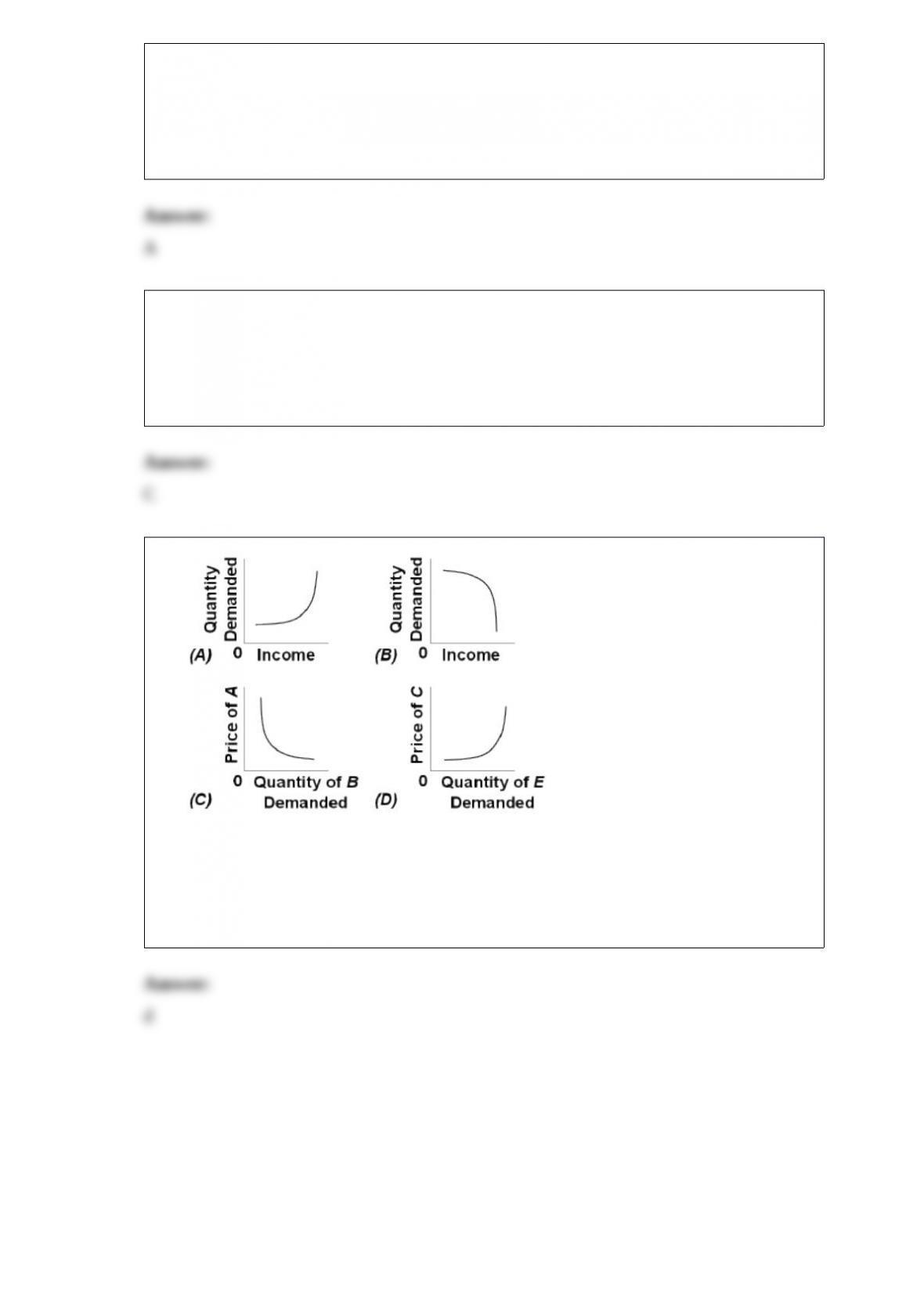
14) Answer the next question(s) on the basis of the following table for a particular
country in which C is consumption expenditures, Ig is gross investment expenditures, G
is government expenditures, X is exports, and M is imports. All figures are in billions of
dollars. Each question is independent of the other questions.
Refer to the above table. The real-balances effect of changes in the price level is:
A.shown by columns (1) and (2) of the table.
B.shown by columns (1) and (5) of the table.
C.shown by columns (1) and (4) of the table.
D.not shown by the data in the table.
15) Actual investment equals saving:
A.at all levels of GDP.
B.at all below-equilibrium levels of GDP.
C.at all above-equilibrium levels of GDP.
D.only at the equilibrium GDP.
16) The Bretton Woods system of exchange rates relied on:
A.freely floating exchange rates.
B.fixed exchange rates with no mechanism for changing them.
C.fixed or pegged exchange rates, with occasional orderly adjustments to the rates.
D.the United States to set and periodically review worldwide exchange rates.
17)
refer to the above diagrams. the case of substitute goods is represented by figure:
a.a.
b.b.
c.c.
d.d.