
1) Conspiracies to fix prices are:
A.illegal under the Clayton Act.
B.illegal under the Celler-Kefauver Act.
C.per se violations of the antitrust laws.
D.more tolerated by government today than two or three decades ago.
2) the two general types of economic systems that exist today are:
a.market systems and capitalism.
b.socialism and central planning.
c.market systems and command systems.
d.laissez faire systems and pure command systems.
3) susie lives in a dorm and likes to play loud music in her room. her neighbor kara
enjoys the same type of music and gets pleasure from susie turning up the music. her
other neighbor, alex, can’t stand susie’s music and gets mad when she turns it up for all
to hear. when susie plays her music loudly, she creates:
a.a positive externality for kara, and a negative externality for alex.
b.a negative externality for kara, and a positive externality for alex.
c.positive externalities for both kara and alex.
d.negative externalities for both kara and alex.
4) Suppose that real domestic output in an economy is 20 units, the quantity of inputs is
10, and the price of each input is $4. Answer the following question(s) on the basis of
this information.
Refer to the above information. The level of productivity is:
A.20.
B.10.
C.5.
D.2.
5)
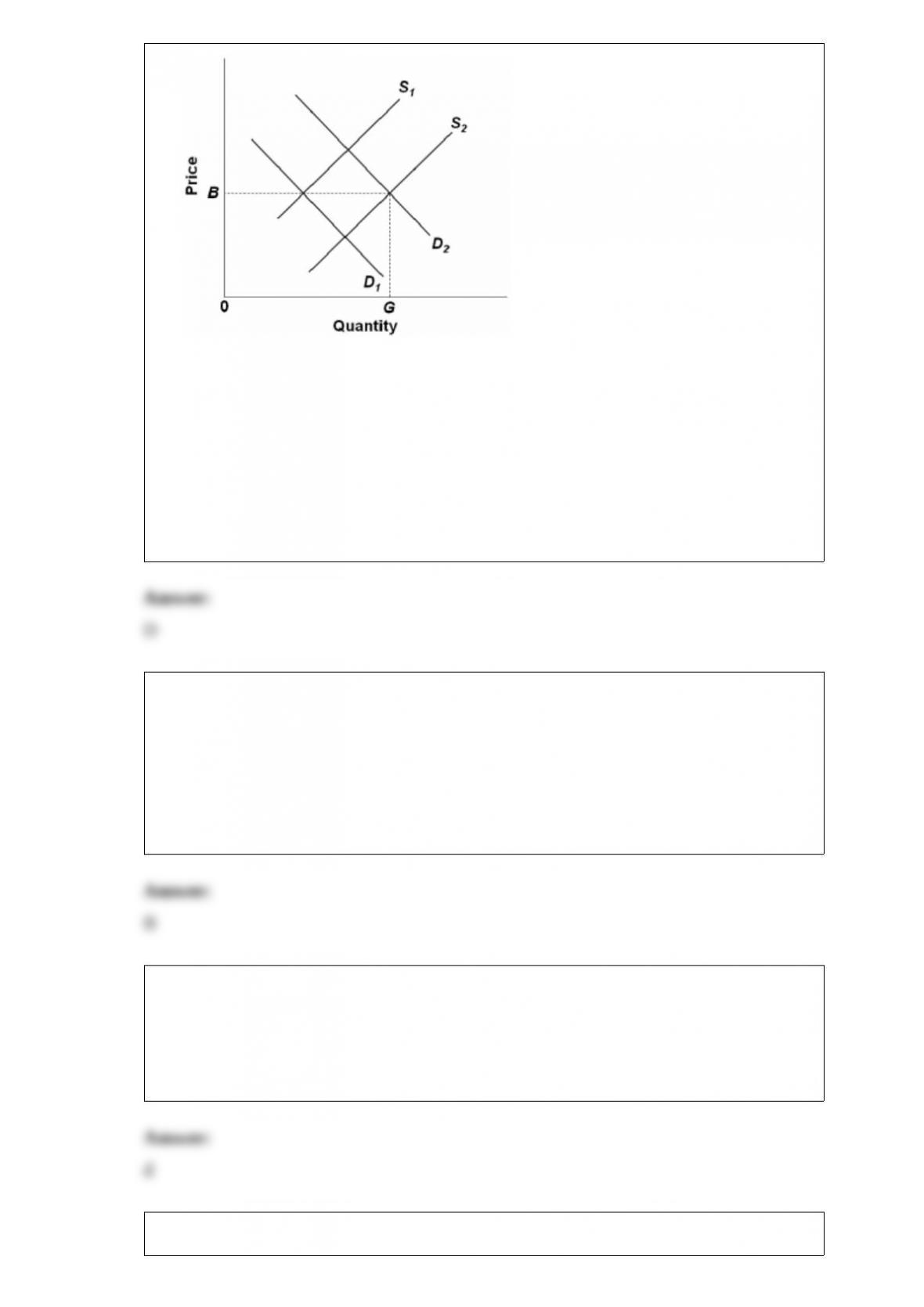
Refer to the above competitive market diagram for product Z. Assume that the current
market demand and supply curves for Z are D2 and S2. If there are substantial external
benefits associated with the production of Z, then:
A.efficient resource allocation occurs at output G and price B because the market
mechanism does not measure all benefits.
B.an output smaller than G would improve resource allocation.
C.government should levy a per unit excise tax on Z to shift the demand curve toward
D1.
D.an output greater than G would result in a more efficient allocation of resources.
6) Suppose all workers are identical, but working for Ajax is more pleasant than
working for Acme. In all other nonwage aspects the two firms offer the same job
characteristics. We would expect:
A.wage rates at Ajax to be higher than at Acme.
B.wage rates at Ajax to be lower than at Acme.
C.wage rates at Ajax and Acme to be the same.
D.workers at Ajax would have to be monitored more closely than at Acme.
7) in calculating the gdp national income accountants:
a.treat inventory changes as an adjustment to personal consumption expenditures.
b.ignore inventories because they do not represent final goods.
c.subtract increases in inventories or add decreases in inventories.
d.add increases in inventories or subtract decreases in inventories.
8) Marginal resource cost refers to the:
A.increase in total revenue resulting from the sale of the extra output of one more
worker.
B.price at which additional units of a resource can be hired in an imperfectly
competitive resource market.
C.increase in total cost resulting from the production of one more unit of output.
D.amount by which a firm’s total resource cost increases as the result of hiring one
more unit of the resource.
9)
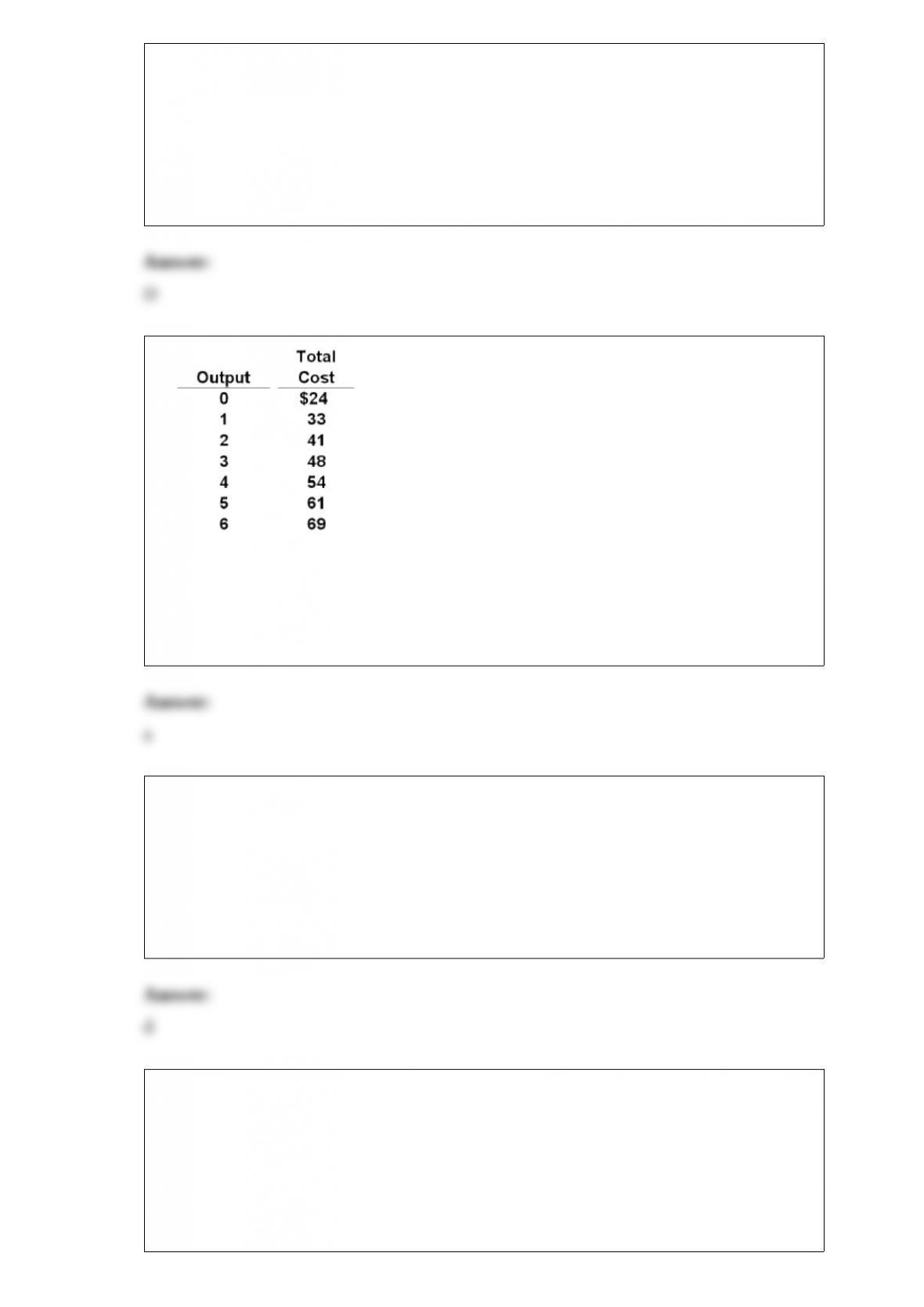
refer to the above data. the average fixed cost of producing 3 units of output is:
a.$8.
b.$7.40.
c.$5.50.
d.$6.
10) suppose that a business incurred implicit costs of $500,000 and explicit costs of $5
million in a specific year. if the firm sold 100,000 units of its output at $50 per unit, its
accounting:
a.profits were $100,000 and its economic profits were zero.
b.losses were $500,000 and its economic losses were zero.
c.profits were $500,000 and its economic profits were $1 million.
d.profits were zero and its economic losses were $500,000.
11) Answer the next two questions using the following information: The price of a bond
with no expiration date is $1000 and its fixed annual interest payment is $50; bond
annual rate of interest is 5%.
(a)If the price of this bond decreases by $250 to $750, what will its effective interest
rate be for the new buyer?
(b)If the price of this bond increases to $1200, what will its effective interest rate be for
the new buyer?