
1) Answer the next three questions on the basis of the following data:
(a)What type of tax is represented by the tax schedule?
(b)What will your average tax rate be if your taxable income is $50,000?
(c)If your taxable income increases from $30,000 to $40,000, what will your marginal
tax rate be?
2) An increase in investment spending caused by higher expected rates of return will:
A.shift the aggregate supply curve to the left.
B.move the economy up along an existing aggregate demand curve.
C.shift the aggregate expenditures curve downward and the aggregate demand curve to
the left.
D.shift the aggregate expenditures curve upward and the aggregate demand curve to the
right.
3) Suppose that a union successfully negotiated a 10 percent wage increase and the
quantity of labor demanded decreased by 10 percent. Given a fixed labor demand curve,
we can conclude that:
A.the labor demand curve is upward sloping.
B.labor demand is elastic.
C.labor demand is unit-elastic.
D.the coefficient of elasticity of labor demand is less than 1.
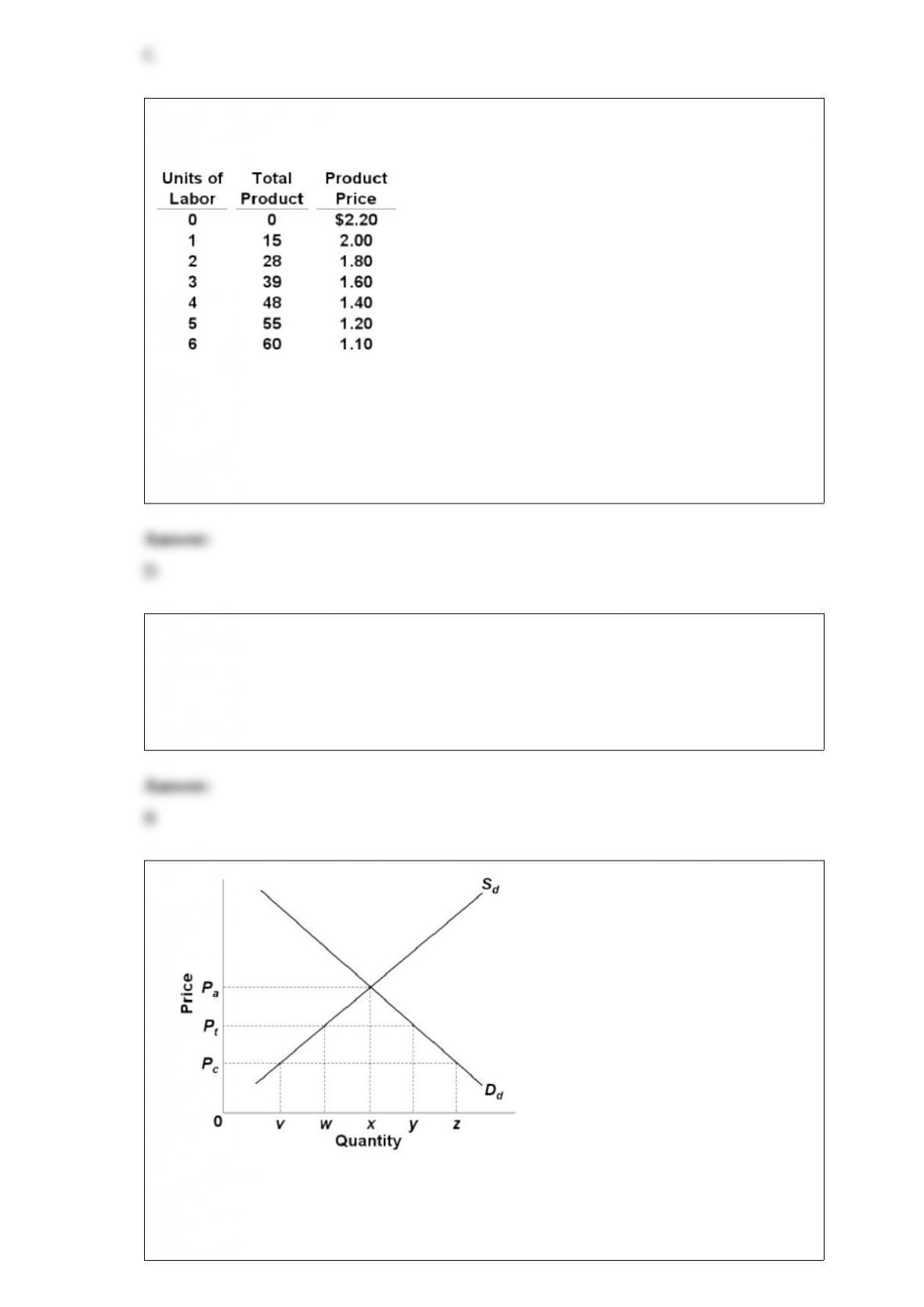
4) Assume that the firm is hiring labor in a purely competitive market.
Refer to the above data. If the wage rate is $20, how many workers will the firm choose
to employ?
A.5
B.4
C.3
D.2
5) Rational expectations theory implies that the:
A.aggregate demand curve is vertical.
B.long-run aggregate supply curve is vertical.
C.long-run aggregate supply curve is horizontal.
D.long-run aggregate supply curve is quite flat.
6)
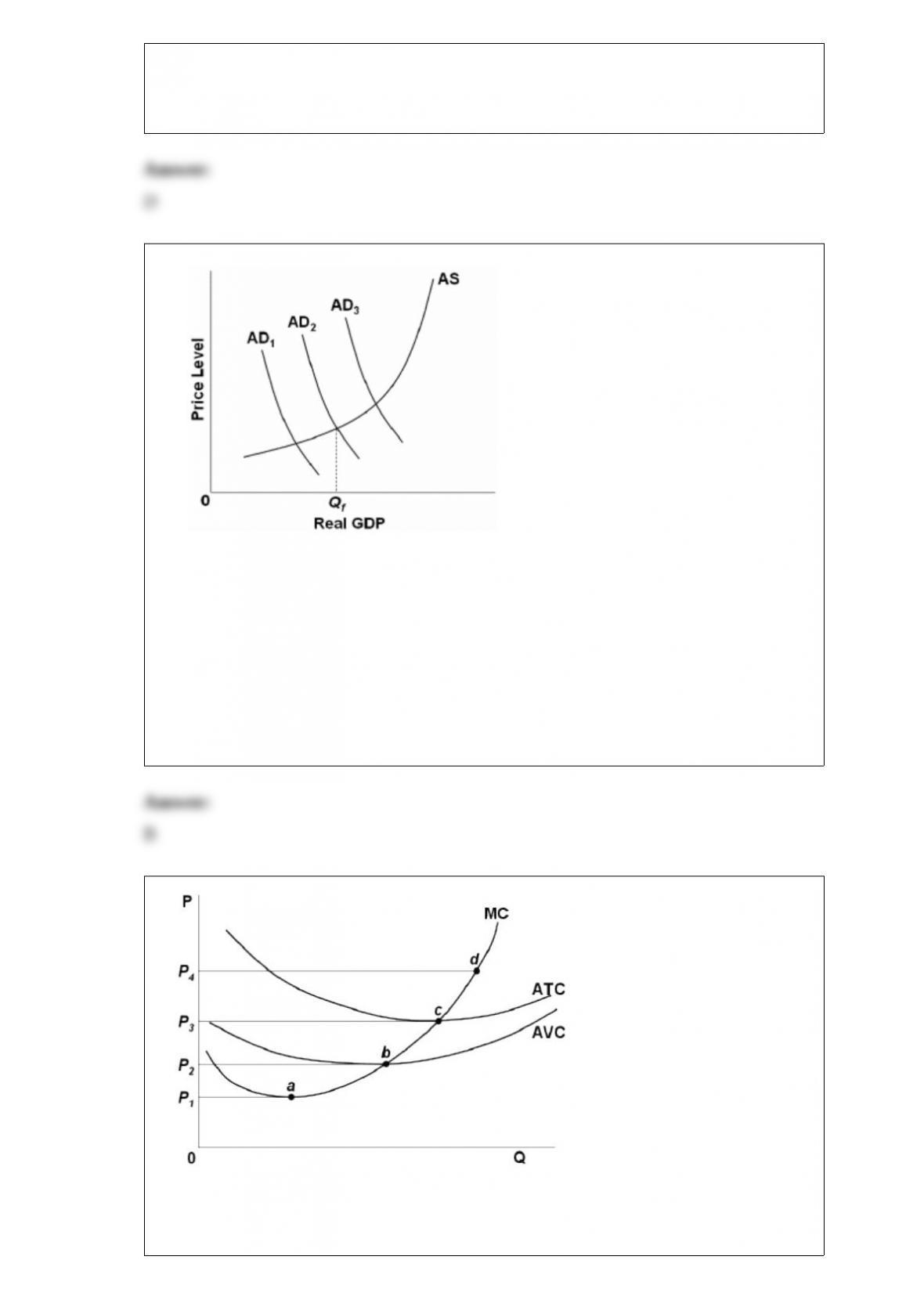
Refer to the above diagram, where Sd and Dd are the domestic supply and demand for a
product and Pc is the world price of that product. With a PcPt per unit tariff, the
quantities sold by foreign and domestic producers respectively will be:
A.xz and x
B.xv and xz
C.x and xz
D.wy and w
7)
Refer to the above diagram, in which Qf is the full-employment output. If aggregate
demand curve AD3describes the current situation, appropriate fiscal policy would be to:
A.do nothing since the economy appears to be achieving full-employment real output.
B.increase taxes and reduce government spending to shift the aggregate demand curve
leftward from AD3 to AD2, assuming downward price flexibility.
C.increase taxes on businesses to shift the aggregate supply curve rightward to reduce
the price level.
D.increase taxes and reduce government spending to shift the aggregate demand curve
from AD3 to AD1.
8)
refer to the above diagram for a purely competitive producer. if product price is p3:
a.the firm will maximize profit at point d.
b.the firm will earn an economic profit.
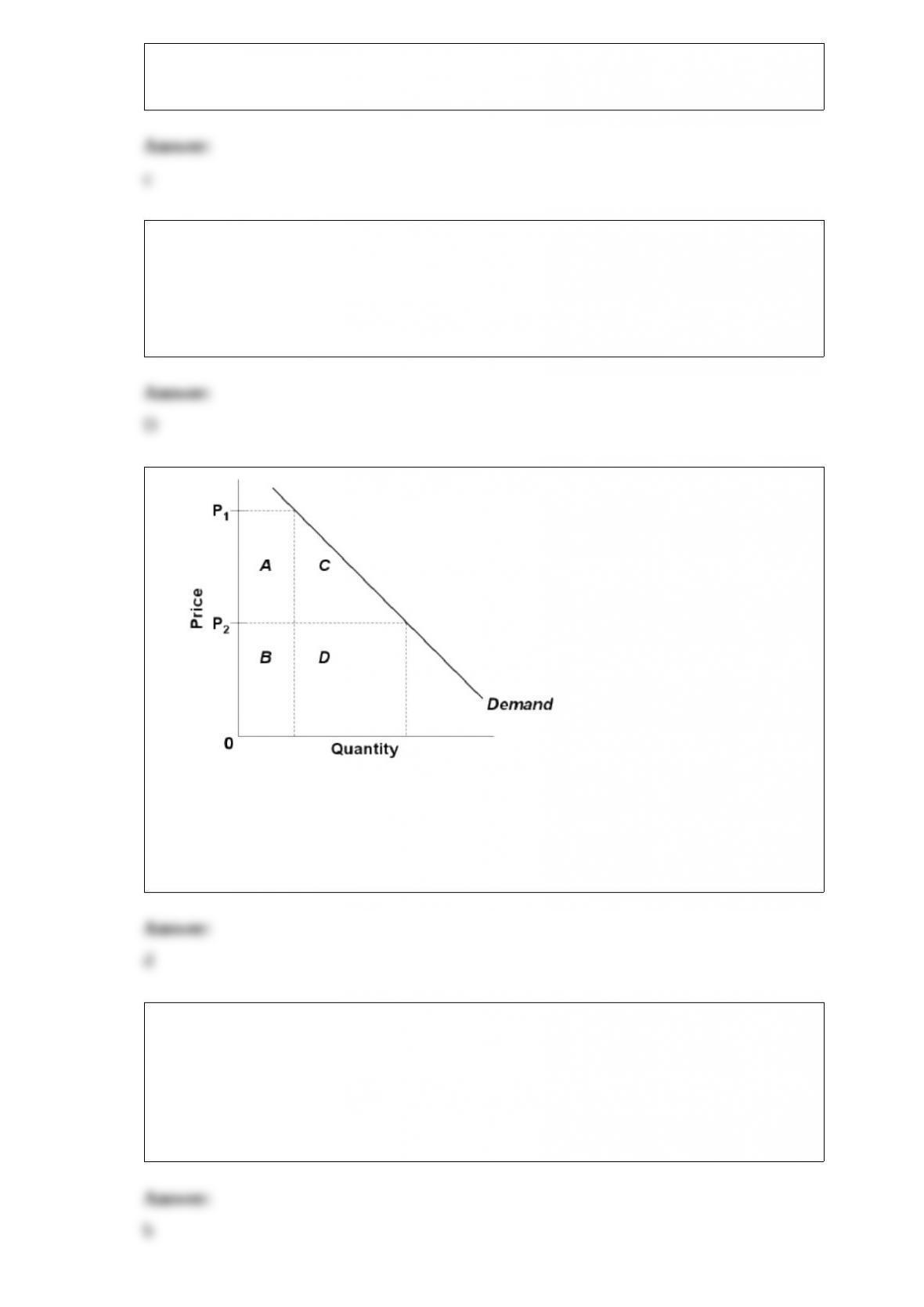
c.economic profits will be zero.
d.new firms will enter this industry.
9) Which of the following is not part of the M2 money supply?
A.money market mutual fund balances
B.money market deposit accounts
C.currency
D.large time deposits
10)
refer to the above diagram. the decline in price from p1to p2will:
a.increase total revenue by d
b.increase total revenue by b + d
c.decrease total revenue by a
d.increase total revenue by d – a
11) the unemployed are disproportionately represented among the uninsured because:
a.one must be working to qualify for medicaid.
b.most workers obtain health insurance through their employers.
c.most are young and in excellent health, so they choose not to purchase health
insurance.
d.a large percentage of the unemployed are heads of single-parent families.

12) the pure food and drug act is an illustration of:
a.governmental provision of public goods.
b.the redistributional function of government.
c.governmental provision of a suitable legal framework for the market system.
d.governmental action designed to enhance competition.