1) full-employment output is also called:
a.zero-unemployment output.
b.equilibrium output.
c.potential output.
d.zero-savings output.
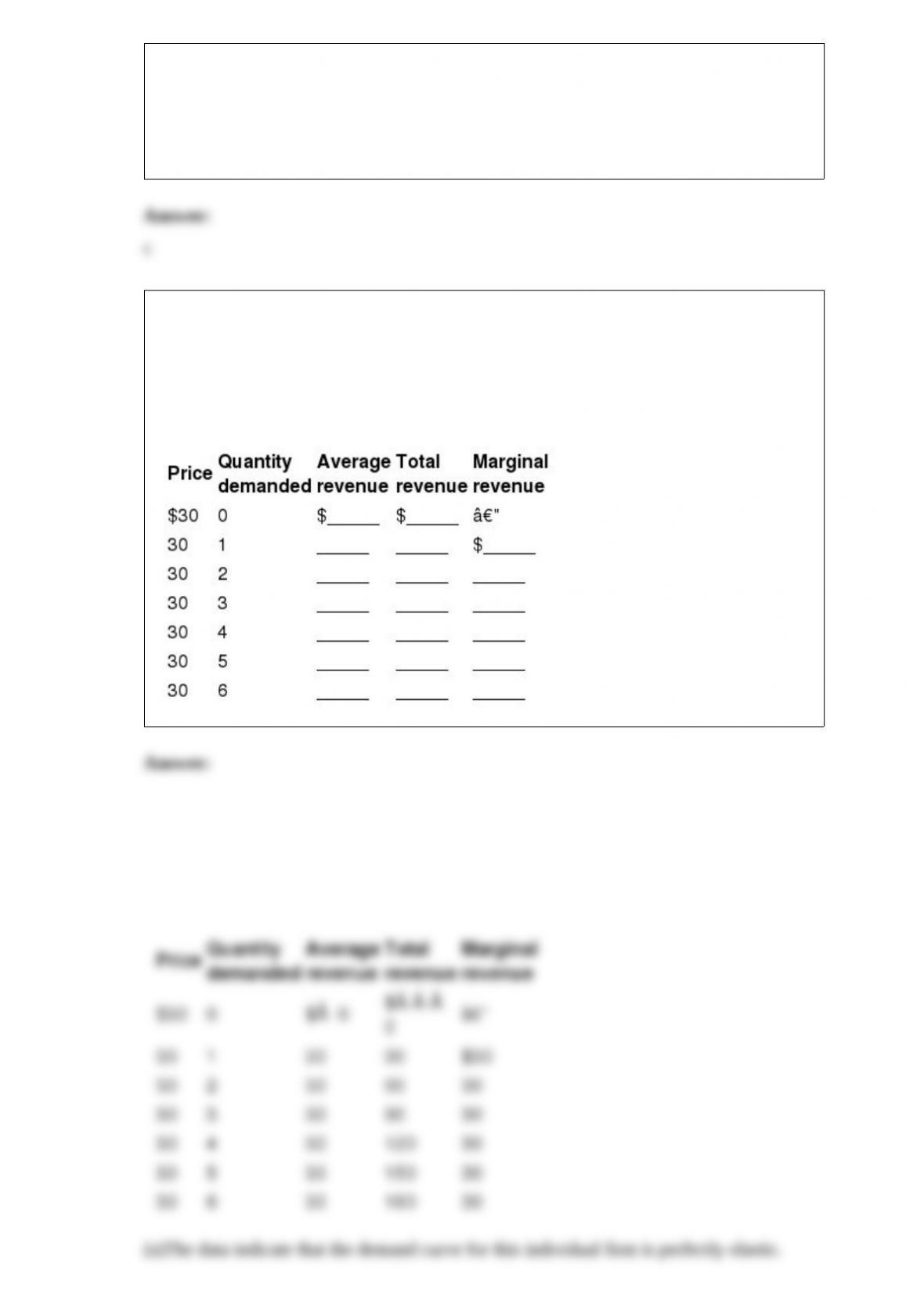
2) Below is a demand schedule facing an individual firm. Complete the table by
computing average revenue, total revenue, and marginal revenue. Then answer the
following two questions: (a) How can you tell whether a firm is operating in a market
that is purely competitive? (b) What relationship exists between average revenue and
marginal revenue?
3) Mining of “conflict diamonds” tends to:
A.be more profitable as warring factions are willing to pay more for the diamonds.
B.occur at a slower pace than would maximize the long-term stream of profits because
war increases extraction costs.
C.occur at a pace slower than would maximize the long-term stream of profits since the
war disrupts production.
D.occur at a pace faster than would maximize the long-term stream of profits since
warring factions extract diamonds as quickly as possible due to fears that they may
soon lose control of the diamond mines.
4)
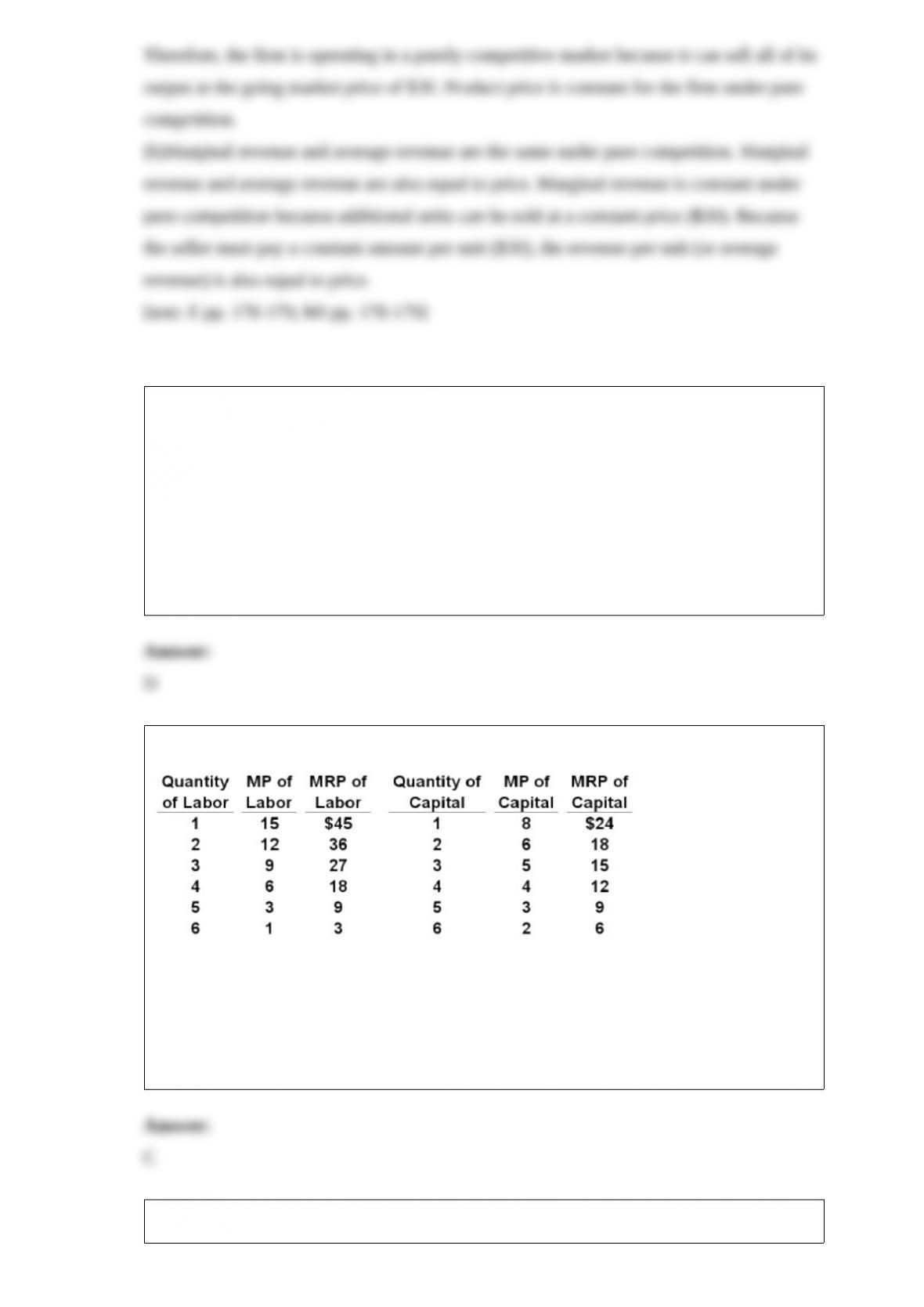
Refer to the above data. If the prices of labor and capital are $9 and $15 respectively, at
the profit-maximizing level the firm’s total output will be:
A.38 units.
B.60 units.
C.64 units.
D.27 units.
5) Suppose the United States eliminates high tariffs on German bicycles. As a result, we

would expect:
A.the price of German bicycles to increase in the United States.
B.employment to decrease in the German bicycle industry.
C.employment to decrease in the U.S. bicycle industry.
D.profits to rise in the U.S. bicycle industry.
6) price exceeds marginal revenue for the pure monopolist because the:
a.law of diminishing returns is inapplicable.
b.demand curve is downsloping.
c.monopolist produces a smaller output than would a purely competitive firm.
d.demand curve lies below the marginal revenue curve.
7) if a good’s production creates substantial positive externalities and no negative
externalities, then too:
a.much of the good will be produced unless firms are subsidized.
b.much of the good will be produced unless firms are taxed.
c.little of the good will be produced unless firms are subsidized.
d.little of the good will be produced unless firms are taxed.
8) the process by which economists test hypotheses against facts to develop theories,
principles, and models is called:
a.the economic perspective.
b.the scientific method.
c.policy economics.
d.microeconomics.
9) the following table showing the demand schedule facing a nondiscriminating
monopolist:
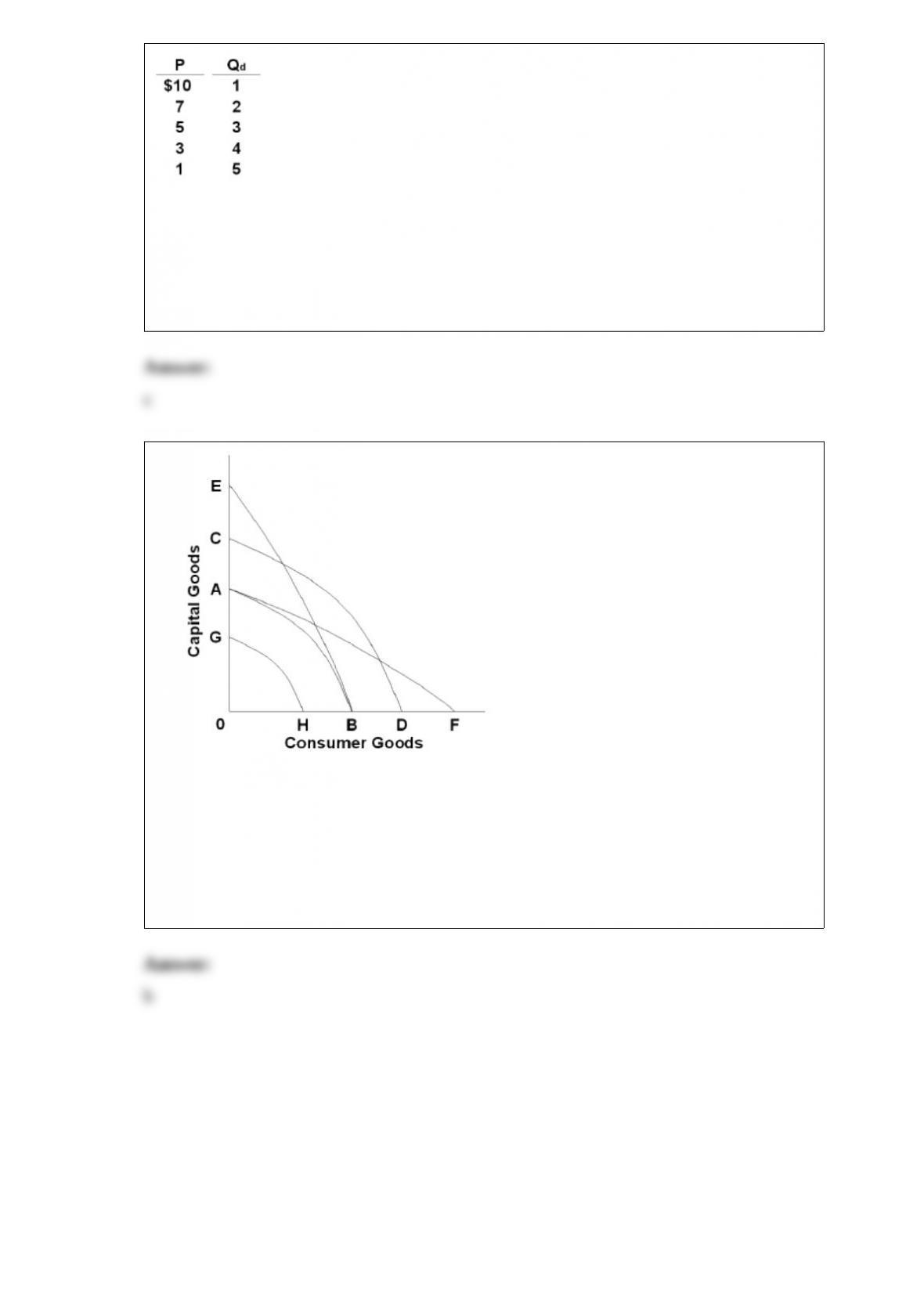
refer to the above table. assume that this monopolist faces zero production costs. the
profit-maximizing monopolist will set a price of:
a.$10.
b.$7.
c.$5.
d.$3.
10)
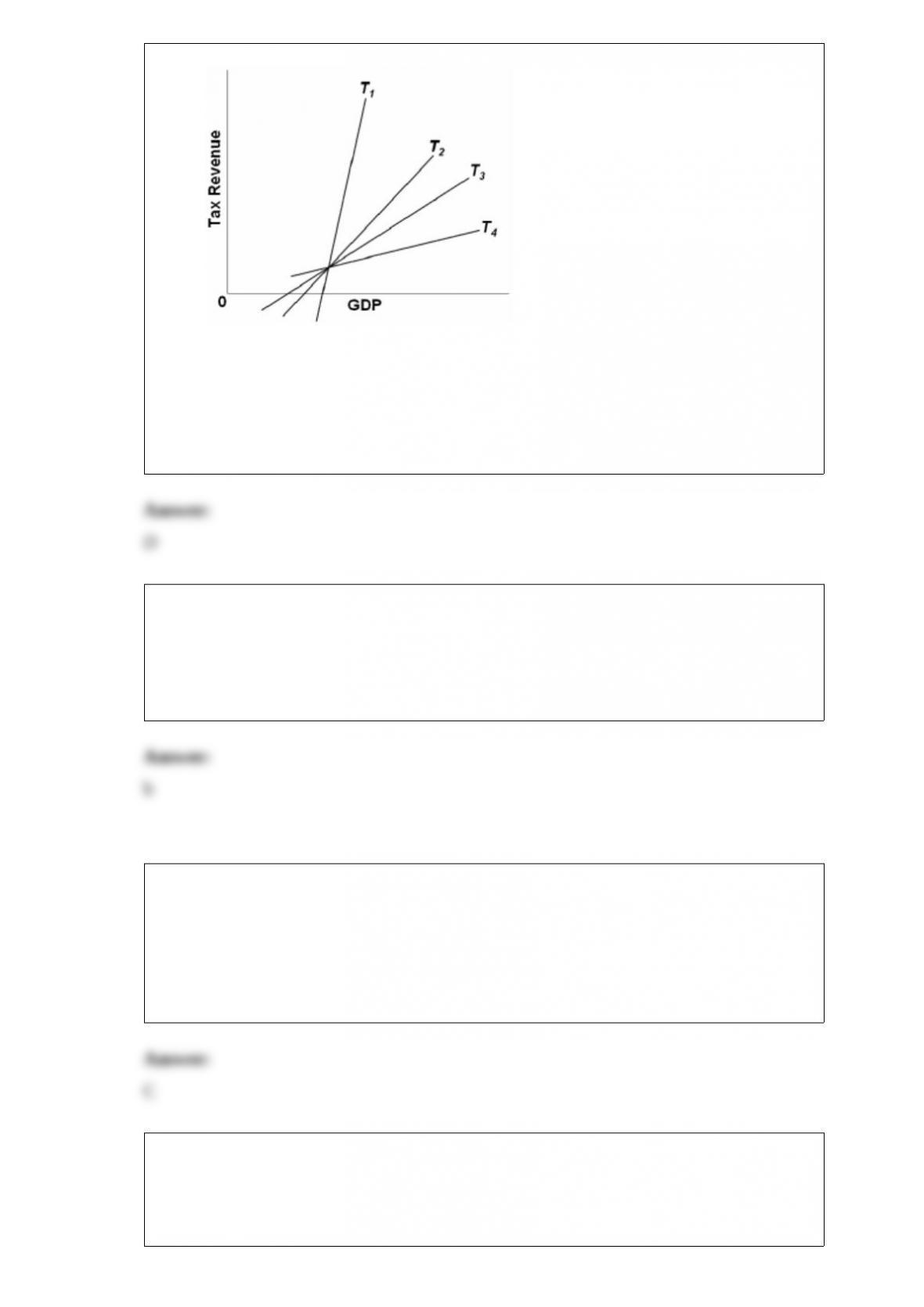
refer to the above diagram. technological advance that improves the ability to produce
capital goods but not consumer goods is shown by the shift of the production
possibilities curve from ab to:
a.cd.
b.be.
c.af.
d.gh.
11)
Refer to the above diagram. Which tax system has the most built-in stability?
A.T4
B.T3
C.T2
D.T1
12) the post hoc fallacy and the correlation problem both relate to:
a.the calculation of marginal costs and marginal benefits of any economic activity.
b.the issue of determining causation.
c.the frequent inability of households and businesses to behave rationally.
d.the tradeoff problem associated with competing goals.
13) Assume the supply curve for product X is perfectly elastic and that government
imposes a $2 per unit excise tax. We can conclude that the resulting:
A.increase in output will be greater the less elastic the demand curve.
B.decrease in output will be greater the less elastic the demand curve.
C.decrease in output will be greater the more elastic the demand curve.
D.increase in output will be greater the more elastic the demand curve.
14) If government uses fiscal policy to restrain cost-push inflation, we can expect:
A.the unemployment rate to rise.
B.the unemployment rate to fall.
C.the aggregate demand curve to shift rightward.
D.tax-rate declines and increases in government spending.
15) the following is cost information for the creamy crisp donut company:
entrepreneur’s potential earnings as a salaried worker = $50,000
annual lease on building = $22,000
annual revenue from operations = $380,000
payments to workers = $120,000
utilities (electricity, water, disposal) costs = $8,000
value of entrepreneur’s talent in the next best entrepreneurial activity = $80,000
entrepreneur’s forgone interest on personal funds used to finance the business = $6,000
refer to the above data. creamy crisp:
a.has lower implicit costs, including a normal profit, than its explicit costs.
b.is earning a normal profit but not an economic profit.
c.is earning an economic profit.
d.is suffering an economic loss, when implicit costs are considered.
16) Technological advance improves allocative efficiency by:
A.enhancing monopoly power.
B.reducing income inequality.
C.giving society a more-preferred mix of goods and services.
D.encouraging saving.
17)
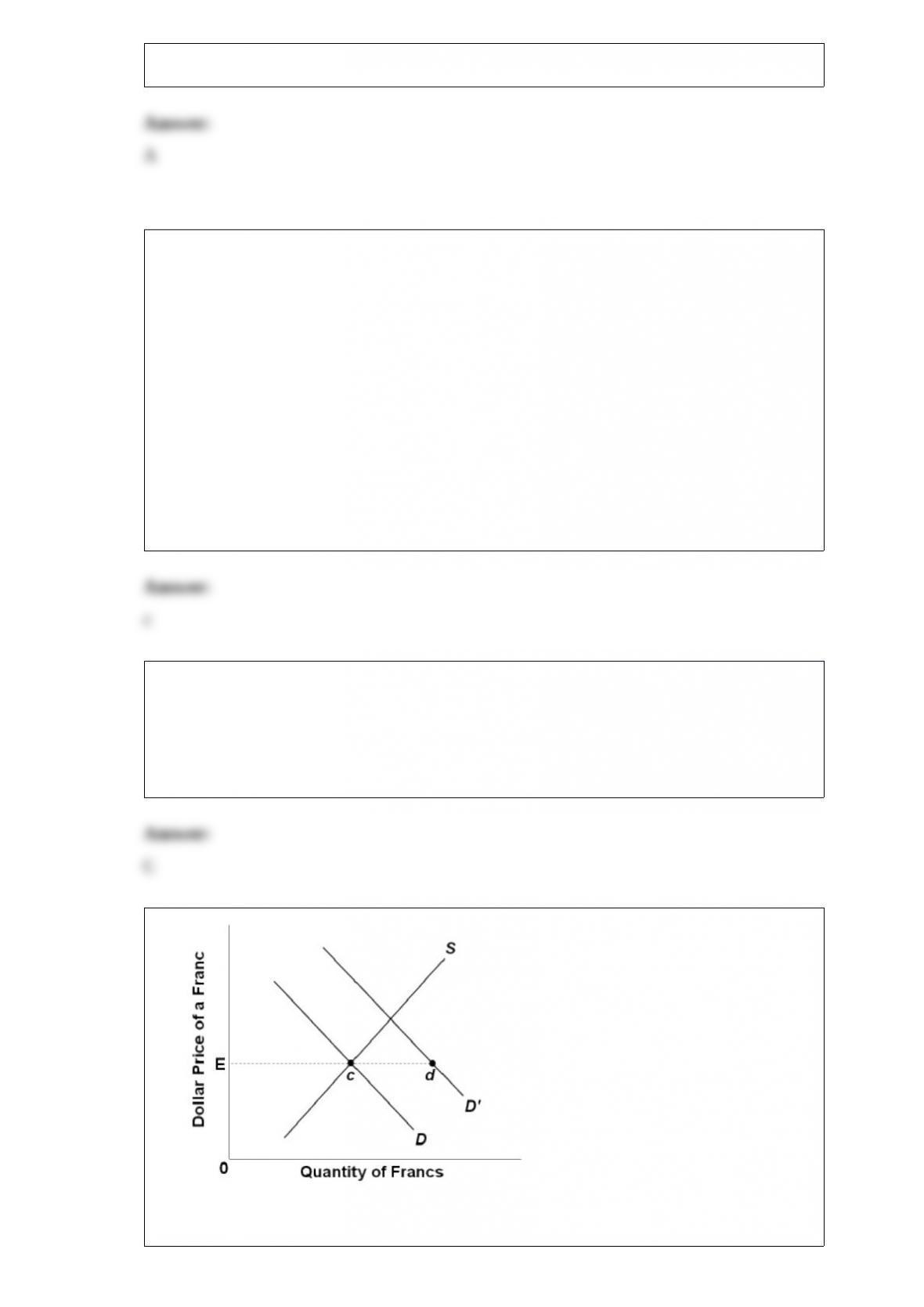
Refer to the above diagram where D and S are the United States’ demand for and supply
of Swiss francs. At the equilibrium exchange rate, E, the United States’ balance of

payments is in equilibrium. Given a change in demand from D to D’ the United States
could maintain the dollar price of Swiss francs by:
A.shifting the S curve to the right through the use of domestic expansionary policies.
B.instituting exchange controls to ration Ed Swiss francs to U.S. importers who want
Ec francs.
C.using international monetary reserves to cover the Ec shortage of Swiss francs.
D.using international monetary reserves to cover the cd shortage of Swiss francs.