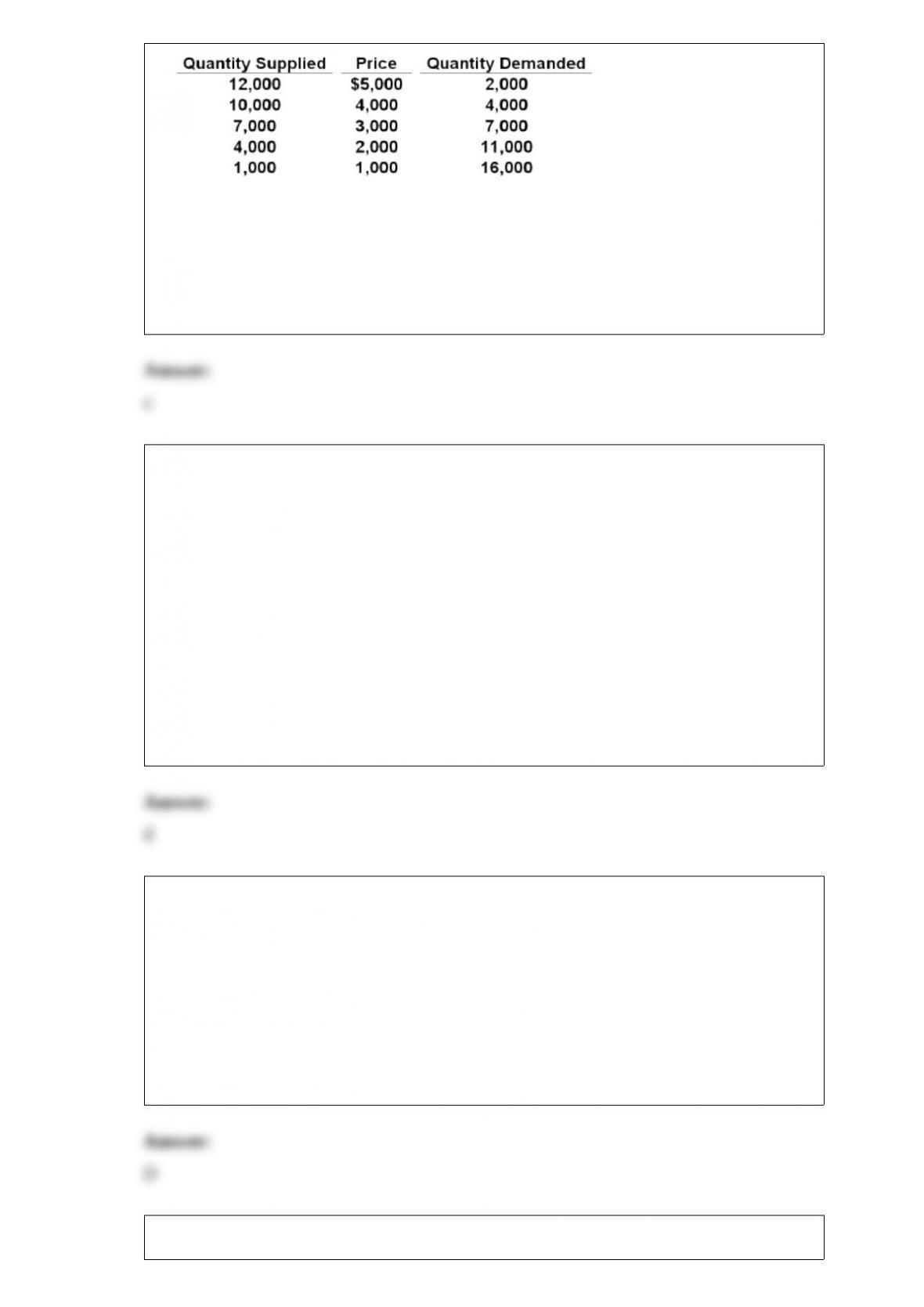
1)
refer to the above supply and demand data for a certain elective surgical procedure.
without health insurance, the equilibrium price and quantity would be:
a.$5,000 and 2,000.
b.$4,000 and 4,000.
c.$3,000 and 7,000.
d.$2,000 and 11,000.
2) the following is cost information for the creamy crisp donut company:
entrepreneur’s potential earnings as a salaried worker = $50,000
annual lease on building = $22,000
annual revenue from operations = $380,000
payments to workers = $120,000
utilities (electricity, water, disposal) costs = $8,000
value of entrepreneur’s talent in the next best entrepreneurial activity = $80,000
entrepreneur’s forgone interest on personal funds used to finance the business = $6,000
refer to the above data. creamy crisp’s economic profit is:
a.$150,000.
b.$80,000.
c.$230,000.
d.$94,000.
3) Which of the following is an example of statistical discrimination?
A.An employer hires only white workers even though there are otherwise identical
African-American workers available at lower pay.
B.Women students in college business schools are overrepresented in human resource
management courses and underrepresented in finance courses.
C.A young woman who plans to work for only five to seven years after graduating
college decides that getting an advanced degree “just won’t pay off.”
D.A firm hires a man rather than a woman for a specific job because, on average,
women have higher rates of absenteeism than do men.
4) Generally, the prime interest rate:
A.moves in the opposite direction as the Federal funds rate.
B.remains constant over long periods of time.
C.is highly inflexible downward.
D.moves in the same direction as the Federal funds rate.
5) Global resource demand has:
A.remained relatively constant because increases in population have been offset by
declining consumption per person.
B.declined because of technological progress.
C.remained constant because population growth and increased consumption per person
have been offset by technological progress.
D.increased because population growth and increased consumption per person have
more than offset reduced demand due to technological progress.
6) The Gini ratio:
A.measures the relative extent of poverty in a nation.
B.compares the income of persons, households, or households at the 90th percentile of
the income distribution to the income at the 10th percentile.
C.is a numerical measure of the overall dispersion of income in a nation.
D.is found by dividing the entire area below and to the right of the diagonal in the
Lorenz diagram by the area between the diagonal and Lorenz curve.
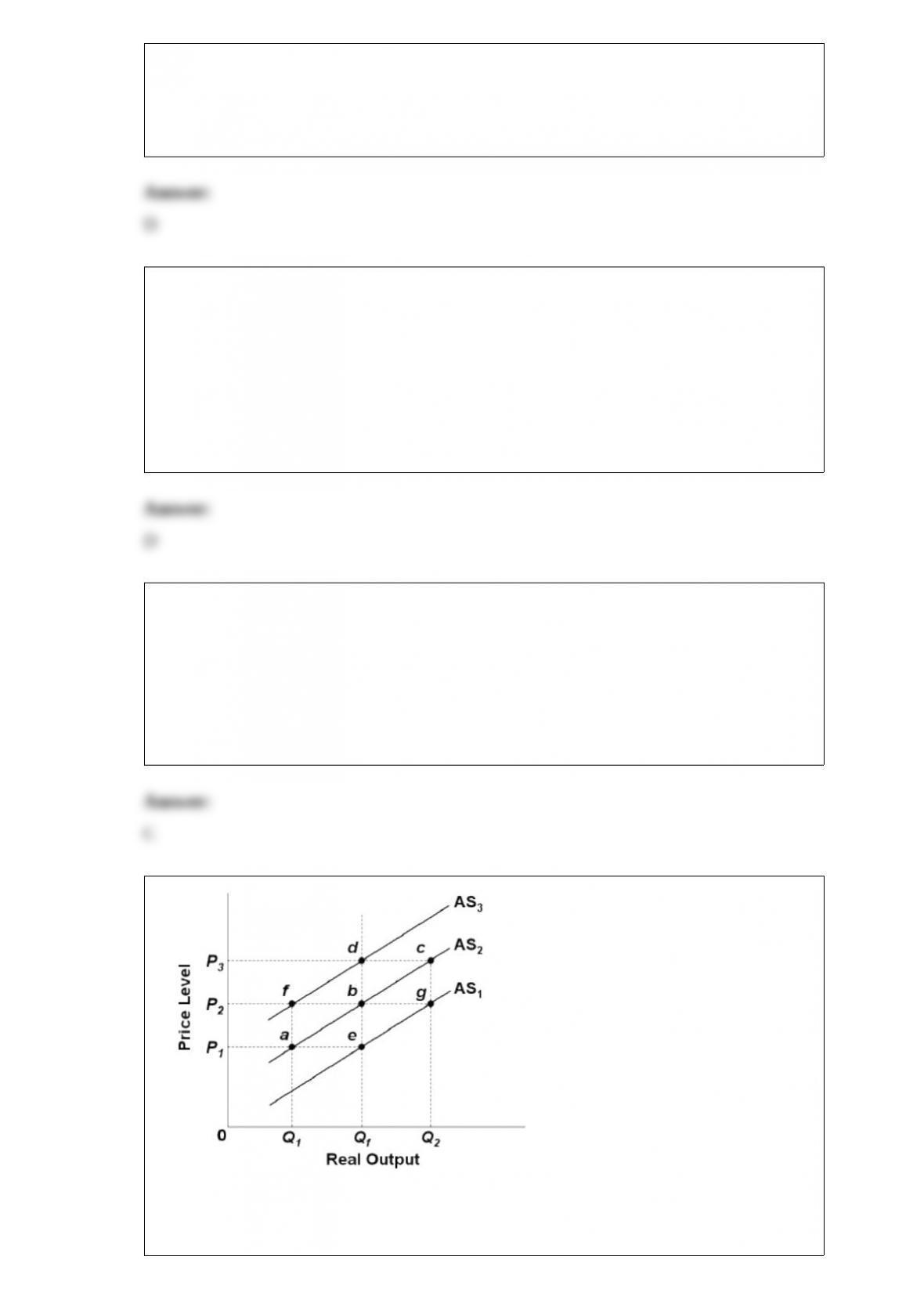
7)
Refer to the above diagram. Assume that nominal wages initially are set on the basis of
the price level P2 and that the economy initially is operating at its full-employment
level of output Qf. In the long run, an increase in the price level from P2 to P3 will:

A.increase real output from Qf to Q2.
B.change aggregate supply from AS2 to AS1.
C.decrease real output from Q2 to Q1.
D.move the economy from b to d.
8) Those who feel that unions positively affect productivity and efficiency argue that
unions are:
A.”voice mechanisms” which reduce labor turnover.
B.”exit mechanisms” which reduce labor turnover.
C.”voice mechanisms” which accelerate labor turnover.
D.”exit mechanisms” which accelerate labor turnover.
9) a large negative gdp gap implies:
a.an excess of imports over exports.
b.a low rate of unemployment.
c.a high rate of unemployment.
d.a sharply rising price level.
10) (Consider This) In the market for used cars:
A.”lemon laws” reduce the demand for, and the price of, used cars.
B.owners of defective cars have less incentive than owners of high-quality used-cars to
sell their cars because buyers refuse to pay high prices for “lemons.”
C.late-model used-cars look like they are brand new and therefore buyers tend to ignore
the possibility that a particular car has defects.
D.new cars lose much of their value immediately when buyers drive them off the
dealers’ lots because potential used-car buyers cannot easily distinguish the defective
“lemons” from the high-quality cars.