
1) the federal government requires automobile manufacturers to install pollution control
equipment. this is an illustration of the:
a.intrusion problem.
b.production of public goods.
c.internalization of external benefits.
d.internalization of external costs.
2) the illinois central railroad once asked the illinois commerce commission for
permission to increase its commuter rates by 20 percent. the railroad argued that
declining revenues made this rate increase essential. opponents of the rate increase
contended that the railroad’s revenues would fall because of the rate hike. it can be
concluded that:
a.both groups felt that the demand was elastic but for different reasons.
b.both groups felt that the demand was inelastic but for different reasons.
c.the railroad felt that the demand for passenger service was inelastic and opponents of
the rate increase felt it was elastic.
d.the railroad felt that the demand for passenger service was elastic and opponents of
the rate increase felt it was inelastic.
3) the perceived central economic problem associated with the u.s. health care system
is:
a.too many frivolous malpractice law suits.
b.an overabundance of scanning machines.
c.an overallocation of resources to the system.
d.that workers lose their insurance when they lose their jobs.
4) part-time workers are counted as:
a.unemployed and therefore the official unemployment rate may overstate the level of
unemployment.
b.unemployed and therefore the official unemployment rate may understate the level of
unemployment.
c.fully employed and therefore the official unemployment rate may overstate the level
of unemployment.
d.fully employed and therefore the official unemployment rate may understate the level
of unemployment.
5) The interest-rate and real-balances effects are important because they help explain:
A.rightward and leftward shifts of the aggregate demand curve.
B.why fiscal policy cannot be used effectively to curb inflation.
C.the shape of the aggregate demand curve.
D.the shape of the aggregate supply curve.
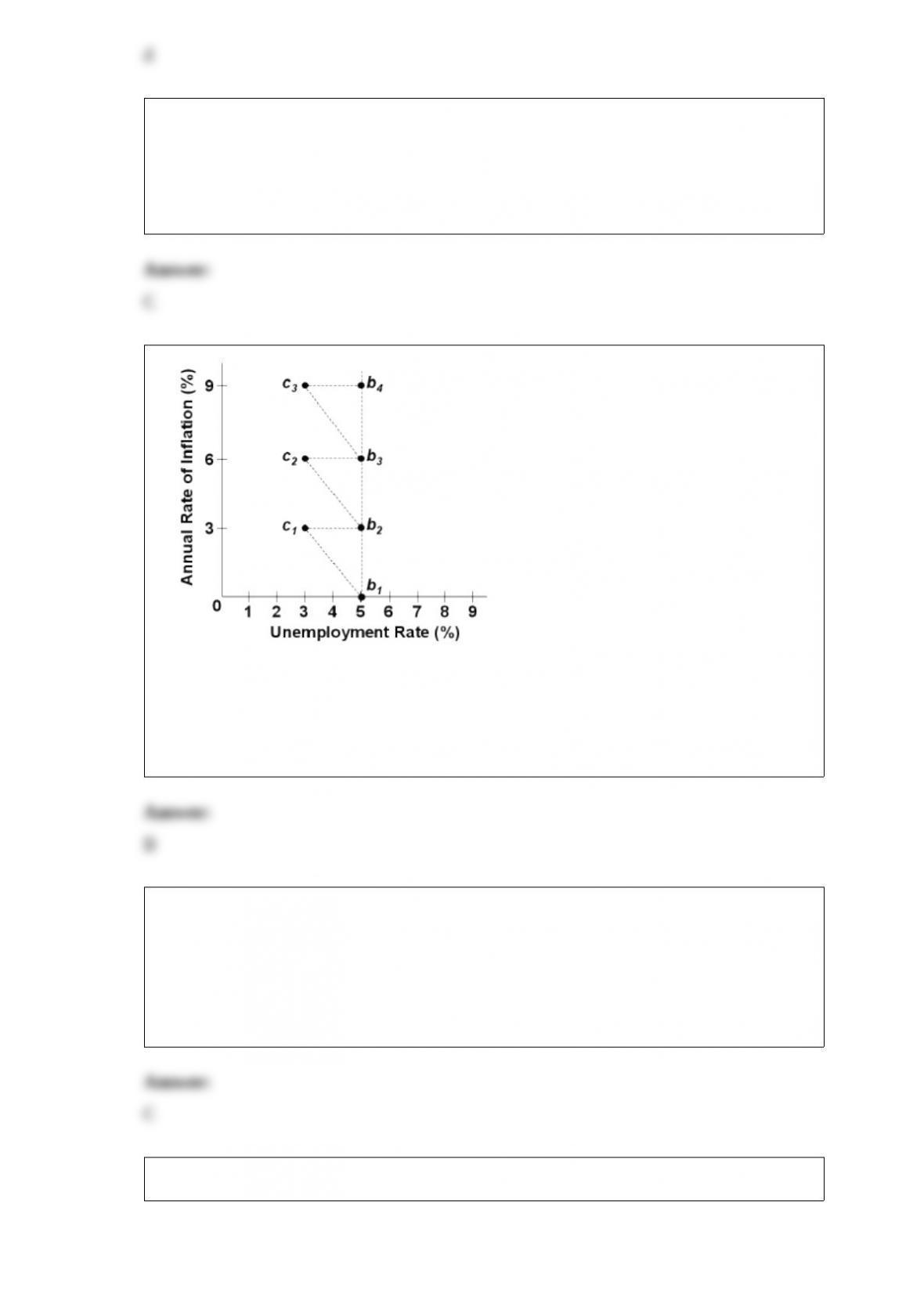
6)
Refer to the above diagram. The natural rate of unemployment for this economy is:
A.3 percent.
B.5 percent.
C.6 percent.
D.4 percent.
7) Which of the following represents an uninsurable risk to a business firm?
A.the possibility that its warehouse will burn down
B.the possibility that several of its workers will be injured at work
C.the possibility that an adverse change in consumer tastes will decrease the demand
for the firm’s product
D.the possibility that a tornado will damage the plant and stop production for a month
8) in which price range of the accompanying demand schedule is demand elastic?

a.$4-$3
b.$3-$2
c.$2-$1
d.below $1
9) ticket scalping implies that:
a.event sponsors have established ticket prices at above-equilibrium levels.
b.an event is not likely to be sold out.
c.event sponsors have established ticket prices at below-equilibrium levels.
d.the demand for tickets has fallen between the time tickets were originally sold and the
event takes place.
10) Modern mainstream macroeconomists agree with the monetarists that:
A.the Fed should increase the money supply at a fixed annual rate.
B.velocity is highly stable.
C.fiscal policy is largely ineffective.
D.”money matters” in the macroeconomy.
11) In fisheries management, a fishery is defined as:
A.an operation that breeds and releases fish and other marine animals into the wild.
B.a stock of fish or other marine animals that can be thought of as a logically distinct
group.
C.a company that harvests fish or other marine animals.
D.a government organization that regulates the harvesting of fish and other marine
animals.
12) Suppose that the dollar-pound exchange rate is $1 = 2. According to the Big Mac
index, the pound is overvalued if the price of a Big Mac sandwich is $2 in the United
States and:
A.4 in the United Kingdom.
B.5 in the United Kingdom.
C.3 in the United Kingdom.
D.2 in the United Kingdom.
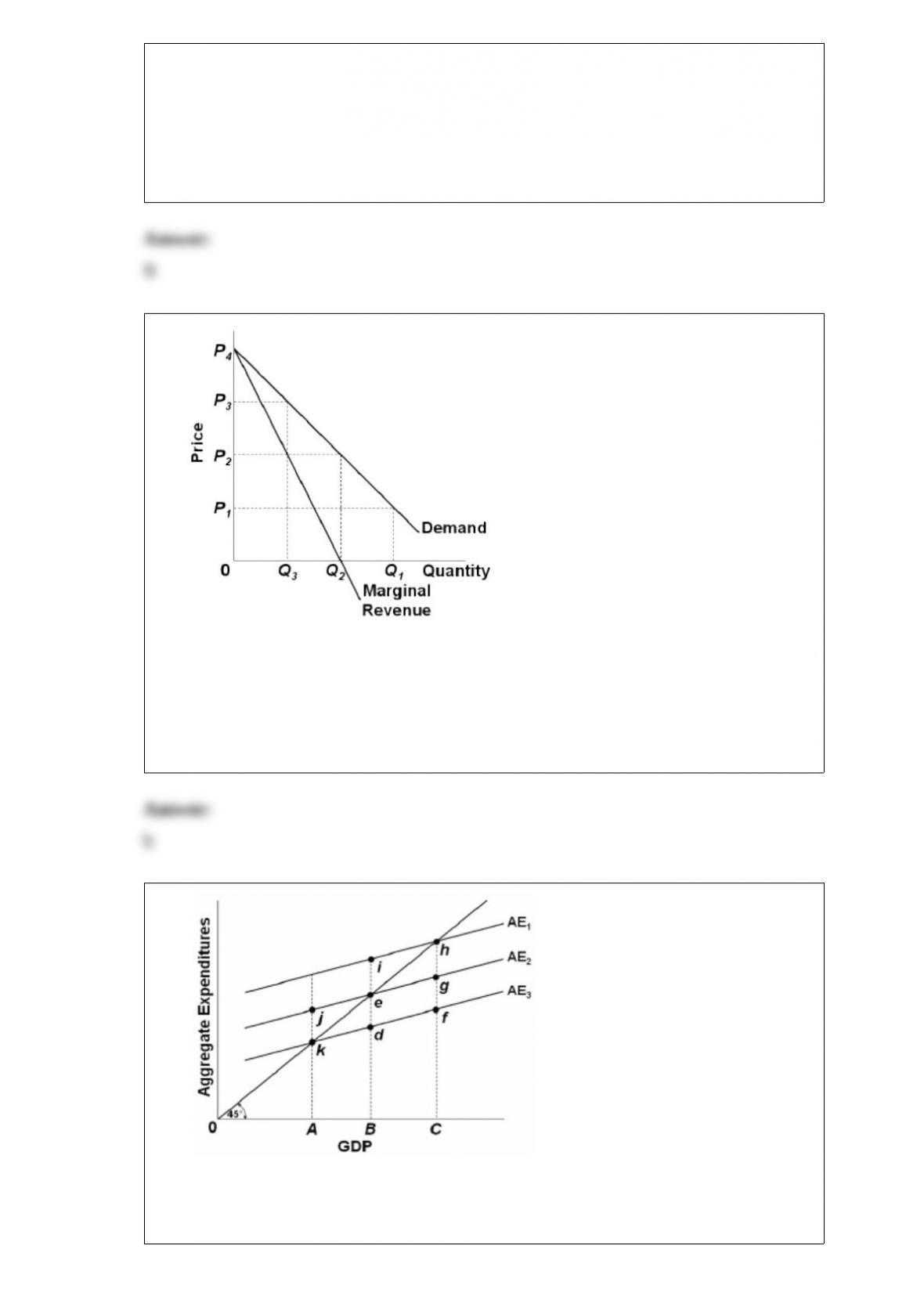
13)
refer to the above diagram. this firm is selling in:
a.a market in which there are an extremely large number of other firms producing the
same product.
b.an imperfectly competitive market.
c.a market in which demand is elastic at all prices.
d.a purely competitive market.
14)
Refer to the above diagram. If the full-employment level of GDP is B and aggregate
expenditures are at AE1, the:
A.inflationary expenditure gap is BC.

B.recessionary expenditure gap is BC.
C.inflationary expenditure gap is zero.
D.inflationary expenditure gap is ei.
15) the value of u.s. imports is:
a.added to exports when calculating gdp because imports reflect spending by americans.
b.subtracted from exports when calculating gdp because imports do not constitute
spending by americans.
c.subtracted from exports when calculating gdp because imports do not constitute
production in the united states.
d.added when calculating gdp because imports do not constitute production in the
united states.
16) in recent years the united states has:
a.exported more goods and services than it has imported.
b.imported more goods and services than it has exported.
c.realized an approximate balance in its imports and exports.
d.experienced a falling absolute dollar amount of imports and a rising absolute dollar
amount of exports.
17) a nation’s production possibilities curve is bowed out from the origin because:
a.resources are not equally efficient in producing every good.
b.the originator of the idea drew it this way and modern economists follow this
convention.
c.resources are scarce.
d.wants are virtually unlimited.
18) According to the marginal-cost-marginal-benefit rule:
A.only government projects (as opposed to private projects) should be assessed by
comparing marginal costs and marginal benefits.
B.the optimal project size is the one for which MB = MC.
C.the optimal project size is the one for which MB exceeds MC by the greatest amount.
D.project managers should attempt to minimize both MB and MC.

19) the value added of a firm is the market value of:
a.a firm’s output plus the value of the inputs bought from others.
b.a firm’s output less the value of the inputs bought from others.
c.of the firm’s output.
d.of the firm’s inputs bought from others.
20) New classical economists say that a fully anticipated decrease in aggregate demand:
A.shifts the long-run aggregate supply curve to the right.
B.shifts the long-run aggregate supply curve to the left.
C.moves the economy down along its vertical long-run aggregate supply curve.
D.eventually results in a self-correcting increase in aggregate demand.