1) which of the following is not a characteristic of pure competition?
a.price strategies by firms
b.a standardized product
c.no barriers to entry
d.a larger number of sellers
2)
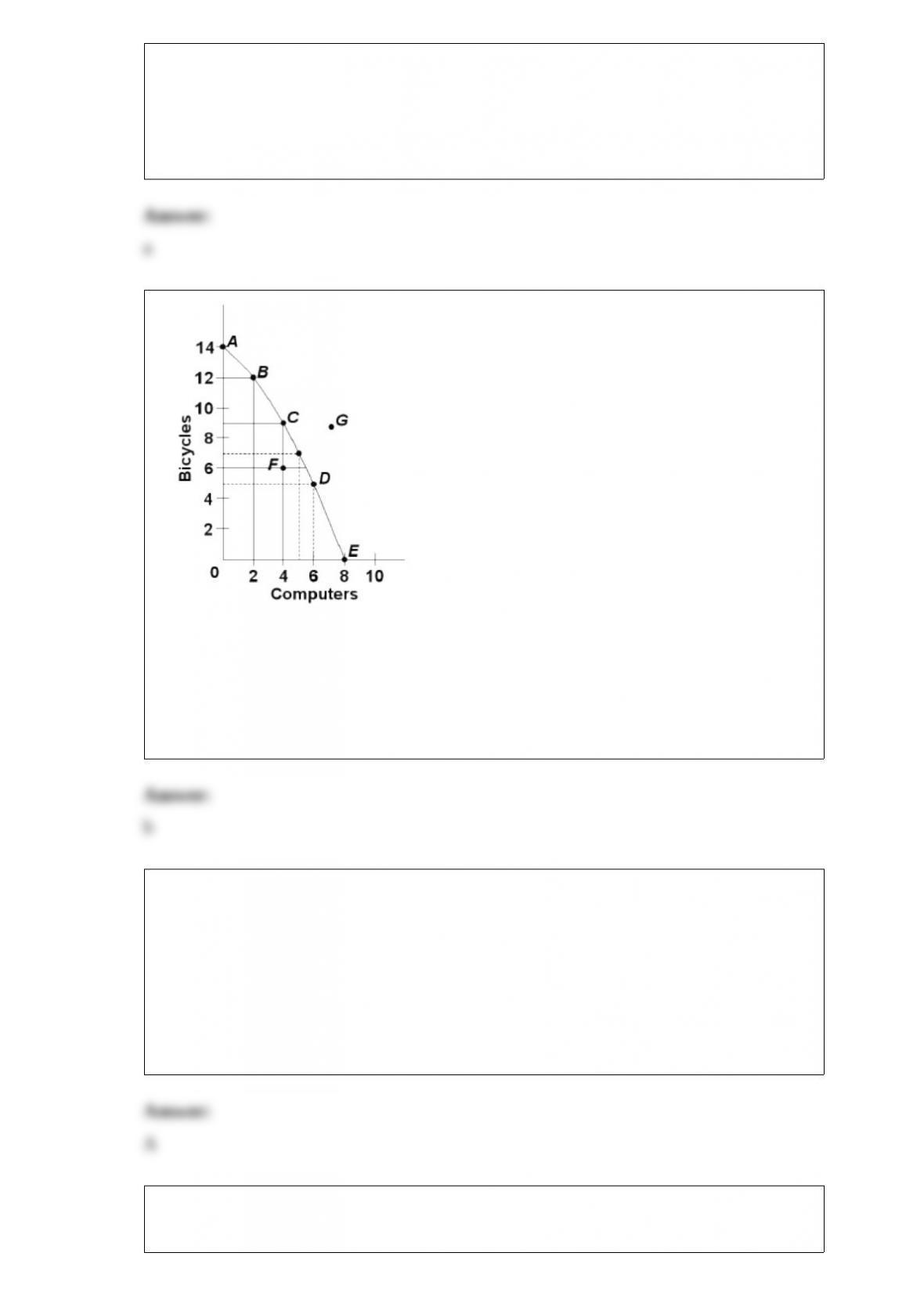
refer to the above diagram. the combination of computers and bicycles shown by point
f:
a.is unattainable, given currently available resources and technology.
b.is attainable, but implies that the economy is not using all its resources.
c.is irrelevant because it is inconsistent with consumer preferences.
d.suggests that opportunity costs are constant.
3) The Clayton Act of 1914:
A.outlawed price discrimination, tying contracts, intercorporate stockholding, and
interlocking directorates that lessen competition.
B.prohibited unfair or deceptive acts or practices in commerce that tend to reduce
competition.
C.outlawed vertical and conglomerate mergers.
D.prohibited one firm from acquiring the assets of another when the effect was to limit
competition.
4) the vertical distance between the horizontal axis and any point on a pure competitor’s
demand curve measures:
a.total revenue.
b.total cost.
c.product price, marginal revenue, and average revenue.
d.the quantity demanded.
5)
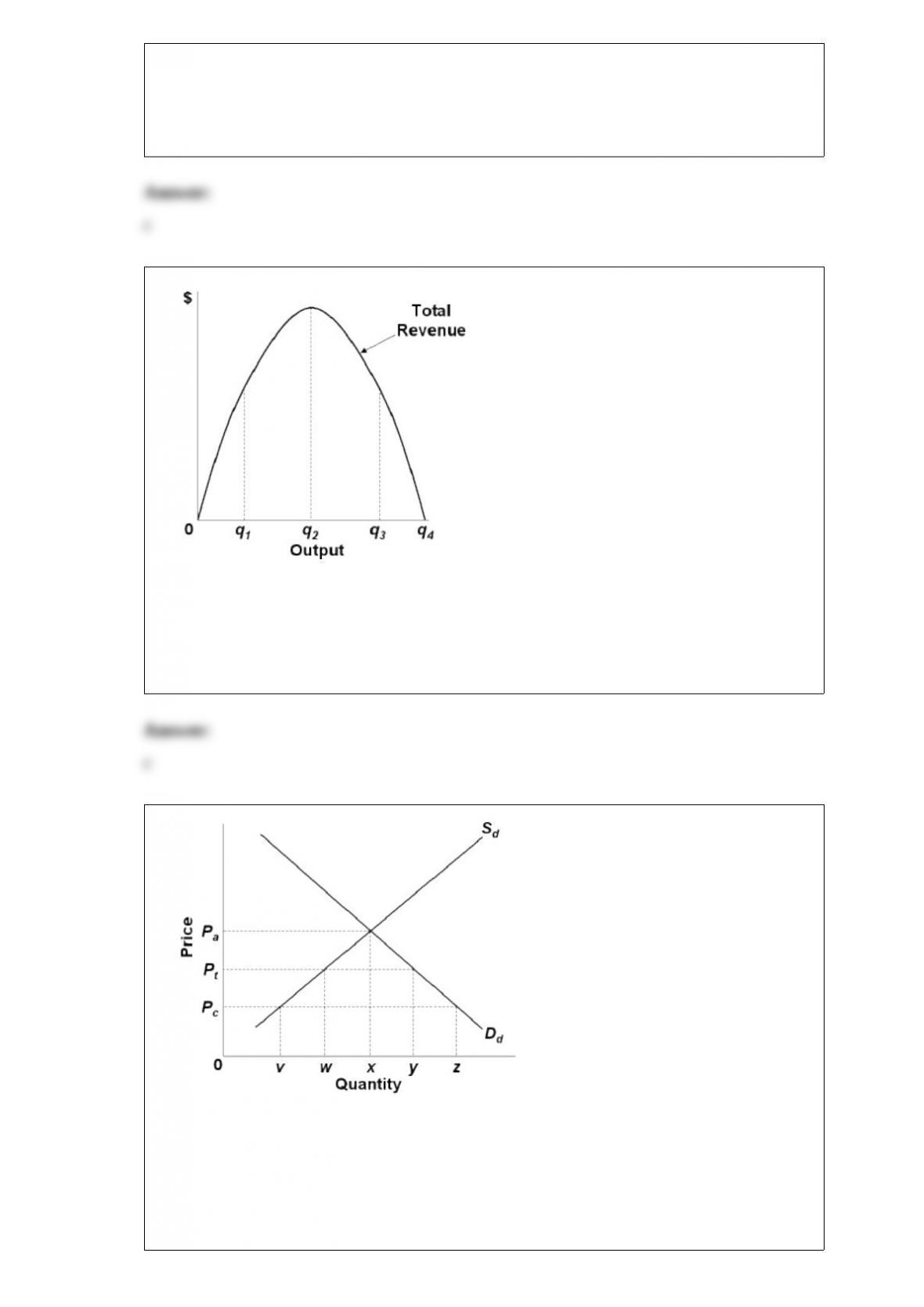
refer to the above diagram for a nondiscriminating monopolist. demand is elastic:
a.in the q1q3 output range.
b.only for outputs greater than q4.
c.for all levels of output less than q2.
d.for all levels of output greater than q2.
6)
Refer to the above diagram, where Sd and Dd are the domestic supply and demand for a
product and Pc is the world price of that product. If the economy is opened to free trade,
the price and quantity sold of this product would be:
A.Pc and v
B.Pa and z
C.Pt and y
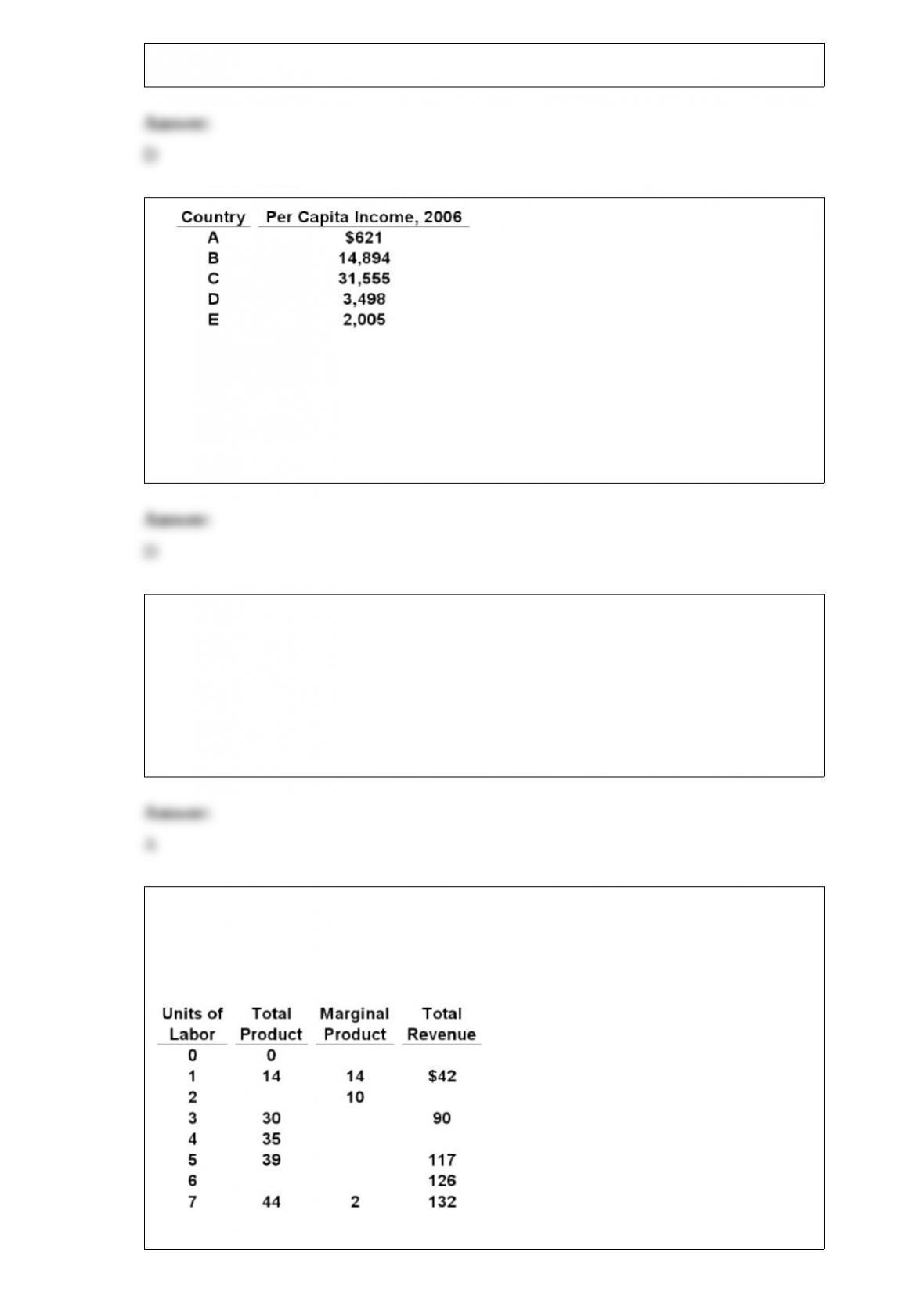
D.Pc and z
7)
Which of the above nations would be high-income countries (IACs), according to the
World Bank?
A.country C only
B.countries B, C, and D
C.countries B, C, D, and E
D.countries B and C
8) Suppose that, as expected, aggregate demand in the economy sharply declines. New
classical economists say that the price level will _____________ and real output will
____________.
A.fall; remain constant
B.rise; remain constant
C.remain constant; fall
D.remain constant; rise
9) Below is the information for Manfred’s Shoe Shine Parlor. Assume Manfred hires
labor, its only variable input, under purely competitive conditions. Shoe shines are also
sold competitively.
Refer to the above data. At what price does each shoe shine sell?
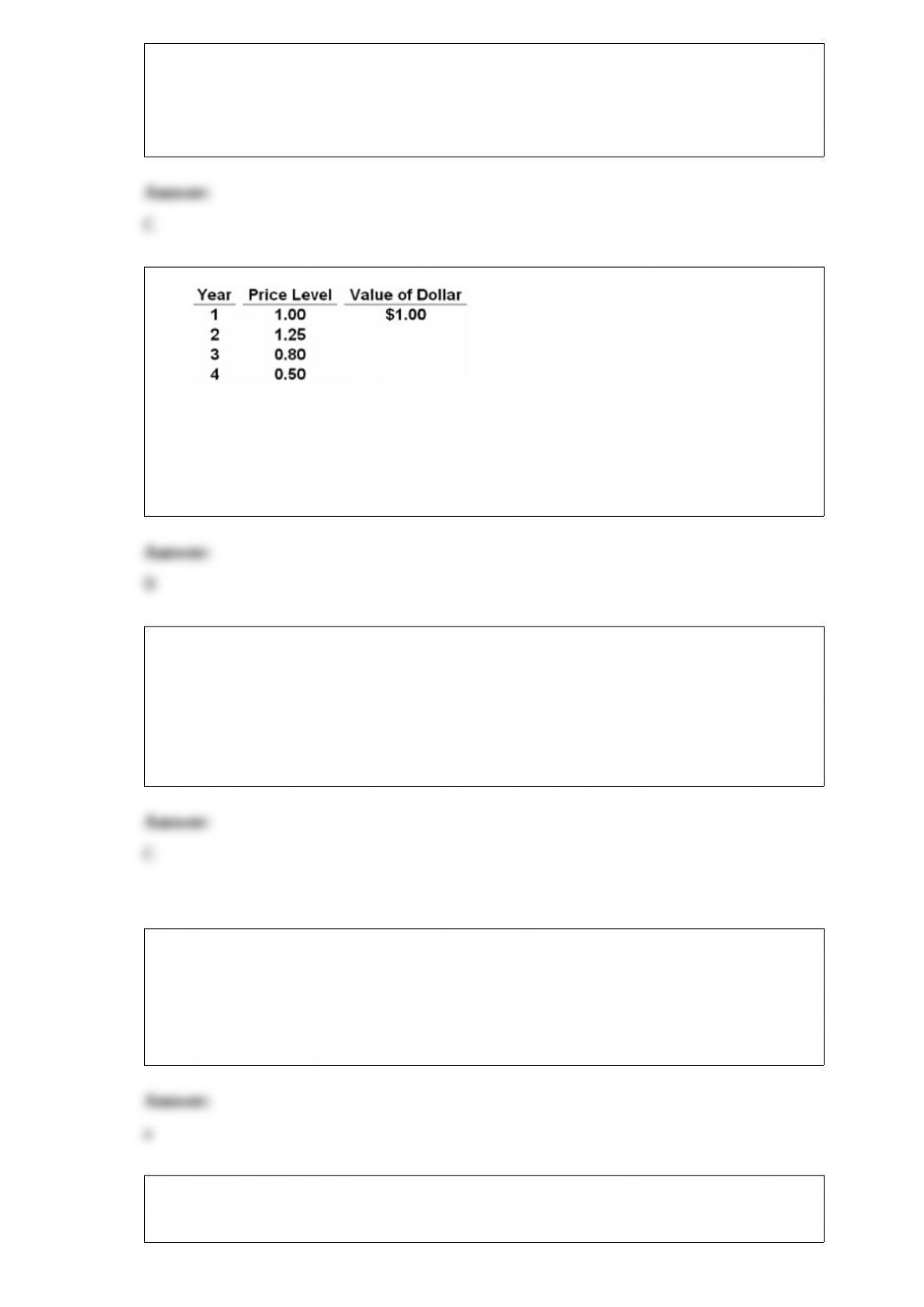
A.$1
B.$2
C.$3
D.$2.50
10)
Refer to the above table. The value of the dollar in year 3 is:
A.$1.00.
B.$1.25.
C.$.80.
D.$1.10.
11) If the economy is operating in the relatively steep (upper) portion of its aggregate
supply curve, a reduction in the money supply will:
A.increase the interest rate and increase employment.
B.reduce the interest rate and increase employment.
C.increase the interest rate and reduce the price level, assuming it is flexible downward.
D. reduce the interest rate and increase the price level.
12) diseconomies of scale:
a.pertain to the long run.
b.pertain to the short run.
c.are synonymous with diminishing returns.
d.are synonymous with increasing returns.
13) in drawing a budget line it is assumed that:
a.consumer preferences are fixed.

b.the prices of the two products are variable.
c.money income is fixed.
14) according to economists, gift registries, returning gifts for cash refunds, and
“recycling gifts”:
a.are inefficient because the time spent is these activities is never worth the benefit
recipients receive from doing them.
b.are selfish acts and morally wrong.
c.are more efficient than if givers simply gave cash gifts.
d.increase the efficiency of gift-giving because they allow the recipient to consume
goods that provide greater utility and transfer away those goods that are less satisfying.
15) The Coase theorem:
A.applies only to circumstances in which externalities are extensive and bargaining
costs are high.
B.holds that the median voter will decide the outcome of elections.
C.states that in some circumstances majority voting can yield inconsistent results.
D.suggests that in some circumstances government intervention is not needed to resolve
externality problems.