1)
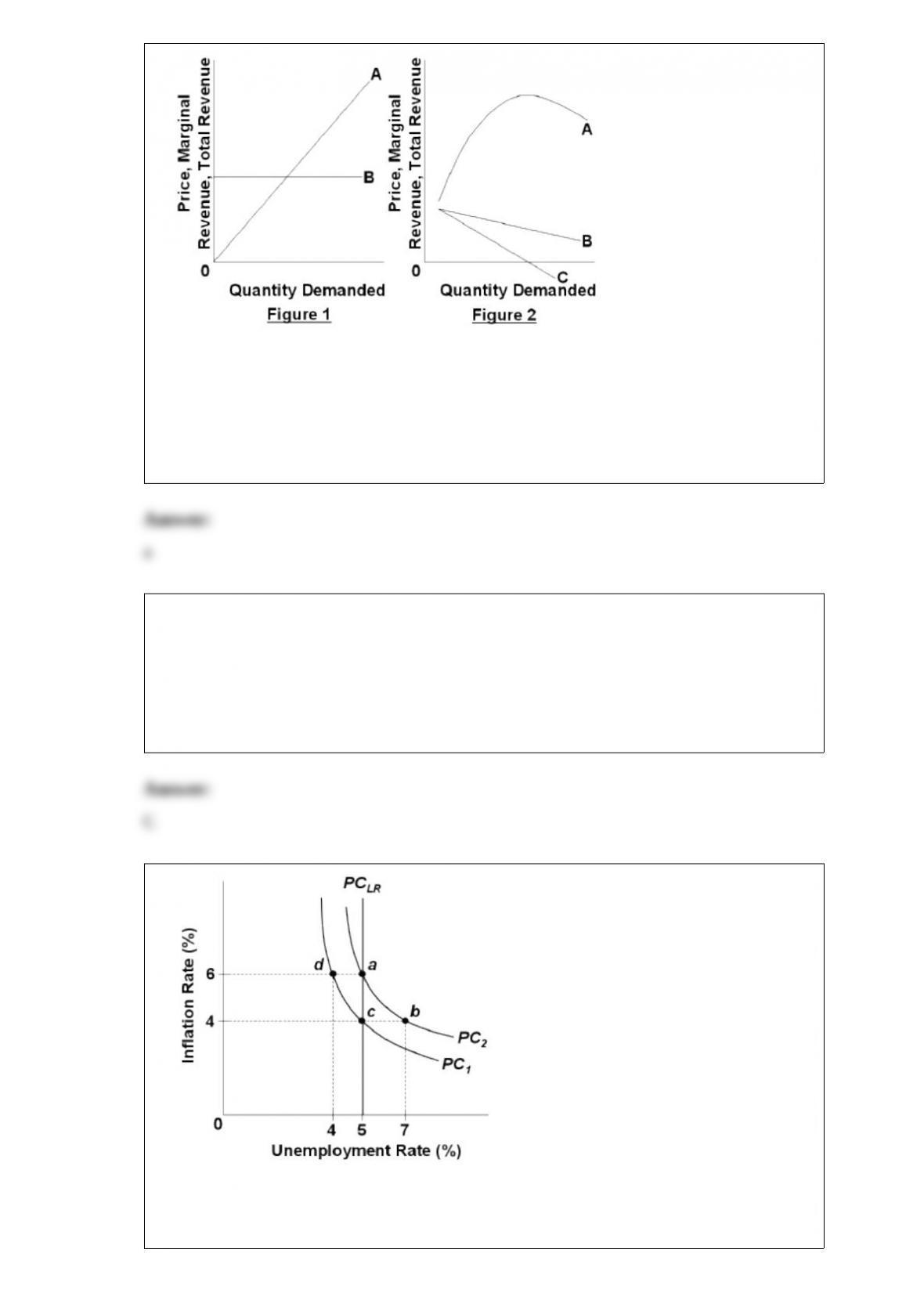
refer to the above two diagrams for individual firms. in figure 2 the firm’s demand and
marginal revenue curves are represented by:
a.lines b and c respectively.
b.lines a and c respectively.
c.lines a and b respectively.
d.line b
2) If the demand for a product is perfectly inelastic and the supply curve is upsloping, a
$1 excise tax per unit of output will:
A.raise price by less than $1.
B.raise price by more than $1.
C.raise price by $1.
D.lower price by $1.
3)
Refer to the above diagram. Point b on short-run Phillips Curve PC1 represents a rate
of:
A.inflation below the natural rate.
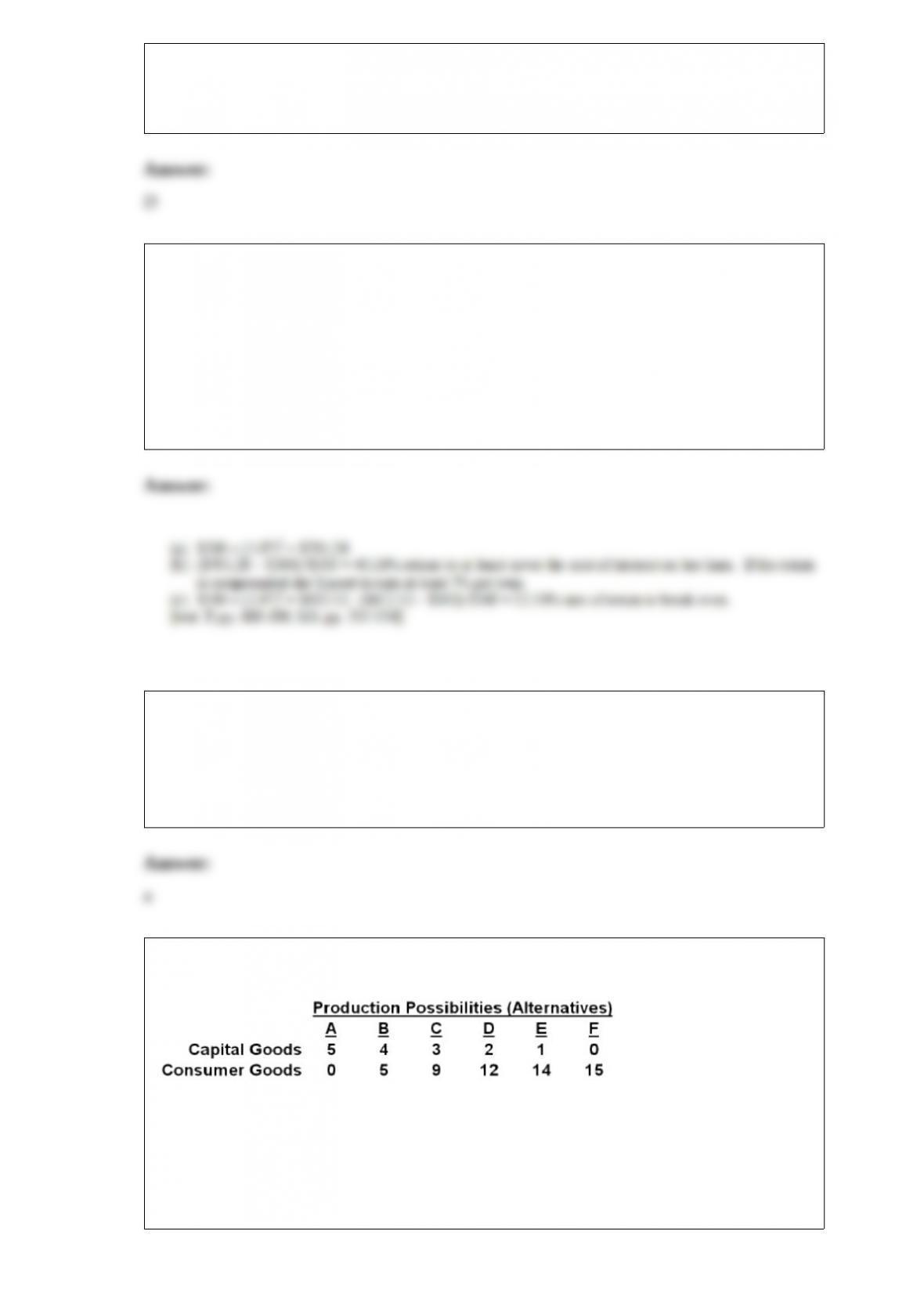
B.inflation above the natural rate.
C.unemployment above the natural rate.
D.unemployment below the natural rate.
4) Suppose Anne borrows $500 at an interest rate of 7%, which she will pay off in 5
years. Answer the following questions.
(a)How much will she owe at the end of the 5 years, assuming the interest is
compounded?
(b)If Anne is planning to invest her loan in an asset that she hopes to turn a profit on,
what is the minimum rate of return she needs to earn?
(c)Suppose Anne is able to pay off her loan in 3 years. What is the size of the repayment
she will owe? What rate of return will she have to earn now to at least break even?
5) gdp is equal to:
a.c + ig + g + xn.
b.c + ig + g – xn.
c.c + in + g + xn.
d.c + in + g – xn.
6) answer the next question(s) on the basis of the data given in the following production
possibilities table:
refer to the above table. if the economy is producing at production alternative c, the
opportunity cost of the tenth unit of consumer goods will be:
a.4 units of capital goods.
b.2 units of capital goods.
c.3 units of capital goods.
d.1/3 of a unit of capital goods.

7) As compared to a purely competitive labor market, in a nonunionized monopsonistic
labor market wages:
A.and employment will both be lower.
B.will be higher, but employment will be lower.
C.will be lower, but employment will be higher.
D.and employment will both be higher.
8) suppose for a regulated monopoly that price equals minimum atc but price exceeds
mc. this means that:
a.both productive and allocative efficiency are being achieved.
b.productive efficiency is being achieved, but not allocative efficiency.
c.allocative efficiency is being achieved, but not productive efficiency.
d.neither productive nor allocative efficiency is being achieved.
9) In effect tariffs on imports are:
A.special taxes on domestic producers.
B.subsidies to domestic consumers.
C.subsidies to foreign producers.
D.subsidies for domestic producers.
10) if a nondiscriminating imperfectly competitive firm is selling its 100th unit of
output for $35, its marginal revenue:
a.may be either greater or less than $35.
b.will also be $35.
c.will be less than $35.
d.will be greater than $35.