1) Unions might support a higher minimum wage because:
A.their constitutions obligate them to do so.
B.they feel a higher minimum wage will lower labor’s tax payments for welfare
programs.
C.a higher minimum wage makes less-skilled workers less substitutable for union
workers.
D.the minimum wage is better targeted than are alternative income-maintenance
programs.
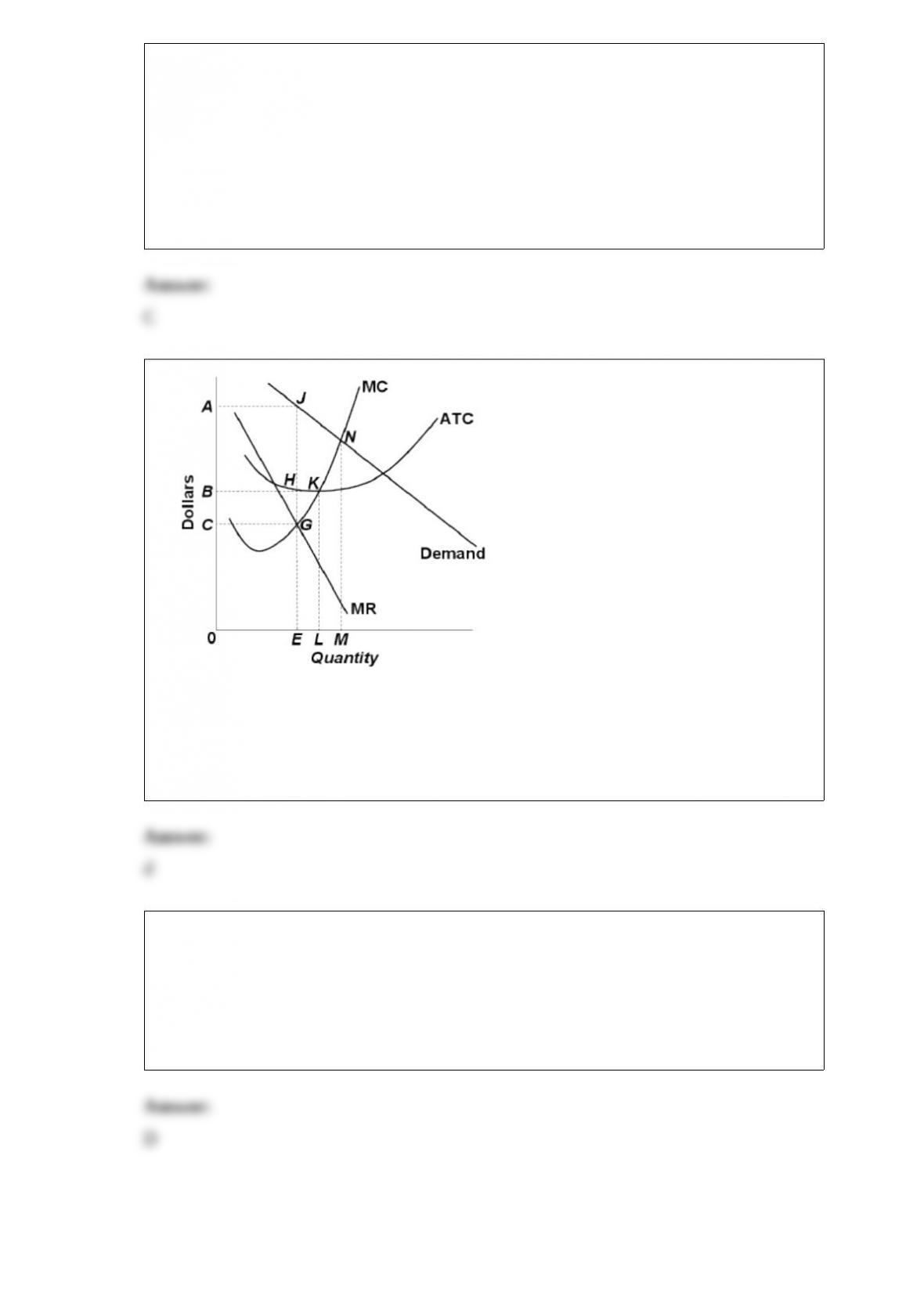
2)
refer to the above diagram. at the profit-maximizing level of output, total cost will be:
a.nm times 0m
b.0aje
c.0cgc
d.0bhe
3) Which one of the following is true about the U.S. Federal Reserve System?
A.The head of the U.S. Treasury also chairs the Federal Reserve Board.
B.There are 10 regional Federal Reserve Banks.
C.There are 14 members of the Federal Reserve Board.
D. The Federal Open Market Committee (FOMC) has more members than does the
Federal Reserve Board of Governors.
4)
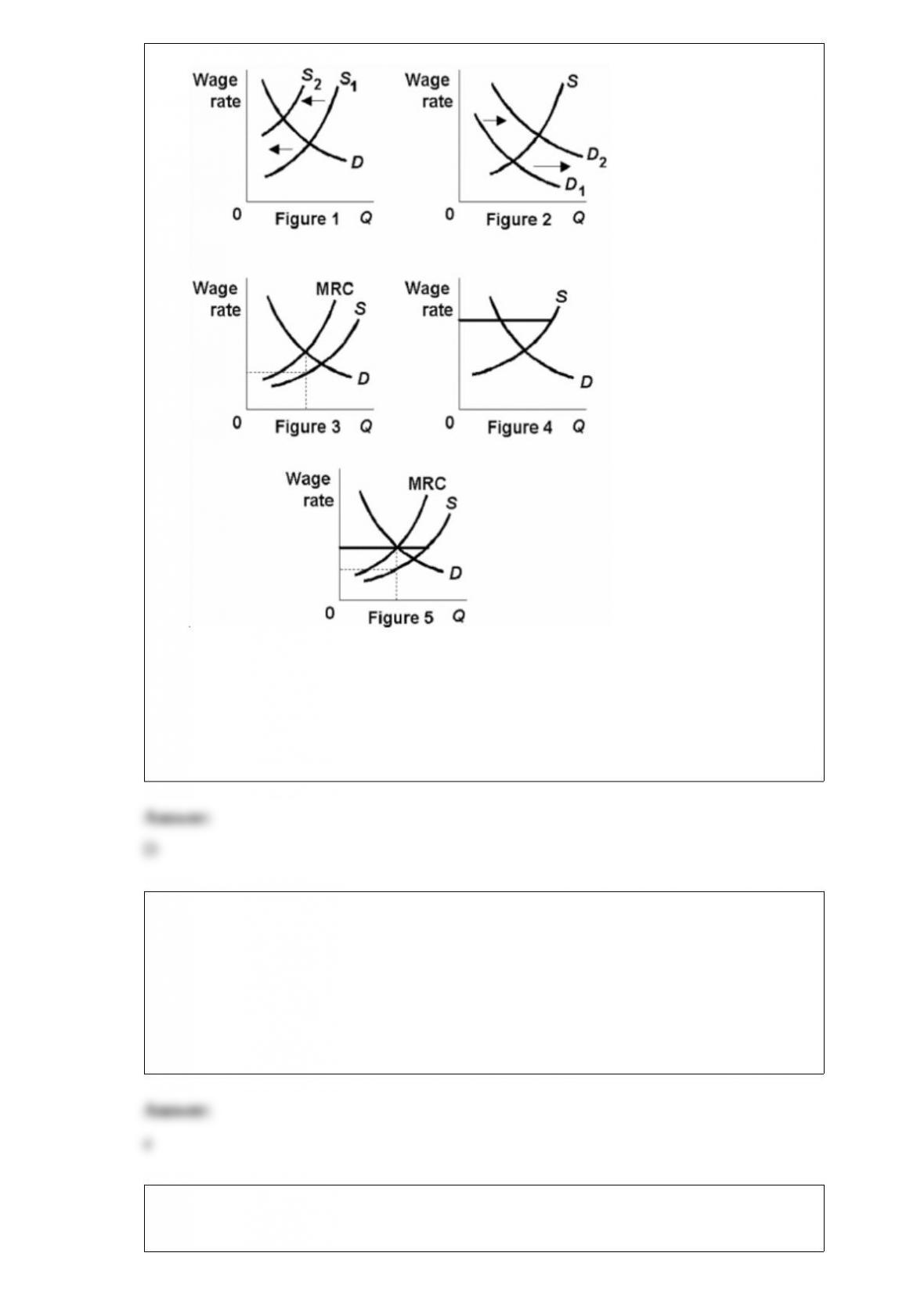
Refer to the above labor market diagrams. The economic impact of occupational
licensing can best be demonstrated through Figure:
A.4
B.3
C.2
D.1
5) assume that a change in government policy results in greater production of both
consumer goods and investment goods. we can conclude that:
a.the economy was not employing all of its resources before the policy change.
b.the economy’s production possibilities curve has been shifted to the left as a result of
the policy decision.
c.this economy’s production possibilities curve is convex (bowed inward) to the origin.
d.the law of increasing opportunity costs does not apply in this society.
6) As of 2008, the world’s population is approximately:
A.6.6 billion.

B.4.2 billion.
C.10.8 billion.
D.2 trillion.
7) at the output where the combined amounts of consumer and producer surplus are
largest:
a.the areas of consumer and producer surplus necessarily are equal.
b.the maximum willingness to pay for the last unit of output equals the minimum
acceptable price of that unit of output.
c.consumer surplus exceeds producer surplus by the greatest amount.
d.marginal benefit exceeds marginal cost by the greatest amount.
8) (Last Word) A section of the 2003 Appropriations bill contained a provision to
qualify catfish farmers for livestock compensation payments for disaster relief. This is
an example of the:
A.special-interest effect.
B.benefits-received principle.
C.paradox of voting.
D.principal-agent problem.
9) which of the following is a labor resource?
a.a computer programmer
b.a computer
c.silicon (sand) used to make computer chips
d.a piece of software used by a firm
10) In year 1 the price level is constant and the nominal rate of interest is 6 percent. But
in year 2 the inflation rate is 3 percent. If the real rate of interest is to remain at the
same level in year 2 as it was in year 1, then in year 2 the nominal interest rate must:
A.rise by 9 percentage points.
B.rise by 3 percentage points.
C.fall by 3 percentage points.
D.rise by 6 percentage points.

11) As it relates to the R&D decision, the interest-rate-cost-of-funds curve:
A.usually slopes downward.
B.is the marginal cost element in the MB = MC decision framework.
C.indicates a constant rate of return, r.
D.reflects the interest rate on bank loans, but not the implicit interest rate on the use of
retained earnings.