
1) Discrimination:
A.affects the distribution of domestic output and income, but not its total size.
B.is shown as some point outside of an economy’s production possibilities curve.
C.places the economy at some point inside of its production possibilities curve.
D.affects the total size of domestic output and income, but not its distribution.
2) a lender need not be penalized by inflation if the:
a.long-term rate of inflation is less than the short-term rate of inflation.
b.short-term rate of inflation is less than the long-term rate of inflation.
c.lender correctly anticipates inflation and increases the nominal interest rate
accordingly.
d.inflation is unanticipated by both borrower and lender.
3) A deficit on the current account:
A.normally causes a surplus on the capital and financial account.
B.normally causes a deficit on the capital and financial account.
C.has no relationship to the capital and financial account.
D.means that a nation is making international transfers.
4) Checkable deposits are classified as money because:
A.they can be readily used in purchasing goods and paying debts.
B.banks hold currency equal to the value of their checkable deposits.
C.they are ultimately the obligations of the Treasury.
D.they earn interest income for the depositor.
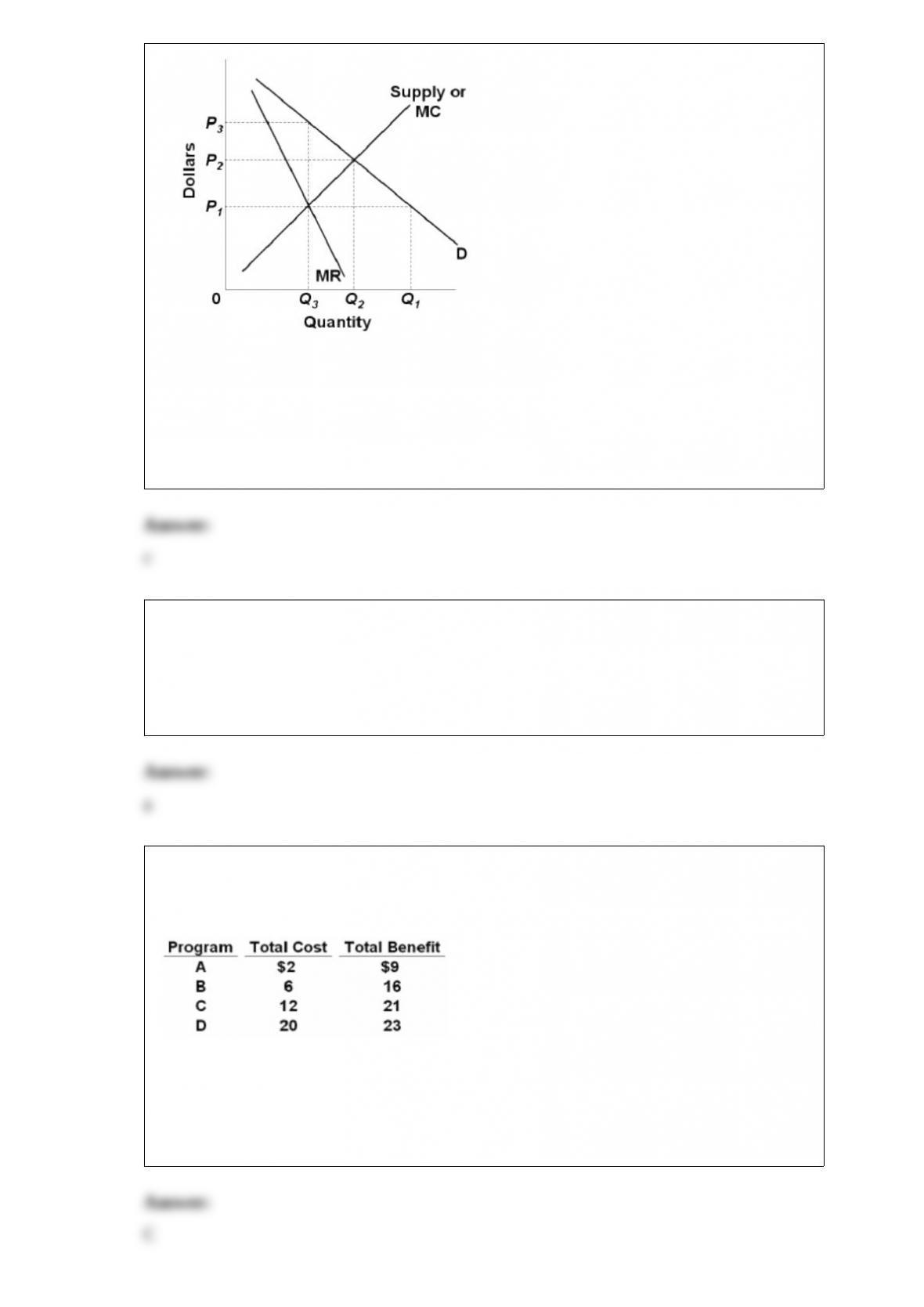
5)
refer to the above diagram. if this industry is purely competitive, the profit-maximizing
price and quantity will be:
a.p3 and q3
b.p1 and q1
c.p2 and q2
d.indeterminate on the basis of the information given
6) in a competitive market:
a.demand will not always reflect all external benefits.
b.demand will always reflect all external benefits.
c.supply will always reflect all external costs.
d.supply will always reflect all external benefits.
7) The following information is for four highway programs of increasing scope. All
figures are in millions of dollars.
On the basis of the above data we can say that:
A.Program D is the most efficient on economic grounds.
B.Program C is the most efficient on economic grounds.
C.Program B is the most efficient on economic grounds.
D.Program A is the most efficient on economic grounds.

8) Congressional representatives have called for extensive ergonomics regulations to
reduce strains and injuries from repetitive activities by workers. Such regulation, if
passed, would be a good example of:
A.industrial regulation.
B.the principal-agent problem.
C.the free-rider problem.
D.social regulation.
9) personal income is most likely to exceed national income:
a.when gross and net investment are equal.
b.during a period of recession or depression.
c.when gross investment exceeds net investment.
d.during a period of extended inflation.
10) Critics of the World Trade Organization (WTO) say that liberalized world trade
does all of the following except:
A.produce environmental degradation.
B.allow producers to circumvent labor protections such as workplace safety, child labor
restrictions, and collective bargaining rights.
C.helps developing nations escape from poverty.
D.promote the interests of multinational corporations.
11) Assume the Standard Internet Company negotiates a loan for $5,000 from the Metro
National Bank and receives a checkable deposit for that amount in exchange for its
promissory note (IOU). As a result of this transaction:
A.the supply of money is increased by $5,000.
B.the supply of money declines by the amount of the loan.
C.a claim has been “demonetized.”
D. the Metro Bank acquires reserves from other banks.
12) given a downsloping demand curve and an upsloping supply curve for a product, an

increase in the price of a substitute good will:
a.increase equilibrium price and quantity.
b.decrease equilibrium price and quantity.
c.increase equilibrium price and decrease equilibrium quantity.
d.decrease equilibrium price and increase equilibrium quantity.
13) Fast-second strategies are more likely to be used by:
A.dominant firms than by startup firms.
B.pure competitors rather than oligopolists.
C.startup firms rather than existing firms.
D.entrepreneurs than by corporations.
14) The main purpose of industrial regulation is to:
A.lower price to marginal cost.
B.lower price to average total cost such that the firm earns a fair return.
C.break monopolies into competing firms.
D.reduce X-inefficiency.