
1) preferred provider organizations (ppos):
a.charge a fixed amount per member, hire many of their own physicians, and provide
health services only to members.
b.require that their members give up the right to file medical malpractice suits.
c.are illegal in several states.
d.require physicians and hospitals to provide discounted prices for their services as a
condition for being included in the insurance plan.
2) if a purely competitive firm is producing where price exceeds marginal cost, then:
a.the firm will fail to maximize profit, but resources will be efficiently allocated.
b.the firm will fail to maximize profit and resources will be overallocated to the
product.
c.the firm will fail to maximize profit and resources will be underallocated to the
product.
d.resources will be underallocated to the product, but the firm will maximize profit.
3) A nation will neither export nor import a specific product when its:
A.domestic price (no-international-trade price) equals the world price.
B.export supply curve lies above its import demand curve.
C.export supply curve is upsloping.
D.import demand curve is downsloping.
4) Which of the following best describes the short-run problem faced by farms?
A.New technology has increased the productivity of farmers and therefore resulted in
declining farm prices and low farm incomes.
B.The highly inelastic nature of agricultural demand, together with fluctuations in
exports of farm goods, has caused small year-to-year fluctuations in farm output to
result in highly unstable farm incomes.
C.The supply of farm products has increased relative to the demand for them, and
because demand is inelastic, prices of farm output and farm income have therefore
declined.
D.The demand for farm products has increased relative to their supply, but the elastic
nature of agricultural demand has caused these shifts to result in declining farm
incomes.

5) Statistical discrimination refers to:
A.the crowding of women or minorities into low-paying occupations.
B.significant differences in average levels of earnings by gender, race, and ethnicity,
after accounting for nondiscriminatory factors.
C.making individual hiring decisions on the basis of the characteristics of the group to
which a person belongs, rather than on his or her personal characteristics and
productivity.
D.the 50-percent unexplained residual in studies that try to account for wage differences
by gender, race, and ethnic origin.
6) The relationship between investment and GDP is shown by the:
A.consumption of fixed capital schedule.
B.saving schedule.
C.investment schedule.
D.consumption schedule.
7) When the benefits of conservation and future use are excluded from a cost-benefit
analysis, there is a tendency to:
A.more efficiently allocate resources.
B.overvalue future resources by considering them “priceless.”
C.stop resource extraction.
D.extract and use resources as quickly as possible.
8) If two nations have straight-line production possibilities curves:
A.then their trading possibilities curves must lie inside the production possibilities
curves.
B.there will be no basis for mutually advantageous trade.
C.there will be a basis for mutually advantageous trade whether the slopes are equal or
not.
D.there will be a basis for mutually advantageous trade provided the slopes differ.
9) the term quantity demanded:
a.refers to the entire series of prices and quantities that comprise the demand schedule.
b.refers to a situation in which the income and substitution effects do not apply.
c.refers to the amount of a product that will be purchased at some specific price.
d.means the same thing as demand.
10) Bank panics:
A.occur frequently in fractional reserve banking systems.
B.are a risk of fractional reserve banking, but are unlikely when banks are highly
regulated and lend prudently.
C.cannot occur in a fractional reserve banking system.
D.occur more frequently when the monetary system is backed by gold.
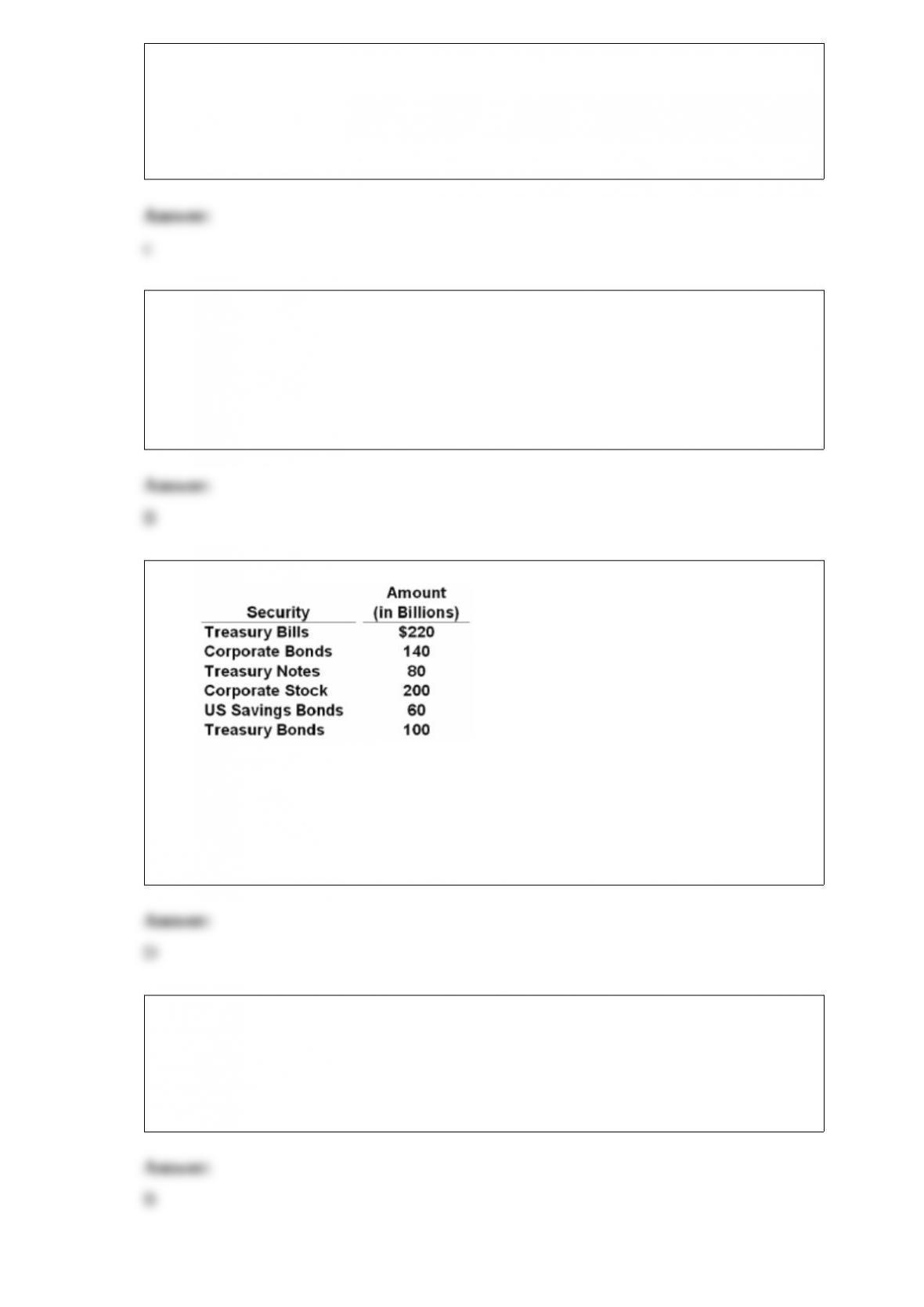
11)
The public debt for the above economy is:
A.$540 billion.
B.$400 billion.
C.$580 billion.
D.$460 billion.
12) One of the morals of the supply-side anecdote is that:
A.there is no such thing as a free breakfast (or lunch).
B.the people who pay the highest taxes get the most benefit from a tax reduction.
C.tax cuts increase tax revenue.
D.the U.S. tax system is regressive.
13) The money supply is backed:
A.by the government’s ability to control the supply of money and therefore to keep its
value relatively stable.
B.by government bonds.
C.dollar-for-dollar with gold and silver.
D.dollar-for-dollar with gold bullion.
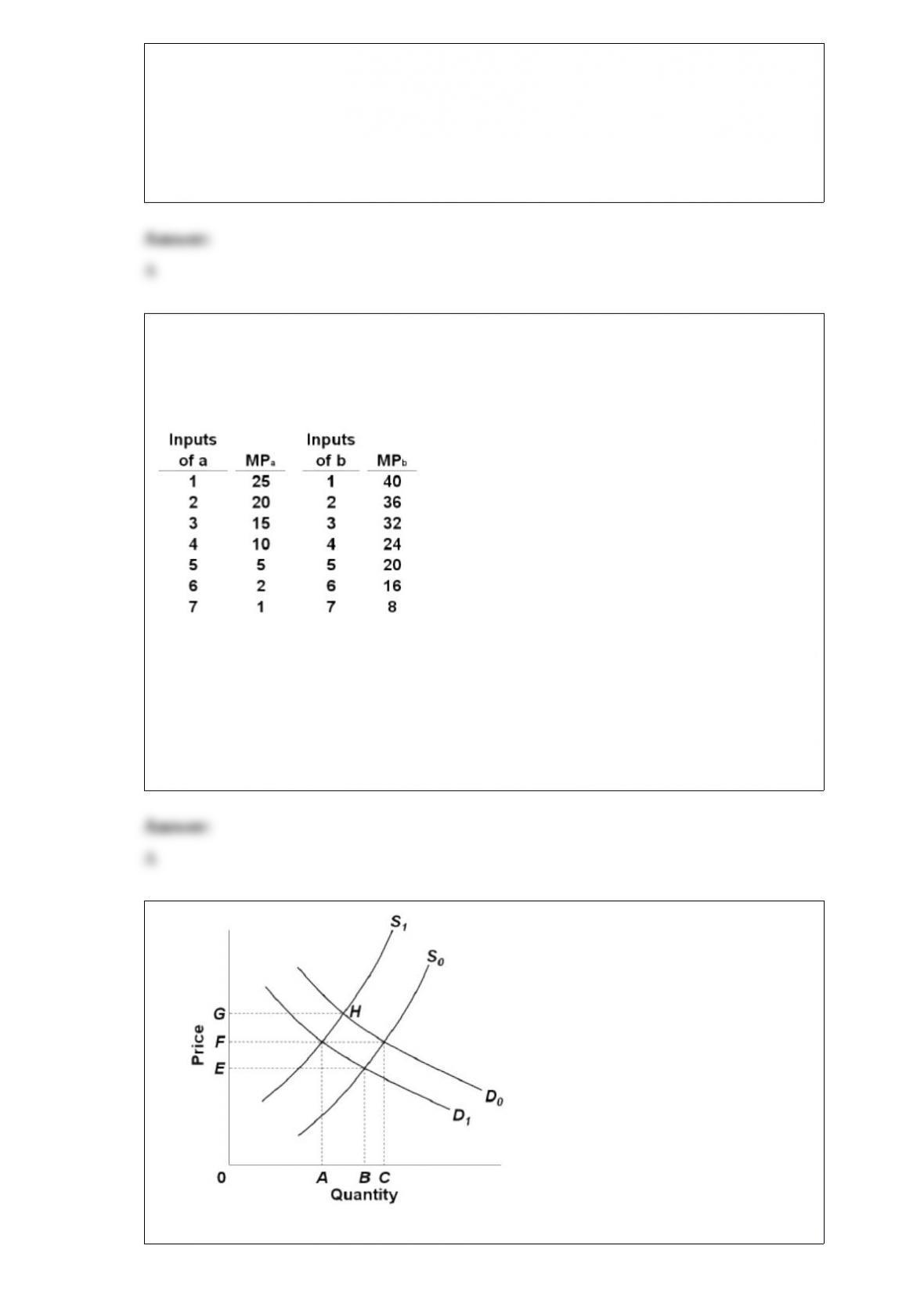
14) Answer the question on the basis of the following marginal product data for
resources a and b. The output of these independent resources sells in a purely
competitive market at $1 per unit.
Refer to the above data. Assuming the prices of resources a and b are $5 and $8
respectively, when the firm hires the profit-maximizing combination of resources, its
economic profit will be:
A.$170.
B.$76.
C.$145.
D.$138.
15)
refer to the above diagram, which shows demand and supply conditions in the

competitive market for product x. if the initial demand and supply curves are d0 and s0,
equilibrium price and quantity will be:
a.0f and 0c respectively.
b.0g and 0b respectively.
c.0f and 0a respectively.
d.0e and 0b respectively.
16) the price of old baseball cards rises rapidly with increases in demand because:
a.the supply of old baseball cards is inelastic.
b.the supply of old baseball cards in elastic.
c.the demand for old baseball cards is inelastic.
d.the demand for old baseball cards is elastic.
17) In recent years, the governments of the IACs have:
A.forgiven a portion of the debt owed by some low-income DVCs.
B.substantially reduced foreign aid to the DVCs.
C.substantially reduced their contributions to the World Bank.
D.discouraged skilled DVC workers from emigrating to the IACs.