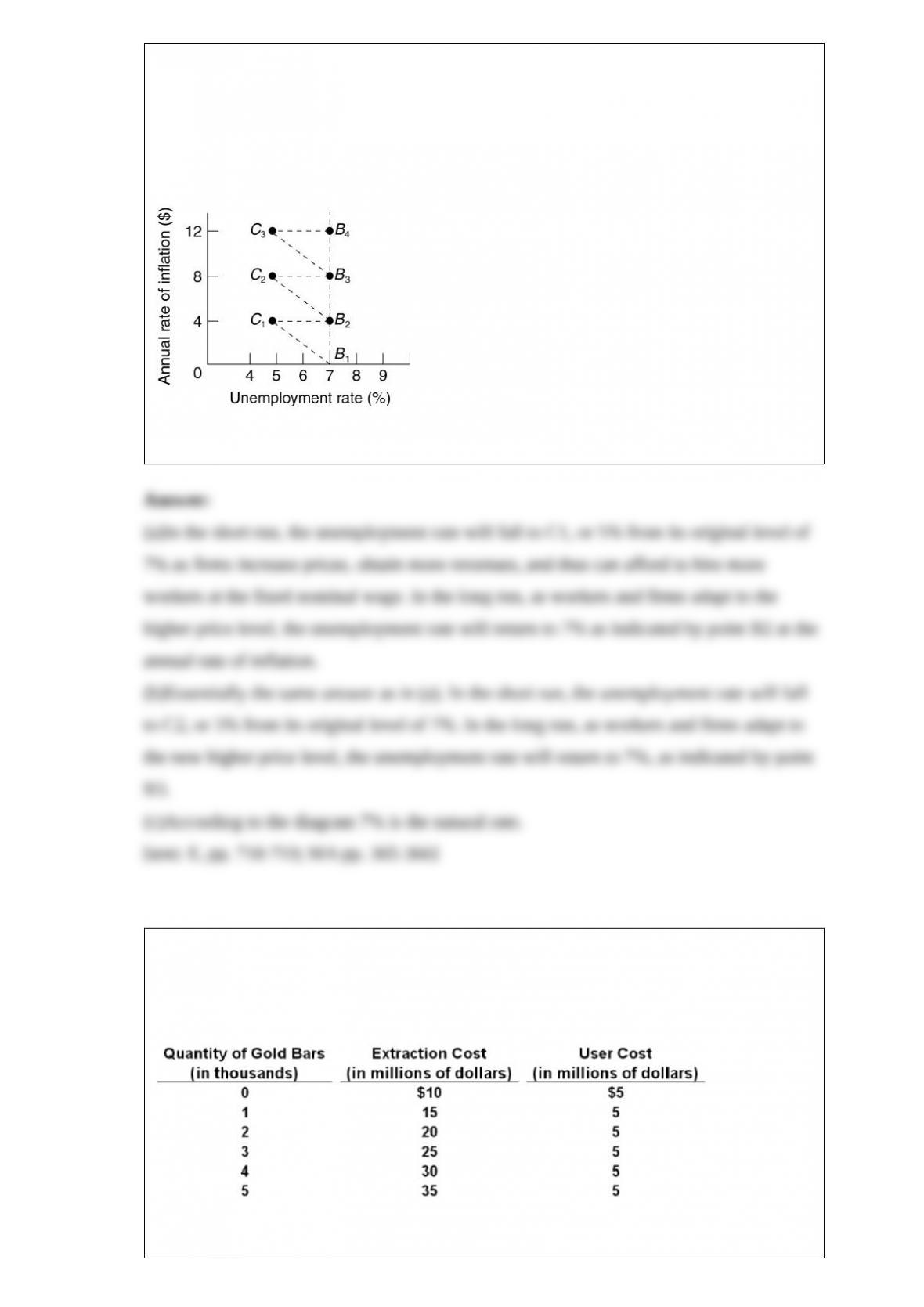
1) Answer the questions based on the following diagram.
(a)Assume the economy is initially at point B1 and there is an increase in aggregate
demand which results in a 4% increase in prices. Describe the short-run and long-run
outcomes that would result in this economy.
(b)Assume the economy is initially at point B2, and there is an increase in aggregate
demand. What will happen in the economy? Explain, using the graph.
(c)Based on this diagram, what would the prediction be for the natural
(full-employment) rate of unemployment?
2) The table below shows the quantity of gold bars (Qb) in thousands, the extraction
cost for each thousand bars (in millions of dollars), and user cost of each thousand bars
(in millions of dollars) facing the OZ Mining Company this year.
If the current price of a bar of gold is $25,000, how many bars (in thousands) should
OZ extract and sell this year in order to maximize profits?

A.1
B.2
C.3
D.4
3) which of the following is correct?
a.both purely competitive and monopolistic firms are “price takers.”
b.both purely competitive and monopolistic firms are “price makers.”
c.a purely competitive firm is a “price taker,” while a monopolist is a “price maker.”
d.a purely competitive firm is a “price maker,” while a monopolist is a “price taker.”
4) The aggregate supply curve (short-run):
A.graphs as a horizontal line.
B.is steeper above the full-employment output than below it.
C.slopes downward and to the right.
D.presumes that changes in wages and other resource prices match changes in the price
level.
5) when the price of a product falls, the purchasing power of our money income rises
and thus permits consumers to purchase more of the product. this statement describes:
a.an inferior good.
b.the rationing function of prices.
c.the substitution effect.
d.the income effect.
6) The equations for the demand and supply curves for a particular product are P = 10
.4Q and P = 2 + .4Q, where P is price and Q is quantity expressed in units of 100. After
an excise tax is imposed on the product the supply equation is P = 3 + .4Q.
Refer to the above information. The excise tax on each unit of the product is:
A.$1.
B.$2.
C.$3.
D.$4.
7) The group of three economists appointed by the President to provide fiscal policy
recommendations is the:
A.Council of Economic Advisers.
B.Joint Economic Committee.
C.Bureau of Economic Analysis.
D.Federal Reserve Board of Governors.
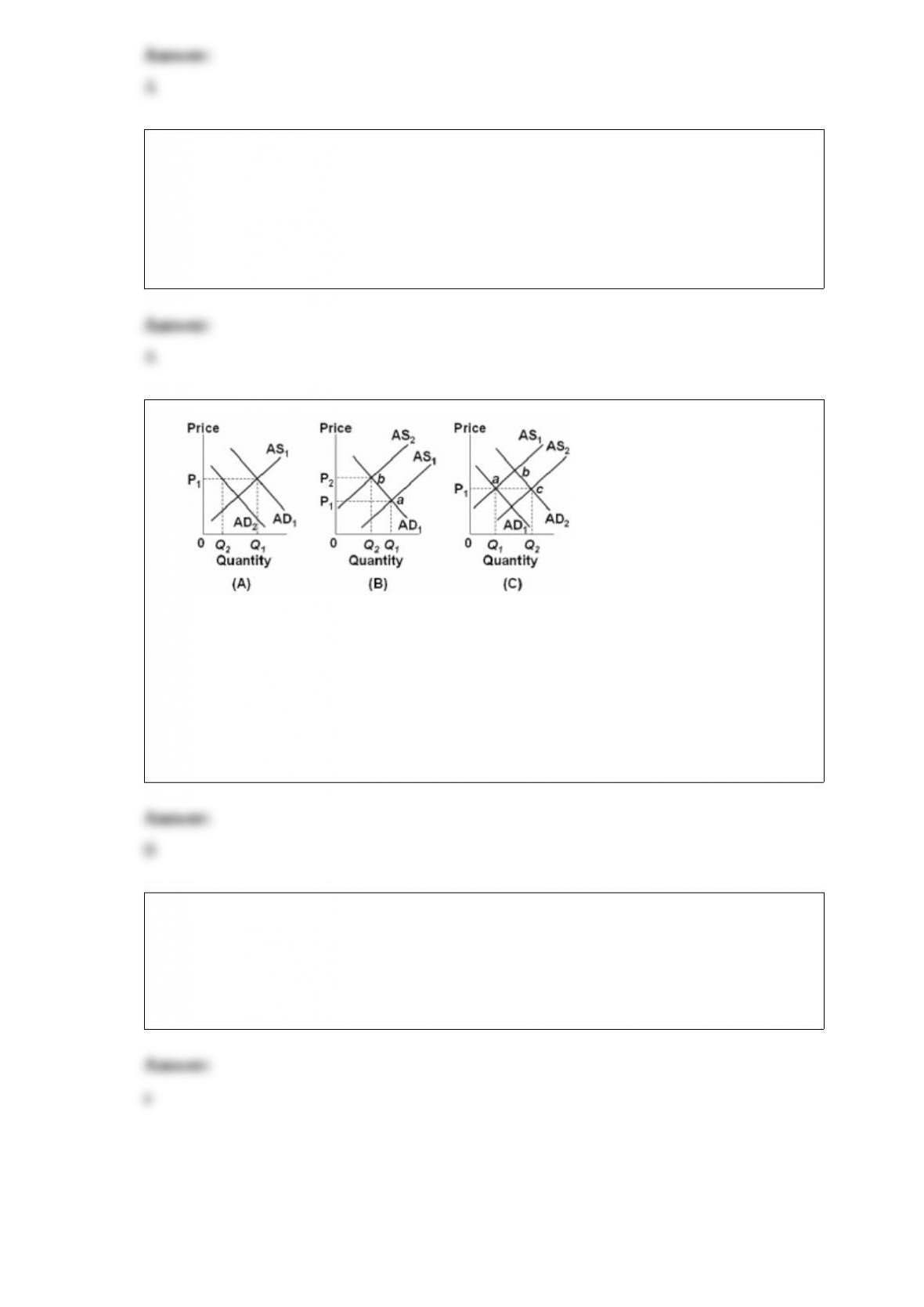
8)
Refer to the above diagrams, in which AD1 and AS1 are the “before” curves and AD2
and AS2 are the “after” curves. Other things equal, a decline in productivity is depicted
by:
A.panel (A) only.
B.panel (B) only.
C.panel (C) only.
D.panels (B) and (C).
9) the average u.s. tariff rate on imported goods is about:
a.5 percent.
b.12 percent.
c.25 percent.
d.50 percent.
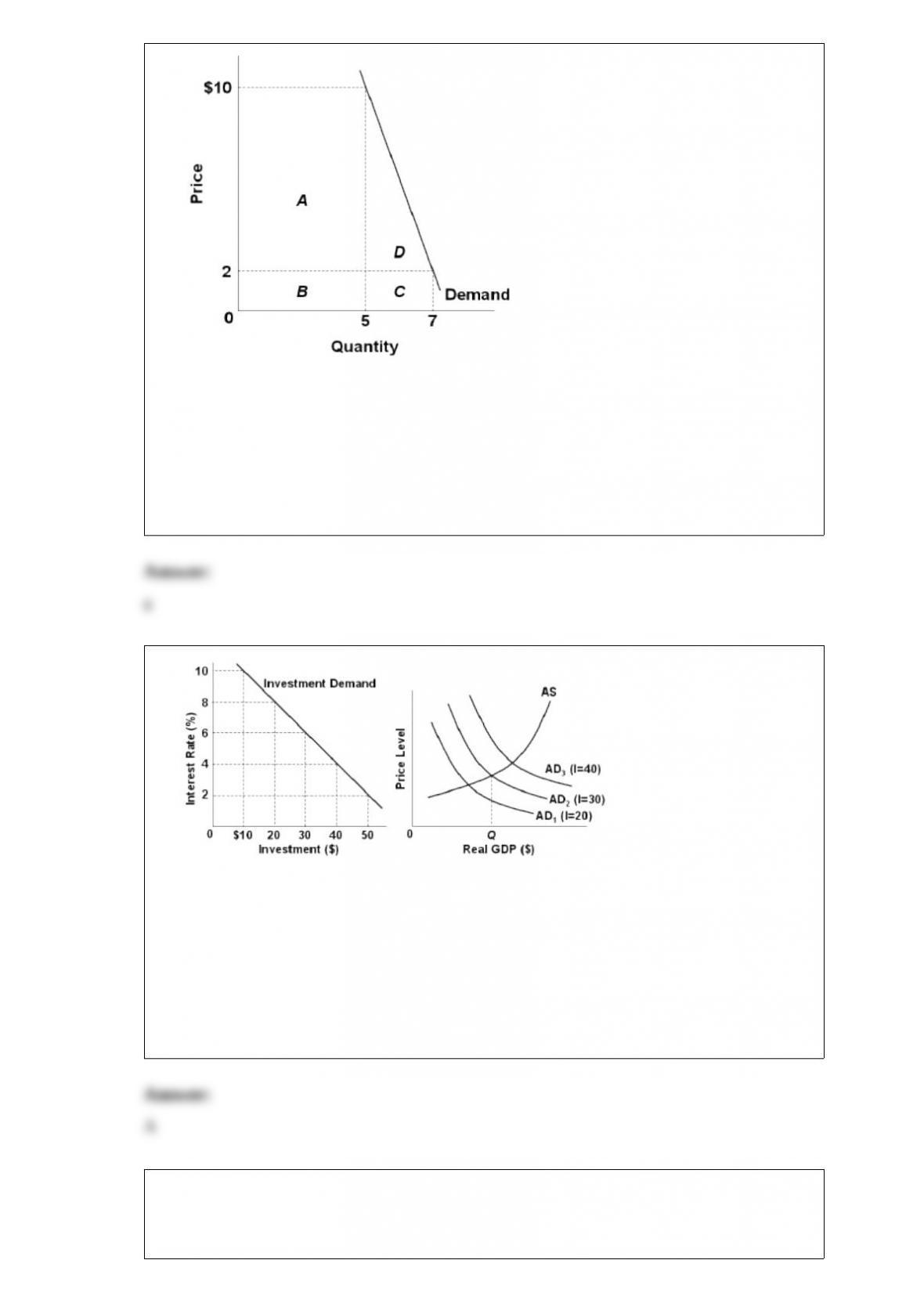
10)
refer to the above diagram and assume that price declines from $10 to $2. the
coefficient of price elasticity of demand (midpoints formula) relating to this change in
price is about:
a..25 and demand is inelastic.
b.1.5 and demand is elastic.
c.1 and demand is unit elastic.
d..67 and demand is inelastic.
11)
Refer to the above diagrams. The numbers in parentheses after the AD1, AD2, and AD3
labels indicate the levels of investment spending associated with each curve,
respectively. All numbers are in billions of dollars. If the interest rate is 4 percent and
the Fed desires to reduce or eliminate demand-pull inflation, it should:
A.increase the interest rate from 4 percent to 6 percent.
B.decrease the interest rate from 4 to 2 percent.
C.increase investment spending by $20 billion.
D.maintain the interest rate at 4 percent.
12) A bumper crop of farm products causes:
A.only a slight decline in the price of farm products because the demand for farm
products is income inelastic.
B.a large decline in the price of farm products because the demand for farm products is
price inelastic.
C.only a slight decline in the price of farm products because the demand for farm
products is income elastic.
D.a large decline in the price of farm products because the demand for farm products is
price elastic.
13) in performing its stabilization function, it may be appropriate for the nation’s central
bank (the federal reserve in the united states) to:
a.raise taxes to reduce inflation.
b.increase government spending to reduce unemployment.
c.increase subsidies to businesses to reduce unemployment.
d.lower interest rates to stimulate private spending and reduce unemployment.
14) federal tax policy:
a.treats employer health insurance premiums as taxable income.
b.subsidizes health insurance and thereby increases the demand for health care.
c.subsidizes health insurance and thereby decreases the demand for health care.
d.corrects the overallocation of resources to the health care industry which would
otherwise exist.
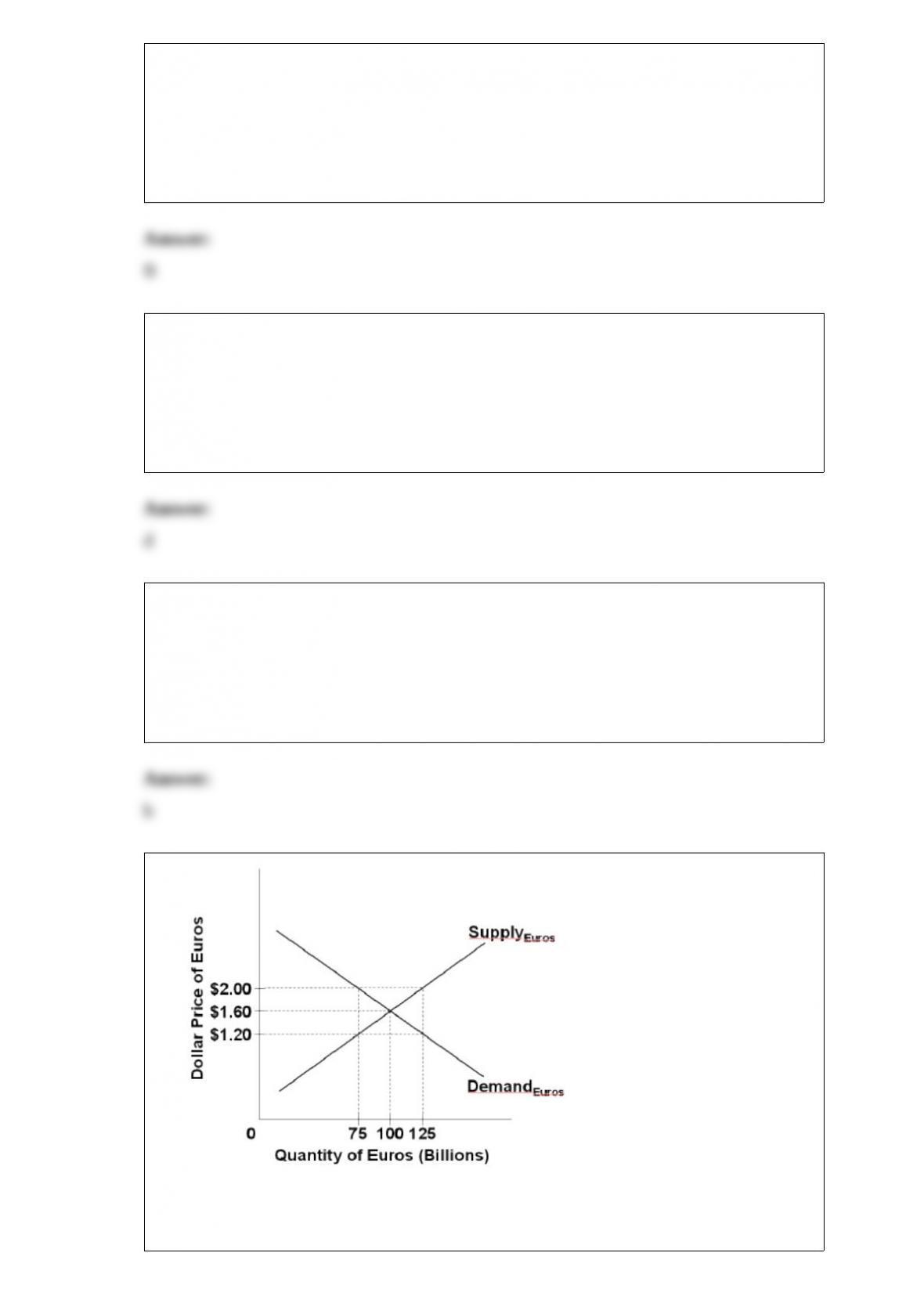
15)
refer to the above diagram. if u.s. consumers increase their travel to euro zone nations,
we would expect:
a.the demand for euros to increase, and the euro to appreciate.

b.the demand for euros to increase, and the dollar to appreciate.
c.the supply of euros to increase, and the euro to depreciate.
d.the supply of euros to decrease, and the dollar to depreciate.
16) Assume that by devoting all of its resources to the production of X, nation Alpha
can produce 40 units of X. By devoting all of its resources to Y, Alpha can produce 60Y.
Comparable figures for nation Beta are 60X and 40Y. We can conclude that:
A.the terms of trade will be 3X equals 1Y
B.Alpha should specialize in Y and Beta in X
C.Alpha should specialize in X and Beta in Y
D.there is no basis for mutually beneficial specialization and trade.