1) economists define saving as:
a.that part of after-tax income which is not consumed.
b.total income less taxes.
c.bank accounts.
d.purchases of stocks and bonds.
2)
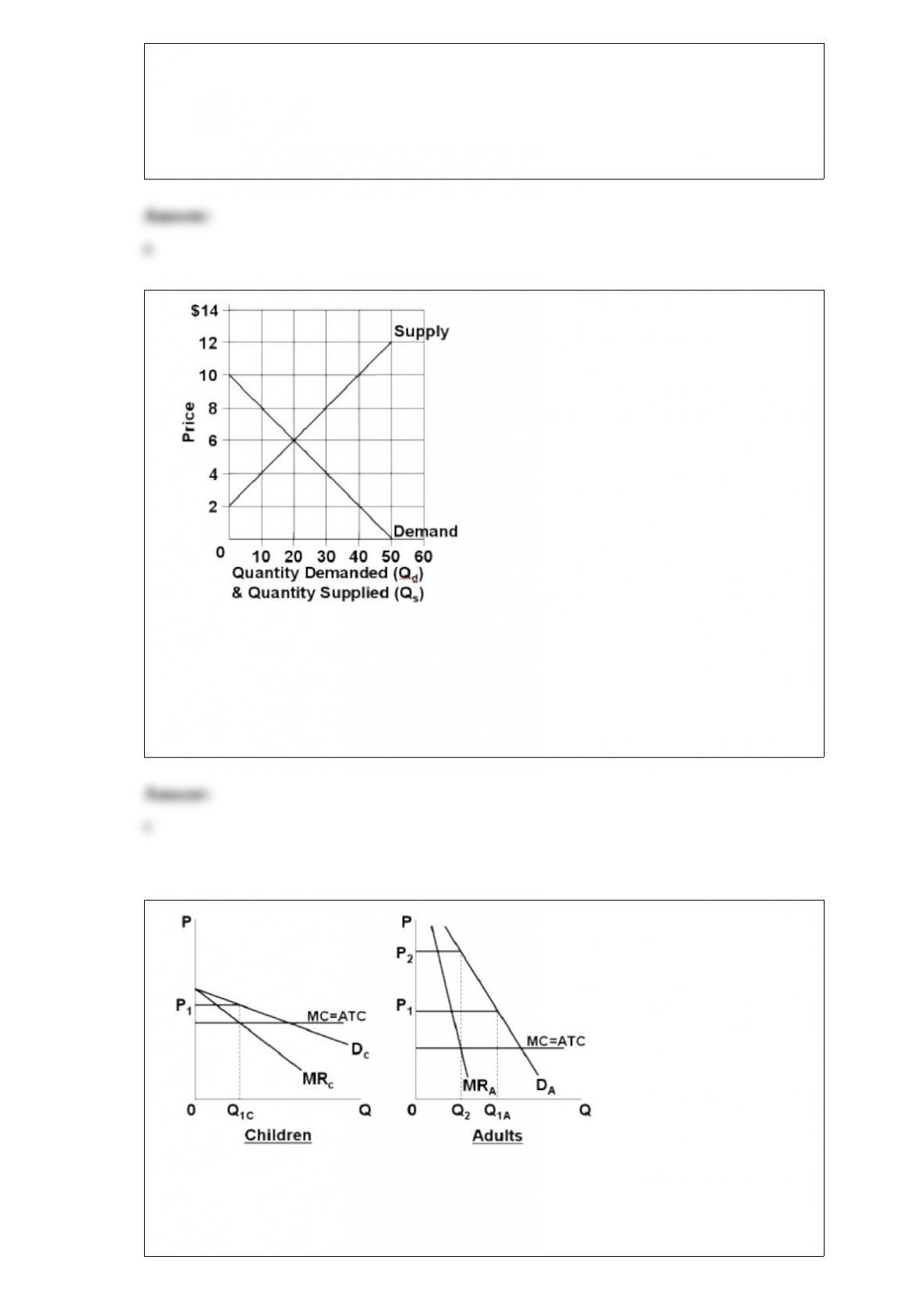
refer to the above graph. using qd for quantity demanded and p for price, which of the
following equations correctly states the demand for this product?
a.p = qd/10.
b.p = 50 – p/2.
c.p = 10 – .2qd.
d.p = 10 – 2qd.
3)
assume the above figure applies to a pure monopolist. if this firm is able to price
discriminate between children and adults, it should charge prices of:
a.p1 to children, and p2 to adults.
b.p1 to adults, and p2 to children.
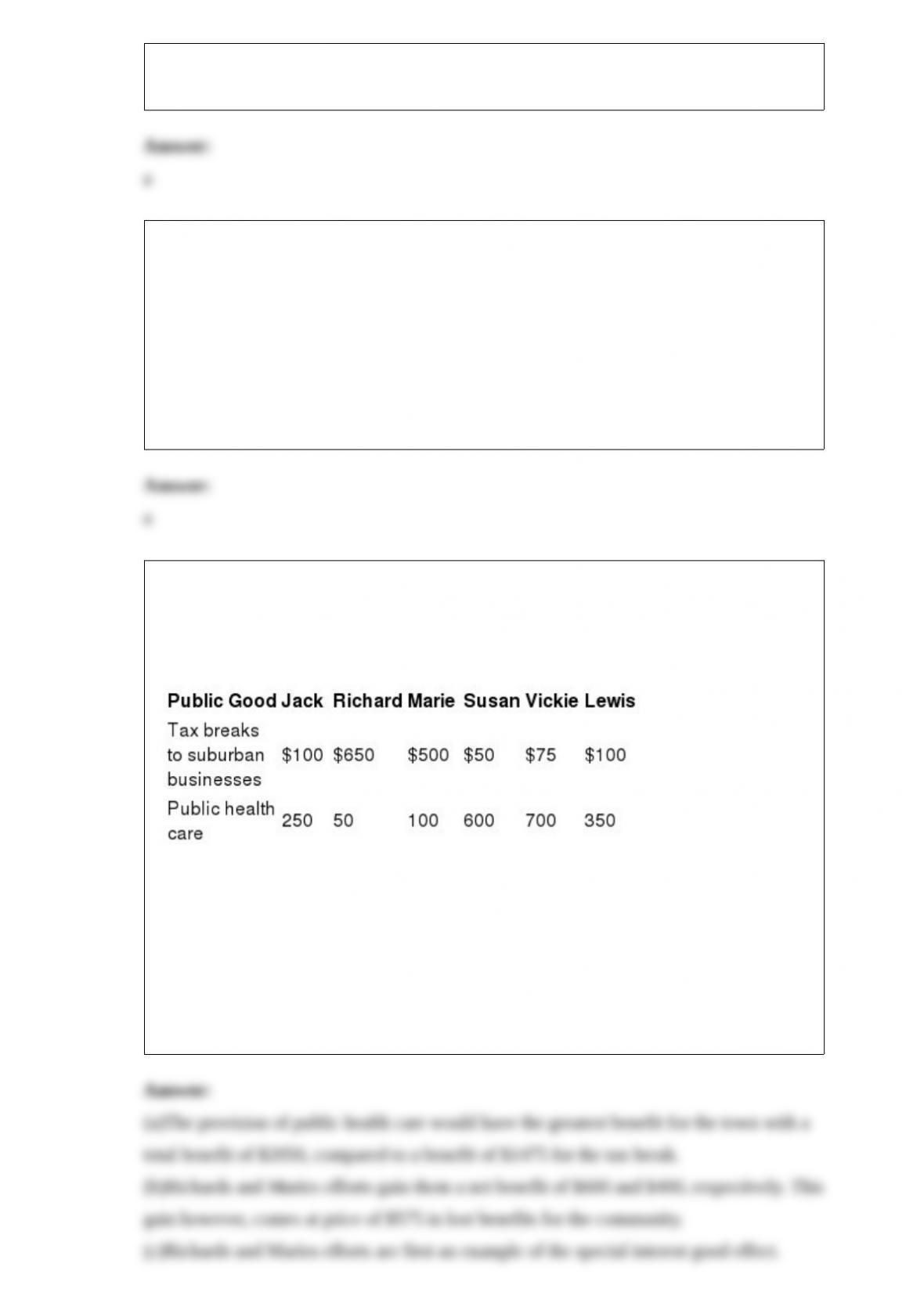
c.p1 to both children and adults.
d.p2 to both children and adults.
4) which of the following statements is correct?
a.the demand curve for a purely competitive firm is perfectly elastic, but the demand
curve for a purely competitive industry is downsloping.
b.the demand curve for a purely competitive firm is downsloping, but the demand curve
for a purely competitive industry is perfectly elastic.
c.the demand curves are downsloping for both a purely competitive firm and a purely
competitive industry.
d.the demand curves are perfectly elastic for both a purely competitive firm and a
purely competitive industry.
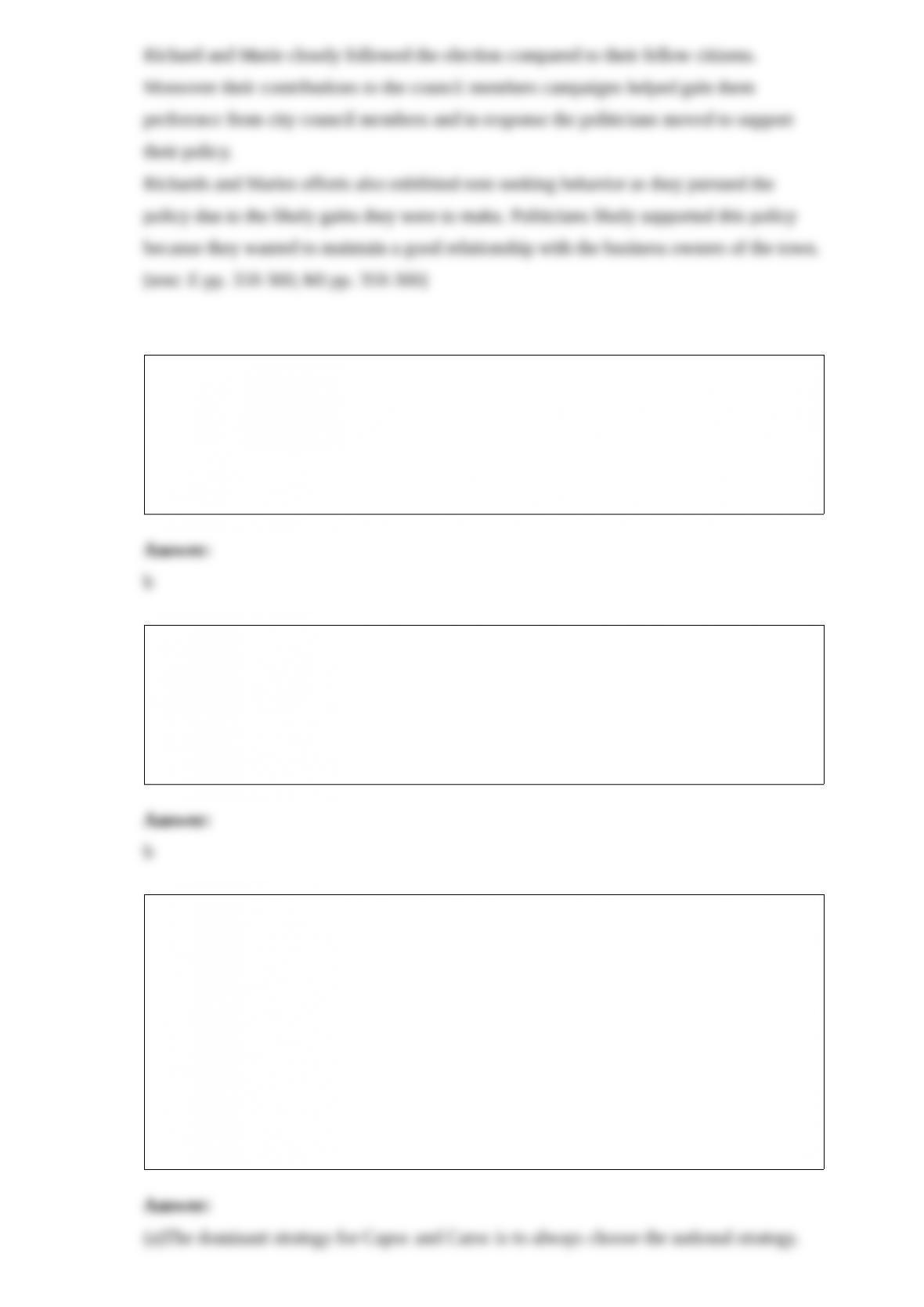
5) Suppose a town is considering either providing a tax break to suburban businesses in
the city or to provide public health care in an effort to promote growth in the city.
Assume there are 5 people living in the city: Jack, Richard, Marie, Susan, and Lewis.
Their willingness to pay for the policies is summarized in the table below.
(a)Which policy would have the greatest gain for the towns citizens?
(b)Suppose that Richard and Marie, the two businesspersons of the town, have been
closely following this debate and decide to lobby for the tax break, as they stand to
make significant gains from the policy. To further cement their effort, they make
contributions to key city council persons campaign funds and in the end, they are able
to get the tax breaks passed. What effect does this have on the total benefit for Richard
and Marie? For the community as a whole?
(c)What type of government failure does this example illustrate?
6) in comparing the changes in tvc and tc associated with an additional unit of output,
we find that:
a.no generalization about the changes in tc and tvc can be made.
b.the changes in tc and tvc are equal.
c.the change in tc is greater than the change in tvc.
d.the change in tvc is greater than the change in tc.
7) economic profits and losses:
a.are both considered by economists to be a part of production costs.
b.are essential to the reallocation of resources from less desired goods to more desired
goods.
c.have no influence on the composition of the domestic output.
d.equalize the distribution of income in the long run.
8) Answer the following questions based on the payoff matrix for a single-period,
two-firm game for firms, Capoc and Caroc. The numbers in the matrix indicate the
profit in billions of dollars for a national of regional strategy. The profit outcome cells
are A, B, C, and D
(a)Which strategies are the dominate ones for Capoc and Caroc?
(b)What is the Nash Equilibrium?
(c)What will be the total amount of profits for both firms if both firms decide their
strategy simultaneously?
(d)If Capoc makes a credible threat that determines the strategy for Caroc, which
combination of strategies will be selected and what will be the total amount of profits
for both firms?
9) If the reserve ratio is 100 percent, the value of the monetary multiplier is:
A.0.
B.1.
C.10.
D.100.
10) A monopsonistic employer:
A.has a perfectly elastic labor supply curve.
B.is necessarily a monopolist in the product market.
C.confronts a marginal resource (labor) cost that is greater than the wage rate.
D.confronts a marginal resource (labor) cost that is less than the wage rate.
11) Actual investment is $62 billion at an equilibrium output level of $620 billion in a
private closed economy. The average propensity to save at this level of output is:
A.0.10.
B.10.0
C.0.62.
D.0.84.
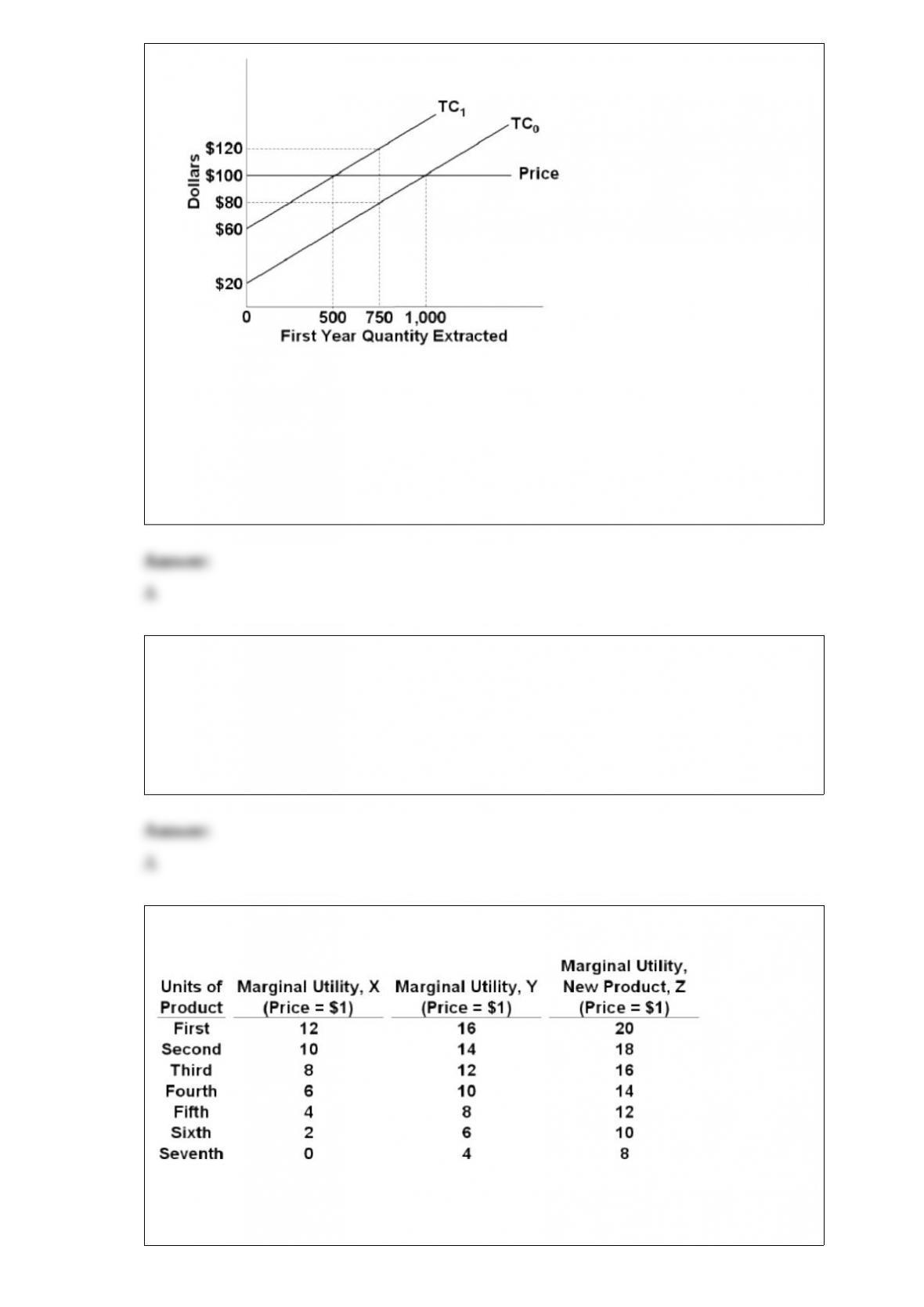
12)
Refer to the diagram above, assuming that the firm represented is operating on curve
TC1. If the current price of the resource rises by $20, the optimal quantity extracted in
the first year will:
A.increase by 250
B.increase by 500
C.decline by 250
D.remain unchanged
13) If the demand for a product is perfectly inelastic, the incidence of an excise tax will
be:
A.entirely on the buyer.
B.mostly on the buyer.
C.entirely on the seller.
D.mostly on the seller.
14) Consumer’s income = $12
Refer to the above data for a utility-maximizing consumer. Assume that new product Z
doesn’t exist. How many units of X and Y will this consumer buy, given his or her $12
budget?

A.5 of X and 7 of Y.
B.7 of X and 5 of Y.
C.6 of X and 6 of Y.
D.5 of X and 6 of Y.
15) The Sherman Act was designed to:
A.exempt commercial banks from the antitrust laws.
B.make interlocking directorates legal.
C.prohibit misleading and antisocial advertising.
D.make monopoly and acts that restrain trade illegal.