
1) The equilibrium interest rate:
A.affects both the size of total output and its composition.
B.falls when the demand for loanable funds increases.
C.determines the composition of R&D spending but not its total amount.
D.increases when the expected rate of return on R&D spending falls.
2) fiscal policy:
a.is enacted by the nation’s central bank (the federal reserve in the u.s.).
b.refers to government spending and taxation policies aimed at promoting price stability
and full employment.
c.directly raises or lowers the level of interest rates to promote levels of spending
consistent with full employment and price stability.
d.is only used to reduce unemployment rates that are too high.
3) Other things equal, a decrease in the real interest rate will:
A.expand investment and shift the AD curve to the left.
B.expand investment and shift the AD curve to the right.
C.reduce investment and shift the AD curve to the left.
D.reduce investment and shift the AD curve to the right.
4) Where there is asymmetric information between buyers and sellers.
A.product shortages will occur at the equilibrium price.
B.product surpluses will occur at the equilibrium price.
C.markets can produce inefficient outcomes.
D.markets will fail due to the “free-rider problem.”
5) answer the next question(s) on the basis of the following data. all figures are in
billions of dollars.
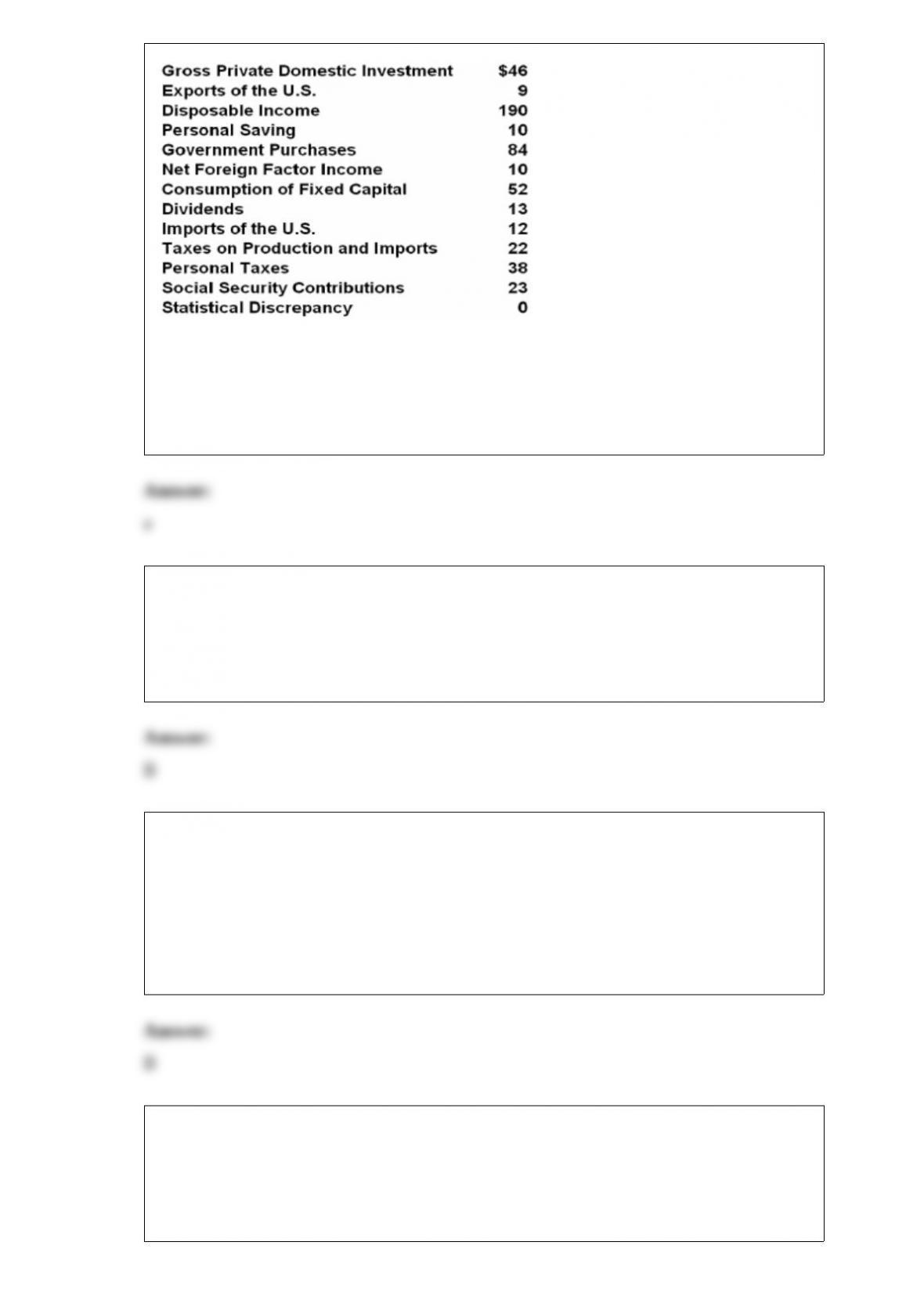
refer to the above data. the national income is:
a.$265.
b.$223.
c.$208.
d.$346.
6) Labor unions may attempt to raise wage rates by:
A.increasing the supply of labor.
B.forcing employers, under the threat of a strike, to pay above-equilibrium wage rates.
C.decreasing the demand for labor.
D.increasing the price of complementary resources.
7) On a diagram where the interest rate and the quantity of money demanded are shown
on the vertical and horizontal axes respectively, the transactions demand for money can
be represented by:
A.a line parallel to the horizontal axis.
B.a vertical line.
C.a downsloping line or curve from left to right.
D.an upsloping line or curve from left to right.
8) Which of the following is correct?
A.Most IAC private capital flows in the 1990s were to African nations.
B.IAC capital flows in the 1990s shifted from private enterprises in the DVCs to their
governments.
C.IAC capital flows in the 1990s were largely to DVCs that instituted macro and micro

reforms.
D.Generally, in the 1990s DVC nations restructured their economies toward greater
governmental direction and involvement.
9) Which of the following laws prohibited mergers by stock acquisition if the effect was
to lessen competition?
A.Celler-Kefauver Act of 1950
B.Wheeler-Lea Act of 1938
C.Clayton Act of 1914
D.Sherman Act of 1890
10) protective tariffs are:
a.maximum limits on the quantity or total value of specific products imported to a
nation.
b.excise taxes or duties placed on imported products.
c.licensing requirements, unreasonable quality standards, and the like designed to
impede imports.
d.government payments to domestic producers to reduce the world prices of exported
goods.
11) assuming no change in product demand, a pure monopolist:
a.can increase price and increase sales simultaneously because it dominates the market.
b.adds an amount to total revenue which is equal to the price of incremental sales.
c.should produce in the range where marginal revenue is negative.
d.must lower price to increase sales.