1)
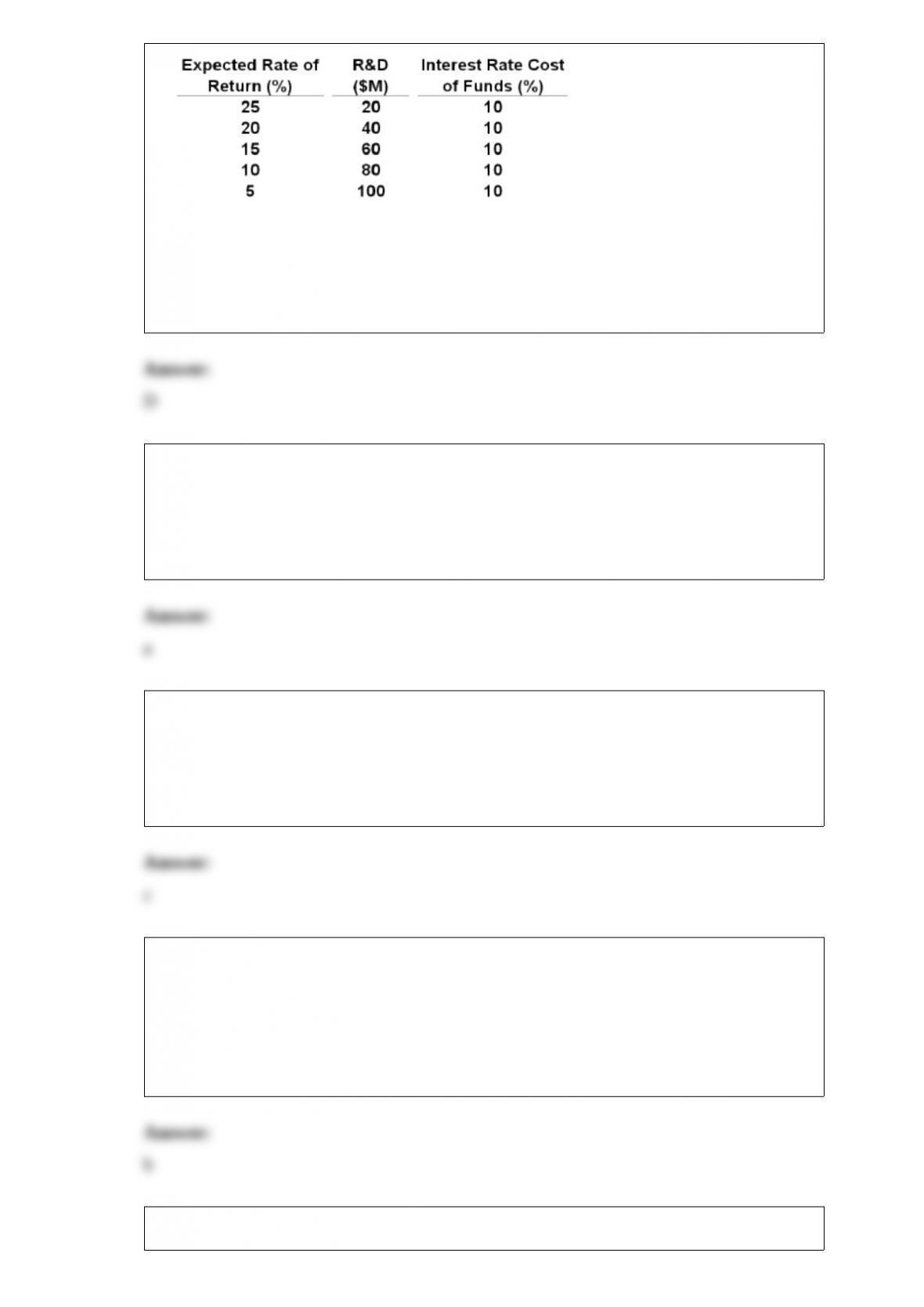
Refer to the above data. At $20 million of R&D expenditures, the:
A.marginal cost of R&D exceeds the marginal benefit.
B.expected total return from R&D is at a maximum.
C.interest rate cost of funds is negative.
D.marginal benefit of R&D exceeds the marginal cost.
2) money is not an economic resource because:
a.money, as such, is not productive.
b.idle money balances do not earn interest income.
c.it is not scarce.
d.money is not a free gift of nature.
3) if a firm decides to produce no output in the short run, its costs will be:
a.its marginal costs.
b.its fixed plus its variable costs.
c.its fixed costs.
d.zero.
4) economics may best be defined as the:
a.interaction between macro and micro considerations.
b.social science concerned with how individuals, institutions, and society make optimal
choices under conditions of scarcity.
c.empirical testing of value judgments through the use of logic.
d.use of policy to refute facts and hypotheses.
5) Restructuring of a major industry resulted from the:

A.U.S. Steel case.
B.AT&T case.
C.IBM case.
D.DuPont cellophane case.
6) State industries are notoriously poor ‘incubators’ for the development of
profit-focused, entrepreneurial persons who may leave the firm to set up their own
businesses. This statement is an argument in favor of:
A.free immigration and emigration.
B.privatizing state industries.
C.central planning.
D.free trade.
7) Answer the question on the basis of the following marginal product data for
resources a and b. The output of these independent resources sells in a purely
competitive market at $1 per unit.
Refer to the above data. Assuming the prices of resources a and b are $5 and $8
respectively, what is the least costly combination of resources for the firm to employ in
producing 192 units of output?
A.2 of a and 6 of b
B.6 of a and 2 of b
C.4 of a and 3 of b
D.3 of a and 4 of b
8) Rapid population growth can be an obstacle to economic development because:
A.it can translate a relatively large increase in real output into a small increase in real
output per capita.
B.more investment will be required to simply maintain the quantity of capital goods per
person.
C.it may lead to the overutilization and therefore ecological degradation of farmland.
D.all of these reasons.
9) market economies have been characterized by:
a.occasional instability of employment and price levels.
b.uninterrupted economic growth.
c.persistent full employment.
d.declining populations.
10) Which of the following occupations is not among the ten projected fastest growing
U.S. occupations in terms of percentage increases?
A.school teachers
B.data communication analysts
C.medical assistants
D.personal and home care aides
11)
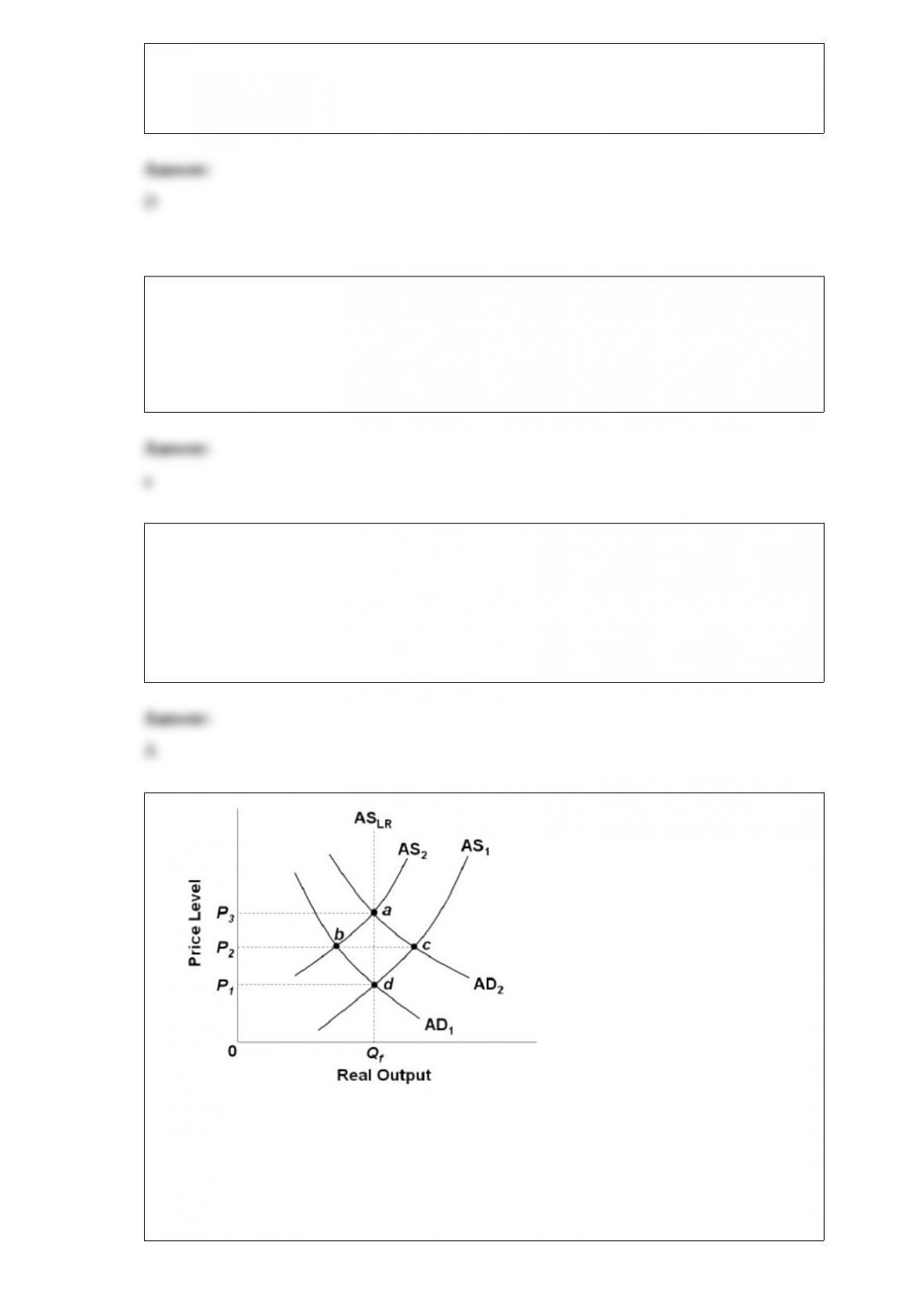
Refer to the above diagram. The initial aggregate demand curve is AD1 and the initial
aggregate supply curve is AS1. If government offsets the decline in real output resulting
from short-run cost-push inflation by increasing aggregate demand from AD1 to AD2:
A.real output will rise above Qf.
B.the price level will rise from P1 to P2.
C.it is possible that aggregate supply will shift rightward from AS2 because nominal
wage demands will rise.
D.the price level will rise from P2 to P3.
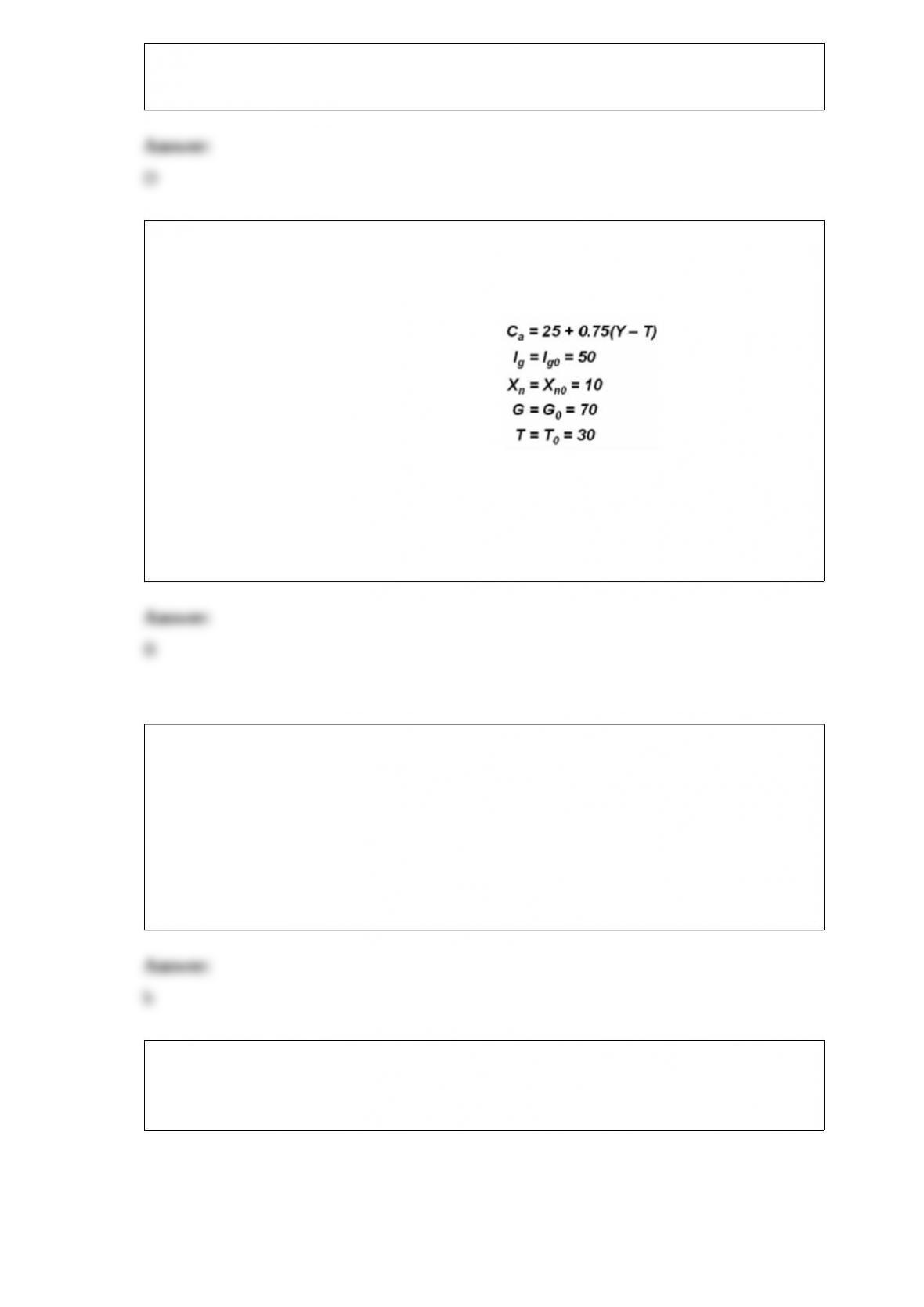
12) (Advanced analysis) Answer the next question(s) on the basis of the following
information for a mixed open economy. The letters Y, Ca, Ig, Xn, G, and T stand for
GDP, consumption, gross investment, net exports, government purchases, and net taxes
respectively. Figures are in billions of dollars.
Refer to the above information. The equilibrium level of GDP for this economy is:
A.$600.
B.$530.
C.$415.
D.$400.
13) official unemployment statistics:
a.understate unemployment because individuals receiving unemployment compensation
are counted as employed.
b.understate unemployment because discouraged workers are not counted as
unemployed.
c.include cyclical and structural unemployment, but not frictional unemployment.
d.overstate unemployment because workers who are involuntarily working part time are
counted as being employed.
14) The following table which indicates the dollar price of libras, the currency used in
the hypothetical nation of Libra. Assume that a system of freely floating exchange rates
is in place.
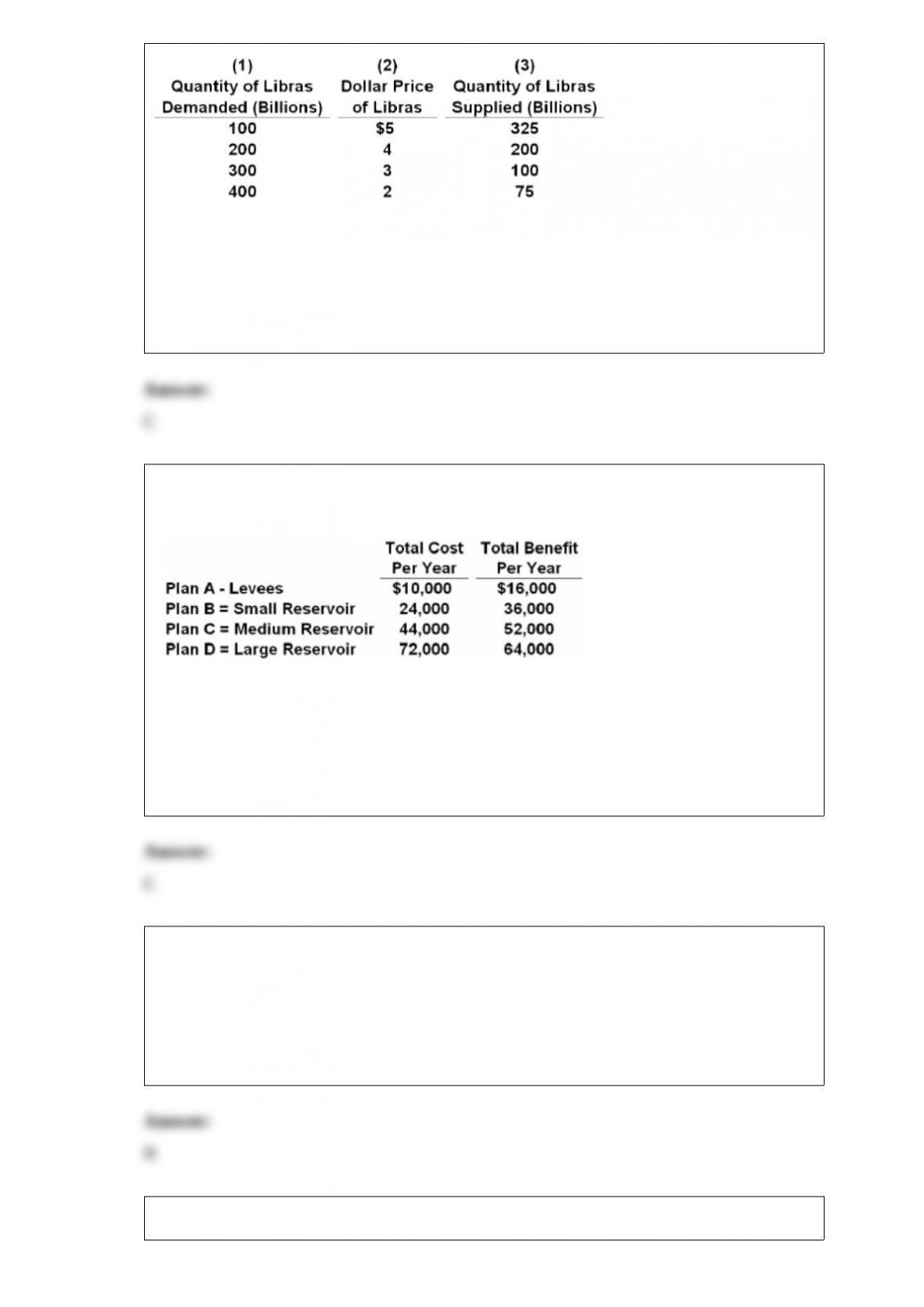
Refer to the above table. Suppose that Libra decided to import more U.S. products. We
would expect the quantity of libras:
A.demanded at each dollar price to rise and the dollar to depreciate relative to the libra.
B.demanded at each dollar price to fall and the dollar to appreciate relative to the libra.
C.supplied at each dollar price to rise and the dollar to appreciate relative to the libra.
D.supplied at each dollar price to fall and the dollar to depreciate relative to the libra.
15) The following data are for a series of increasingly extensive flood control projects:
Refer to the above data. On the basis of cost-benefit analysis government should
undertake:
A.Plan D.
B.Plan C.
C.Plan B.
D.Plan A.
16) John Maynard Keynes created the aggregate expenditures model based primarily on
what historical event?
A.Bank panic of 1907
B.Great Depression
C.Spectacular economic growth during World War II
D.Economic expansion of the 1920s
17) between 2007 and 2013, productivity growth is expected to account for about
________ percent of the growth of real gdp in the united states.
a.10
b.30
c.70
d.90
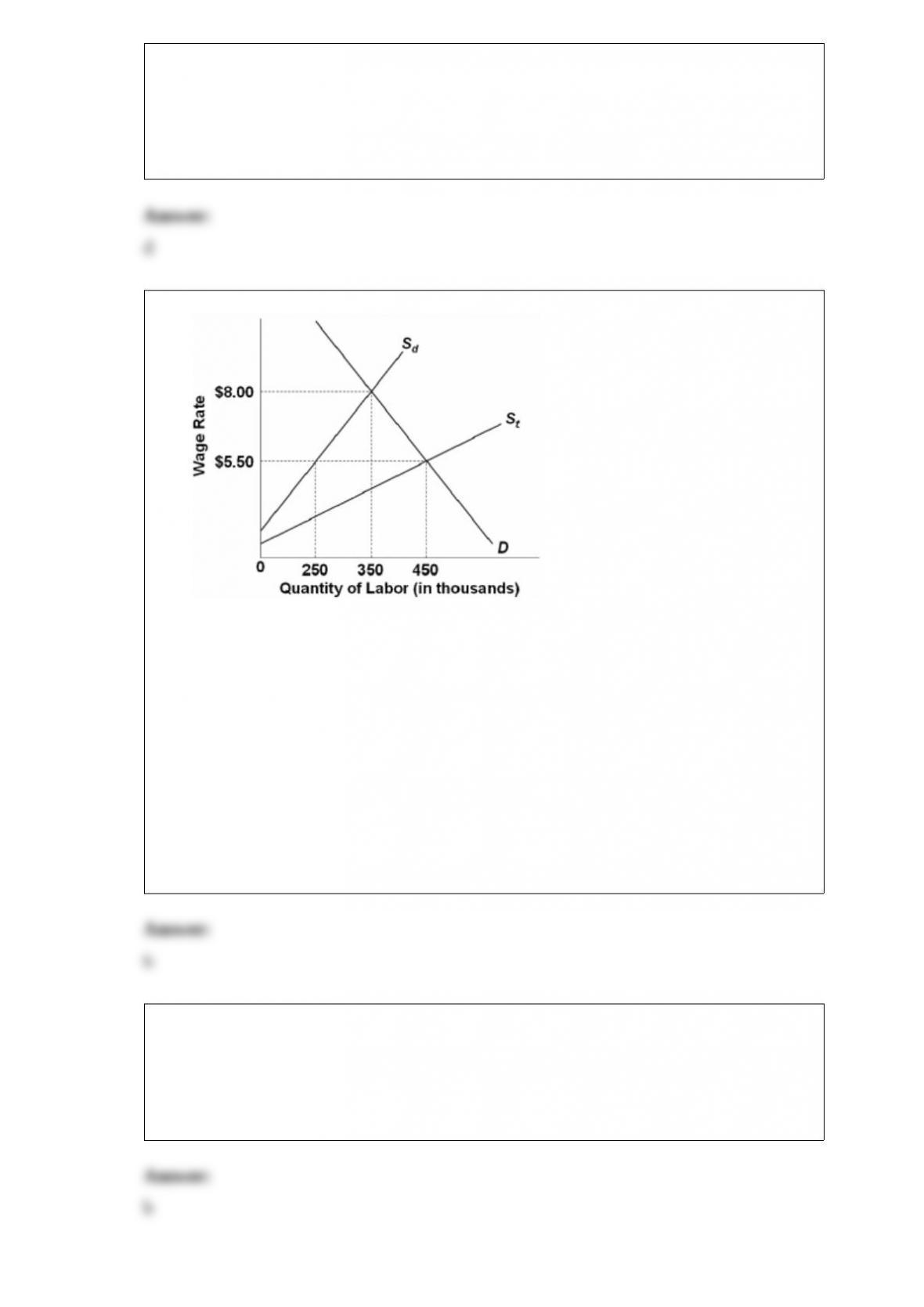
18)
assumptions: 1) employers in this market are willing and able to ignore minimum wage
laws; 2) sd represents the supply of domestically-born (and legal immigrant) workers;
3) st represents the total supply of workers in this labor market (sd plus illegal
immigrants); and 4) unless otherwise stated, illegal immigration is not effectively
blocked by the government.
refer to the above figure. how many domestically-born (and legal immigrant) workers
will be hired at equilibrium?
a.200,000
b.250,000
c.350,000
d.450,000
19) if a competitive industry is neither expanding nor contracting, we would expect:
a.total revenue to be zero.
b.economic profits to be zero.
c.total opportunity cost to be zero.
d.more resources to flow to that industry.
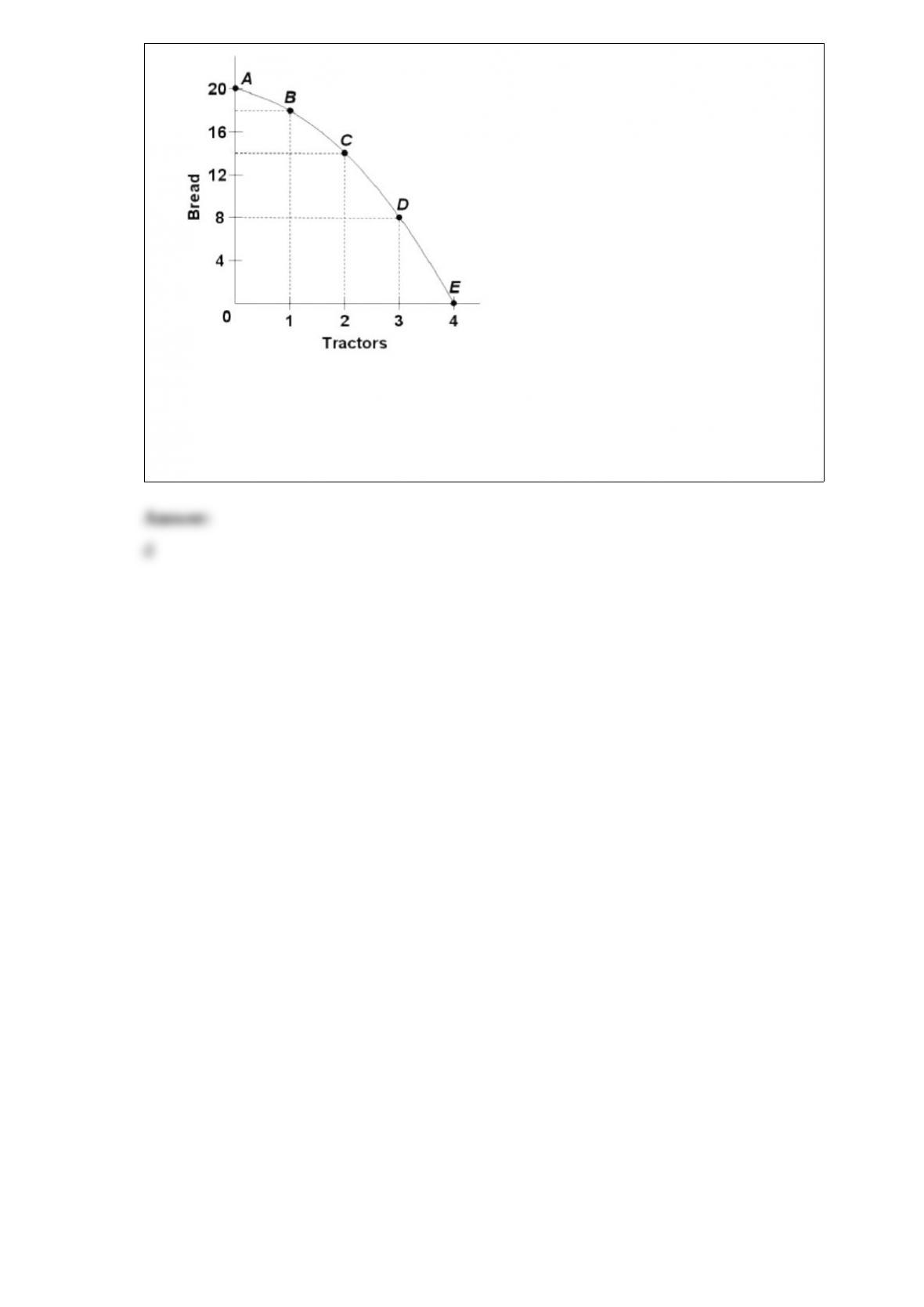
20)
refer to the above diagram. this production possibilities curve is constructed so that:
a.resources are presumed to be perfectly shiftable between bread and tractors.
b.the opportunity cost of bread diminishes as more bread is produced.
c.the opportunity cost of tractors increases as more bread is produced.
d.the opportunity cost of both bread and tractors increases as more of each is produced.