1) other things the same, if a price change causes total revenue to change in the opposite
direction, demand is:
a.perfectly inelastic.
b.relatively elastic.
c.relatively inelastic.
d.of unit elasticity.
2) suppose losses cause industry x to contract and, as a result, the prices of relevant
inputs decline. industry x is:
a.a constant-cost industry.
b.a decreasing-cost industry.
c.an increasing-cost industry.
d.encountering x-inefficiency.
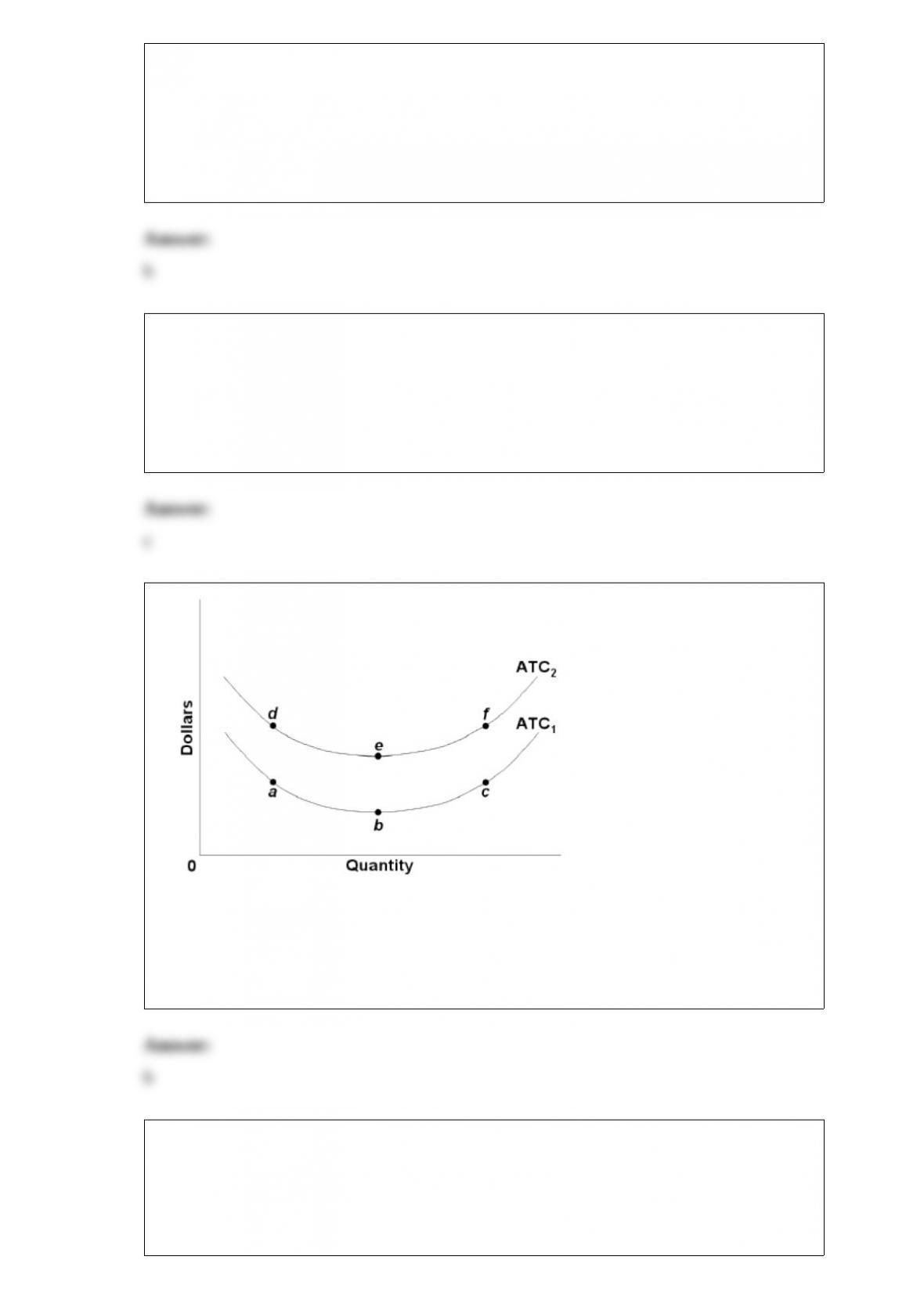
3)
refer to the above graph. diminishing marginal returns are reflected in:
a.the shift of the short-run average total cost curve from atc2 to atc1.
b.a move along short-run average total cost curve atc2 from point e to point f.
c.a move along short-run average total cost curve atc1 from point b to point a.
d.the shift of the short-run average total cost curve from atc1 to atc2.
4) when the pure monopolist’s demand curve is elastic, marginal revenue:
a.may be either positive or negative.
b.is zero.
c.is negative.
d.is positive.

5) The demand for most agricultural products is:
A.elastic with respect to price, but inelastic with respect to income.
B.inelastic with respect to price, but elastic with respect to income.
C.elastic with respect to both price and income.
D.inelastic with respect to both price and income.
6) (consider this) the main point of the consider this box on clipping coins is that:
a.decreases in the money supply cause deflation.
b.decreases in tax rates often increase tax revenues.
c.inflation imposes a “hidden tax” on those who hold money.
d.demand creates its own supply.
7) (Consider This) Which of the following nations has implemented policies that pay
women to have additional children?
A.Italy.
B.United States.
C.China.
D.All of these nations.
8) a firm comprised of plants or units operating in different industries, say, beer and
theme parks, best illustrates a:
a.vertically integrated firm.
b.multinational corporation.
c.multiplant firm.
d.conglomerate.
9) for a nation’s real gdp per capita to rise during a year:
a.consumption spending must increase.
b.real gdp must increase more rapidly than population.

c.population must increase more rapidly than real gdp.
d.investment spending must increase.
10) Suppose laid off workers and other qualified unemployed workers offer to work for
less than the wages being paid existing employed workers, but employers do not hire
these workers for fear that existing workers will refuse to cooperate with them. This
situation best describes the:
A.efficiency wage theory.
B.theory of compensating wage differentials.
C.insider-outsider theory.
D.rational expectations theory.
11) Recessions have contributed to the public debt by:
A.reducing national income and therefore tax revenues.
B.increasing real interest rates.
C.increasing the international value of the dollar.
D.increasing national saving.
12) a production possibilities curve illustrates:
a.scarcity.
b.market prices.
c.consumer preferences.
d.the distribution of income.
13) the supply curve of a pure monopolist:
a.is that portion of its marginal cost curve which lies above average variable cost.
b.is the same as that of a purely competitive industry.
c.is its average variable cost curve.
d.does not exist because prices are not “given” to a monopolist.
14) How can supply and demand analysis be used to explain the equilibrium price and
quantity of exports and imports for aluminum when there is trade between two nations
(e.g., the United States and Canada)?
15) Which of the following groups of economists is most likely to favor annually
balanced Federal budgets?
A.Mainstream economists
B.Supply-side economists
C.Rational expectations economists
D.Functional finance economists
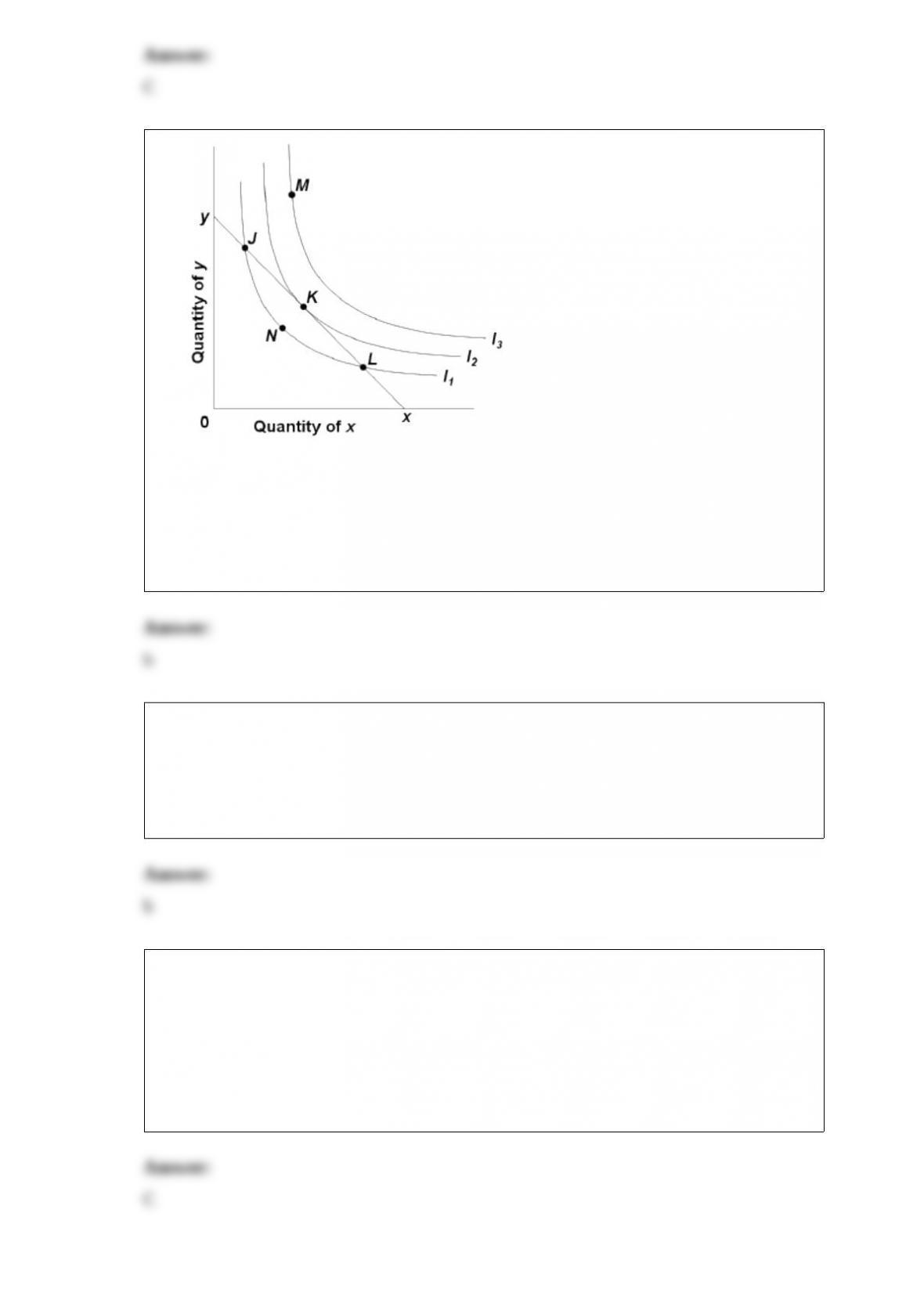
16)
refer to the above diagram where xy is the relevant budget line and i1, i2, and i3 are
indifference curves. at point k:
a.mux = muy.
b.mrs = px/py.
c.mrs = py/px.
d.px exceeds py.
17) you should decide to go to a movie:
a.if the marginal cost of the movie exceeds its marginal benefit.
b.if the marginal benefit of the movie exceeds its marginal cost.
c.if your income will allow you to buy a ticket.
d.because movies are enjoyable.
18) The basic argument for income inequality is that:
A.the very rich establish consumption patterns that are desirable for the rest of society
to emulate.
B.the rich buy luxury goods that soon become affordable to everyone else because of
economies of scale.
C.income inequality is essential to maintain incentives to produce.
D.inequality undermines incentives and tends to reduce the size of the national income.

19) suppose the income elasticity of demand for toys is +2.00. this means that:
a.a 10 percent increase in income will increase the purchase of toys by 20 percent.
b.a 10 percent increase in income will increase the purchase of toys by 2 percent.
c.a 10 percent increase in income will decrease the purchase of toys by 2 percent.
d.toys are an inferior good.