1) a purely competitive seller is:
a.both a “price maker” and a “price taker.”
b.neither a “price maker” nor a “price taker.”
c.a “price taker.”
d.a “price maker.”
2)
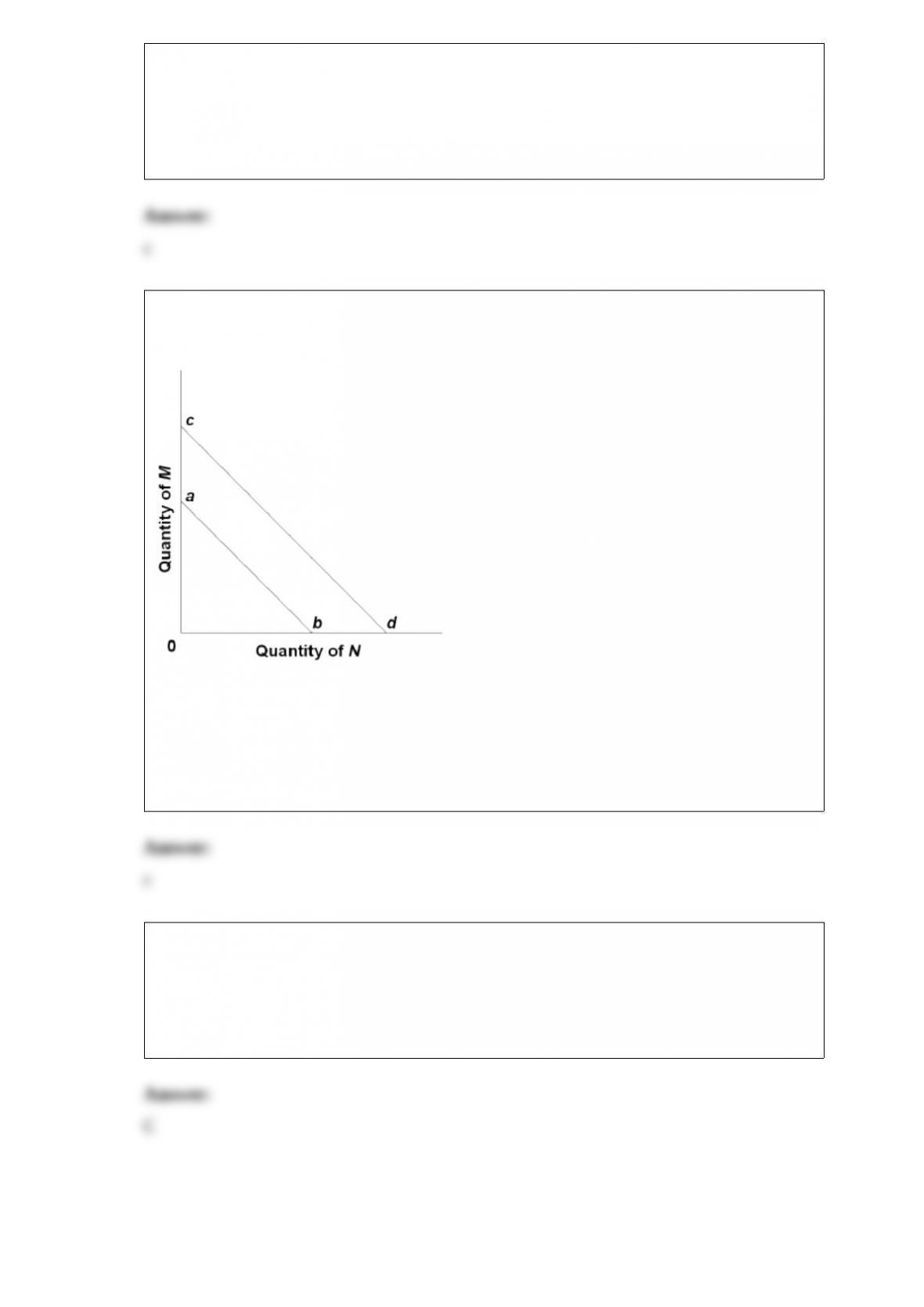
the shift of the budget line from cd to ab in the above figure is consistent with:
a.decreases in the prices of both m and n.
b.an increase in the price of m and a decrease in the price of n.
c.a decrease in money income.
d.an increase in money income.
3) Income:
A.is a stock concept.
B.consists of accumulated assets.
C.is a flow concept.
D.consists of wages only.
4)
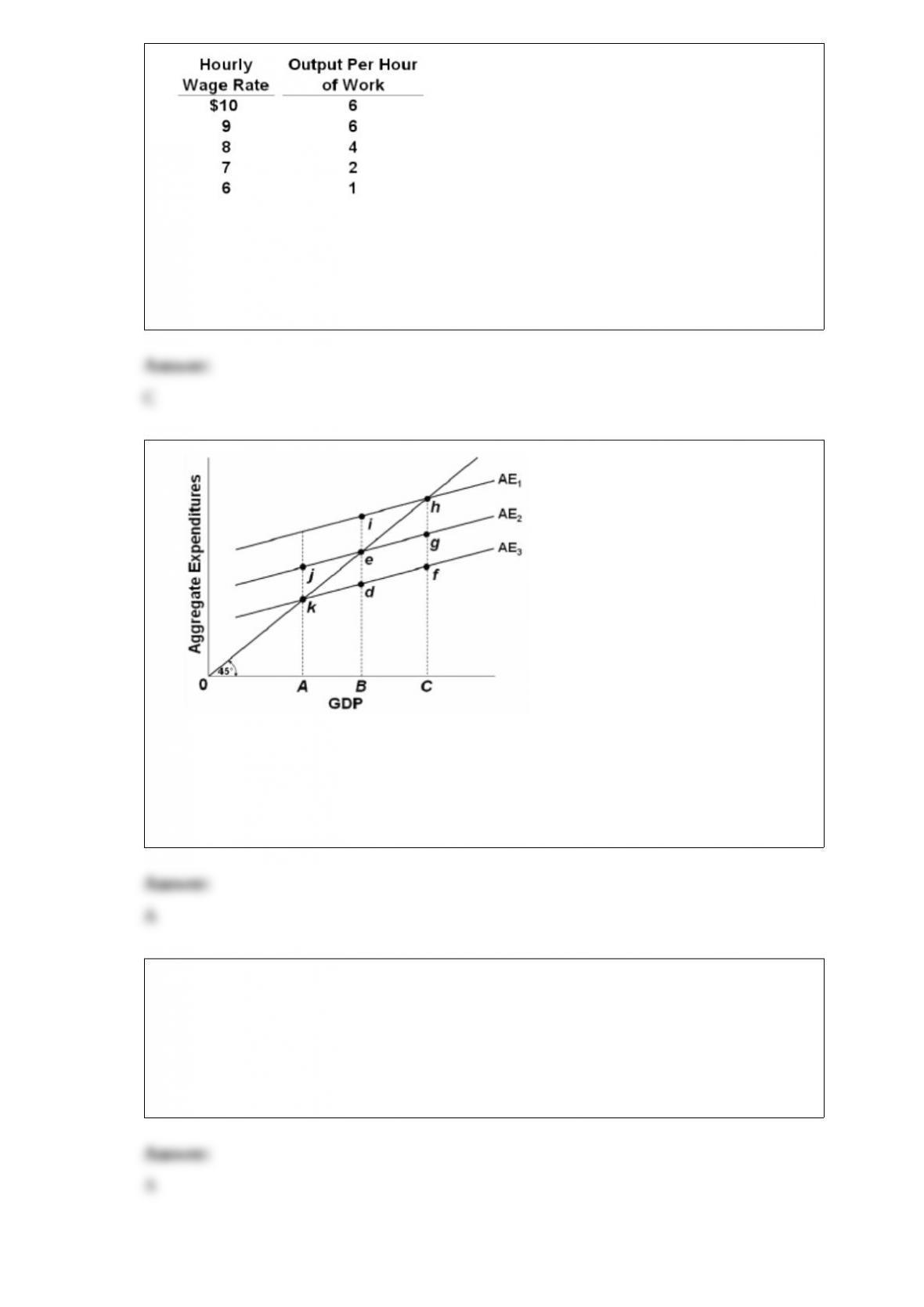
Refer to the above table. At the $8 wage, labor cost per-unit of output is:
A.$1.25.
B.$1.50.
C.$2.00.
D.$1.67.
5)
Refer to the above diagram. The value of the multiplier for this economy is:
A.BC/hg.
B.BC/AB.
C.ed/di.
D.df/BC.
6) A bank temporarily short of required reserves may be able to remedy this situation
by:
A.borrowing funds in the Federal funds market.
B.granting new loans.
C.shifting some of its vault cash to its reserve account at the Federal Reserve.
D.buying bonds from the public.
7) Suppose in some economy there are 100 million workers; 10 million of those
workers work in retail trade, and 1 million of the retail workers belong to unions. Total
union membership in this economy is 40 million. The rate of unionization in retail trade
is:
A.1 percent.
B.10 percent.
C.40 percent.
D.100 percent.
8) the achievement of full employment through time will:
a.diminish labor productivity.
b.reduce the level of investment as a percentage of gdp.
c.increase the realized rate of economic growth.
d.have no impact on the rate of economic growth.
9)
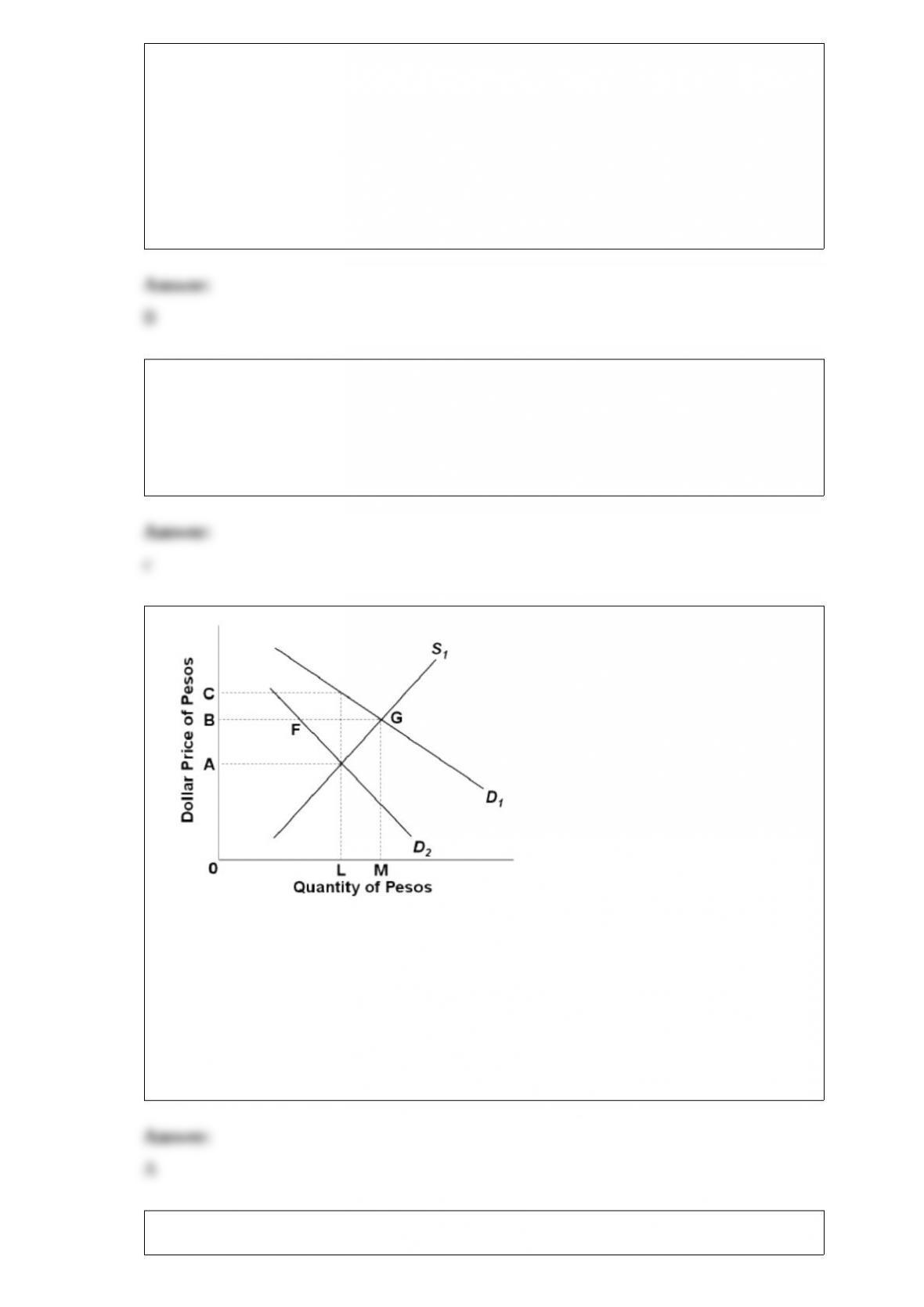
Refer to the above diagram. The initial demand for and supply of pesos are shown by
D1 and S1. Suppose the United States reduces its imports of Mexican goods, shifting its
demand for pesos from D1 to D2. If the United States and Mexico were both on the
international gold standard:
A.gold would flow from Mexico to the United States.
B.the exchange rate would rise from B dollars equals 1 peso to C dollars equals 1 peso.
C.gold would flow from the United States to Mexico.
D.the exchange rate would fall from B dollars equals 1 peso to A dollars equals 1 peso.
10) The pure rate of interest refers to the:

A.nominal rate of interest adjusted for inflation.
B.nominal rate of interest.
C.interest rate paid on virtually riskless long-term bonds.
D.rate which large banks charge their corporate borrowers.
11) If the price of capital declines, the consequent output effect would be:
A.greater, the more elastic the demand for the product.
B.greater, the less elastic the demand for the product.
C.negative.
D.of consequence only if capital and labor are used in fixed proportions.