1) The Financial Services Modernization Act of 1999:
A.set limits on the fees that banks can charge for automatic teller machine (ATM)
withdrawals.
B.established a new dollar coin that will replace the dollar bill in 2008.
C.permitted banks, thrifts, pension companies, and securities firms to merge and to sell
each other’s products.
D.outlawed “payday loans” that are advanced against forthcoming payroll checks.
2)
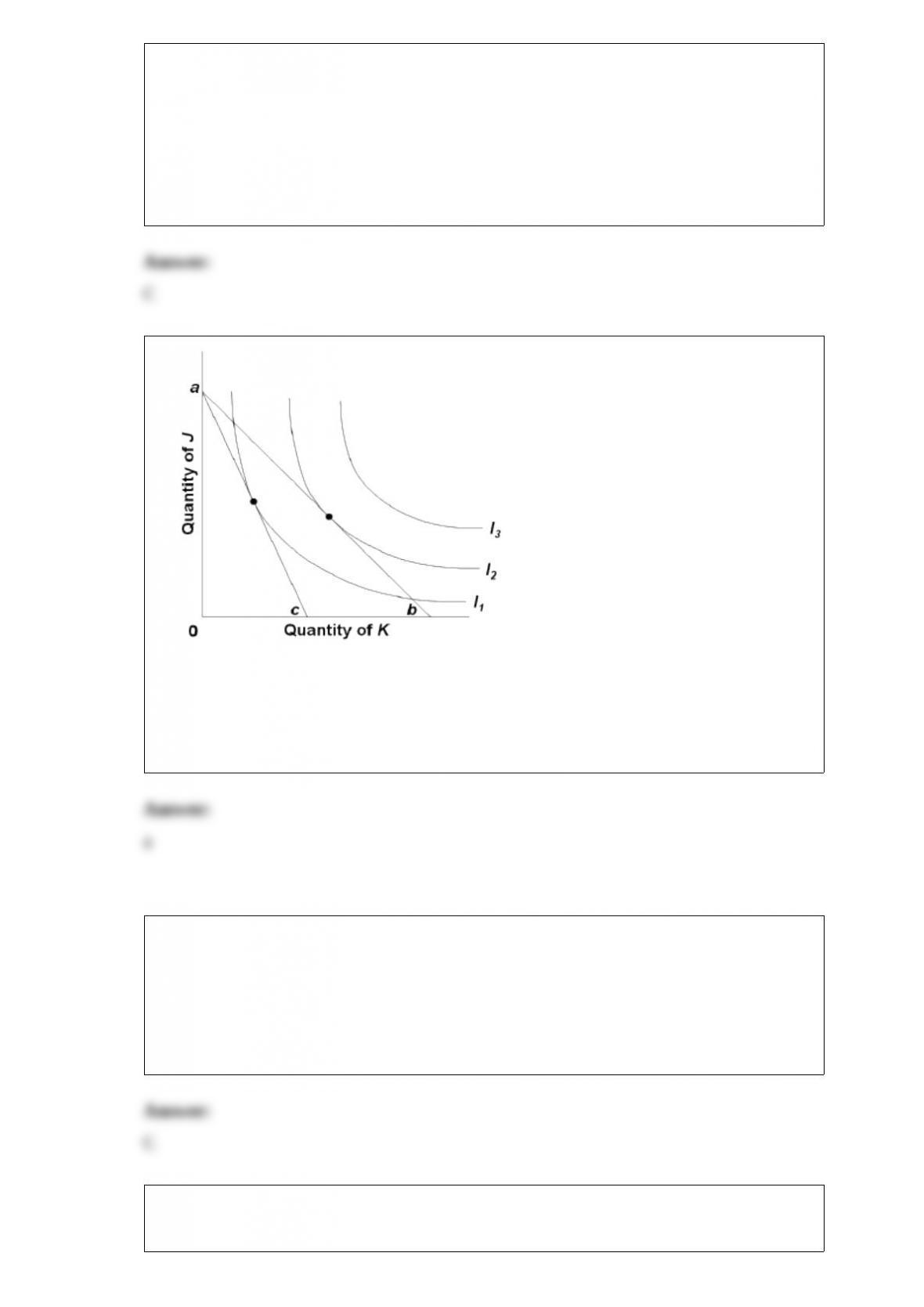
refer to the above diagram. if the budget line shifts from ab to ac the:
a.price of k has increased.
b.consumer’s money income has fallen.
c.price of k has decreased.
d.price of j has increased.
3) Discretionary fiscal policy is so named because it:
A.is undertaken at the option of the nation’s central bank.
B.occurs automatically as the nation’s level of GDP changes.
C.involves specific changes in T and G undertaken expressly for stabilization at the
option of Congress.
D.is invoked secretly by the Council of Economic Advisers.
4) All else equal, when the Federal Reserve Banks engage in a restrictive monetary
policy, the prices of government bonds usually:
A.fall.
B.rise.
C.remain constant.
D.move in the same direction as the bonds’ interest rate yield.
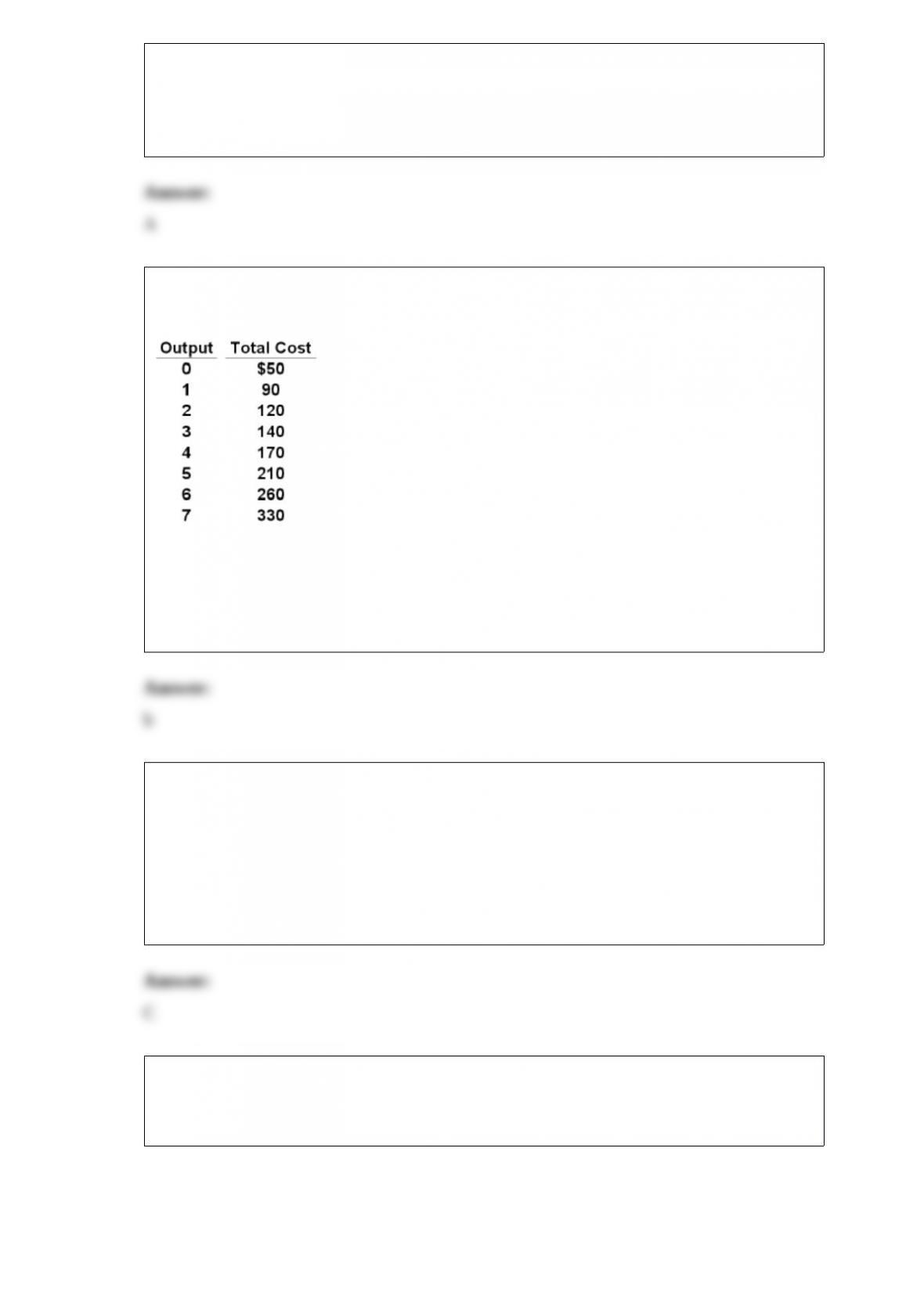
5) the following cost data for a purely competitive seller:
refer to the above data. if product price is $25, the firm will:
a.shut down and incur a $90 loss.
b.shut down and incur a $50 loss.
c.produce 3 units and incur a $65 loss.
d.produce 4 units and realize a $10 economic profit.
6) Suppose a firm anticipates that a particular R&D expenditure of $100 million will
result in a new product and thus create a one-time added profit of $108 million a year
later. The firm will:
A.undertake the R&D expenditure if its interest-rate-cost of borrowing is 12 percent.
B.undertake the R&D expenditure if its interest-rate-cost of borrowing is 10 percent.
C.not undertake the R&D expenditure if its interest-rate-cost of borrowing is 9 percent.
D.not undertake the R&D expenditure if its interest-rate-cost of borrowing is 7 percent.
7) Use the following total-product schedule for a resource to answer the next three
questions. Assume that the quantities of other resources the firm employs remain
constant.
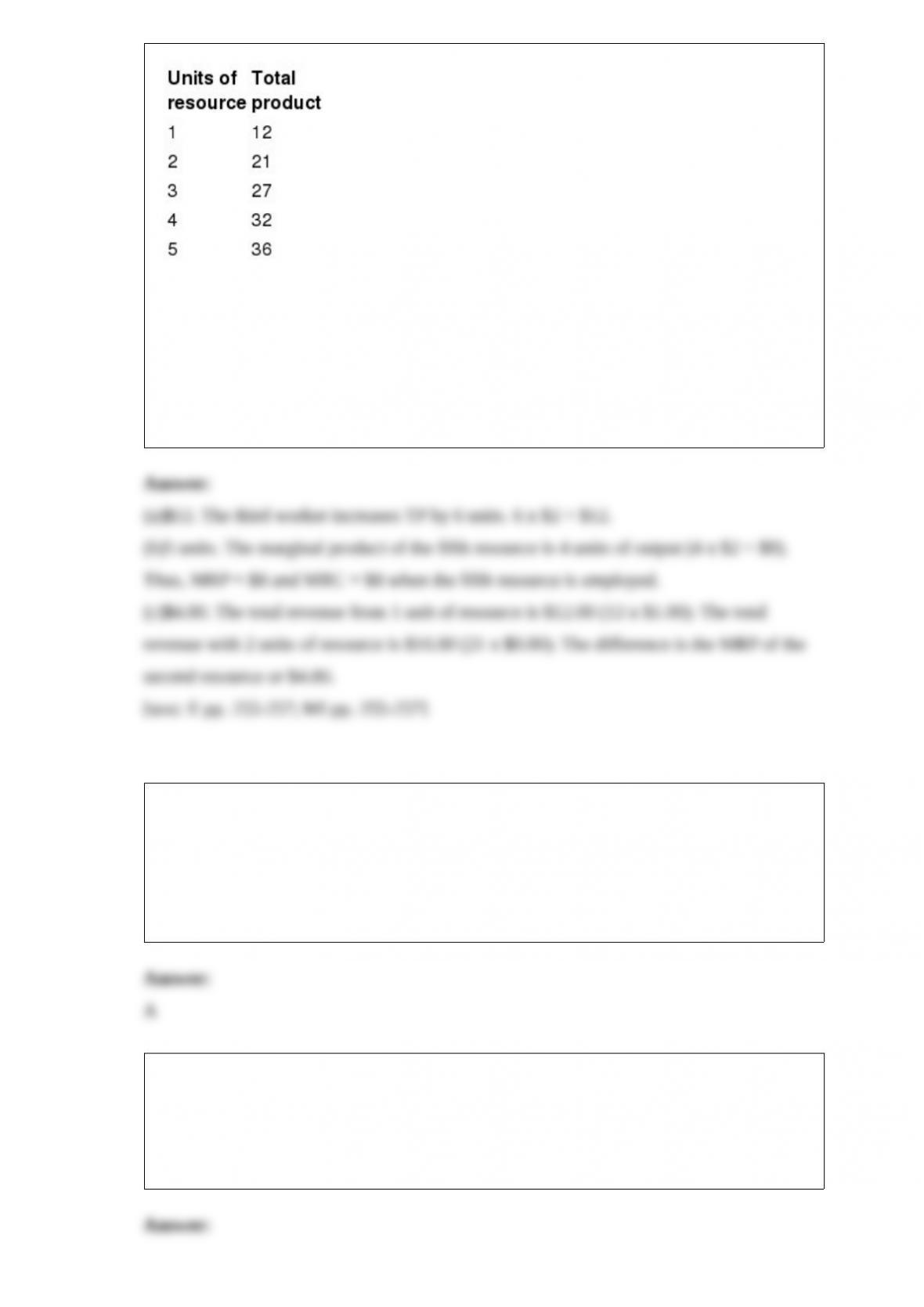
(a)If the firms product sells for a constant $2 per unit, what is the marginal revenue
product of the third unit of the resource?
(b)If the firms product sells for a constant $2 per unit and the price of this resource is
$8, how many units of the resource will the firm employ?
(c)If the firm can sell 12 units of output at a price of $1.00 per unit and 21 units of
output at a price of $0.80 per unit, what is the marginal revenue product of the second
unit of the resource?
8) An excise tax on an imported good that helps shield domestic producers of the good
is called a:
A.protective tariff.
B.import quota.
C.revenue tariff.
D.voluntary export restriction.
9) In the equation of exchange the nominal GDP is designated by:
A.PQ/M.
B.MV/P.
C.PQ.
D.MV.
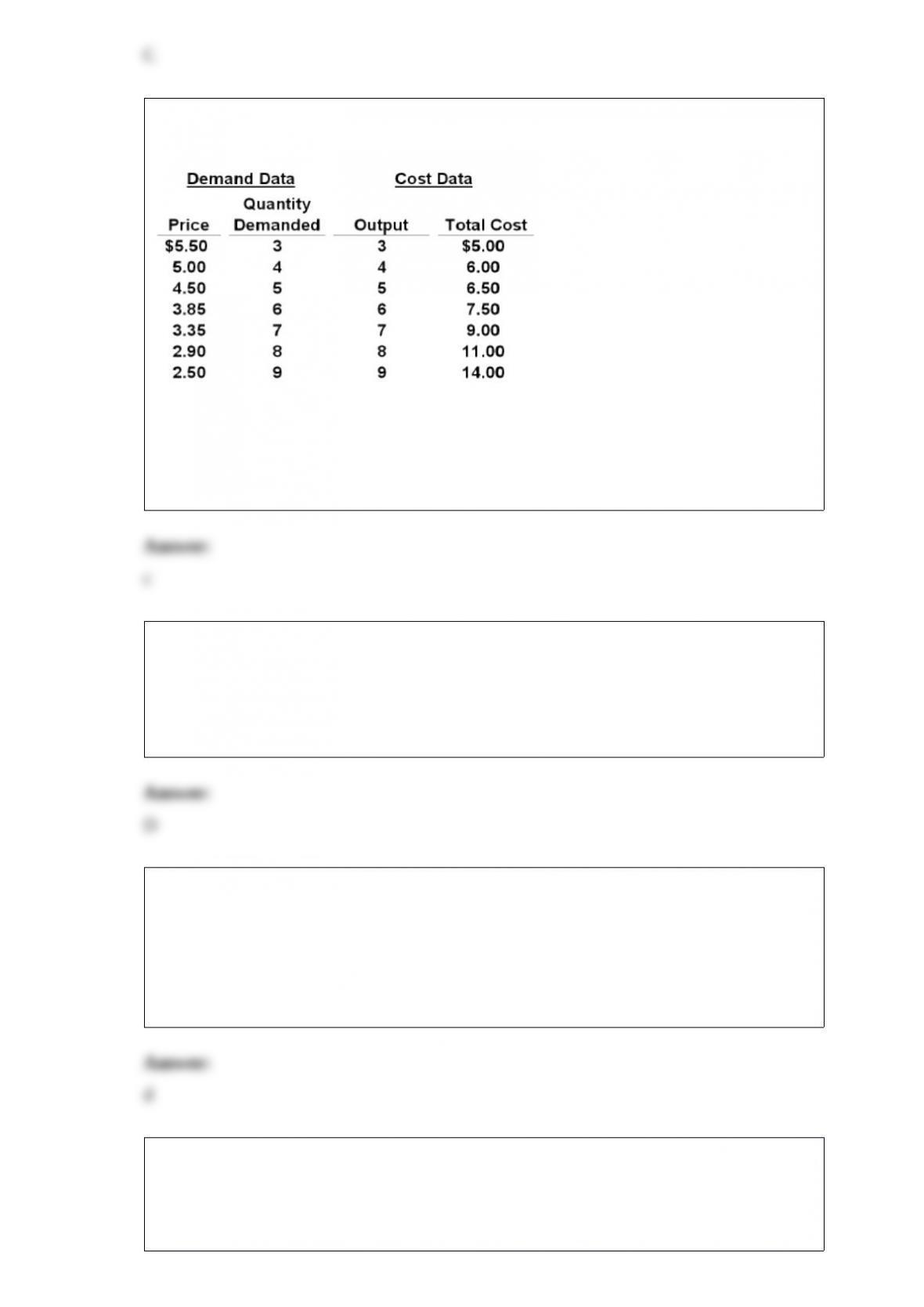
10) the following demand and cost data for a pure monopolist:
refer to the above data. the profit-maximizing monopolist will realize a:
a.profit of $8.50.
b.profit of $7.50.
c.profit of $16.
d.loss of $14.
11) In terms of absolute dollar volume, the top 3 leaders in world exports are:
A.Japan, China, and the European Union.
B.the United States, England, and Canada.
C.Germany, England, and the United States.
D.Germany, the United States, and China.
12) in economics, an organization that employs resources to produce goods and services
for profit and operates one or more plants is called a(n):
a.industry.
b.shop.
c.conglomerate.
d.firm.
13) which of the following conditions is not required for price discrimination?
a.buyer with different elasticities must be physically separate from each other.
b.the good or service cannot be resold by original buyers.
c.the seller must be able to segment the market, that is, to distinguish buyers with
different elasticities of demand.
d.the seller must possess some degree of monopoly power.
14)
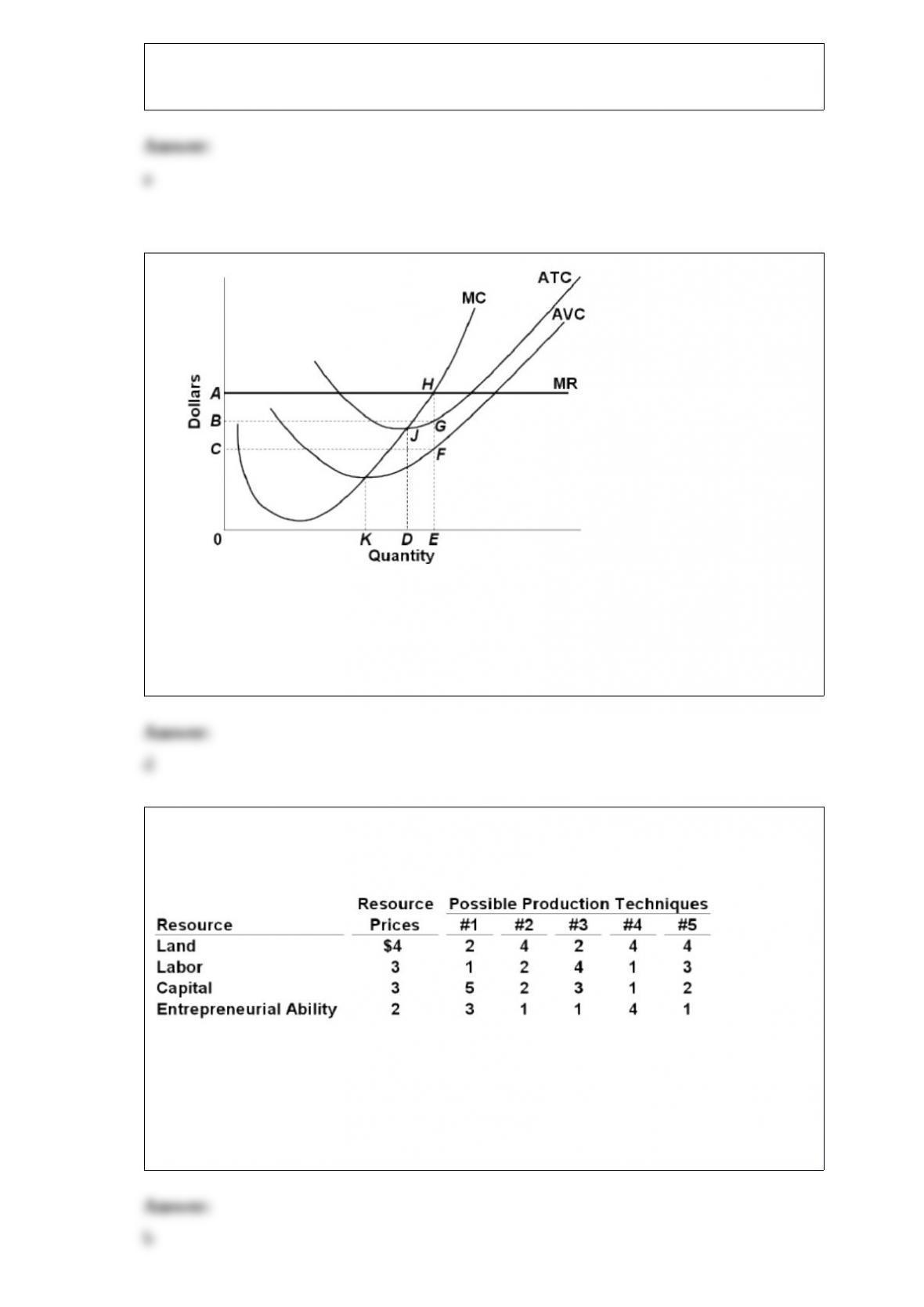
refer to the above diagram. at the profit-maximizing output, total fixed cost is equal to:
a.0ahe
b.0bge
c.0cfe
d.bcfg
15) answer the next question(s) using the following data which show all available
techniques for producing 20 units of a particular commodity:
refer to the above data. in view of the indicated resource prices, the economically most
efficient production technique(s) is (are) technique(s):
a.#1
b.#2 and #4
c.#3
d.#1 and #3

16) if a firm’s demand for labor is elastic, a union-negotiated wage increase will:
a.necessarily be inflationary.
b.cause the firm’s total payroll to increase.
c.cause the firm’s total payroll to decline.
d.cause a shortage of labor.
17) the mr = mc rule can be restated for a purely competitive seller as p = mc because:
a.each additional unit of output adds exactly its price to total revenue.
b.the firm’s average revenue curve is downsloping.
c.the market demand curve is downsloping.
d.the firm’s marginal revenue and total revenue curves will coincide.