
1) when an economy is operating under conditions of full employment, the production
of more of commodity a will mean the production of less of commodity b because:
a.of the law of increasing opportunity costs.
b.economic wants are insatiable.
c.resources are limited.
d.resources are specialized and only imperfectly substitutable.
2) Tying agreements:
A.establish common boards of directors for previously competing firms.
B.obligate a purchaser of product X to also buy product Y from the same seller.
C.allow manufacturers to specify the retail prices of their products.
D.prohibit firms from selling their products outside of specified geographic areas.
3) in the short run a purely competitive firm will always make an economic profit if:
a.p = atc.
b.p > avc.
c.p = mc.
d.p > atc.
4) Which of the following is a true statement?
A.There is a long-run tradeoff between inflation and unemployment.
B.There is no tradeoff between inflation and unemployment in the short-run.
C.The short-run Phillips Curve is horizontal.
D.The long-run Phillips Curve is vertical.
5) In 1993 the Federal government boosted income tax rates. The change in tax revenue
that occurred in the seven years that followed:
A.supported the claims of supply-side economists and the Laffer Curve.
B.contradicted the claims of supply-side economists and the Laffer Curve.
C.caused productivity growth to slow.
D.significantly increased the size of the government’s budget deficit.

6) If investment increases by $10 billion and the economy’s MPC is .8, the aggregate
demand curve will shift:
A.leftward by $50 billion at each price level.
B.rightward by $10 billion at each price level.
C.rightward by $50 billion at each price level.
D.leftward by $40 billion at each price level.
7) The kinked-demand schedule that an oligopolist believes confronts the firm is given
in the table below. Compute the oligopolists total revenue at each of the nine prices, and
enter these figures in the table. Also compute marginal revenue for each unit between
the nine prices and enter these figures in the table.
(a)Where is the kink in the demand curve? What is the current selling price at that kink
and how much output will be demanded?
(b)What is the range of marginal cost that will keep the price set at the kink?
8) Suppose the courts declare that XYZ Corporation violated the antitrust laws and as a
result the ABC Corporation lost $100 million of profits. XYZ Corporation will have to
pay ABC Corporation a monetary award of:
A.$100 million.
B.$33.3 million.
C.$150 million.
D.$300 million.
9) According to mainstream macroeconomists, U.S. macro instability has resulted from:
A.investment “booms” and “busts” and, occasionally, adverse aggregate supply shocks.
B.adherence by the Fed to a monetary rule.
C.government’s attempts to balance its budget.
D.wide fluctuations in net exports.
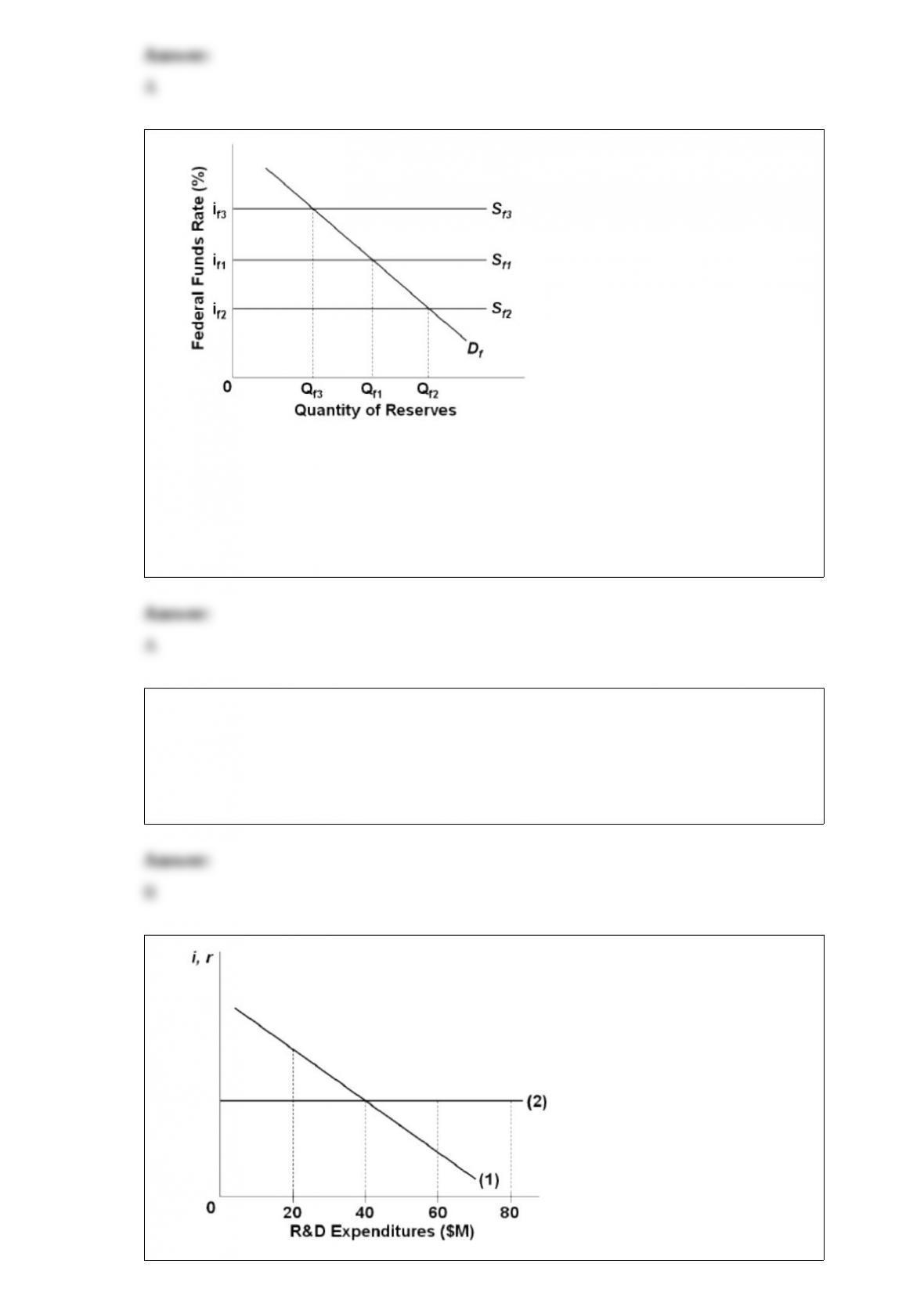
10)
Refer to the above diagram for the Federal funds market. An expansionary monetary
policy would be shown by:
A.a shift from Sf3 to Sf2.
B.a shift from Sf1 to Sf3.
C.a rightward shift of Df.
D.a leftward shift of Df.
11) The equation underlying the mainstream view of macroeconomics is:
A.MV = PQ.
B.Ca + Ig + Xn + G = GDP.
C.S = a – bY.
D.GDP = P x Q.
12)

Assume that a firm’s interest-rate-cost of funds curve for R&D is perfectly elastic.
Which of the following would increase a firm’s optimal R&D expenditures and, in
equilibrium, leave the expected rate of return on the last dollar of R&D unchanged?
A.a rightward shift of the expected-rate-of-return curve
B.an upward shift of the interest-rate-cost of funds curve
C.a leftward shift of the expected-rate-of-return curve
D.a downward shift of the interest-rate-cost of funds curve