1) the personal distribution of income in the united states is such that the richest fifth
receives about _____ percent of personal income.
a.30
b.40
c.50
d.60
2)
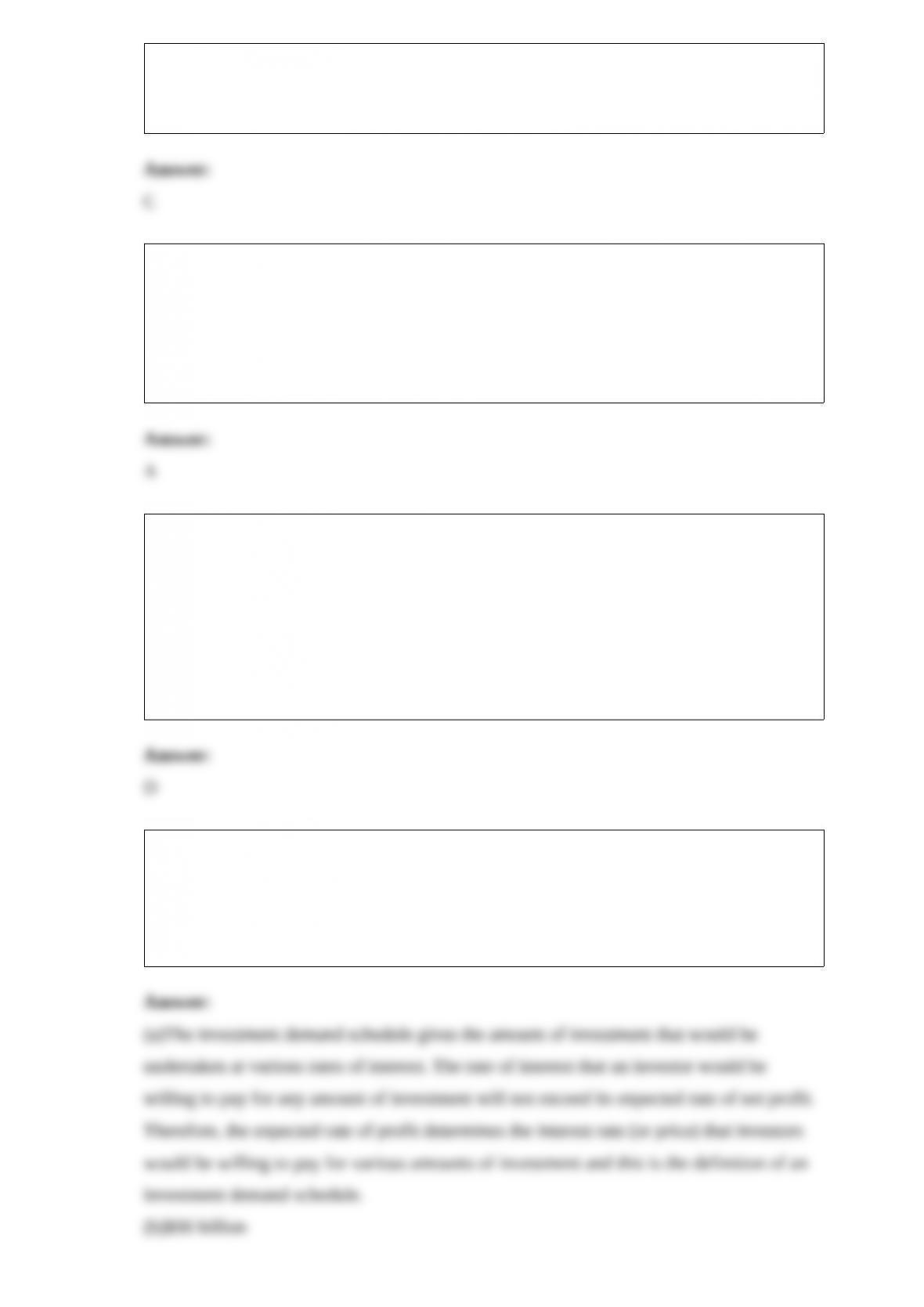
Refer to the above diagram that applies to a private closed economy. If aggregate
expenditures are C + Ig 2, the amount of saving at income level J is:
A.LK.
B.KN.
C.KD.
D. JD
3) The extended AD-AS model:
A.distinguishes between short-run and long-run aggregate demand.
B.explains inflation but not recession.
C.includes G and Xn whereas the simple AD-AD model does not.
D.distinguishes between short-run and long-run aggregate supply.
4) Famines in sub-Saharan Africa:
A.are solely the result of unalterable weather conditions.
B.have become less common in recent decades.
C.are the result of drought, civil strife, overpopulation, and inappropriate public
policies.
D.are solely the result of government policies that overprice agricultural products.
5) If government increases its tax revenues by $15 billion and the MPC is 2/3, then we
can expect the equilibrium GDP to:
A.decrease by $30 billion.
B.decrease by $45 billion.
C.decrease by $35 billion.
D.decrease by $55 billion.
6) An expansionary monetary policy may be less effective than a restrictive monetary
policy because:
A.the Federal Reserve Banks are always willing to make loans to commercial banks
which are short of reserves.
B.fiscal policy always works at cross purposes with an expansionary monetary policy.
C.changes in exchange rates complicate an expansionary monetary policy more than it
does a restrictive monetary policy.
D.commercial banks may not be able to find loan customers.
7) Use the following data to answer the questions.
(a)Explain why this table is essentially an investment demand schedule.
(b)If the interest rate was 8%, how much investment would be undertaken?
(c)Why is there an inverse relationship between the rate of interest and the amount of
investment?
8)
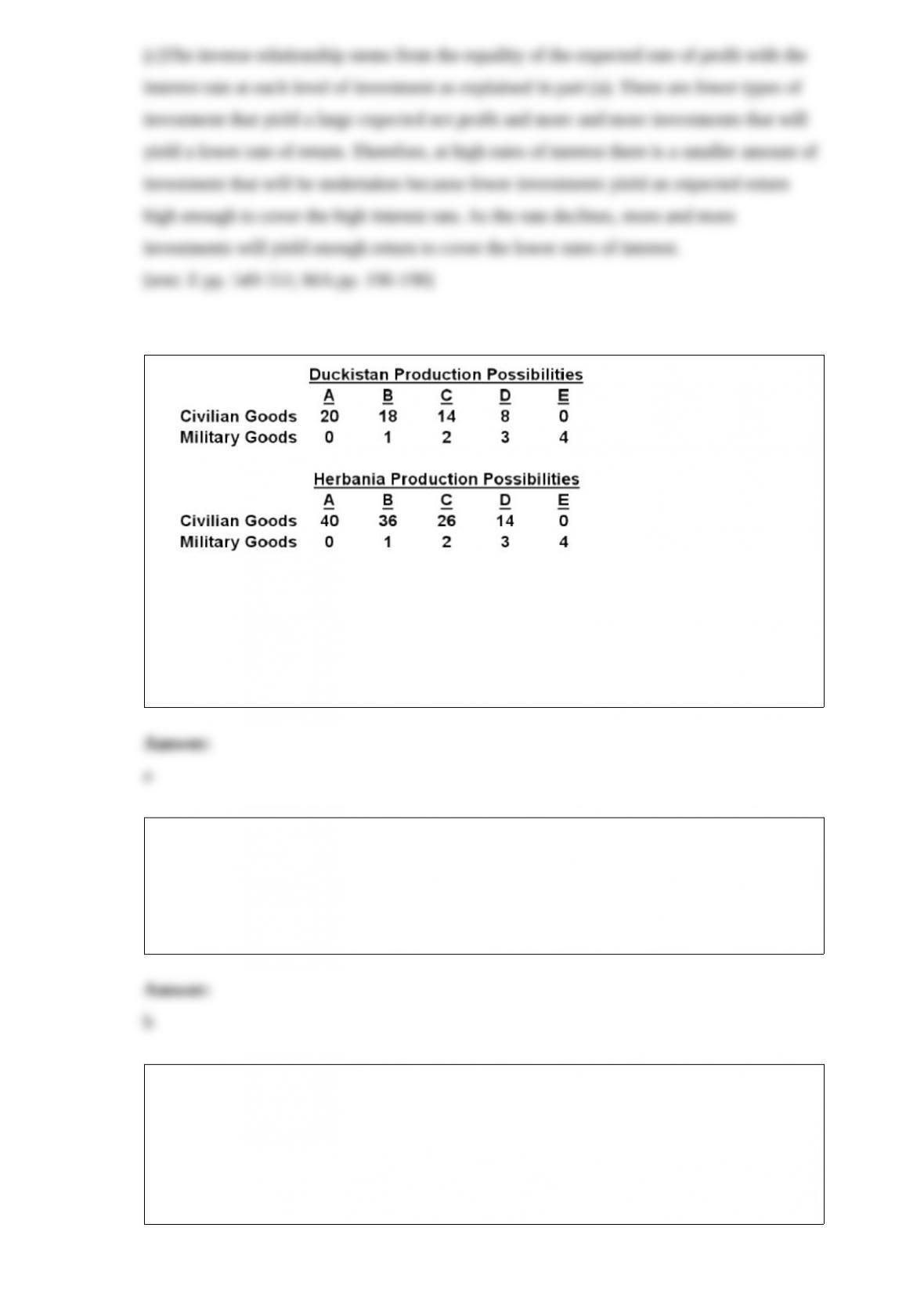
refer to the above tables. suppose that duckistan and herbania are each producing 14
units of civilian goods and 2 unit of military goods. then:
a.duckistan is fully employing its resources but herbania is not.
b.both duckistan and herbania are fully employing their resources.
c.herbania is fully employing its resources by duckistan is not.
d.neither duckistan nor herbania are fully employing their resources.
9) fixed cost is:
a.the cost of producing one more unit of capital, say, machinery.
b.any cost which does not change when the firm changes its output.
c.average cost multiplied by the firm’s output.
d.usually zero in the short run.
10) the price of product x is reduced from $100 to $90 and, as a result, the quantity
demanded increases from 50 to 60 units. therefore demand for x in this price range:
a.has declined.
b.is of unit elasticity.
c.is inelastic.
d.is elastic.

11) The gain from international trade is:
A.increased employment in the domestic export sector.
B.more goods than would be attainable through domestic production alone.
C.tariff revenue.
D.increased employment in the domestic import sector.
12) when the price of nike soccer balls fell, ronaldo purchased more nike soccer balls,
and fewer adidas soccer balls. which of the following best explains ronaldo’s decision to
buy more nike soccer balls?
a.the substitution effect
b.the income effect
c.an increase in the demand for nike soccer balls
d.the price effect
13) an owner’s liability for the debts of a business is:
a.limited in a corporation to the assets of preferred stockholders.
b.limited in a corporation to the assets of bondholders.
c.limited to the owner’s investment in a single proprietorship.
d.unlimited in a partnership.
14) The benchmark interest rate that banks use as a reference point for a variety of
consumer and business loans is the:
A.Federal funds rate.
B.prime interest rate.
C.discount rate.
D.Treasury bill rate.
15)
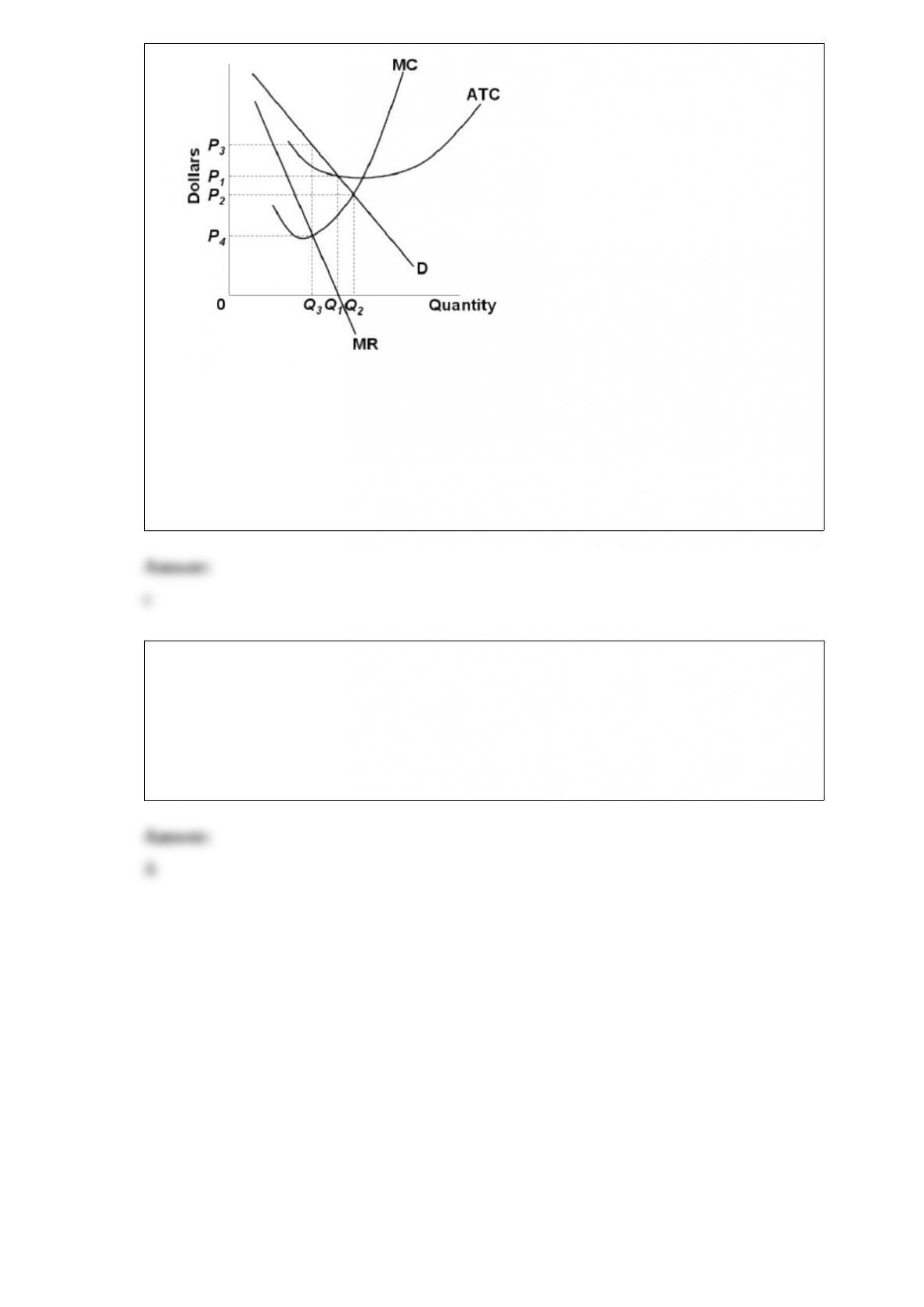
refer to the above diagram for a pure monopolist. if a regulatory commission seeks to
achieve the most efficient allocation of resources to this line of production, it will set a
price of:
a.p1.
b.p3.
c.p2.
d.p4.
16) The optimal amount of social regulation occurs where the marginal benefit of such
regulation:
A.equals the marginal cost.
B.exceeds the marginal cost by the greatest amount.
C.is zero.
D.is at its maximum.