
1) which of the following is least likely to be considered economic immigration?
a.bob migrates to canada to improve his access to health care.
b.manuela migrates to the united states to open an authentic italian cooking school.
c.myklos migrates to switzerland because the public pension system is more generous
than in his home country.
d.alexander migrates to the united states because his political writings are censored in
his home country.
2) the “most-favored-nation” clause of reciprocal trade agreements:
a.outlaws tariffs on products for which an exporting nation has a comparative
advantage.
b.singles out a particular nation for exemption from an import quota.
c.means that any tariff reductions the united states negotiates with a specific nation will
automatically apply to many other nations.
d.confers special trade privileges to nations in which the united states has military
bases.
3) If an unintended increase in business inventories occurs at some level of GDP, then
GDP:
A.entails a rate of aggregate expenditures in excess of the rate of aggregate production.
B.may be either above or below the equilibrium output.
C.is too low for equilibrium.
D.is too high for equilibrium.
4) A firm charged with monopolizing a market is less likely to be convicted if:
A.the court accepts a broad definition of the market.
B.the court accepts a narrow definition of the market.
C.it has gained its monopoly through abusive means.
D.it sells its product to other firms, rather than directly to consumers.
5) the gdp gap measures the difference between:
a.ndp and gdp.
b.ni and pi.

c.actual gdp and potential gdp.
d.nominal gdp and real gdp.
6) In a mixed open economy, if aggregate expenditures exceed GDP:
A.Ig + X + G = Ca.
B.Ca + Ig + Xn + G < domestic output.
C.Ig > S.
D.Ig + X + G > Sa + M + T.
7) Which of the following statements is not correct?
A.State and local governments in the aggregate have realized budget surpluses in some
years.
B.A Federal deficit of $20 billion in 2010 would increase the public debt by $20 billion.
C.The public debt is the accumulation of all the Federal government’s deficits and
surpluses.
D.The public debt refers to the debts of all units of governmentFederal, state, and local.
8) the first, second, and third workers employed by a firm add 24, 18, and 9 units to
total product respectively. therefore, the:
a.marginal product of the third worker is 9.
b.total product of the three workers is 54.
c.average product of the three workers is 18.
d.marginal product of the first worker is 18.
9) According to the Taylor rule, if real GDP rises 1 percent above potential GDP, the
Fed should raise the Federal funds rate, relative to the current rate of inflation, by:
A.0.5 percentage points.
B.1 percentage points.
C.1.5 percentage points.
D.2 percentage points.

10) A change in an input price will alter both production costs and the
profit-maximizing output. Thus a decline in the price of capital will reduce production
costs, increase the profit-maximizing output, and thereby increase the demand for labor.
This describes the:
A.output effect.
B.substitution effect.
C.idea of derived demand.
11) Suppose that the price of capital increases relative to the wage rate and, as a result,
the demand for labor increases. This means that:
A.the substitution effect is greater than the output effect.
B.labor and capital are complementary resources.
C.it is impossible to substitute labor for capital.
D.the output effect is greater than the substitution effect.
12) the vertical distance between the horizontal axis and any point on a
nondiscriminating monopolist’s demand curve measures:
a.the quantity demanded.
b.product price and marginal revenue.
c.total revenue.
d.product price and average revenue.
13) Which of the following will not shift the demand curve for labor?
A.the use of a larger stock of capital with the labor force
B.a change in the wage rate
C.an increase in the price of the product which labor is helping to produce
D.the adoption of a more efficient method of combining labor and capital in the
production process
14) A bank’s actual reserves can be found by:
A.adding its required and excess reserves.
B.subtracting its required reserves from its excess reserves.
C.multiplying its excess reserves by the reserve ratio.
D.multiplying its checkable deposits by the reserve ratio.
15) the four factors of production are:
a.land, labor, capital, and money
b.land, labor, capital, and entrepreneurial ability
c.labor, capital, technology, and entrepreneurial ability
d.labor, capital, entrepreneurial ability, and money
16)
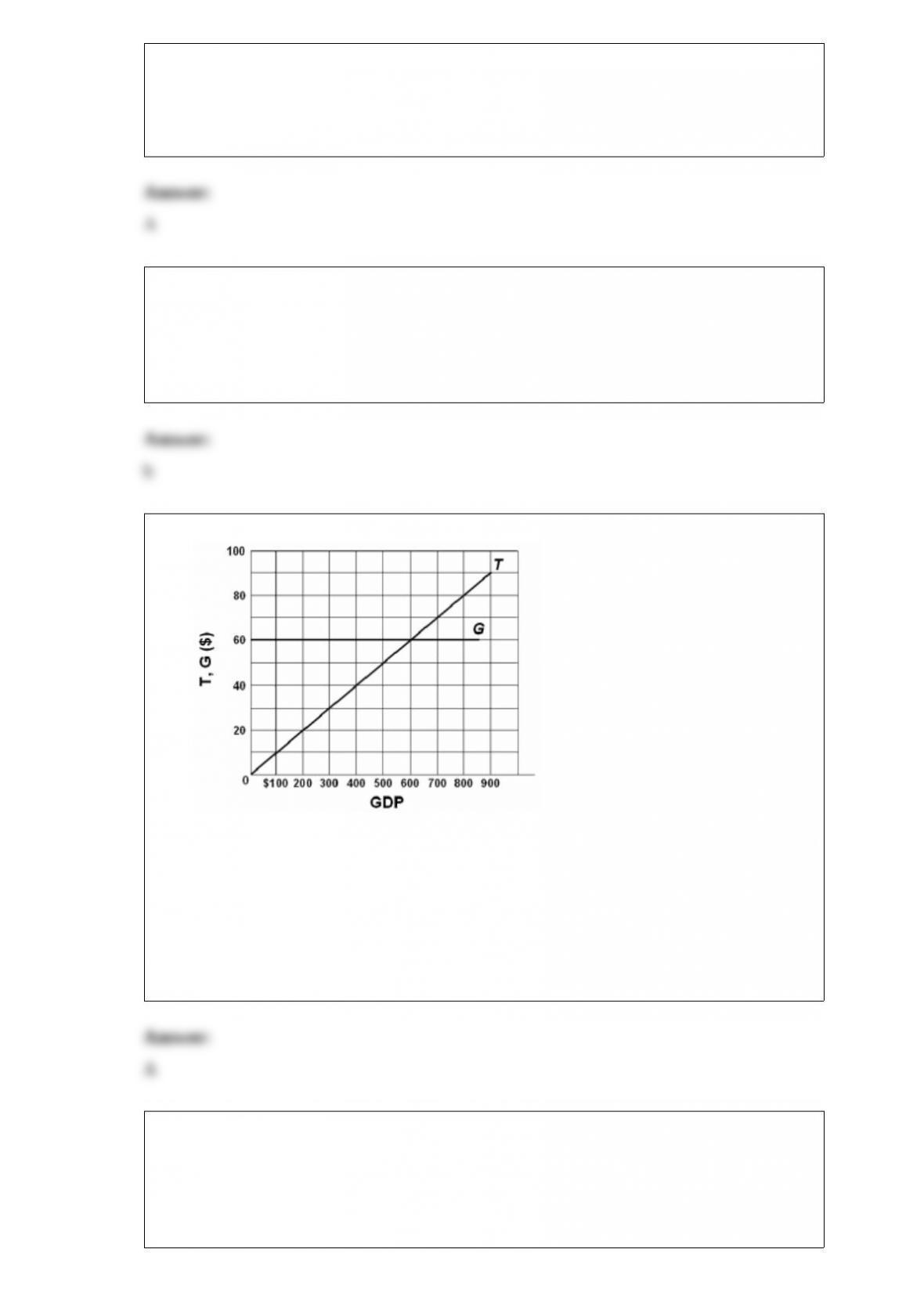
Refer to the above diagram where T is tax revenues and G is government expenditures.
All figures are in billions of dollars. If the full-employment GDP is $400 billion while
the actual GDP is $200 billion, the:
A.actual budget deficit exceeds the standardized budget deficit.
B.actual budget deficit is less than the standardized budget deficit.
C.standardized deficit exceeds the cyclical deficit.
D.cyclical deficit exceeds the standardized deficit.
17) Which of the following statements is true regarding why the balance on the current
account and the balance on the capital and financial account must always sum to zero?
A.Any deficit or surplus in the current account automatically creates an offsetting entry
in the capital and financial account.
B.People can only trade one of two things with each other; currently produced goods
and services or preexisting assets.
C.If trading partners have an imbalance in their trade of currently produced goods and
services, the only way to correct that imbalance is with a net transfer of assets from one
party to the other.
D.All of these are true statements.
18)
Refer to the above diagram. The level of government spending:
A.is equal to tax collections at each level of GDP.
B.is the same at all levels of GDP.
C.varies inversely with the level of GDP.
D.varies directly with the level of GDP.
19)
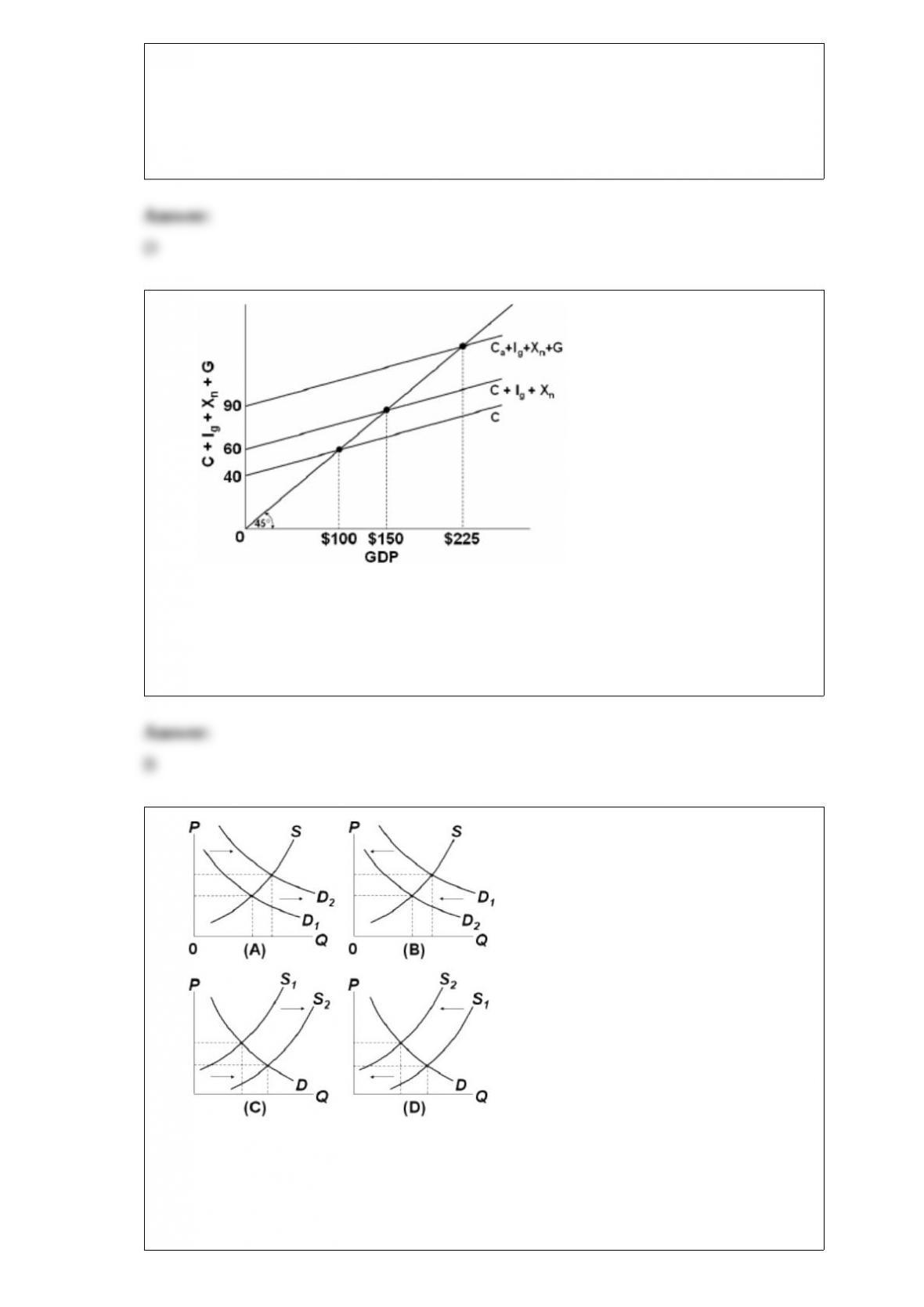
which of the above diagrams illustrate(s) the effect of an increase in automobile worker
wages on the market for automobiles?
a.a only.
b.b only.
c.c only.

d.d only.
20) Suppose the price of the product that labor is producing increases and
simultaneously the price of capital, which is substitutable for labor, decreases.
Assuming that the substitution effect is greater than the output effect, the demand for
labor:
A.will increase.
B.will decrease.
C.may either increase or decrease.
D.will not change.