
1) Small innovative firm X that has developed a new product, accepts an offer to be
acquired by a larger firm. As it relates to new technology, this behavior or outcome is
known as a:
A.fast-second strategy.
B.limit pricing.
C.zero-sum game.
D.a buyout.
2) the long-run average total cost curve:
a.displays declining unit costs so long as output is increasing.
b.indicates the lowest unit costs achievable when a firm has had sufficient time to alter
plant size.
c.has a shape which is the inverse of the law of diminishing returns.
d.can be derived by summing horizontally the average total cost curves of all firms in
an industry.
3) Suppose that real GDP falls to 2 percent below potential GDP. The, according to the
Taylor rule, the Fed should reduce the Federal funds, relative to the current rate of
inflation, by:
A.1/2 percentage point.
B.1 percentage point.
C.2 percentage points.
D.4 percentage points.
4) The following are simplified balance sheets for the commercial banking system and
the Federal Reserve System. Perform each of the following three transactions, a, b, and
c, making appropriate changes in columns (1) through (3) in each balance sheet. Do not
cumulate your answers. Also, answer these three questions for each part: (a) What
change, if any, took place in the money supply as a direct result of this transaction? (b)
What change, if any, occurred in commercial bank reserves? (c) What change occurred
in the money-creating potential of the commercial banking system if the reserve ratio is
20%? All figures are in billions of dollars.
(a)Suppose a drop in the discount rate causes commercial banks to borrow an additional
$3 billion from the Fed. Show the new sheet figures in column 1.
(b)The Fed buys $2 billion of government bonds from the public. Show the new sheet
figures in column 2.
(c)The Treasury spends $1 billion on research on new farm products. Show the new
sheet figures in column 3
5) In which of the following sets of antitrust cases did the government gain
convictions?
A.the U.S. Steel case and the Microsoft case
B.the Alcoa case and the Microsoft case
C.the DuPont cellophane case and the AT&T case
D.the U.S. Steel case and the Alcoa case
6) (Consider This) Suppose that Susie creates a work of art and displays it in a public
place. Economists would expect:
A.those enjoying the art to contribute money to compensate Susie for her costs.
B.those enjoying the art to “free ride” since they cannot be made to bear any of the cost.
C.government to tax those entering the public place in order to pay Susie for her efforts.
D.asymmetric information to lead some to pay Susie while others do not.
7) moving upward on a downward-sloping straight-line demand curve, we find that
price elasticity:
a.is constant.
b.increases continuously.
c.decreases continuously.
d.may either increase or decrease.
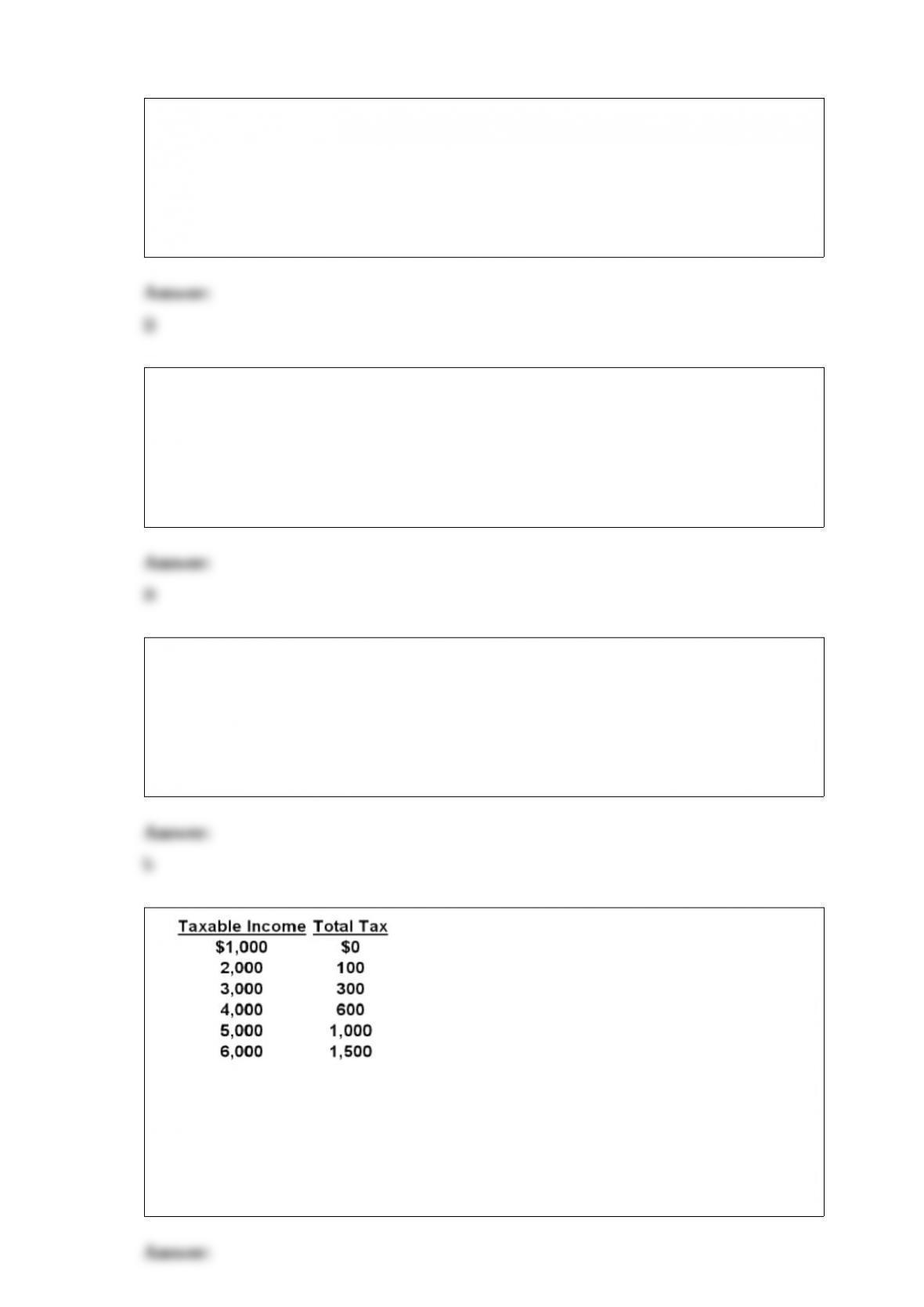
8)
refer to the above data. if your taxable income increases from $4000 to $5000, you will
encounter a marginal tax rate of:
a.40 percent.
b.25 percent.
c.15 percent.
d.10 percent.

9) (last word) critics of the 2006 massachusetts law requiring all residents to have
health care insurance claim that:
a.the law fails to address the problem of rising health care prices.
b.the law will drive health care prices up faster by increasing the demand for health
care.
c.even if viable in massachusetts, it could be cost prohibitive on a national scale.
d.all of these are concerns of the massachusetts law.
10) The Bretton Woods system of exchange rates:
A.is also known as the gold standard and met its demise in the 1930s.
B.relied heavily on floating exchange rates determined in the market for foreign
exchange.
C.was abandoned in the 1930s.
D.was a system of fixed or pegged exchange rates, which occasionally could be
adjusted.
11) (Last Word) In recent years:
A.significant changes in the price of oil have had much less effect on the U.S. economy
than did similar changes in oil prices in previous decades.
B.large increases in the price of oil have reduced U.S. aggregate supply and caused
cost-push inflation.
C.large decreases in the price of oil have increased U.S. aggregate supply and caused
deflation.
D.the United States has become a net exporter of oil.
12) barriers to entering an industry:
a.are justified because they result in allocative efficiency.
b.are justified because they result in productive efficiency.
c.are the basis for monopoly.
d.apply only to purely monopolistic industries.
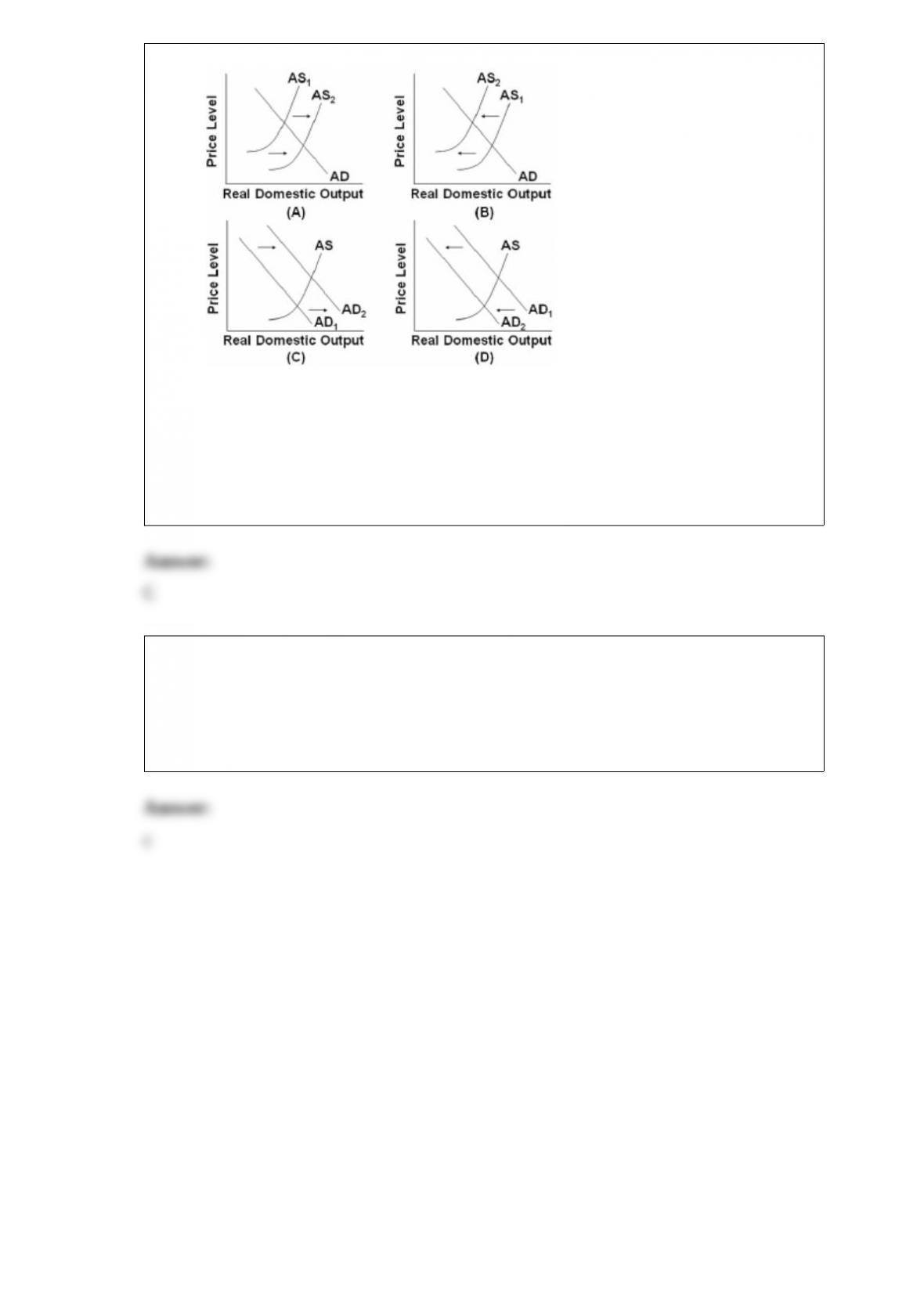
13)
Which of the above diagrams best portrays the effects of an increase in consumer
spending?
A.A
B.B
C.C
D.D
14) an increase in the price of product a will:
a.reduce the demand for resources used in the production of a.
b.increase the demand for complementary product c.
c.increase the demand for substitute product b.
d.reduce the demand for substitute product b.