
1) if a demand for a product is elastic, the value of the price elasticity coefficient is:
a.zero.
b.greater than one.
c.equal to one.
d.less than one.
2) proponents of economic growth say that pollution:
a.is an inevitable by-product of growth.
b.occurs, not because of growth, but because common properties are treated as free
goods.
c.declines as a country moves from agriculture to industry.
d.is detrimental to economic growth.
3) Suppose the reserve requirement is 10 percent. If a bank has $5 million of checkable
deposits and actual reserves of $500,000, the bank:
A.can safely lend out $500,000.
B.can safely lend out $5 million.
C.can safely lend out $50,000.
D.cannot safely lend out more money.
4) Capital and labor:
A.are always complementary.
B.are always substitutable.
C.may be either complementary or substitutable.
D.are both normal inputs.
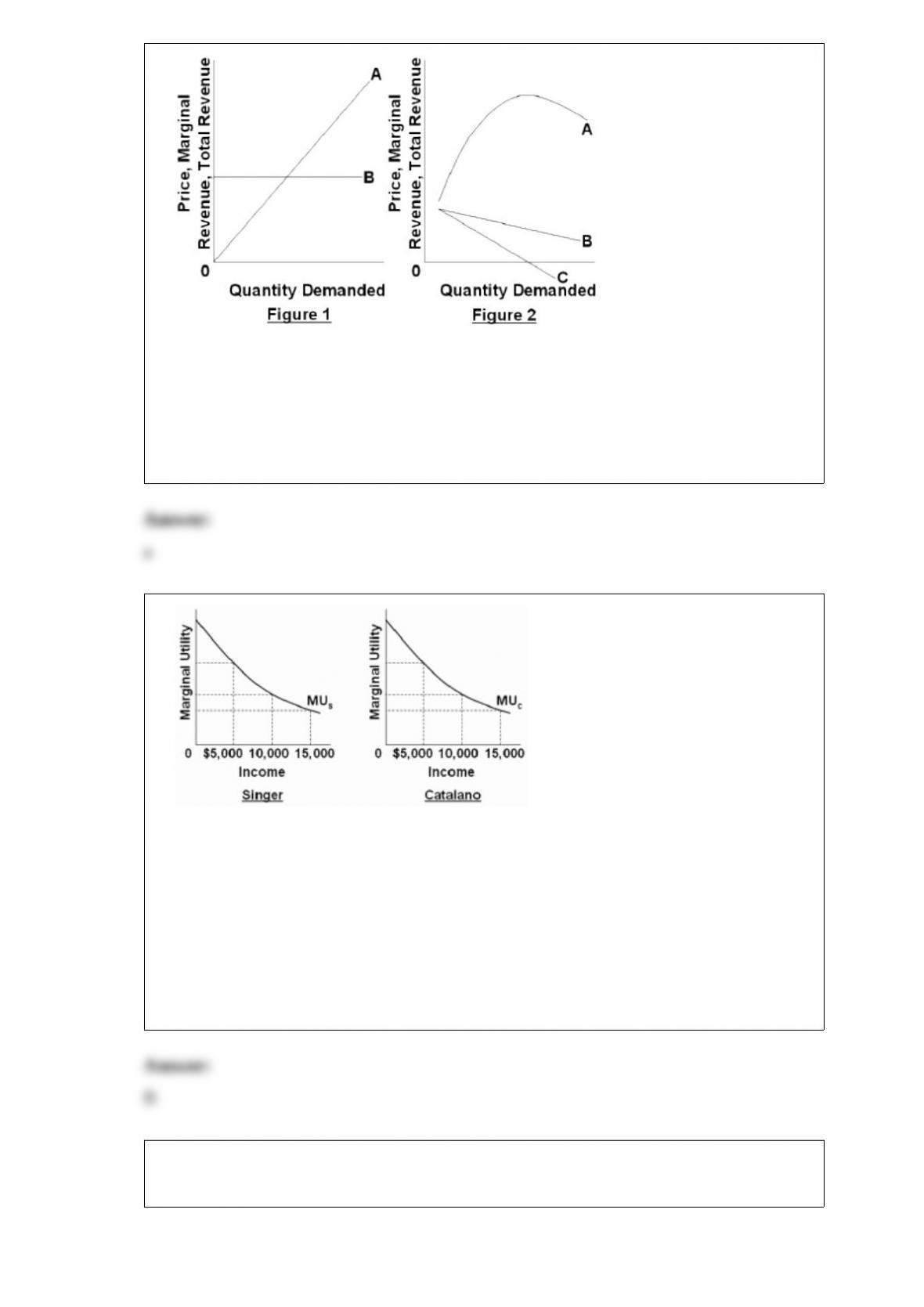
5)
refer to the above two diagrams for individual firms. in figure 1 line b represents the
firm’s:
a.demand and marginal revenue curves.
b.demand curve only.
c.marginal revenue curve only.
d.average revenue curve only.
6)
Refer to the above diagrams that show identical marginal utility from income curves for
Singer and Catalano. If this initial distribution of $15,000 to Singer and $5,000 to
Catalano is altered in favor of greater equality, it may be argued that:
A.the combined total utility of the two consumers will decline because Catalano has a
greater capacity to derive utility from income than does Singer.
B.incentives to produce will be weakened and total income will decrease.
C.incentives to produce will be enhanced and total income will increase.
D.the combined total utility of the two consumers will decline because Singer has a
greater capacity to derive utility from income than does Catalano.
7) answer the next question(s) on the basis of the following data. all figures are in
billions of dollars.
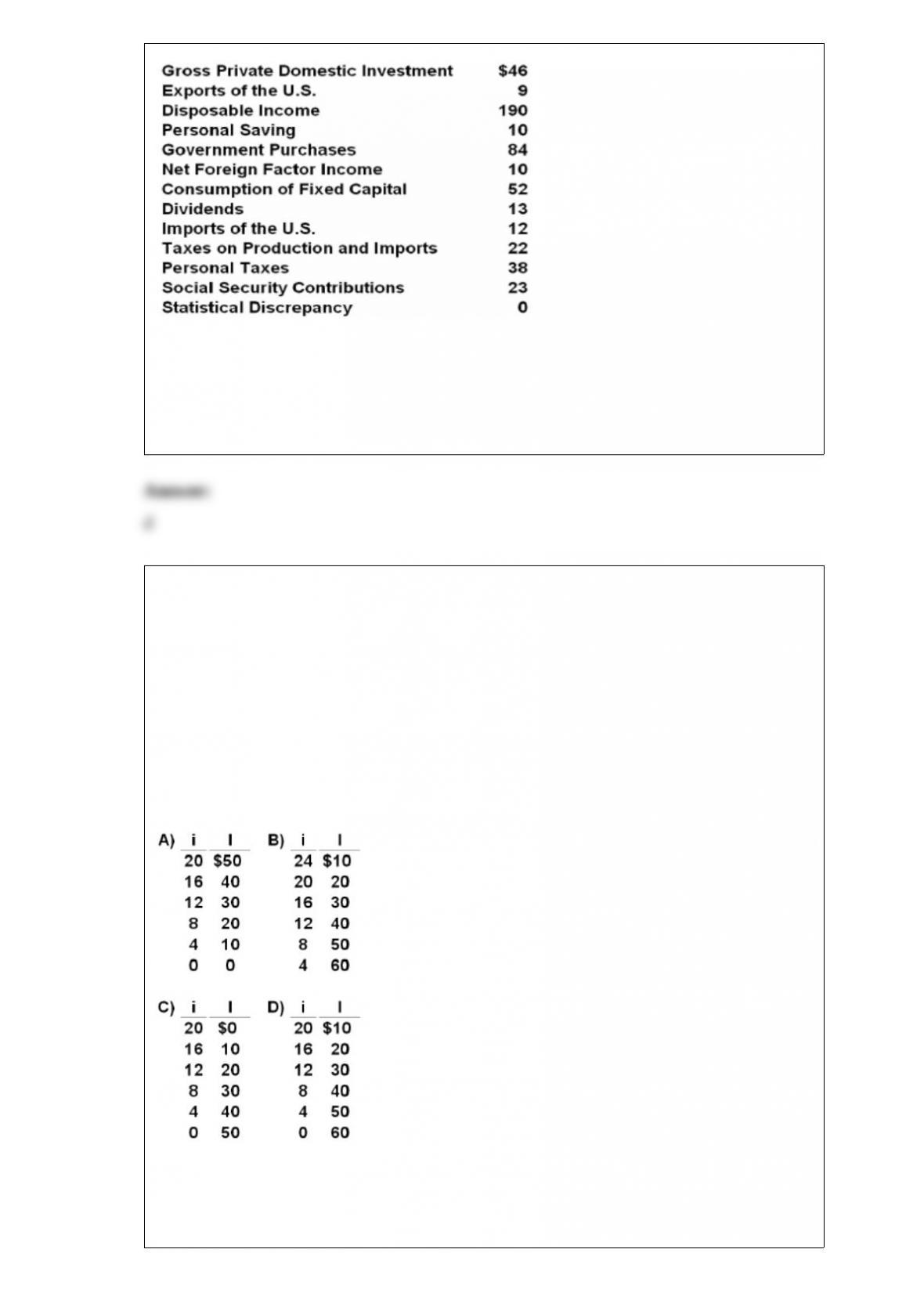
refer to the above data. personal income is:
a.$184.
b.$221.
c.$149.
d.$228.
8) assume that if the interest rate that businesses must pay to borrow funds were 20
percent, it would be unprofitable for businesses to invest in new machinery and
equipment so that investment would be zero. but if the interest rate were 16 percent,
businesses will find it profitable to invest $10 billion. if the interest rate were 12
percent, $20 billion would be invested. assume that total investment continues to
increase by $10 billion for each successive 4 percentage point decline in the interest
rate.
refer to the above information. using i and i to indicate the interest rate and investment
(in billions of dollars) respectively, which of the following is the correct tabular
presentation of the described relationship?
a.choice a
b.choice b
c.choice c
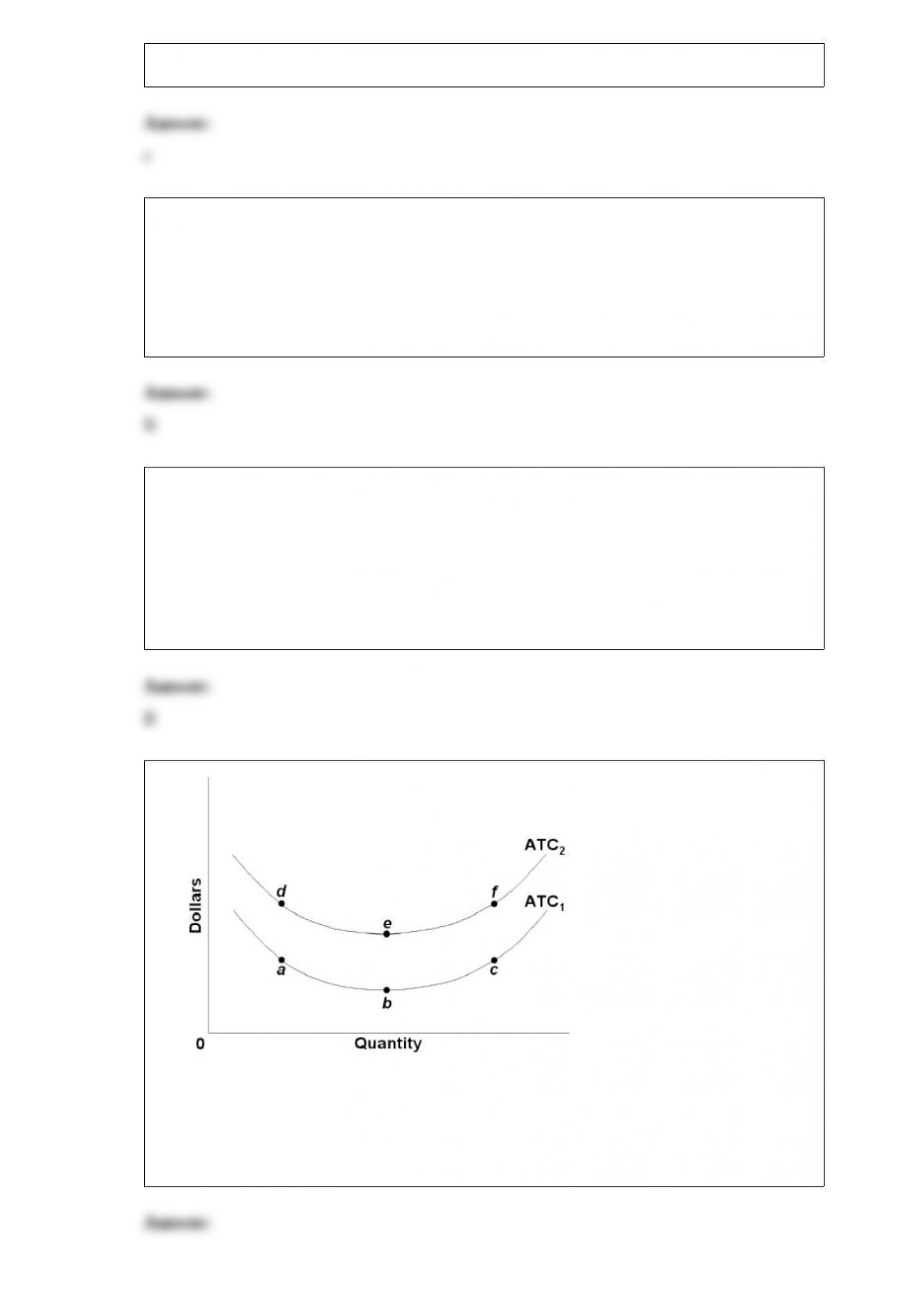
d.choice d
9) If APC = .6 and MPC = .7, the immediate impact of an increase in personal taxes of
$20 will be to:
A.have no effect on consumption.
B.decrease consumption by $14.
C.decrease consumption by $12.
D.increase consumption by $14.
10) Most of the DVCs find it difficult to accumulate capital goods because:
A.the terms of trade prohibit the inflow of private capital from the advanced nations.
B.it is very difficult to restrict consumption and thus to free resources for capital goods
production.
C.domestic monetary policies designed to achieve price stability result in low interest
rates, thereby discouraging investment.
D.investment is interest inelastic in DVCs.
11)
refer to the above graph. a decrease in fixed costs is shown by:
a.a move along short-run average total cost curve atc2 from point e to point f.
b.a move along short-run average total cost curve atc1 from point a to point b.
c.the shift of the short-run average total cost curve from atc1 to atc2.
d.the shift of the short-run average total cost curve from atc2 to atc1.
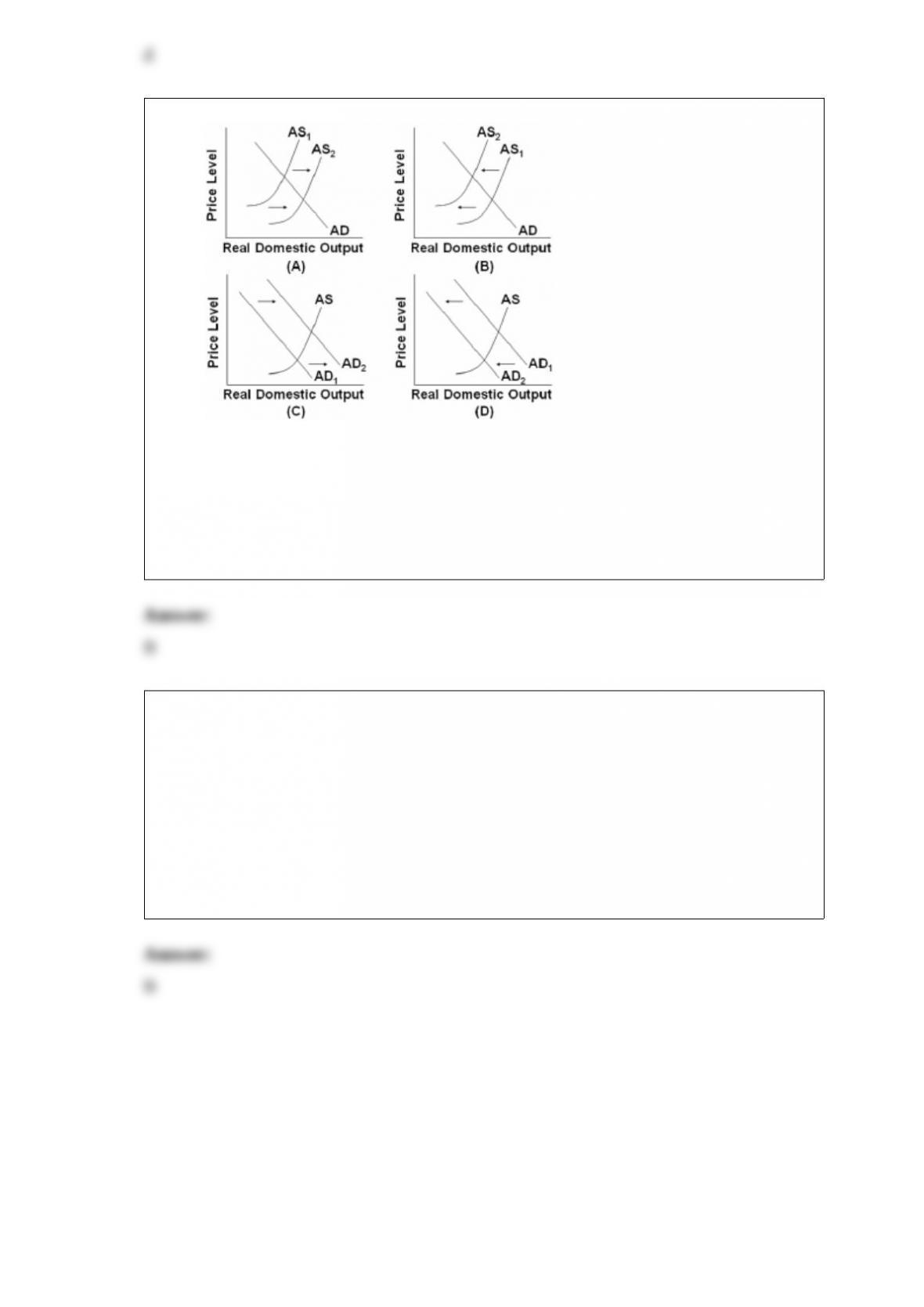
12)
Which of the above diagrams best portrays the effects of a dramatic increase in energy
prices?
A.A
B.B
C.C
D.D
13) Equal increases in government purchases and taxes will:
A.increase the equilibrium GDP and the size of that increase varies directly with the
size of the MPC.
B.increase the equilibrium GDP and the size of that increase is independent of the size
of the MPC.
C.increase the equilibrium GDP and the size of that increase varies inversely with the
size of the MPC.
D.decrease the equilibrium GDP and the size of that decrease is independent of the size
of the MPC.
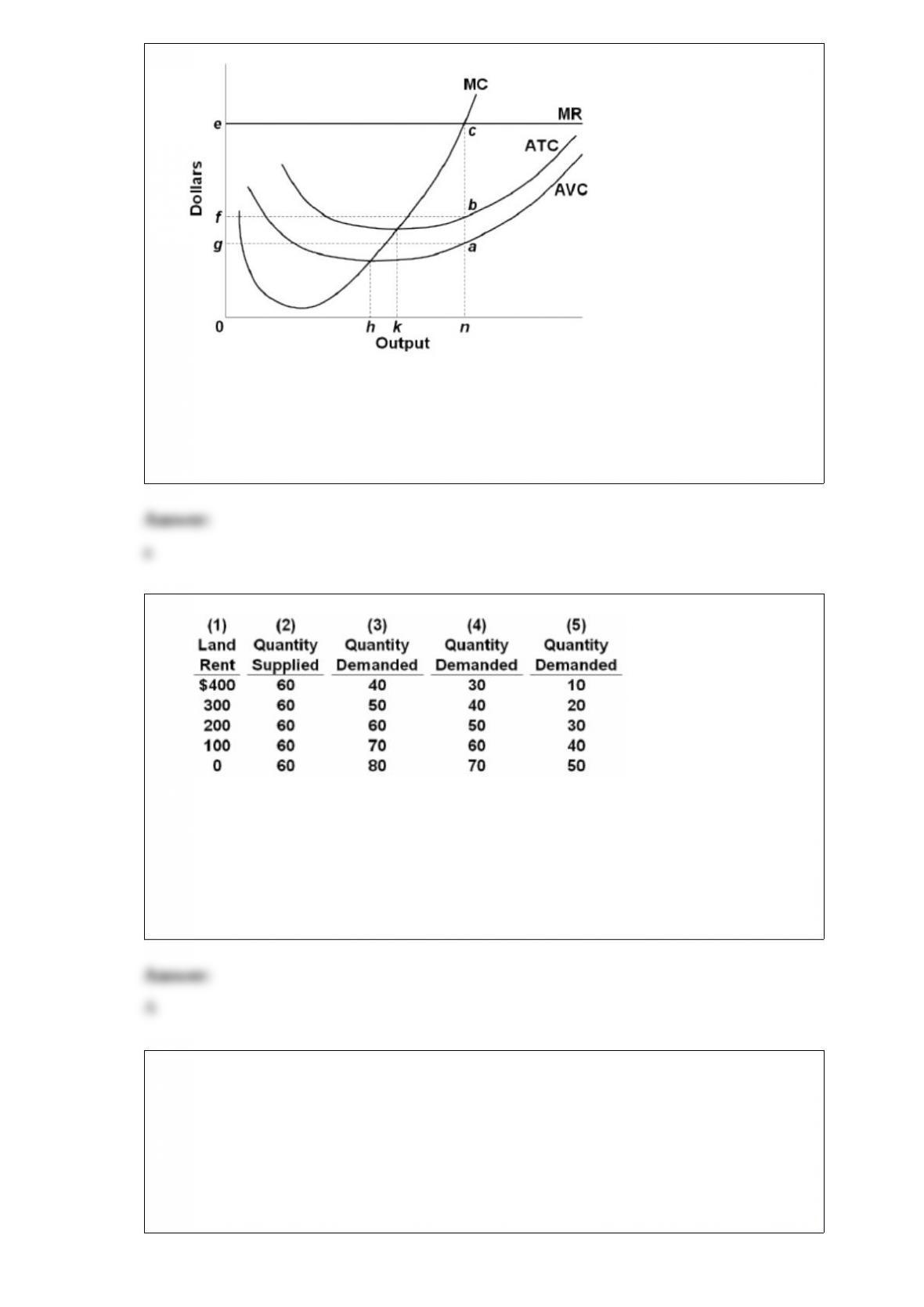
14)
refer to the above diagram. at the profit-maximizing output, total profit is:
a.efbc
b.fgab
c.egac
d.0fbn
15)
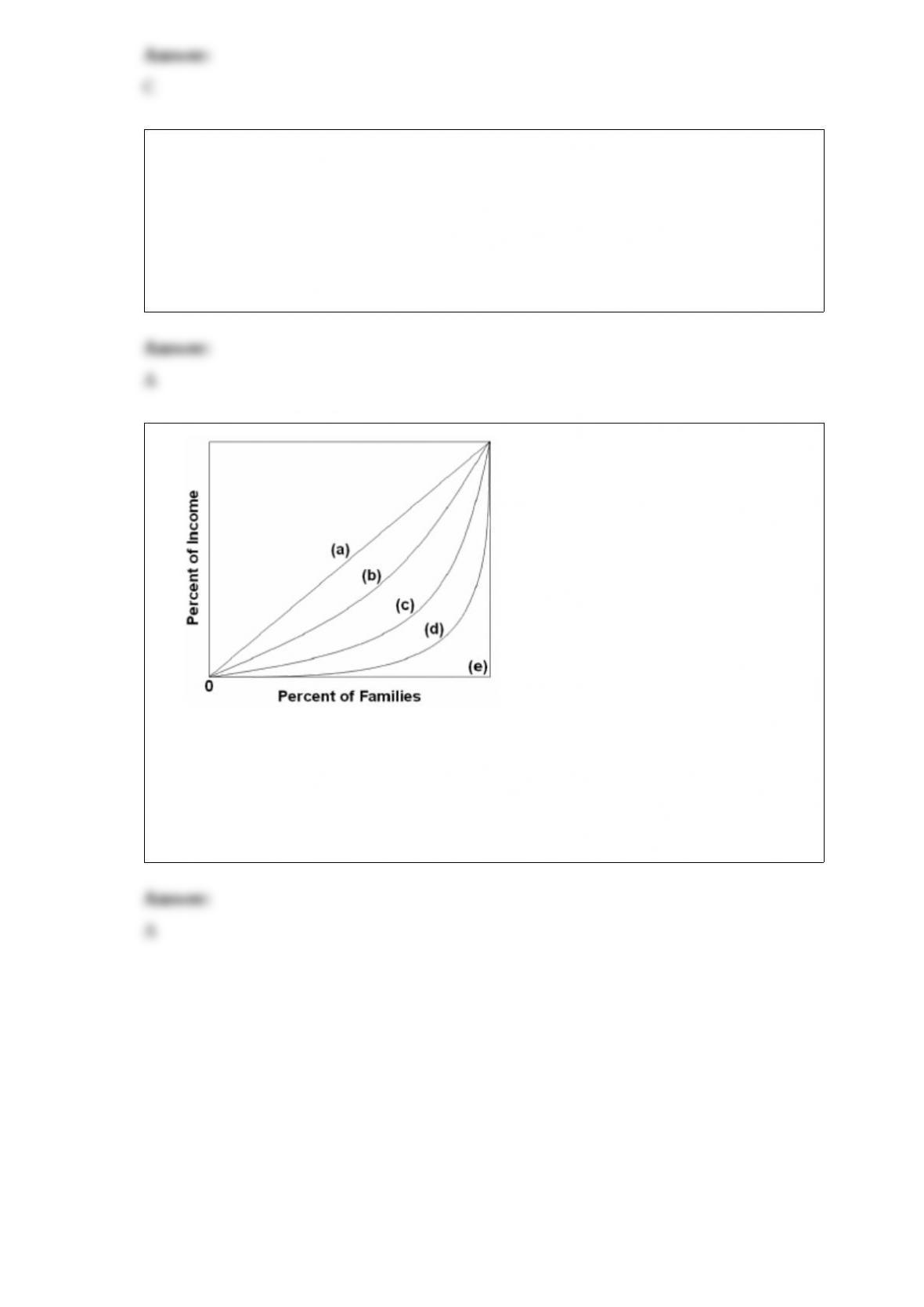
Refer to the above table, in which the values for columns (2) through (5) are in acres. If
the relevant columns are (1), (2), and (4), land rent will be:
A.$100 per acre.
B.$200 per acre.
C.$300 per acre.
D.$400 per acre.
16) Suppose the Federal Reserve Banks sell $2 billion of government bonds to the
public which pays for them by drawing checks. As a result, commercial bank reserves
will:
A.increase by $10 billion.
B.remain unchanged.
C.decrease by $2 billion.
D.increase by $2 billion.
17) Suppose the government purposely changes the economy’s standardized budget
from a deficit of 0 percent of real GDP to a deficit of 3 percent of real GDP. The
government is engaging in a(n):
A.expansionary fiscal policy.
B.contractionary fiscal policy.
C.neutral fiscal policy.
D.low-interest rate policy.
18)
Refer to the above diagram where curves (a) through (e) are for five different countries.
The Gini ratio is lowest in country:
A.a.
B.b.
C.c.
D.e.
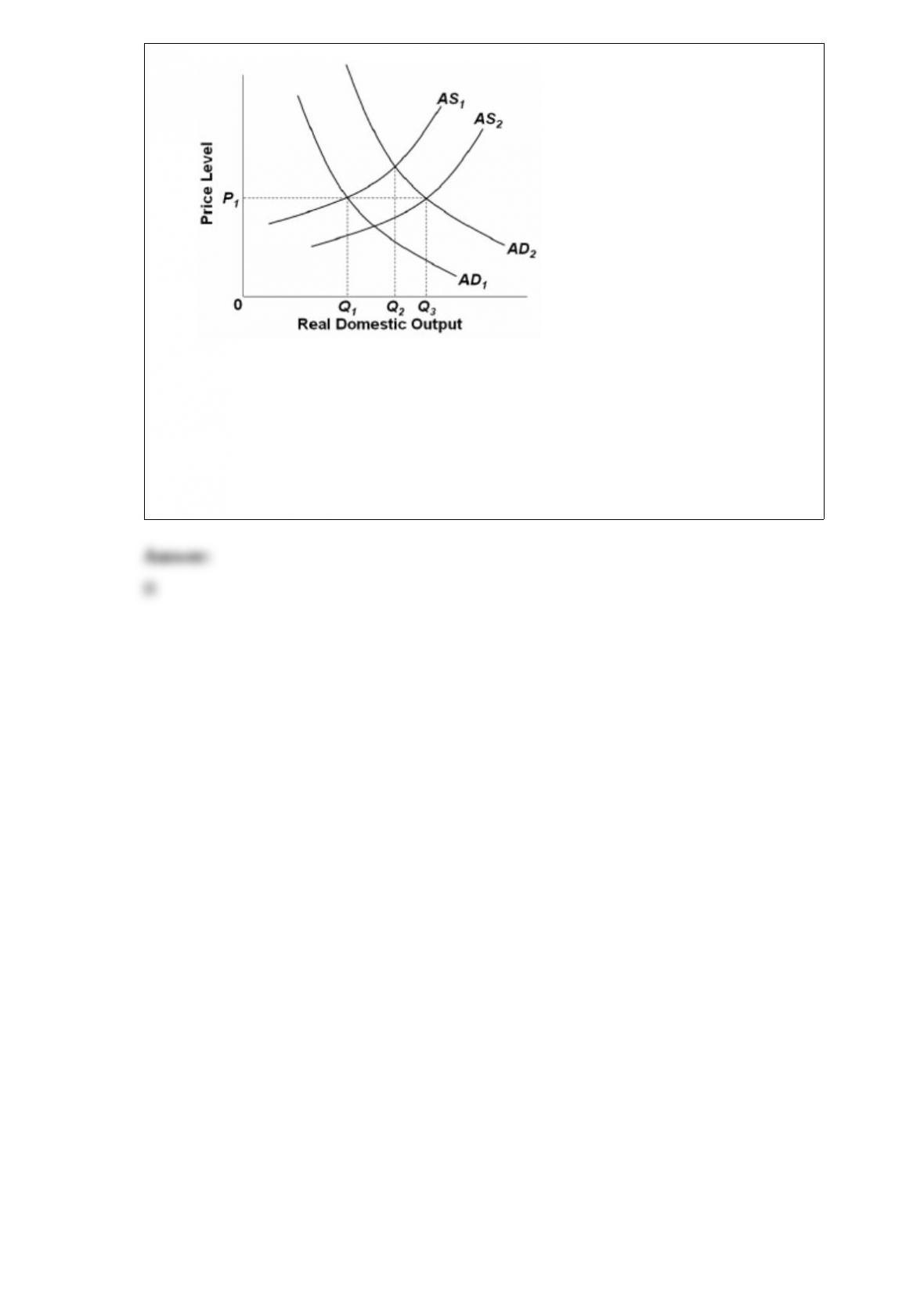
19)
In the above figure AD1 and AS1 represent the original aggregate supply and demand
curves and AD2 and AS2 show the new aggregate demand and supply curves. The
changes in aggregate demand and supply in the above diagram produce:
A.a higher price level.
B.an expansion of real output and a stable price level.
C.an expansion of real output and a higher price level.
D.a decline in real output and a stable price level.