Archives: Quiz
ECON 601 Test
1) The Sherman Act: A.was declared unconstitutional in 1895. B.provided for government regulation of the railroads. C.declared monopoly and restraints of trade to be illegal. D.exempted the railroad and communications industries from the antitrust laws. 2) in the simple circular […]
ECB 214 Midterm 2
1) Economists consider governments to be “wasteful:” A.whenever they over- or underallocate resources to a project. B.only when they overallocate resources to a project. C.only when they underallocate resources to a project. D.whenever they attempt to correct a market failure. […]
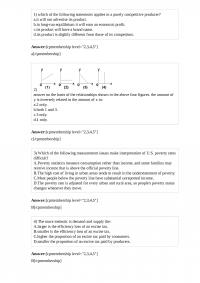
ECON 236
1) which of the following statements applies to a purely competitive producer? a.it will not advertise its product. b.in long-run equilibrium it will earn an economic profit. c.its product will have a brand name. d.its product is slightly different from […]
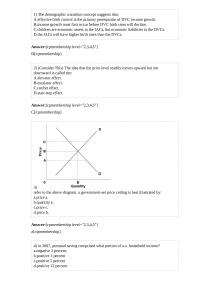
ECON 838 Final 1 The demographic
1) The demographic transition concept suggests that: A.effective birth control is the primary prerequisite of DVC income growth. B.income growth must first occur before DVC birth rates will decline. C.children are economic assets in the IACs, but economic liabilities in […]
Economics 358 Quiz
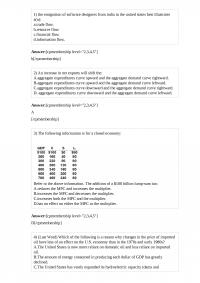
1) the emigration of software designers from india to the united states best illustrates a(n): a.trade flow. b.resource flow. c.financial flow. d.information flow. 2) An increase in net exports will shift the: A.aggregate expenditures curve upward and the aggregate demand […]
MicroEconomic 557 Final
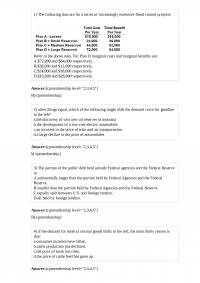
1) The following data are for a series of increasingly extensive flood control projects: Refer to the above data. For Plan D marginal costs and marginal benefits are: A.$72,000 and $64,000 respectively. B.$28,000 and $12,000 respectively. C.$24,000 and $18,000 respectively. […]
ECON A 142
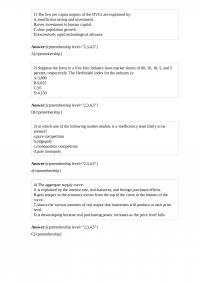
1) The low per capita outputs of the DVCs are explained by: A.insufficient saving and investment. B.over investment in human capital. C.slow population growth. D.excessively rapid technological advance. 2) Suppose the firms in a five-firm industry have market shares of […]
Economics 848 1 ideally value
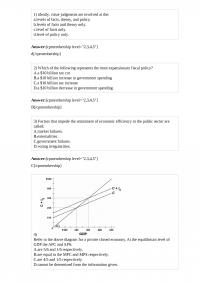
1) ideally, value judgments are involved at the: a.levels of facts, theory, and policy. b.levels of facts and theory only. c.level of facts only. d.level of policy only. 2) Which of the following represents the most expansionary fiscal policy? A.a […]
MicroEconomic 172
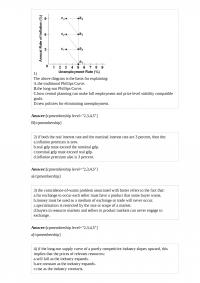
1) The above diagram is the basis for explaining: A.the traditional Phillips Curve. B.the long-run Phillips Curve. C.how central planning can make full employment and price level stability compatible goals. D.new policies for eliminating unemployment. 2) if both the real […]
Economics 247 Test
1) At equilibrium real GDP in a private closed economy: A.the MPC must equal the APC. B.the slope of the aggregate expenditures schedule equals the MPS. C.aggregate expenditures and real GDP are equal. D.planned saving and consumption are equal. 2) […]
ECON E 457
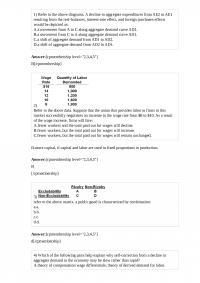
1) Refer to the above diagrams. A decline in aggregate expenditures from AE2 to AE1 resulting from the real-balances, interest-rate effect, and foreign purchases effects would be depicted as: A.a movement from A to C along aggregate demand curve AD1. […]
BUS 305 Midterm 2
1) (consider this) the main point of the consider this box about hypothetical countries slogo, sumgo, and speedo is that over several decades differing: a.inflation rates create large differences in real gdp per capita. b.economic growth rates create large differences […]
MicroEconomic 874 Quiz 1
1) an important outcome of the uruguay round of gatt negotiations was: a.a worldwide reduction of agricultural export subsidies. b.establishment of the european union. c.the elimination of all tariffs and quotas worldwide. d.establishment of the world bank. 2) if a […]
BUS 278 Midterm
1) Economist Arthur Laffer equated Robin Hood to: A.government and equated the people passing through Sherwood Forest to taxpayers. B.charitable organizations and equated the people passing through Sherwood Forest to poor people. C.businesses and equated the people passing through Sherwood […]
ECON A 110 Midterm 2
1) What will be the elasticity of resource demand in the following cases? (a)unit wages rise by 10% and the number of employed workers falls by 5% (b)unit wages rise by 4% and the number of employed workers falls by […]
ECON E 375
1) In recent years the United States has: A.exported more services abroad than it has imported. B.had a small goods trade surplus with Japan. C.had a large goods trade surplus with the rest of the world. Dfallen to third behind […]
ECON 147
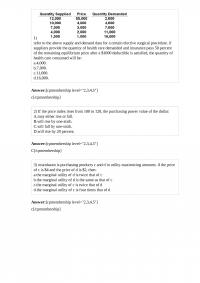
1) refer to the above supply and demand data for a certain elective surgical procedure. if suppliers provide the quantity of health care demanded and insurance pays 50 percent of the remaining equilibrium price after a $1000 deductible is satisfied, […]
ECB 600 Homework
1) (Consider This) Owners of defective used cars have more information about the condition of their vehicles than potential buyers of those used cars. This is an example of: A.the moral hazard problem. B.a spillover cost. C.a positive externality. D.asymmetric […]
Economics 886 Midterm
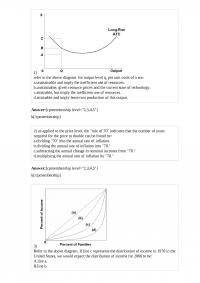
1) refer to the above diagram. for output level q, per unit costs of a are: a.unattainable and imply the inefficient use of resources. b.unattainable, given resource prices and the current state of technology. c.attainable, but imply the inefficient use […]
BUS 608 Quiz
1) If an unintended increase in business inventories occurs: A.we can expect aggregate production to be unaffected. B.we can expect businesses to increase the level of production. C.we can expect businesses to lower the level of production. D.aggregate expenditures must […]
ECON E 731 Quiz 2
1) As it relates to international trade, dumping: A.is a form of price discrimination illegal under U.S. antitrust laws. B.is the practice of selling goods in a foreign market at less than cost. C.constitutes a general case for permanent tariffs. […]
MicroEconomic 334
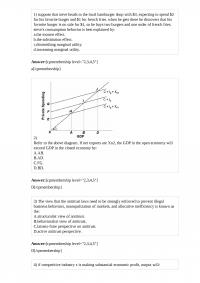
1) suppose that steve heads to the local hamburger shop with $3, expecting to spend $2 for his favorite burger and $1 for french fries. when he gets there he discovers that his favorite burger is on sale for $1, […]
BUS 446 Midterm 2
1) Which of the following are included and which are excluded in calculating this years GDP? Explain in each instance. (a)A homeowner who mows her own lawn (b)A decline in the average hours worked per week (c)Business expenditures on pollution […]
ECON A 717
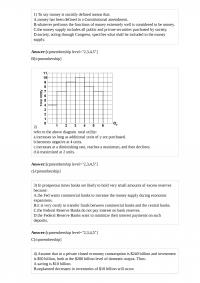
1) To say money is socially defined means that: A.money has been defined in a Constitutional amendment. B.whatever performs the functions of money extremely well is considered to be money. C.the money supply includes all public and private securities purchased […]
BUS 705 Quiz
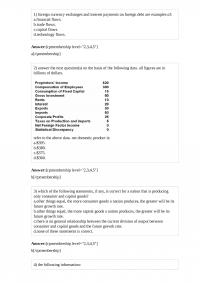
1) foreign currency exchanges and interest payments on foreign debt are examples of: a.financial flows. b.trade flows. c.capital flows. d.technology flows. 2) answer the next question(s) on the basis of the following data. all figures are in billions of dollars. […]
MicroEconomic 201 Midterm 2
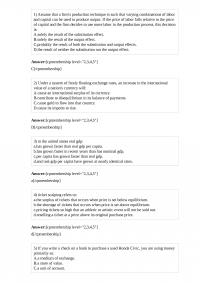
1) Assume that a firm’s production technique is such that varying combinations of labor and capital can be used to produce output. If the price of labor falls relative to the price of capital and the firm decides to use […]
BUS 453
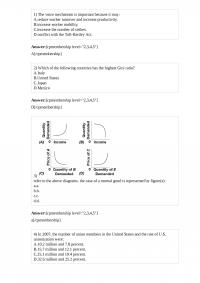
1) The voice mechanism is important because it may: A.reduce worker turnover and increase productivity. B.increase worker mobility. C.increase the number of strikes. D.conflict with the Taft-Hartley Act. 2) Which of the following countries has the highest Gini ratio? A.Italy […]
Economics 657
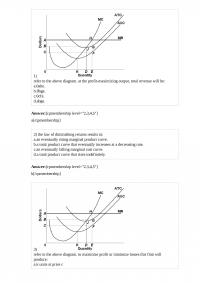
1) refer to the above diagram. at the profit-maximizing output, total revenue will be: a.0ahe. b.0bge. c.0cfe. d.abge. 2) the law of diminishing returns results in: a.an eventually rising marginal product curve. b.a total product curve that eventually increases at […]
ECON E 547 Quiz 2
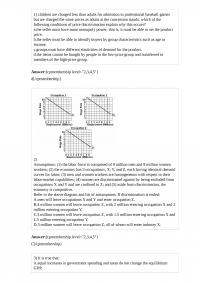
1) children are charged less than adults for admission to professional baseball games but are charged the same prices as adults at the concession stands. which of the following conditions of price discrimination explain why this occurs? a.the seller must […]
Economics 591
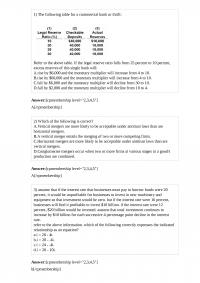
1) The following table for a commercial bank or thrift: Refer to the above table. If the legal reserve ratio falls from 25 percent to 10 percent, excess reserves of this single bank will: A.rise by $6,000 and the monetary […]
ECON A 222
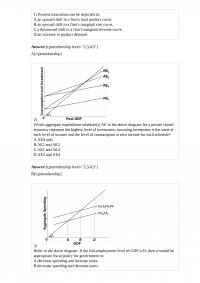
1) Process innovation can be depicted as: A.an upward shift in a firm’s total product curve. B.an upward shift in a firm’s marginal cost curve. C.a downward shift in a firm’s marginal revenue curve. D.an increase in product demand. 2) […]
BUS 432 Quiz 1 quotconsumer
1) “consumer sovereignty” means that: a.buyers can dictate the prices at which goods and services will be purchased. b.advertising is ineffective because consumers already know what they want. c.buyers control the quality of goods and services through regulatory agencies. d.buyers […]
MicroEconomic 652
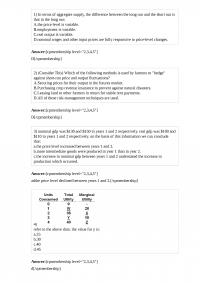
1) In terms of aggregate supply, the difference between the long run and the short run is that in the long run: A.the price level is variable. B.employment is variable. C.real output is variable. D.nominal wages and other input prices […]
ECON 509
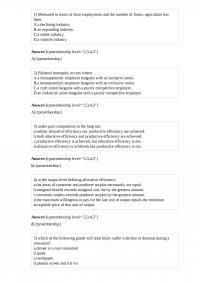
1) Measured in terms of farm employment and the number of farms, agriculture has been: A.a declining industry. B.an expanding industry. C.a stable industry. D.a volatile industry. 2) Bilateral monopoly occurs where: A.a monopsonistic employer bargains with an inclusive union. […]
Economics 654 Homework
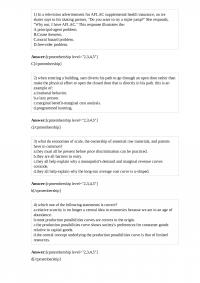
1) In a television advertisement for AFLAC supplemental health insurance, an ice skater says to his skating partner, “Do you want to try a triple jump?” She responds, “Why not, I have AFLAC.” This response illustrates the: A.principal-agent problem. B.Coase […]
ECON 376
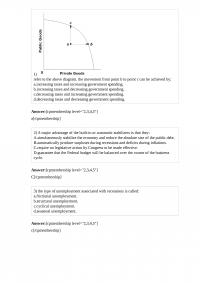
1) refer to the above diagram. the movement from point b to point c can be achieved by: a.increasing taxes and increasing government spending. b.increasing taxes and decreasing government spending. c.decreasing taxes and increasing government spending. d.decreasing taxes and decreasing […]
ECON E 400
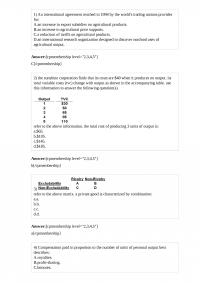
1) An international agreement reached in 1994 by the world’s trading nations provides for: A.an increase in export subsidies on agricultural products. B.an increase in agricultural price supports. C.a reduction of tariffs on agricultural products. D.an international research organization designed […]
BUS 882 Final
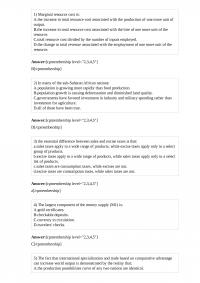
1) Marginal resource cost is: A.the increase in total resource cost associated with the production of one more unit of output. B.the increase in total resource cost associated with the hire of one more unit of the resource. C.total resource […]
ECB 143 Test 2
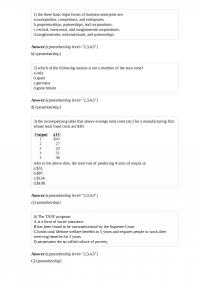
1) the three basic legal forms of business enterprise are: a.monopolists, competitors, and enterprises. b.proprietorships, partnerships, and corporations. c.vertical, horizontal, and conglomerate corporations. d.conglomerates, multinationals, and partnerships. 2) which of the following nations is not a member of the euro […]
ECON 779 1 Firms whose central
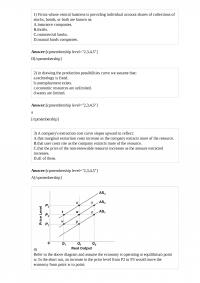
1) Firms whose central business is providing individual account shares of collections of stocks, bonds, or both are known as: A.insurance companies. B.thrifts. C.commercial banks. D.mutual funds companies. 2) in drawing the production possibilities curve we assume that: a.technology is […]
Economics 734 Midterm
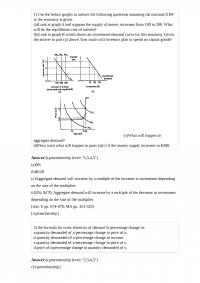
1) Use the below graphs to answer the following questions assuming the nominal GDP in the economy is given. (a)Look at graph A and suppose the supply of money increases from 100 to 200. What will be the equilibrium rate […]
ECON A 180
1) if an economy produces its most wanted goods but uses outdated production methods, it is: a.achieving productive efficiency, but not allocative efficiency. b.not achieving productive efficiency. c.achieving both productive and allocative efficiency. d.engaged in roundabout production. 2) globally, on […]
ECON A 344 Test 2
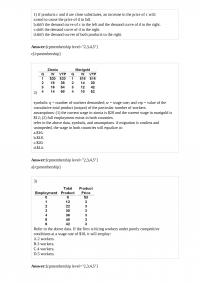
1) if products c and d are close substitutes, an increase in the price of c will: a.tend to cause the price of d to fall. b.shift the demand curve of c to the left and the demand curve of […]
Economics 308 1 economy a gross
1) economy a: gross investment equals depreciation economy b: depreciation exceeds gross investment economy c: gross investment exceeds depreciation other things equal, the above information suggests that the production capacity in economy: a.b is growing more rapidly than either a […]
ECON 764 Test
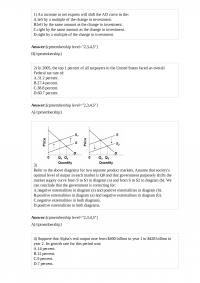
1) An increase in net exports will shift the AD curve to the: A.left by a multiple of the change in investment. B.left by the same amount as the change in investment. C.right by the same amount as the change […]
ECB 853
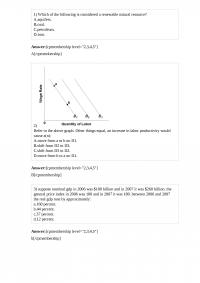
1) Which of the following is considered a renewable natural resource? A.aquifers. B.coal. C.petroleum. D.iron. 2) Refer to the above graph. Other things equal, an increase in labor productivity would cause a(n): A.move from a to b on D1. B.shift […]
MicroEconomic 641 Final
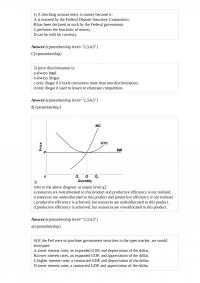
1) A checking account entry is money because it: A.is ensured by the Federal Deposit Insurance Corporation. B.has been declared as such by the Federal government. C.performs the functions of money. D.can be sold for currency. 2) price discrimination is: […]
ECON E 542
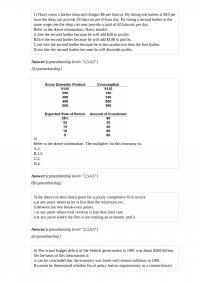
1) Harry owns a barber shop and charges $6 per haircut. By hiring one barber at $10 per hour the shop can provide 24 haircuts per 8-hour day. By hiring a second barber at the same wage rate the shop […]
ECON 677 Final
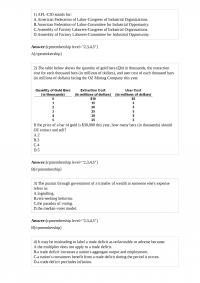
1) AFL-CIO stands for: A.American Federation of Labor-Congress of Industrial Organizations. B.American Federation of Labor-Committee for Industrial Opportunity. C.Assembly of Factory Laborers-Congress of Industrial Organizations. D.Assembly of Factory Laborers-Committee for Industrial Opportunity. 2) The table below shows the quantity of […]
Economics 728 Midterm 1
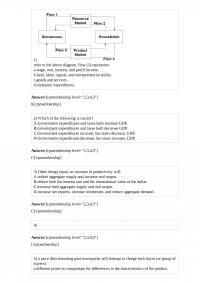
1) refer to the above diagram. flow (2) represents: a.wage, rent, interest, and profit income. b.land, labor, capital, and entrepreneurial ability. c.goods and services. d.consumer expenditures. 2) Which of the following is correct? A.Government expenditures and taxes both increase GDP. […]