1) Which of the following is considered a renewable natural resource?
A.aquifers.
B.coal.
C.petroleum.
D.iron.
2)
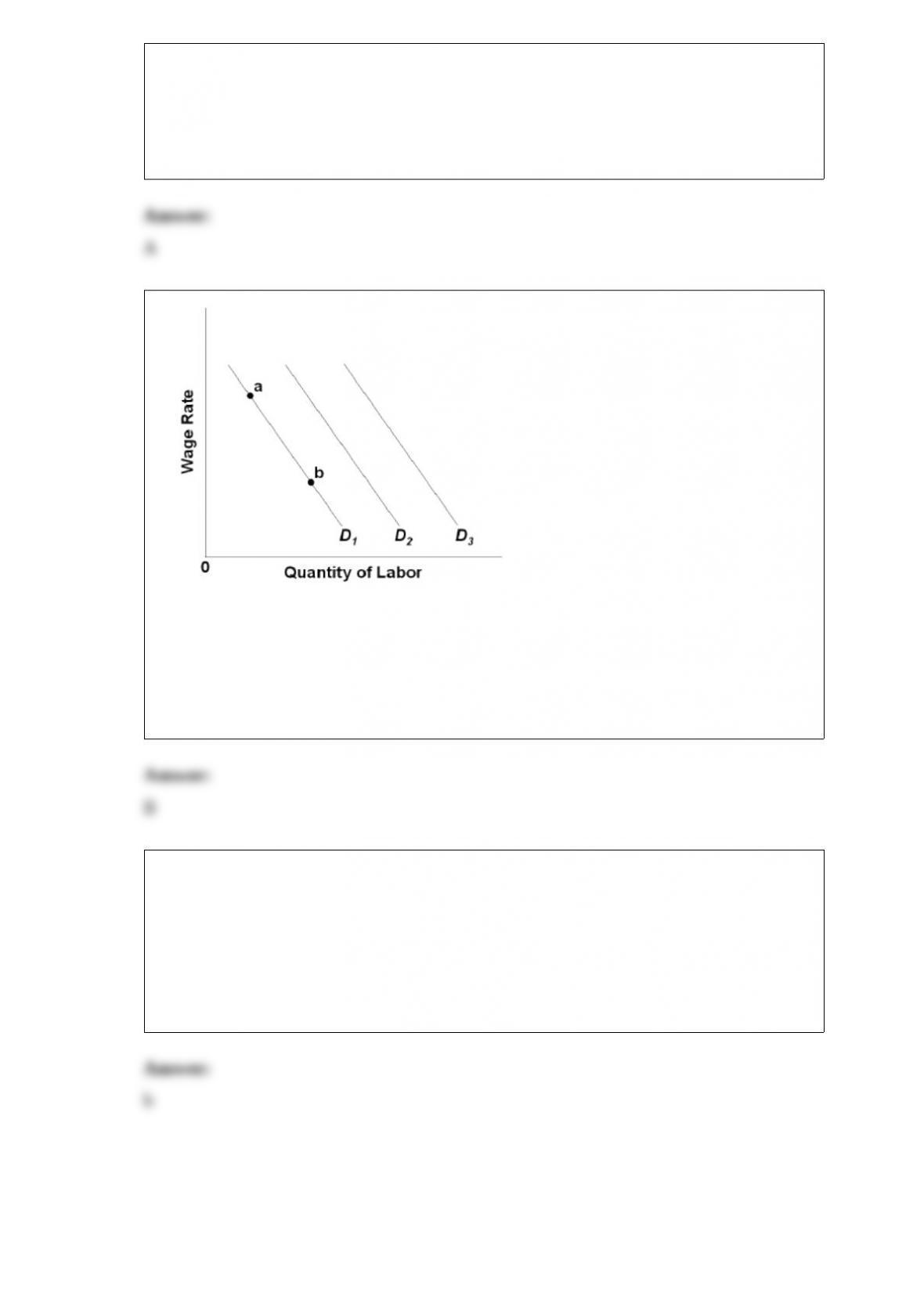
Refer to the above graph. Other things equal, an increase in labor productivity would
cause a(n):
A.move from a to b on D1.
B.shift from D2 to D3.
C.shift from D3 to D2.
D.move from b to a on D1.
3) suppose nominal gdp in 2006 was $100 billion and in 2007 it was $260 billion. the
general price index in 2006 was 100 and in 2007 it was 180. between 2006 and 2007
the real gdp rose by approximately:
a.160 percent.
b.44 percent.
c.37 percent.
d.12 percent.
4)
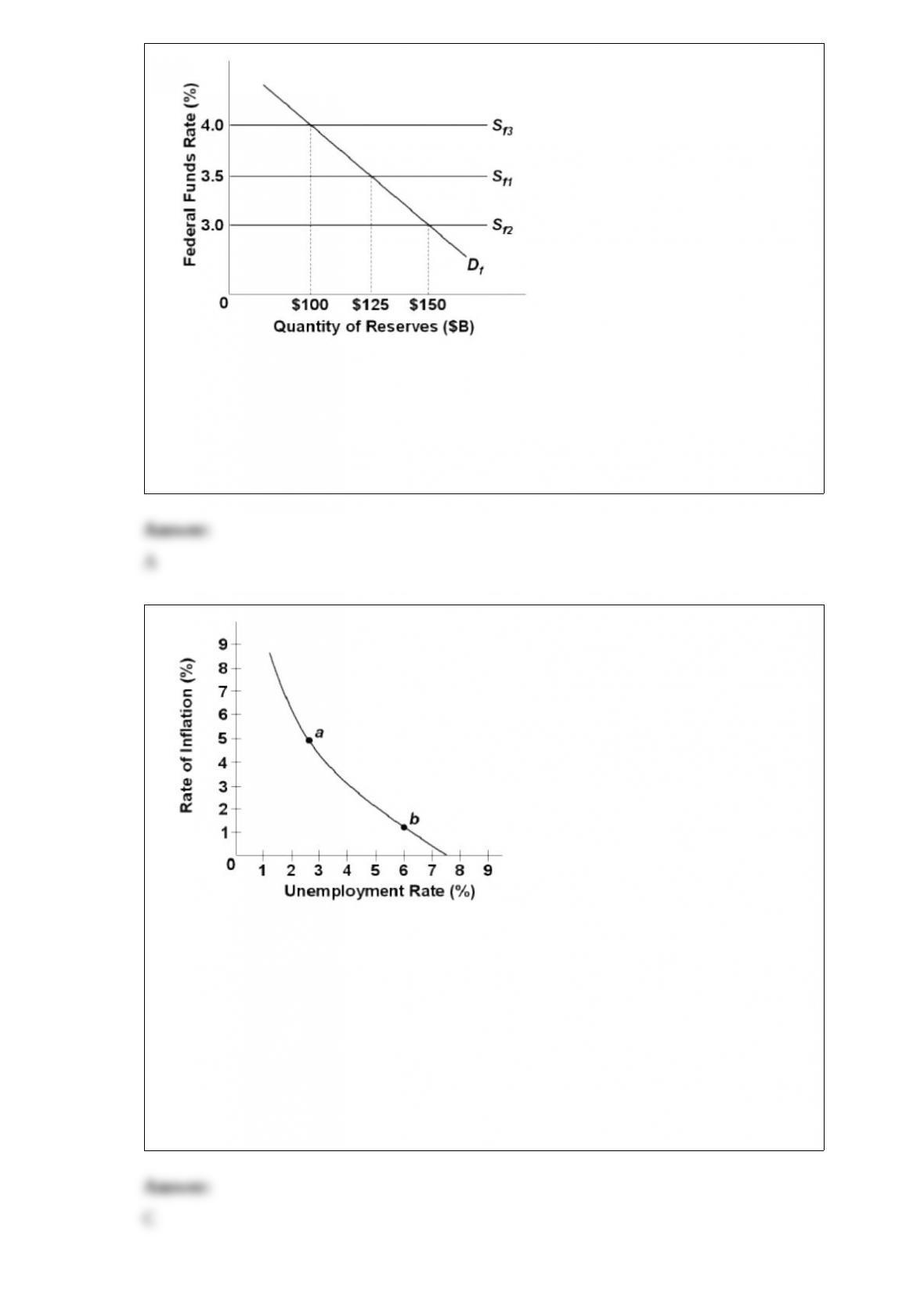
Refer to the above diagram for the Federal funds market. If the Federal funds rate rose
from 3.5 percent to 4.0 percent, which of the following is the most likely explanation?
A.The Fed sold bonds to banks.
B.The Fed bought bonds from banks.
C.The demand for Federal funds fell.
D.The Fed raised the prime interest rate.
5)
Refer to the above diagram for a specific economy. Which of the following best
describes a decision by policymakers that moves this economy from point b to point a?
A.Policymakers have instituted an expansionary monetary policy and/or a budgetary
deficit, thereby accepting more unemployment to reduce the rate of inflation.
B.Policymakers have instituted a restrictive monetary policy and/or a budgetary
surplus, thereby accepting a higher rate of inflation to reduce unemployment.
C.Policymakers have instituted an expansionary monetary and/or a budgetary deficit,
thereby accepting a higher rate of inflation to reduce unemployment.
D.Policymakers have instituted a restrictive monetary policy and/or a budgetary
surplus, thereby accepting more unemployment to reduce the rate of inflation.
6) To say that coins are “token money” means that:
A.their face value is less than their intrinsic value.
B.their face value is greater than their intrinsic value.
C.their face value is equal to their intrinsic value.
D.they are not legal tender.
7) the supply curve of antique reproductions is:
a.relatively elastic.
b.relatively inelastic.
c.perfectly inelastic.
d.unit elastic.
8) An oligopoly producing a homogeneous product is comprised of three firms that act
like a cartel. Assume that these three firms have identical cost schedules. Assume also
that if any one of these firms sets a price for the product, the other two firms charge the
same price. As long as they all charge the same price they will share the market equally;
and the quantity demanded of each will be the same.
Below are the total-cost schedule of one of these firms and the demand schedule that
confronts it when the other firms charge the same price as this firm. Complete the
marginal-cost and marginal-revenue schedules facing the firm.
(a)What price would be charged, what output would be produced, and what profit
would be made by this firm?
(b)If the firms collude to maximize joint profits, what would be the industry price,
output, and profit?
9) The equations for the demand and supply curves for a particular product are P = 10
.4Q and P = 2 + .4Q, where P is price and Q is quantity expressed in units of 100. After
an excise tax is imposed on the product the supply equation is P = 3 + .4Q.
Refer to the above information. The equilibrium quantity after the excise tax is imposed
is:

A.750 units.
B.850 units.
C.875 units.
D.950 units.
10) Assume that Japan and South Korea have flexible exchange rates. Other things
equal, if economic growth is more rapid in Japan than in South Korea:
A.gold bullion will flow out of Japan.
B.the Japanese yen will depreciate.
C.the South Korean won will depreciate.
D.the yen and won exchange rate will stay constant.
11) Which of the following statements is incorrect?
A.Given the economy’s MPS, a $15 billion reduction in government spending will
reduce the equilibrium GDP by more than would a $15 billion increase in taxes.
B.Other things unchanged, a tax reduction of $10 billion will increase the equilibrium
GDP by $25 billion when the MPS is 0.4.
C.If the MPC is 0.8 and GDP has declined by $40 billion, this was caused by a decline
in aggregate expenditures of $8 billion.
D.A government surplus is anti-inflationary; a government deficit is expansionary.
12) The total demand for money is equal to the transactions demand plus the asset
demand for money.
(a)Assume that each dollar held for transactions purposes is spent on the average five
times per year to buy final goods and services. If the nominal GDP is $10,000 billion
($10 trillion), what is the transaction demand?
(b)The table below shows the asset demand at certain rates of interest. Using your
answer to part (a), complete the table to show the total demand for money at various
rates of interest.
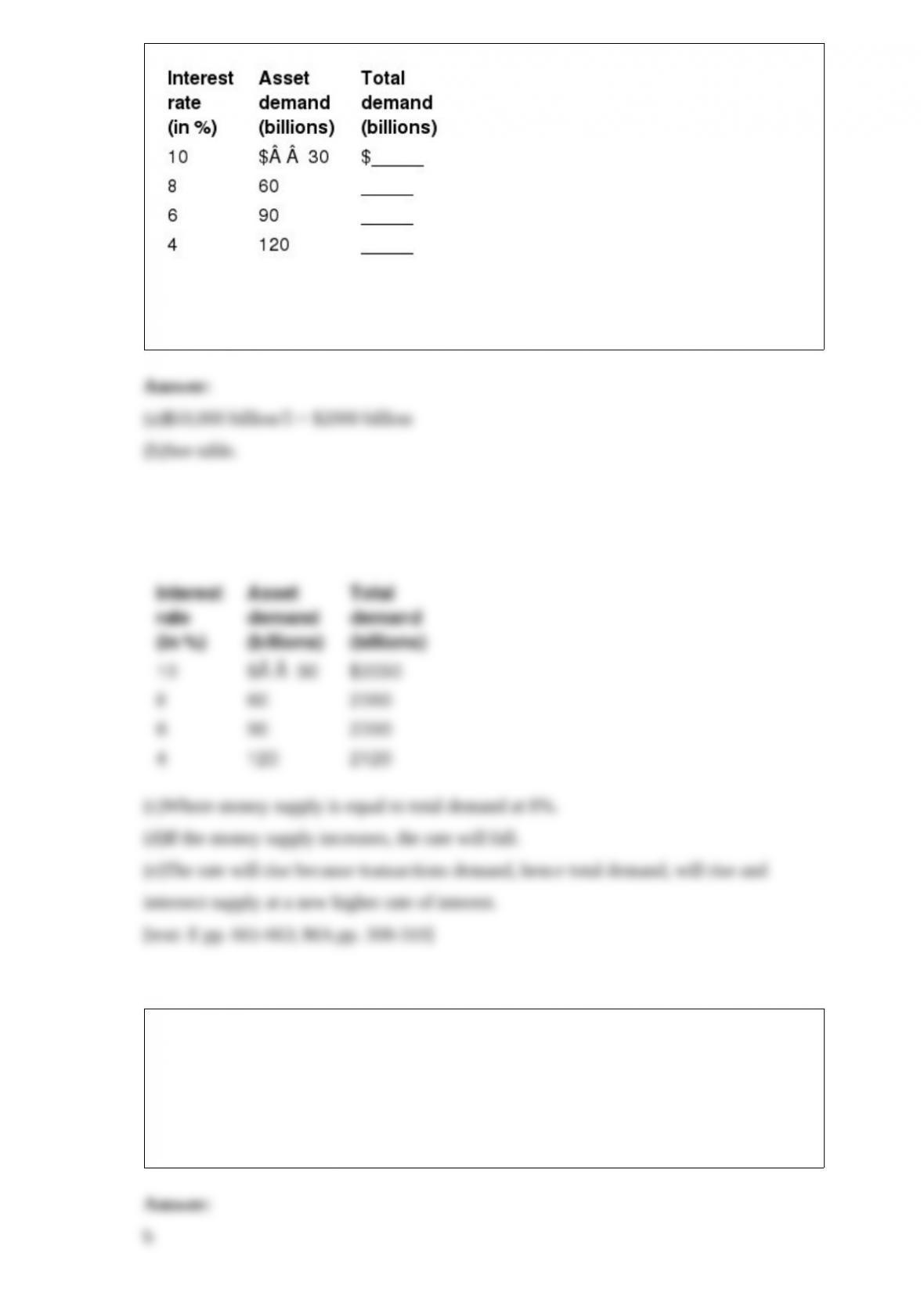
(c)If the money supply is $2060 billion, what will be the equilibrium rate of interest?
(d)If the money supply rises, will the equilibrium rate of interest rise or fall?
(e)If GDP rises, will the equilibrium rate of interest rise or fall?
13) a recent study found that an increase in the federal tax on beer (and thus an increase
in the price of beer) would reduce the demand for marijuana. we can conclude that:
a.beer and marijuana are substitute goods.
b.beer and marijuana are complementary goods.
c.beer is an inferior good.
d.marijuana is an inferior good.