1) children are charged less than adults for admission to professional baseball games
but are charged the same prices as adults at the concession stands. which of the
following conditions of price discrimination explain why this occurs?
a.the seller must have some monopoly power; that is, it must be able to set the product
price.
b.the seller must be able to identify buyers by group characteristics such as age or
income.
c.groups must have different elasticities of demand for the product.
d.the items cannot be bought by people in the low-price group and transferred to
members of the high-price group.
2)
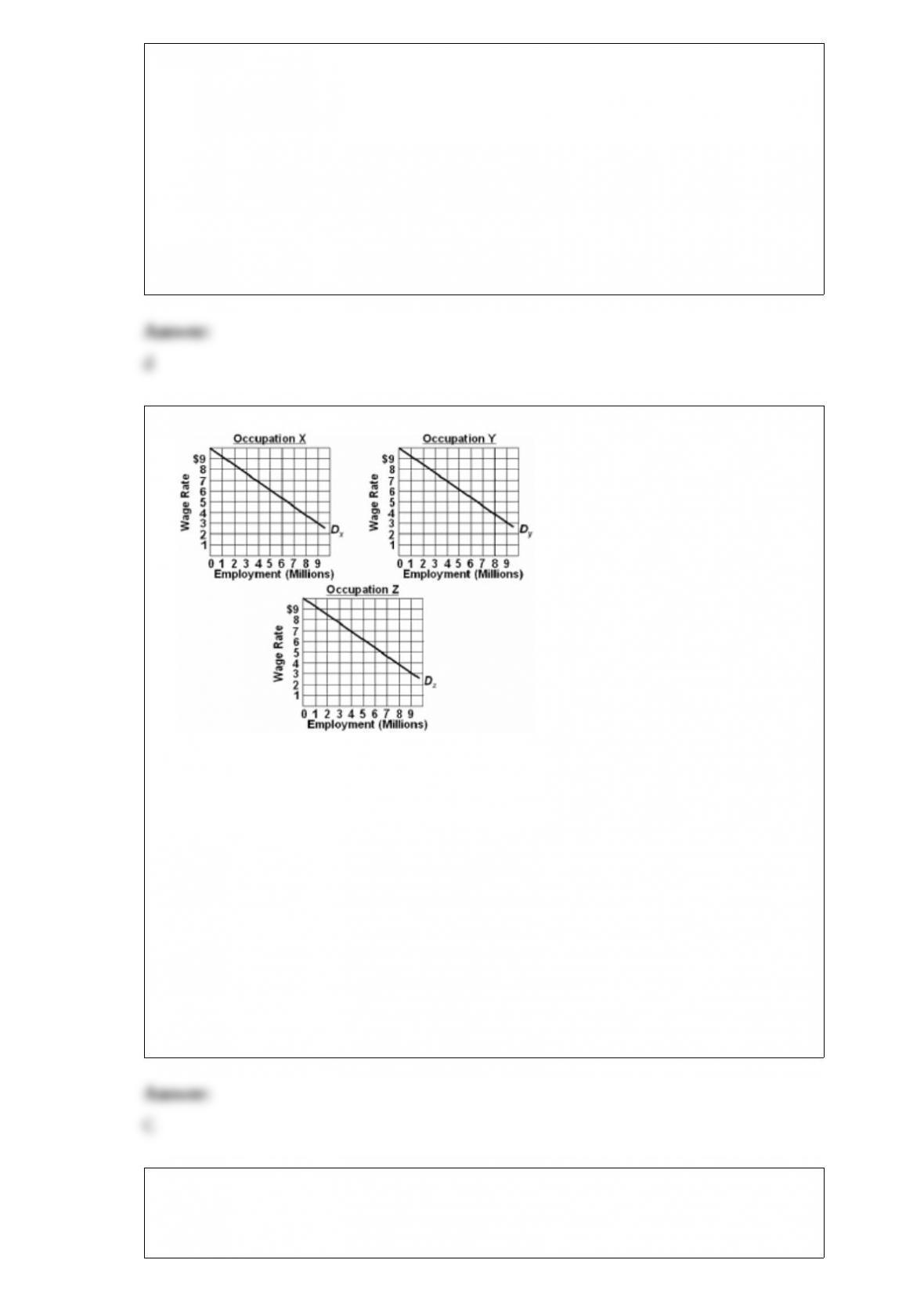
Assumptions: (1) the labor force is comprised of 9 million men and 9 million women
workers; (2) the economy has 3 occupations, X, Y, and Z, each having identical demand
curves for labor; (3) men and women workers are homogeneous with respect to their
labor-market capabilities; (4) women are discriminated against by being excluded from
occupations X and Y and are confined to Z; and (5) aside from discrimination, the
economy is competitive.
Refer to the above diagram and list of assumptions. If discrimination is ended:
A.men will leave occupations X and Y and enter occupation Z.
B.4 million women will leave occupation Z, with 2 million entering occupation X and 2
million entering occupation Y.
C.3 million women will leave occupation Z, with 1.5 million entering occupation X and
1.5 million entering occupation Y.
D.3 million women will leave occupation Z, all of whom will enter industry X.
3) It is true that:
A.equal increases in government spending and taxes do not change the equilibrium
GDP.
B.equal increases in government spending and taxes reduce the equilibrium GDP.
C.equal increases in government spending and taxes increase the equilibrium GDP.
D.taxes have a stronger effect upon equilibrium GDP than do government purchases.
4) In new classical economics, “a price-level surprise”:
A.has no effect on the economy.
B.causes a temporary change in real output.
C.causes a permanent change in real output.
D.can never occur since people correctly anticipate the future.
5)
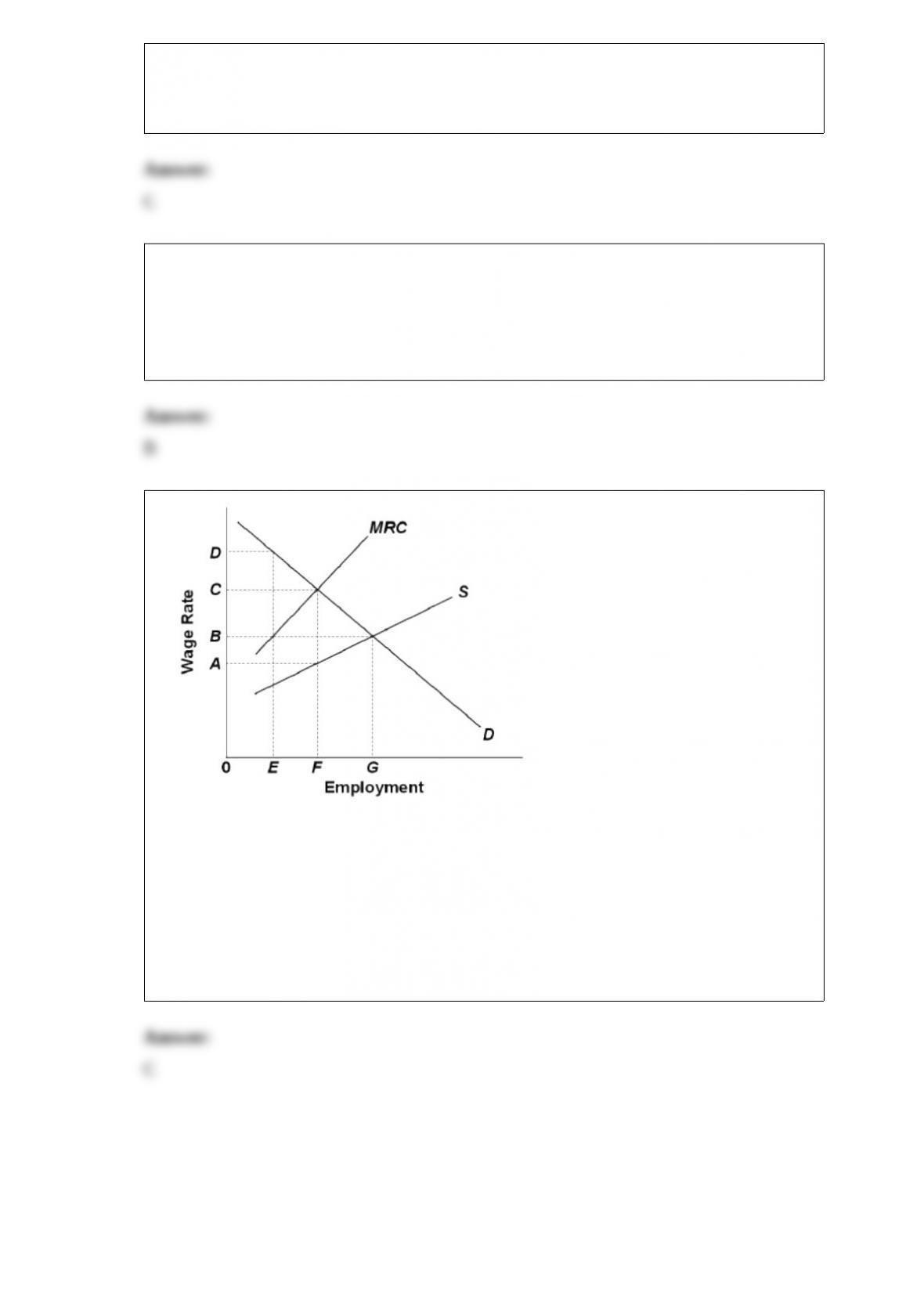
Refer to the above diagram. Assume that an inclusive union is formed to bargain with
the monopsonistic employer of the previous question. To what level can this union
increase the wage rate without causing the number of jobs to decline below that which
the monopsonist would otherwise have provided?
A.D minus A
B.D
C.C
D.B
6)
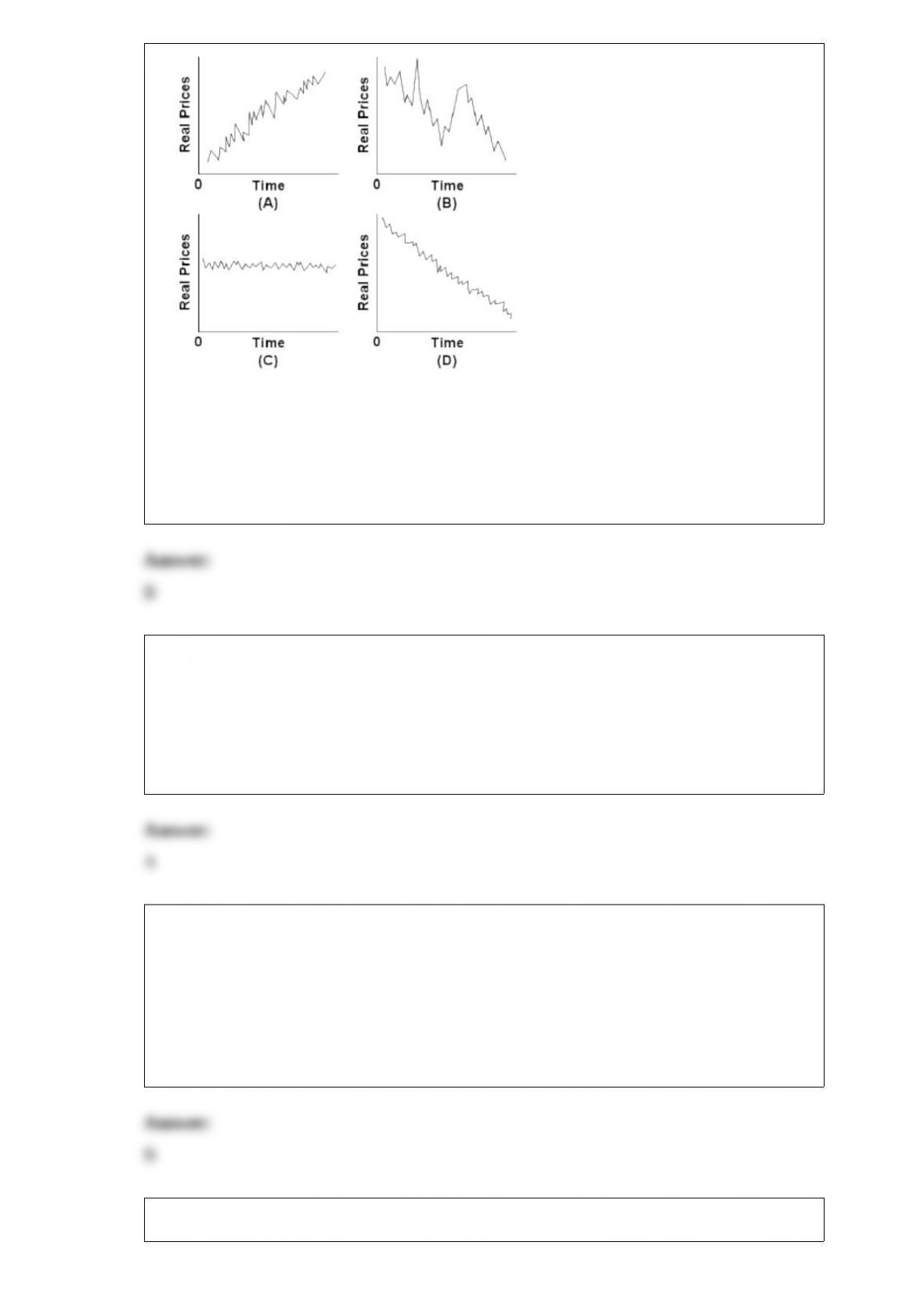
Which of the above diagrams best describes the long-run path of real
(inflation-adjusted) farm prices?
A.A
B.B
C.C
D.D
7) Private capital flows to the DVCs:
A.increased substantially in the 1990s.
B.have changed in composition in recent years from direct foreign investment toward
bank loans.
C.now must first be approved by the IMF.
D.have dwindled to near zero in the last few years.
8) The user cost of extracting a non-renewable resource is:
A.the sum of the dollar expenditures incurred to extract the resource.
B.the cost of not being able to extract it in the future if it is extracted and sold in the
present.
C.the selling price of the resource to the companies using it to produce goods and
services.
D.directly proportional to how much of the non-renewable resource remains.
9) Complete the following table assuming that (a) MPS = 1/3, (b) there is no
government and all saving is personal saving.
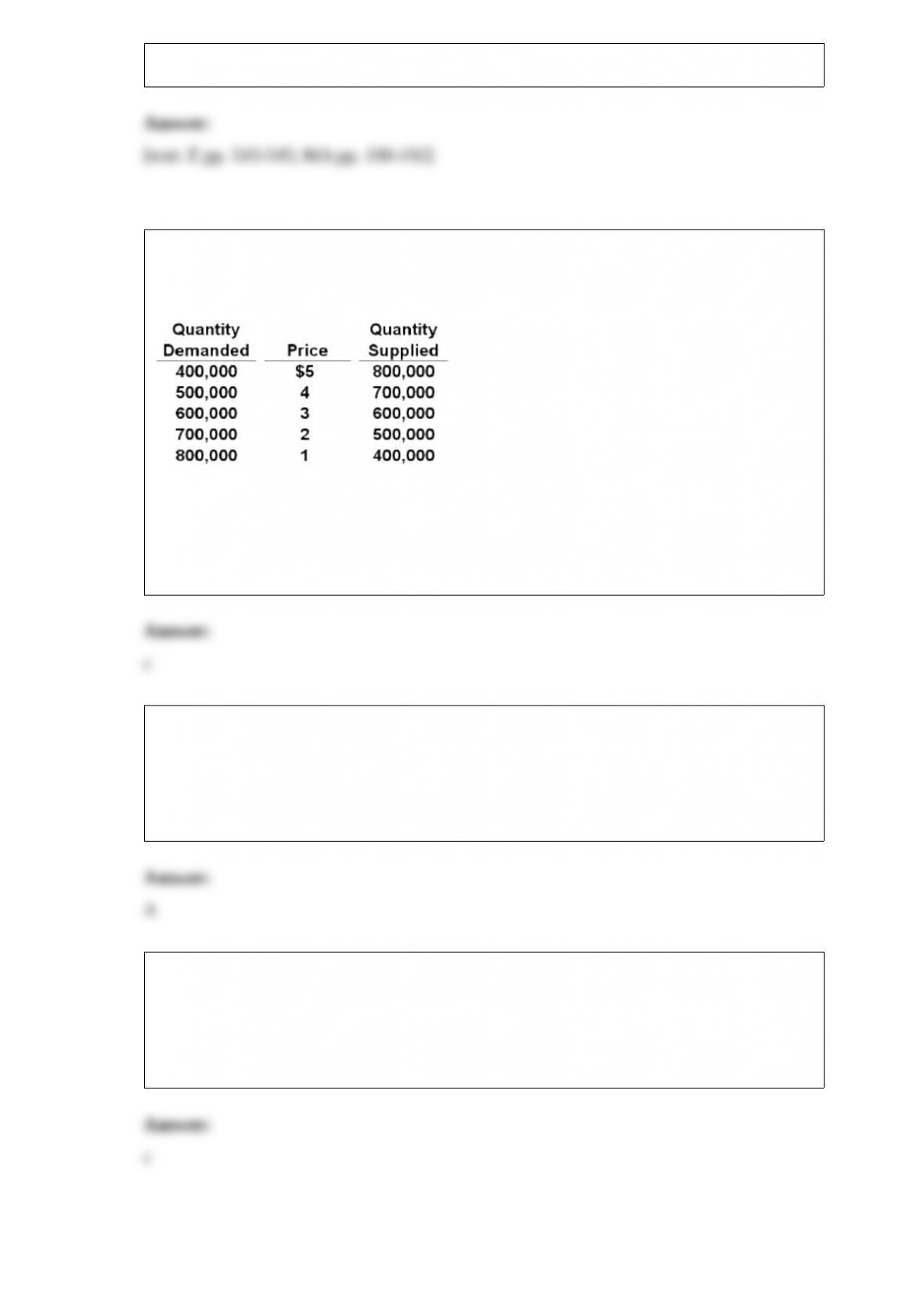
10) the following table applies to a purely competitive industry composed of 100
identical firms.
refer to the above table. the equilibrium price in this purely competitive market is:
a.$5.
b.$4.
c.$3.
d.$2.
11) The real-balances, interest-rate, and foreign purchases effects all help explain:
A.why the aggregate demand curve is downsloping.
B.why the aggregate supply curve is upsloping.
C.shifts in the aggregate demand curve.
D.shifts in the aggregate supply curve.
12) a market-based system of buying and selling human organs for transplant would:
a.reduce total health care spending.
b.create a surplus of organs.
c.increase the quantity of organs available for transplant.
d.reduce the price of organs.
13)
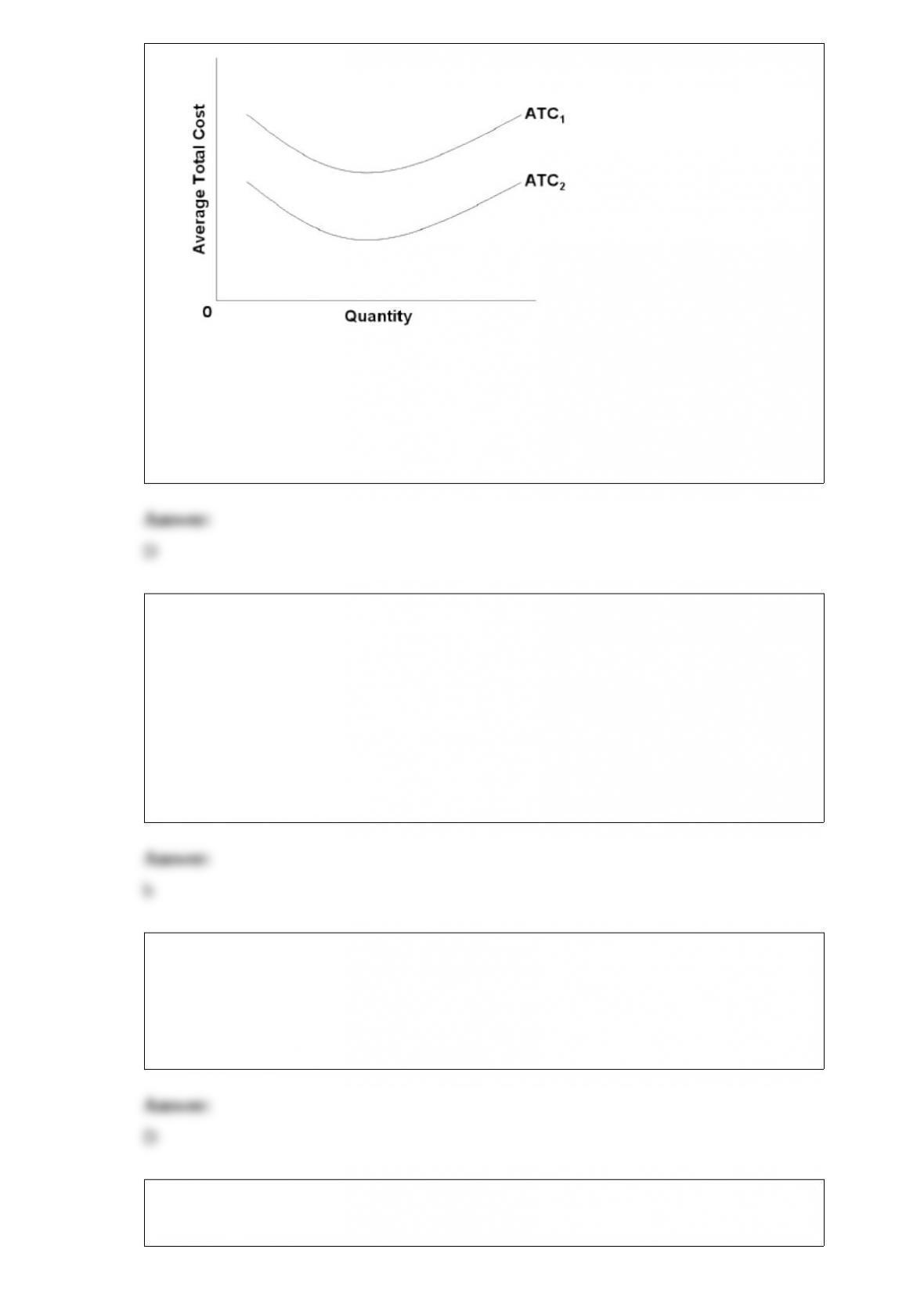
Refer to the above diagram which relates to Firm A. Which of the following would shift
A’s average total cost curve from ATC1 to ATC2?
A.an increase in the price of a key component used by A in producing its product
B.a decrease in the incomes of A’s customers
C.a move along A’s total product curve (not shown)
D.an improved production method that shifts A’s total product curve upward
14) the budget line shows:
a.the amount of product a that a consumer is willing to give up to obtain one more unit
of product b.
b.all possible combinations of two goods that can be purchased, given money income
and the prices of the goods.
c.the minimum amount of two goods that a consumer can purchase with a given money
income.
d.all possible combinations of two goods that yield the same level of utility to the
consumer.
15) The Federal Reserve System was created in:
A.1926.
B.1946.
C.1895.
D.1913.
16) if fred’s annual real income rises by 8 percent each year, his annual real income will
double in about:
a.8-9 years.
b.10-11 years.
c.5-6 years.
d.19-20 years.
17) What percentage of the U.S. public debt is held by Federal agencies and the Federal
Reserve?
A.53 percent
B.58 percent
C.47 percent
D.26 percent
18)
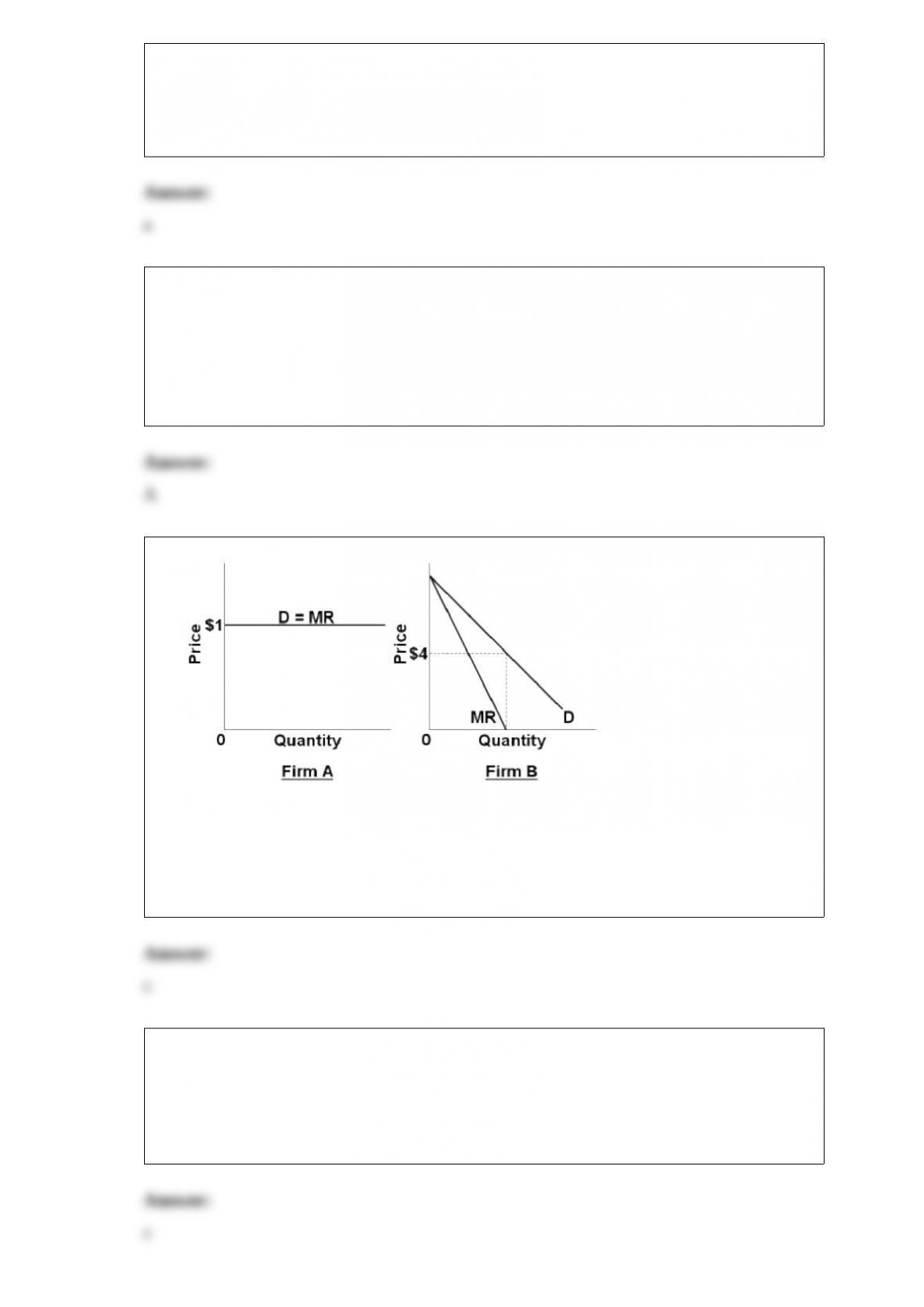
refer to the above diagrams. the demand for firm b’s product is:
a.perfectly elastic over all ranges of output.
b.perfectly inelastic over all ranges of output.
c.elastic for prices above $4 and inelastic for prices below $4.
d.inelastic for prices above $4 and inelastic for prices below $4.
19) a positive statement is concerned with:
a.some goal that is desirable to society.
b.what should be.
c.what is.
d.the formulation of economic policy.

20) Other things equal, an excessive increase in the money supply will:
A.increase the purchasing power of each dollar.
B.decrease the purchasing power of each dollar.
C.have no impact on the purchasing power of the dollar.
D.reduce the price level.