
1) “consumer sovereignty” means that:
a.buyers can dictate the prices at which goods and services will be purchased.
b.advertising is ineffective because consumers already know what they want.
c.buyers control the quality of goods and services through regulatory agencies.
d.buyers determine what will be produced based on their “dollar votes” for the goods
and services offered by sellers.
2) The MRP curve for labor:
A.is downsloping and shows the relationship between wage rates and the quantity of
labor demanded.
B.is perfectly elastic if the firm is selling its output competitively.
C.is upsloping and lies above the labor supply curve.
D.will shift location when the wage rate changes.
3) patents give pharmaceutical companies exclusive rights to produce and sell the
patented medications:
a.forever.
b.for a maximum of 12 years.
c.for a maximum of 20 years.
d.until someone is able to invent a generic equivalent.
4) data from the registrar’s office at gigantic state university indicate that over the past
twenty years tuition and enrollment have both increased. from this information we can
conclude that:
a.higher education is an exception to the law of demand.
b.the supply of education provided by gsu has also increased over the twenty-year
period.
c.school-age population, incomes, and preferences for education have changed over the
twenty-year period.
d.gsu’s supply curve of education is downsloping.

5) The price elasticity coefficient of the demand for agricultural products is .2 to .25.
This means that the demand for agricultural products is:
A.price elastic.
B.income elastic.
C.income inelastic.
D.price inelastic.
6) the nations of the euro zone have:
a.abandoned their national currencies and switched to a common currency.
b.abandoned their national currencies and switched to american dollars.
c.formed a single country called the union of european nations (uen).
d.recently admitted 10 new members.
7) If Congress adjusted the U.S. tax system so that the MPC was reduced, the
A.economy would become more inflation prone.
B.economy would become less stable.
C.stability of the economy would be unaffected.
D. economy would become more stable.
8) If the dollar price of yen rises, then:
A.the yen price of dollars also rises.
B.the dollar depreciates relative to the yen.
C.the yen depreciates relative to the dollar.
D.the dollar will buy fewer U.S. goods.
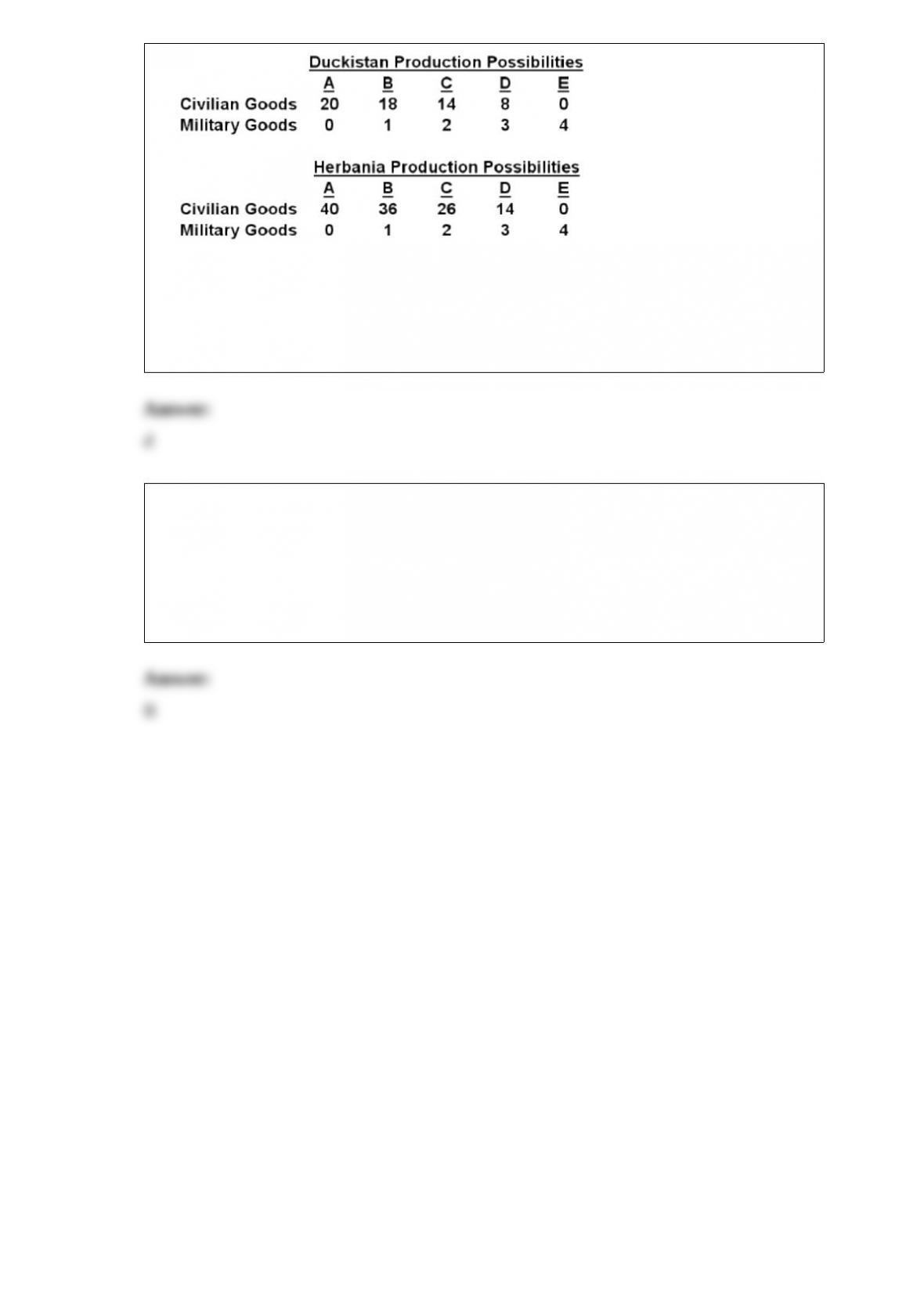
9)
refer to the above tables. opportunity costs of producing military goods are:
a.increasing in duckistan but constant in herbania.
b.constant in both duckistan and herbania.
c.larger in duckistan than in herbania.
d.smaller in duckistan than herbania.
10) Relative to 1800, the living standard of the average person today in the U.S. is
about _____ times higher.
A.5
B.12
C.20
D.42