1) To say money is socially defined means that:
A.money has been defined in a Constitutional amendment.
B.whatever performs the functions of money extremely well is considered to be money.
C.the money supply includes all public and private securities purchased by society.
D.society, acting through Congress, specifies what shall be included in the money
supply.
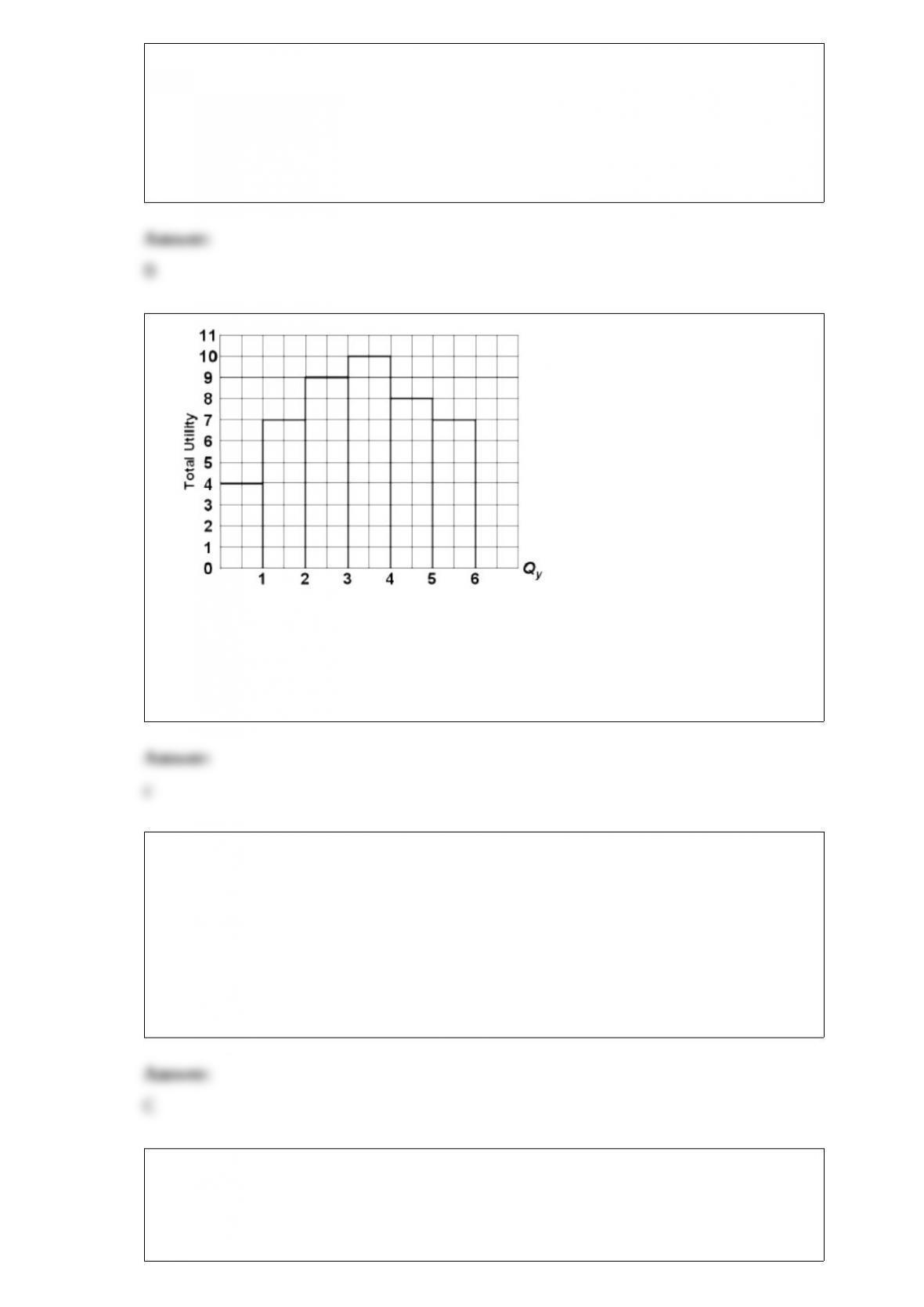
2)
refer to the above diagram. total utility:
a.increases so long as additional units of y are purchased.
b.becomes negative at 4 units.
c.increases at a diminishing rate, reaches a maximum, and then declines.
d.is maximized at 2 units.
3) In prosperous times banks are likely to hold very small amounts of excess reserves
because:
A.the Fed wants commercial banks to increase the money supply during economic
expansions.
B.it is very costly to transfer funds between commercial banks and the central banks.
C.the Federal Reserve Banks do not pay interest on bank reserves.
D.the Federal Reserve Banks want to minimize their interest payments on such
deposits.
4) Assume that in a private closed economy consumption is $240 billion and investment
is $50 billion, both at the $280 billion level of domestic output. Thus:
A.saving is $10 billion.
B.unplanned decreases in inventories of $10 billion will occur.
C.the MPC is .80.
D.unplanned increases in inventories of $10 billion will occur.
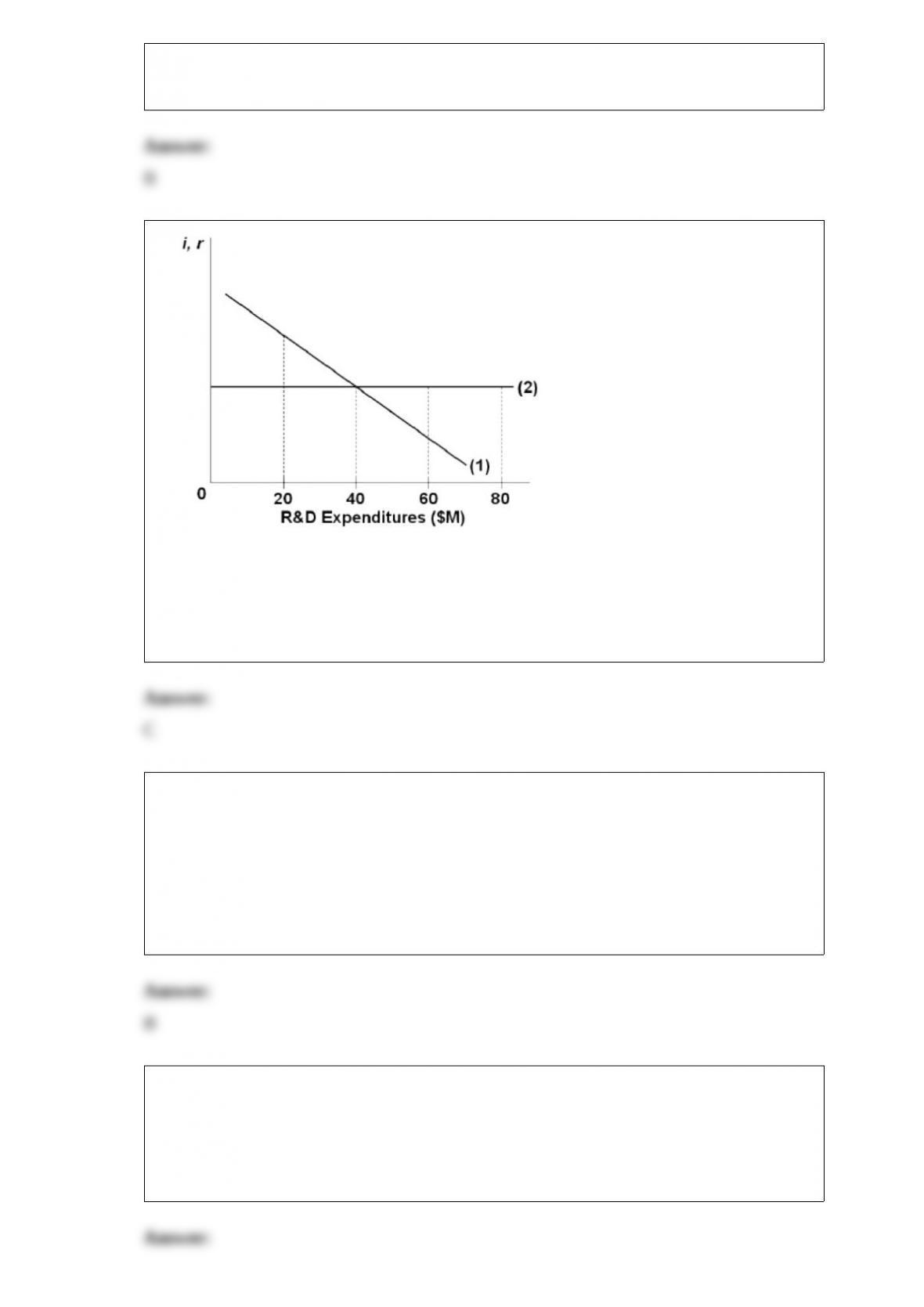
5)
In the above diagram, (1) is the:
A.expected-rate-of-return curve and (2) is the average total cost curve.
B.total revenue curve and (2) is the interest-rate-cost-of funds-curve.
C.expected-rate-of-return curve and (2) is the interest-rate-cost-funds curve.
D.marginal cost curve and (2) is the marginal benefit curve.
6) The demand for land is:
A.perfectly inelastic because offering a different price will not affect how much land is
available for use.
B.downsloping because of diminishing returns.
C.upsloping because buyers want more land as its price rises.
D.perfectly elastic buyers can purchase as much as they want without influencing the
price.
7) stocks are:
a.promises to repay a loan.
b.also known as bonds.
c.issued by sole proprietorships.
d.shares of ownership of a corporation.
8) innovations such as the microchip and the internet lead to business cycle variations
because:
a.they cause prices to be sticky.
b.significant innovations occur irregularly and unexpectedly.
c.the central bank will often change the money supply in response.
d.they cause prices to be flexible.
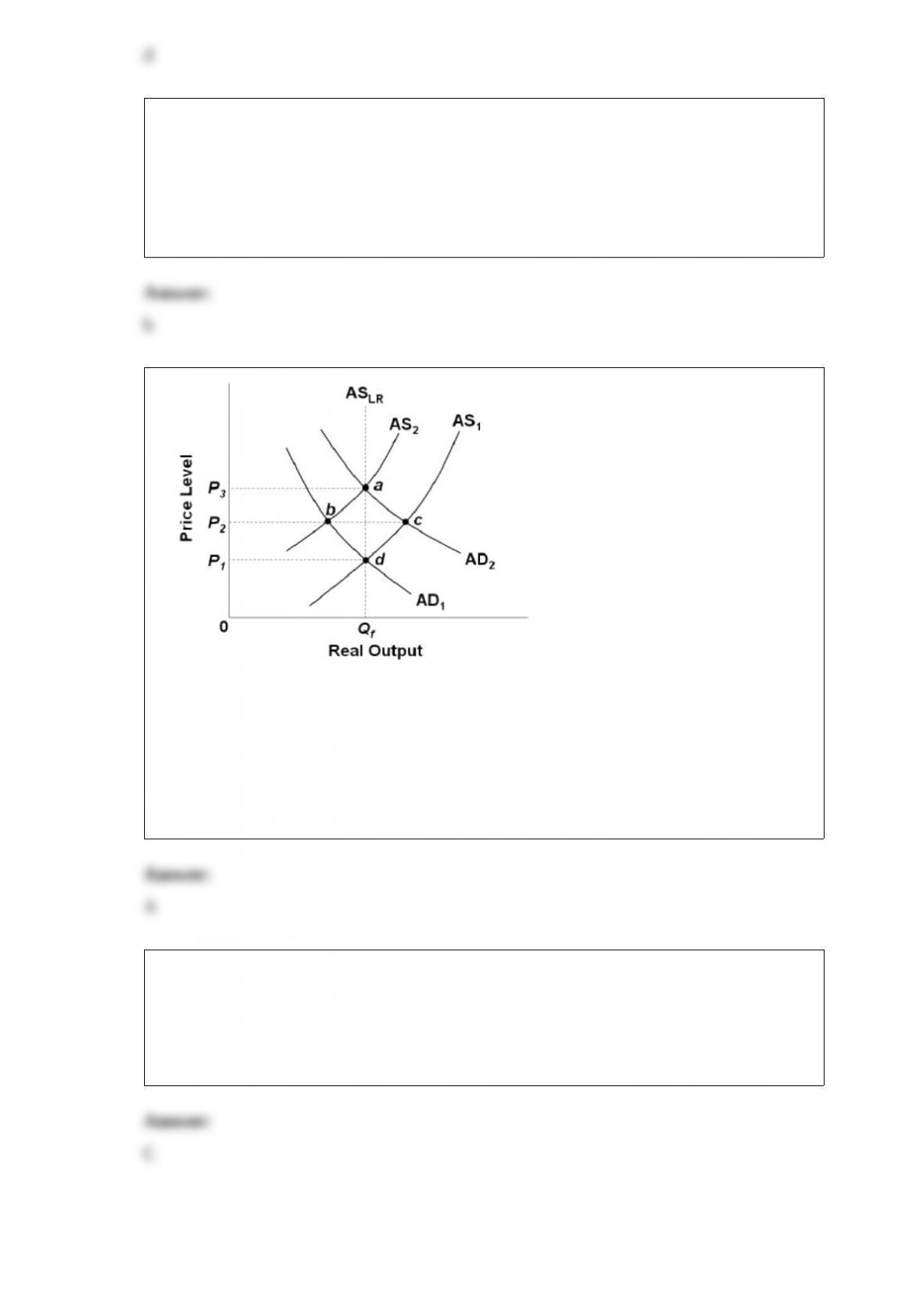
9)
Refer to the above diagram. The initial aggregate demand curve is AD1 and the initial
aggregate supply curve is AS1. Cost-push inflation in the short run is best represented
as a:
A.leftward shift of the aggregate supply curve from AS1 to AS2.
B.rightward shift of the aggregate demand curve from AD1 to AD2.
C.move from d to b to a
D.move from d directly to a
10) Evidence of a chronic balance of payments deficit is:
A.a decline in amount of the nation’s currency held by other nations.
B.an excess of exports over imports.
C.diminishing reserves of foreign currencies.
D.an increase in the international value of the nation’s currency.
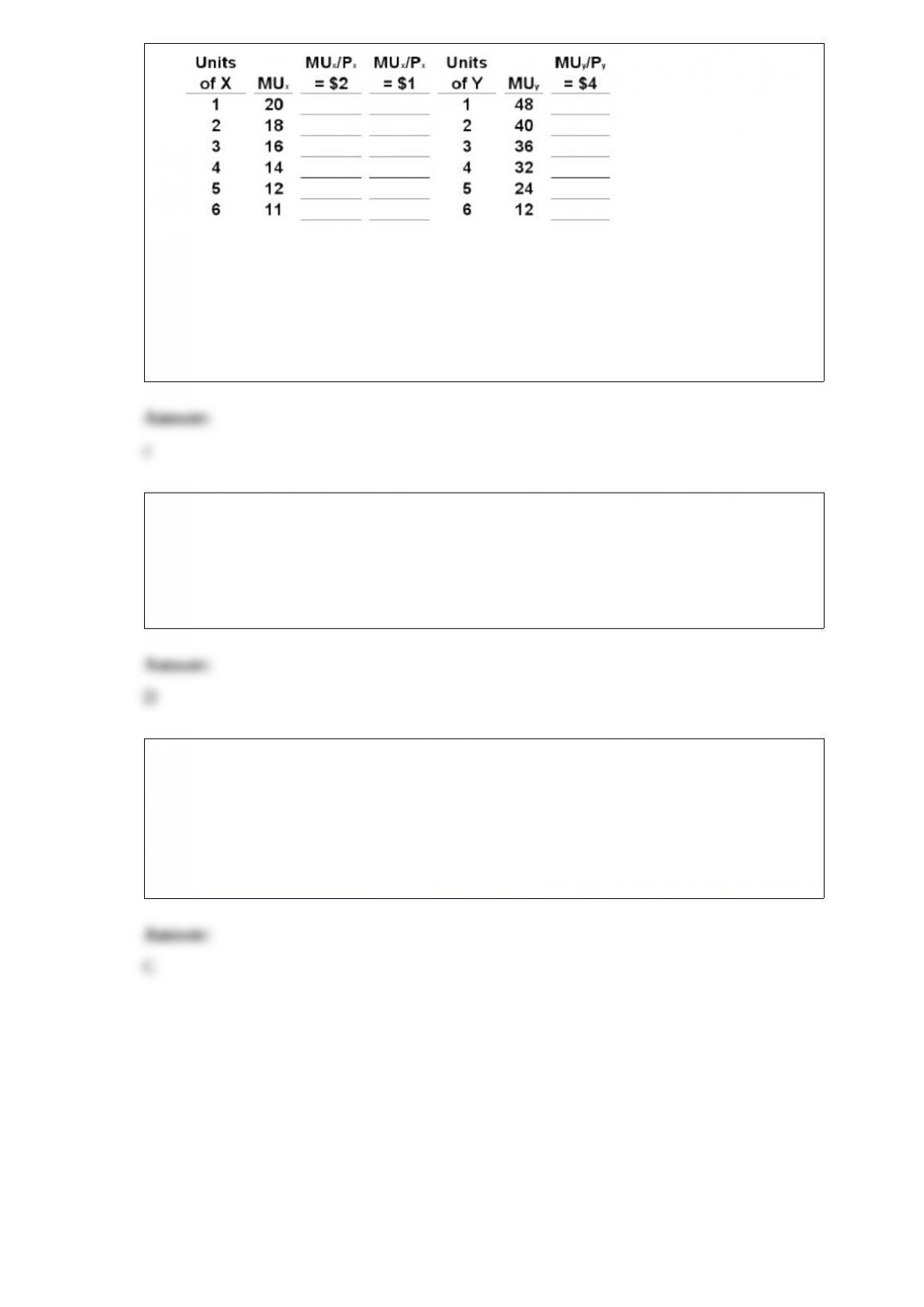
11)
if the prices of x and y are $2 and $4 per unit, respectively, and this consumer has $10
in income to spend, to maximize total utility this consumer should buy:
a.1 units of x and 1 units of y
b.2 units of x and 2 units of y
c.1 units of x and 2 units of y
d.5 units of x and no units of y
12) The insider-outsider theory implies that:
A.wages are flexible both upward and downward.
B.unemployment quickly reduces market wages.
C.agents pursue their own agendas, sometimes at the expense of principals.
D.wages may be inflexible downward.
13) In 2005, the top 1 percent of all taxpayers in the United States paid what percent of
the Federal income tax?
A.11.2 percent.
B.26.7 percent.
C.38.8 percent.
D.60.7 percent.