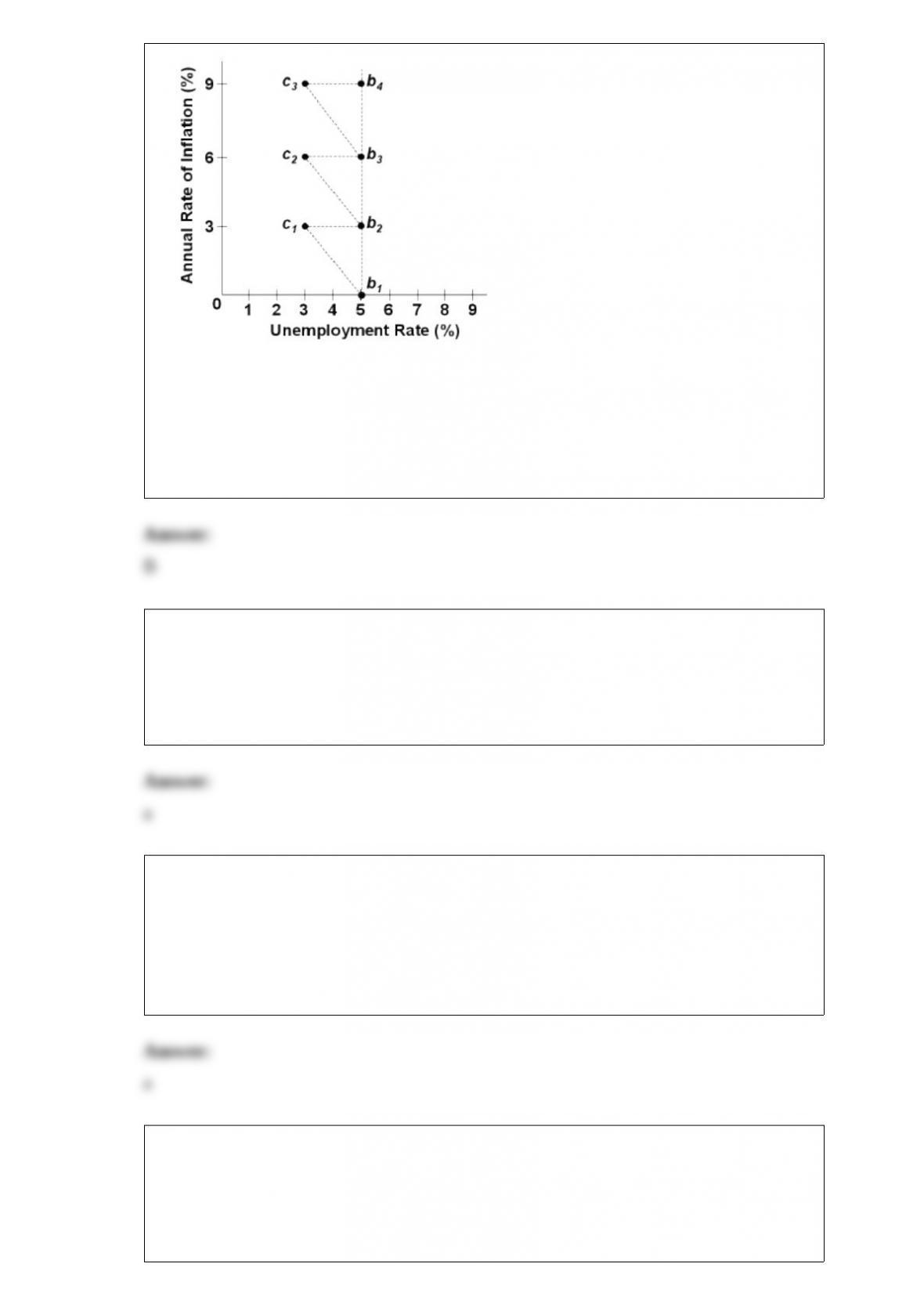
1)
The above diagram is the basis for explaining:
A.the traditional Phillips Curve.
B.the long-run Phillips Curve.
C.how central planning can make full employment and price level stability compatible
goals.
D.new policies for eliminating unemployment.
2) if both the real interest rate and the nominal interest rate are 3 percent, then the:
a.inflation premium is zero.
b.real gdp must exceed the nominal gdp.
c.nominal gdp must exceed real gdp.
d.inflation premium also is 3 percent.
3) the coincidence-of-wants problem associated with barter refers to the fact that:
a.for exchange to occur each seller must have a product that some buyer wants.
b.money must be used as a medium of exchange or trade will never occur.
c.specialization is restricted by the size or scope of a market.
d.buyers in resource markets and sellers in product markets can never engage in
exchange.
4) if the long-run supply curve of a purely competitive industry slopes upward, this
implies that the prices of relevant resources:
a.will fall as the industry expands.
b.are constant as the industry expands.
c.rise as the industry contracts.

d.rise as the industry expands.
5) Which of the following would, other things equal, reduce the demand for U.S. farm
products?
A.poorer crops abroad
B.strong economic growth abroad
C.improved trade relations with China and Russia
D.appreciation of the U.S. dollar
6) if intermediate goods and services were included in gdp:
a.the gdp would be overstated.
b.the gdp would then have to be deflated for changes in the price level.
c.nominal gdp would exceed real gdp.
d.the gdp would be understated.
7) the elasticity of supply of product x is unitary if the price of x rises by:
a.5 percent and quantity supplied rises by 7 percent.
b.8 percent and quantity supplied rises by 8 percent.
c.10 percent and quantity supplied stays the same.
d.7 percent and quantity supplied rises by 5 percent.
8) when patents on new medications expire, the market for those drugs:
a.change from being monopolistic to being competitive.
b.change from being competitive to being monopolistic.
c.collapse.
d.encourage firms to leave the market.
9) when economists say that health care services are overconsumed, they mean that:
a.rich people buy too much health care and poor people buy too little.
b.some resources now used in the health care industry could produce alternative goods
and services that society values more highly.
c.health care is being purchased in amounts such that marginal benefits exceed marginal
costs.
d.the price of health care is below equilibrium so that quantity demanded exceeds
quantity supplied.
10) the primary benefits of international trade include:
a.the more efficient use of world resources and higher living standards.
b.greater stability of domestic output, employment, and the price level.
c.diminished dependence on foreign supplies of goods and materials.
d.greater economic security for our domestic producers.
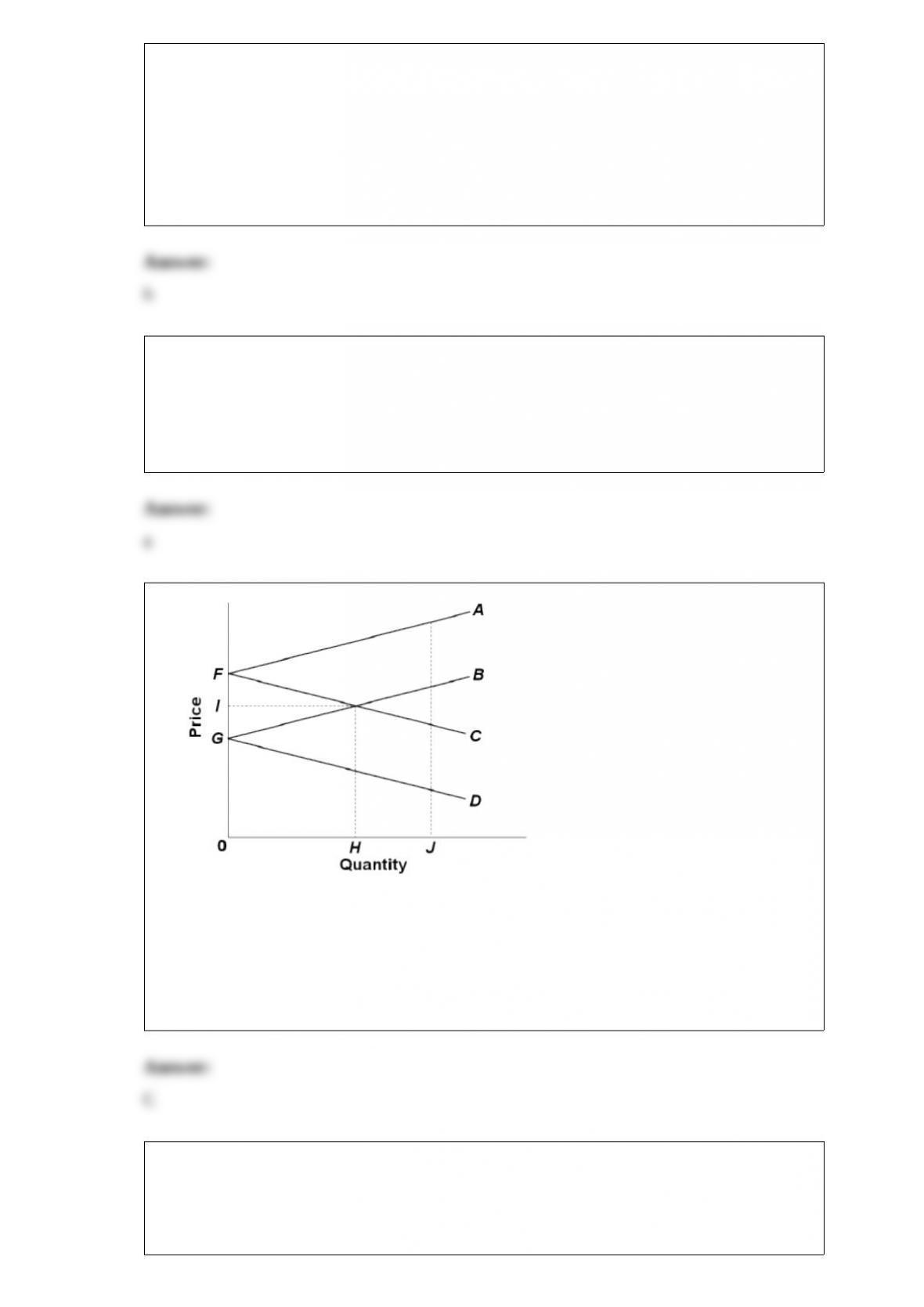
11)
Refer to the above diagram pertaining to two nations and a specific product. Point G is
the:
A.domestic price for the nation represented by lines FA and FC.
B.world equilibrium price.
C.domestic price for the nation represented by lines GB and GD.
D.price above the world equilibrium price.
12) Johnny Deer exclusively grew corn in each of the past three years. Under the Food,
Conservation, and Energy Act of 2008, Deer:
A.must grow corn in the current year in order to receive direct payments from the
Federal government.

B.can grow whatever crop he wants to in the current year but will only receive direct
payments from the Federal government if the price of corn falls below a targeted price.
C.will receive countercyclical payments if the price of corn falls below a targeted price,
even though he does not grow corn in the current year.
D.must grow something other than corn to qualify for direct payments from the Federal
government.
13) One of the potential negative side-effects of pay in the form of sales commissions
is:
A.a greater incentive for sales people to engage in unethical or fraudulent sales
practices that may eventually cause legal problems for the firm.
B.increased volatility of sales revenue for the firm.
C.the potential that pay levels may get so high that they will increase a firm’s marginal
wage cost more than its marginal revenue product.
D.an increased likelihood of shirking by workers.
14) Which of the following is not a source of loanable funds?
A.the saving of households
B.business saving
C.commercial bank lending
D.government budget deficits