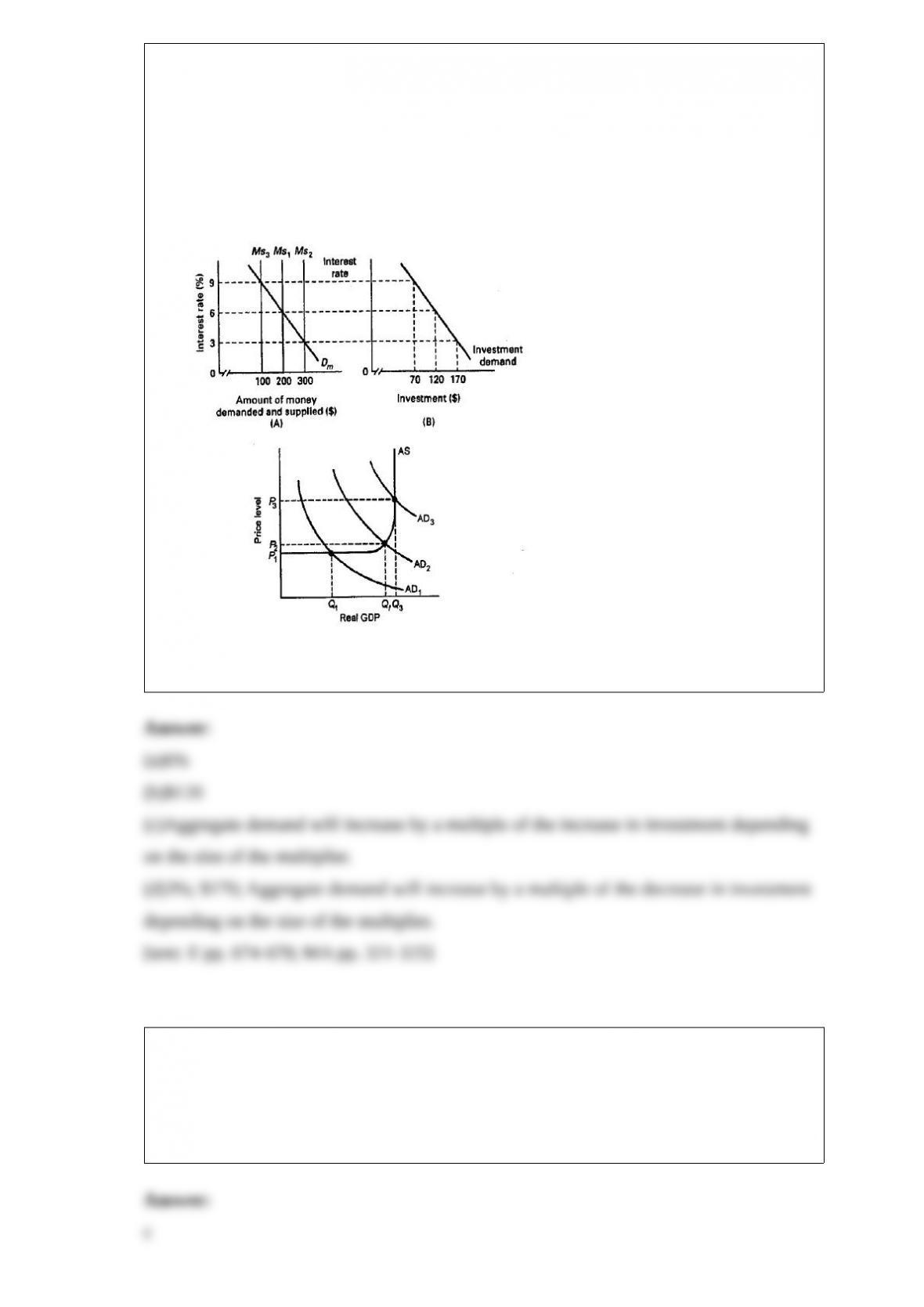
1) Use the below graphs to answer the following questions assuming the nominal GDP
in the economy is given.
(a)Look at graph A and suppose the supply of money increases from 100 to 200. What
will be the equilibrium rate of interest?
(b)Look at graph B which shows an investment-demand curve for this economy. Given
the answer to part (a) above, how much will investors plan to spend on capital goods?
(c)What will happen to
aggregate demand?
(d)Now trace what will happen in parts (a)(c) if the money supply increases to $300.
2) the formula for cross elasticity of demand is percentage change in:
a.quantity demanded of x/percentage change in price of x.
b.quantity demanded of x/percentage change in income.
c.quantity demanded of x/percentage change in price of y.
d.price of x/percentage change in quantity demanded of y.
3)
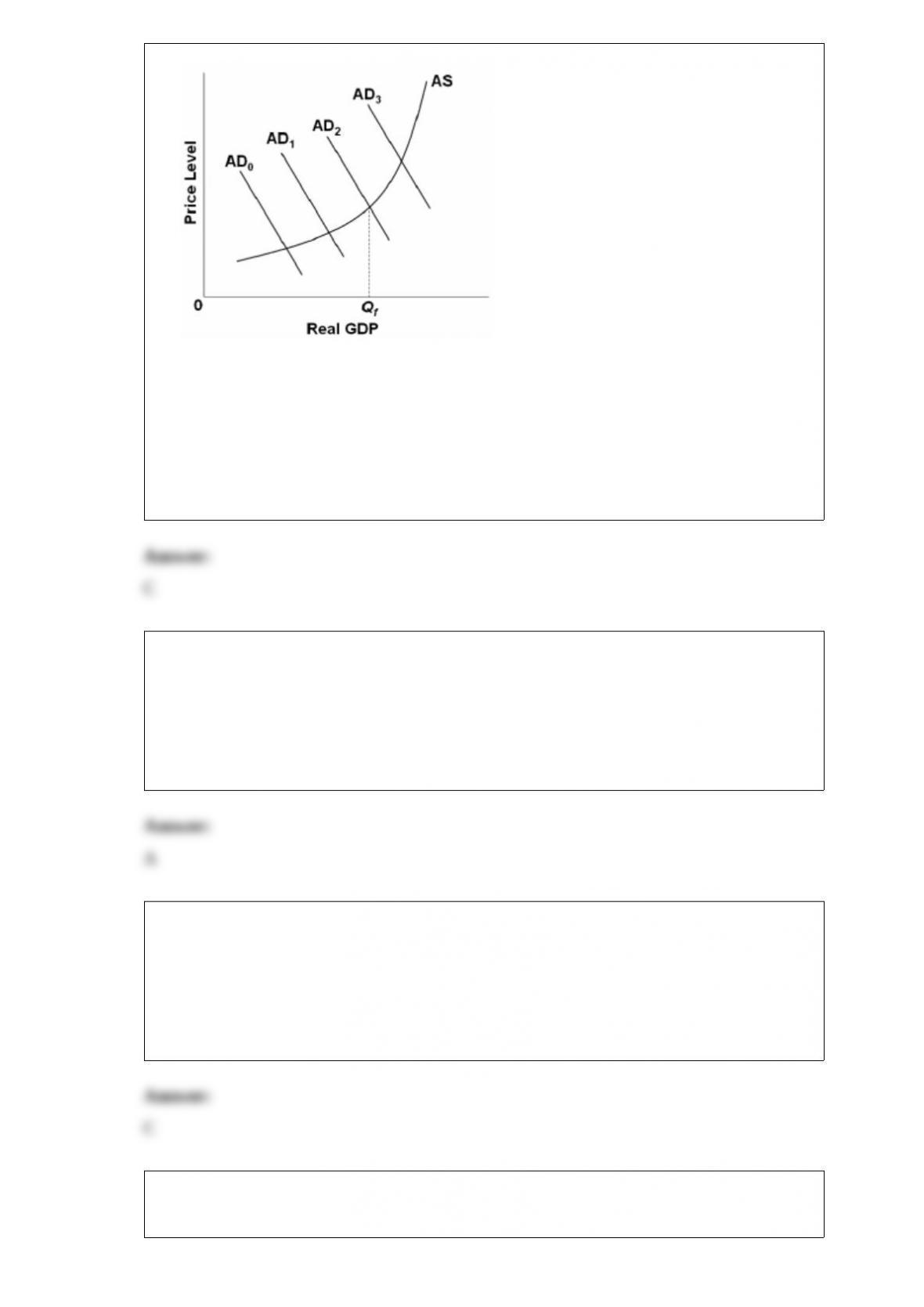
Refer to the above diagram, in which Qf is the full-employment output. If the
economy’s current aggregate demand curve is AD0, it would be appropriate for the
government to:
A.reduce government expenditures and taxes by equal-size amounts.
B.reduce government expenditures or increase taxes.
C.increase government expenditures or reduce taxes.
D.reduce unemployment compensation benefits.
4) The successful commercial introduction of a new product, the use of a new method,
or the creation of a new form of business enterprise is called:
A.innovation.
B.invention.
C.creative destruction.
D.diffusion.
5) Refer to the above diagrams. Assuming a constant price level, an increase in
aggregate expenditures from AE1 to AE2 would:
A.move the economy from A to C along AD1.
B.move the economy from C to A along AD1.
C.increase aggregate demand from AD1 to AD2.
D.decrease aggregate demand from AD2 to AD1.
6) the following information for a pure monopolist:
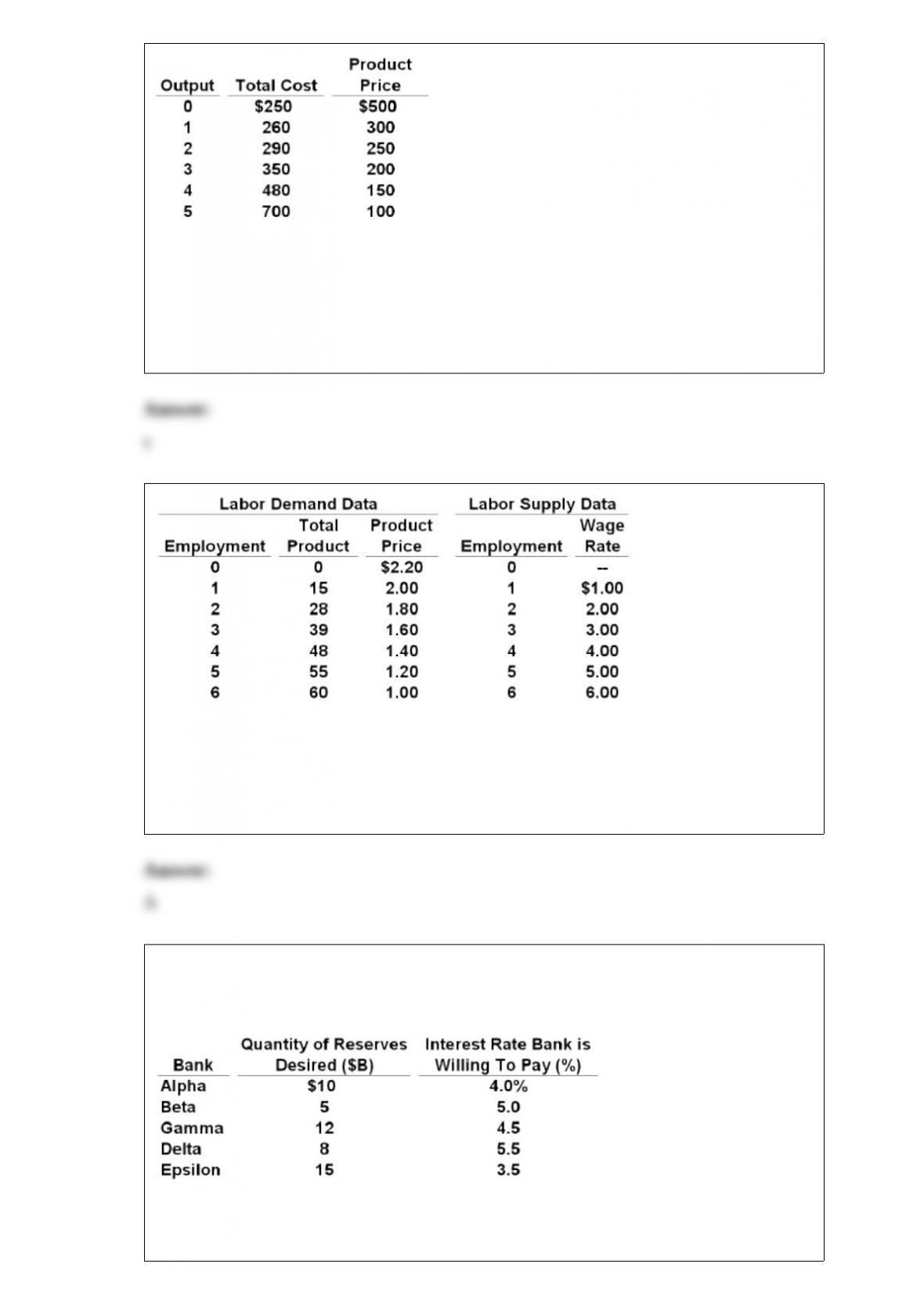
how many units would the above profit-maximizing nondiscriminating monopolist
produce?
a.1
b.2
c.3
d.4
7) Refer to the above
data. How many units of output will this profit-maximizing firm produce?
A.39
B.48
C.55
D.60
8) The following information: The Fed is going to auction $30 billion in reserves using
the term auction facility. It receives the following bids:
Refer to the above information. What interest rate will the Fed charge for these
reserves?
A.4 percent.
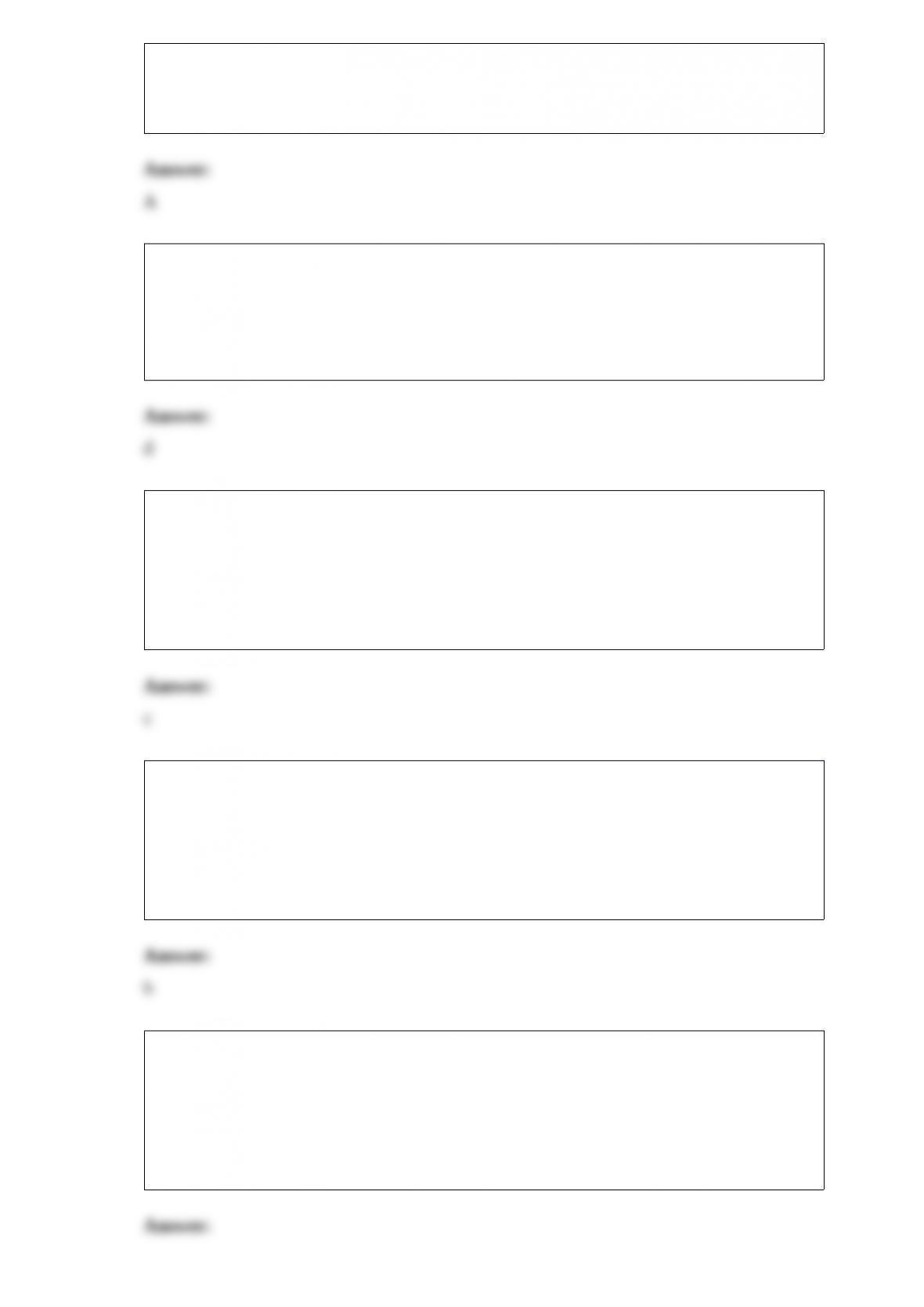
B.4.5 percent.
C.5.5 percent.
D.The interest rate will vary depending on what each bank bid.
9) given the annual rate of inflation, the “rule of 70” allows one to:
a.determine whether the inflation is demand-pull or cost-push.
b.calculate the accompanying rate of unemployment.
c.determine when the value of a real asset will approach zero.
d.calculate the number of years required for the price level to double.
10) if the demand and supply curves for product x are stable, a government-mandated
increase in the price of x will:
a.increase the supply of x and decrease the demand for x.
b.increase the demand for x and decrease the supply of x.
c.increase the quantity supplied and decrease the quantity demanded of x.
d.decrease the quantity supplied of x and increase the quantity demanded of x.
11) which of the following economic regions has experienced the most growth in real
gdp per capita since 1820?
a.japan
b.united states
c.latin america
d.western europe
12) (consider this) the consider this box on patents and innovation demonstrates that:
a.patent protection for u.s. companies may not be as effective when other countries do
not respect or enforce u.s. patent laws.
b.patent laws are relatively uniform across nations.
c.countries like india have no incentive to enact or enforce patent laws.
d.follower countries tend to have stronger patent laws than leader countries.
13) the industrial revolution and modern economic growth resulted in:
a.the average human lifespan more than doubling.
b.a major population shift from urban to rural areas.
c.increased production by local craftsmen.
d.all of these.
14) a consumer who has a limited budget will maximize utility or satisfaction when the:
a.ratios of the marginal utility of each product purchased divided by its price are equal.
b.total utility derived from each product purchased is the same.
c.marginal utility of each product purchased is the same.
d.price of each product purchased is the same.
15) Contractionary fiscal policy is so named because it:
A.involves a contraction of the nation’s money supply.
B.necessarily reduces the size of government.
C.is aimed at reducing aggregate demand and thus achieving price stability.
D.is expressly designed to contract real GDP.