
1) What will be the elasticity of resource demand in the following cases?
(a)unit wages rise by 10% and the number of employed workers falls by 5%
(b)unit wages rise by 4% and the number of employed workers falls by 6%
(c)unit wages rise by 3% and the number of employed workers falls by 3%
2) (Consider This) Credit card balances are:
A.a component of M1.
B.a component of M2 but not of M1.
C.a component of M1 but not of M2.
D.not a component of M1 or M2.
3) in which of the following industries or sectors of the economy will business cycle
fluctuations likely have the greatest effect on output?
a.military goods
b.capital goods
c.textile products
d.agricultural commodities
4) suppose you own $50,000 of personal property, $5,000 of stock in general statics
corporation, a $10,000 savings account, and $20,000 of government bonds. if general
statics goes bankrupt, the most you could lose is:
a.$50,000.
b.$5,000.
c.$35,000.
d.$85,000.
5) the marginal revenue curve for a monopolist:
a.is a straight, upward sloping curve.
b.rises at first, reaches a maximum, and then declines.
c.becomes negative when output increases beyond some particular level.
d.is a straight line, parallel to the horizontal axis.
6) economic systems differ according to what two main characteristics?
a.who owns the factors of production, and the methods used to coordinate economic
activity.
b.the technology used in production, and the quantity and quality of natural resources.
c.how goods are produced, and who gets them.
d.the political system in place, and the degree of scarcity facing the economy.
7) An adverse aggregate supply shock:
A.automatically shifts the aggregate demand curve rightward.
B.causes the Phillips Curve to shift leftward and downward.
C.can be caused by a boost in the rate of growth of productivity.
D.can cause stagflation.
8)
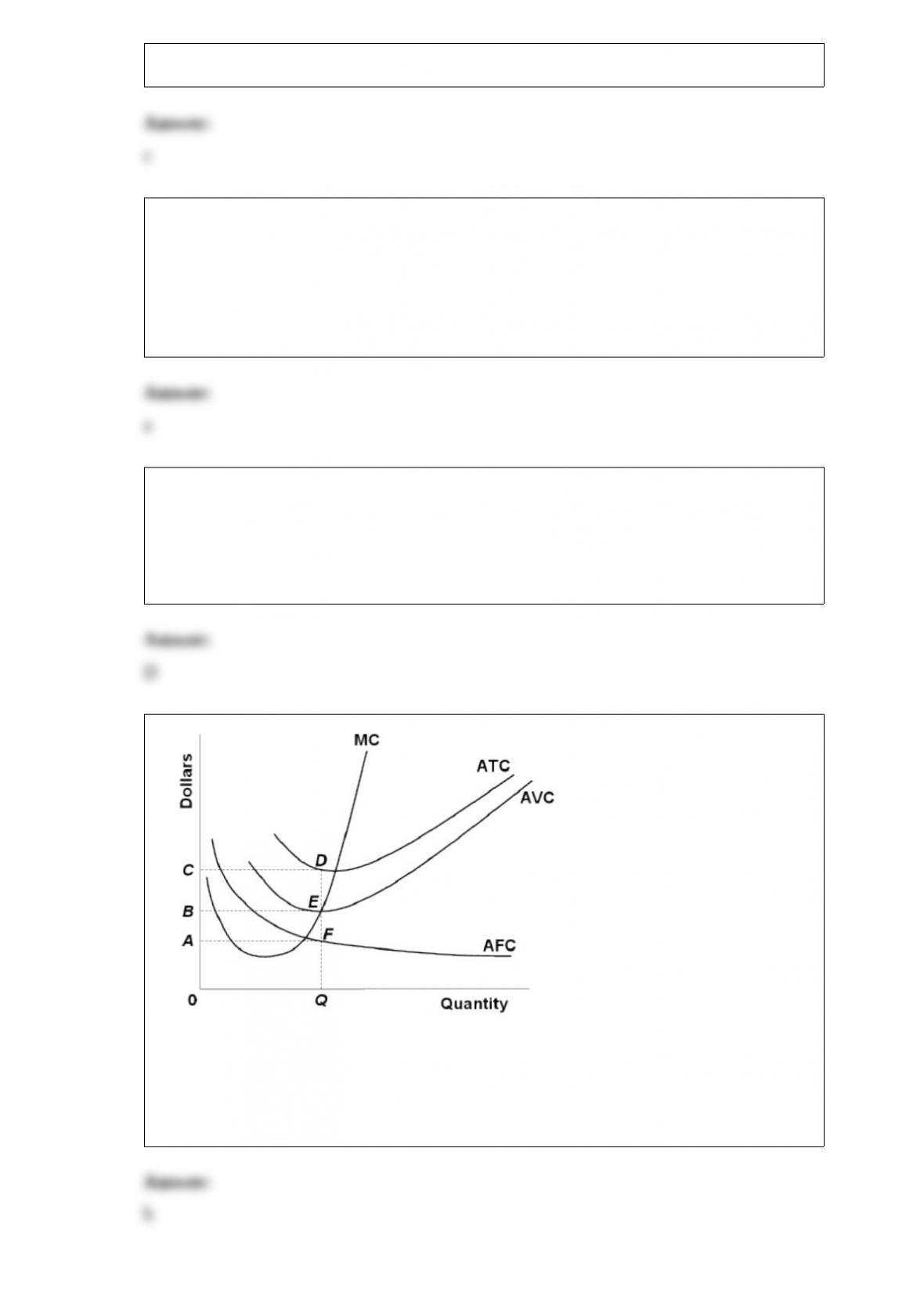
refer to the above diagram. the vertical distance between atc and avc reflects:
a.the law of diminishing returns.
b.the average fixed cost at each level of output.
c.marginal cost at each level of output.
d.the presence of economies of scale.

9) Refer to the above graph. Other things equal, a decrease in the price of a substitute
resource would cause a(n):
A.move from a to b on D1.
B.shift from D2 to D3 assuming the output effect exceeds the substitution effect.
C.shift from D3 to D2 assuming the output effect exceeds the substitution effect.
D.move from b to a on D1.
10) use the list below to answer the following questions:
1. improvements in technology
2. increases in the supply (stock) of capital goods
3. purchases of expanding output
4. obtaining the optimal combination of goods, each at least-cost production
5. increases in the quantity and quality of natural resources
6. increases in the quantity and quality of human resources
refer to the above list. as distinct from the supply factors and efficiency factor of
economic growth, the demand factor of economic growth is:
a.1 only.
b.4 only.
c.1 and 3 only.
d.3 only.
11) if price and total revenue vary in opposite directions, demand is:
a.perfectly inelastic.
b.perfectly elastic.
c.relatively inelastic.
d.relatively elastic.
12) if the price of k declines, the demand curve for the complementary product j will:
a.shift to the left.
b.shift to the right.
c.decrease.
d.remain unchanged.
13)
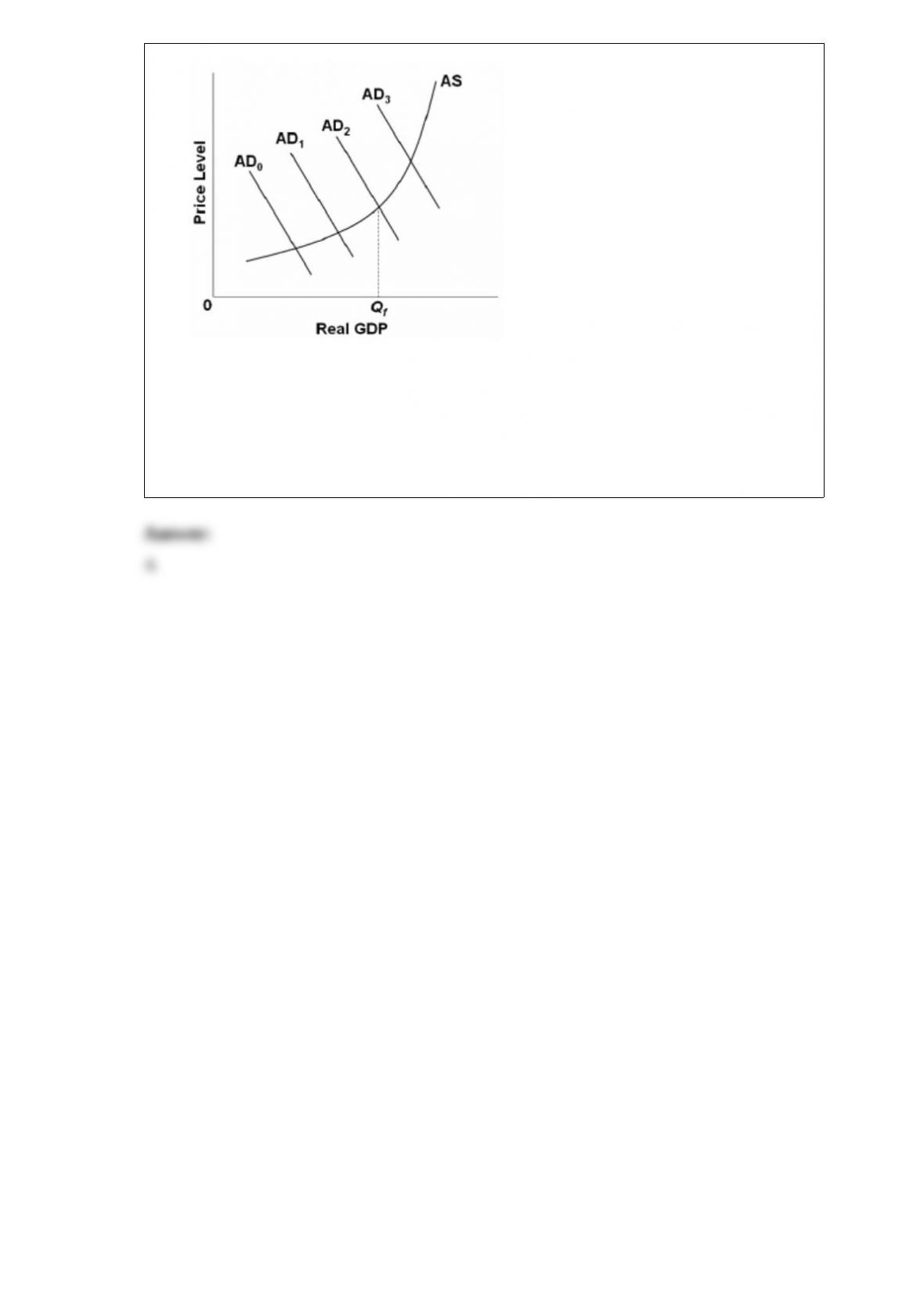
Refer to the above diagram, in which Qf is the full-employment output. If the
economy’s current aggregate demand curve is AD3, it is experiencing:
A.a positive GDP gap.
B.a negative GDP gap.
C.a recession.
D.cost-push inflation.