
1) (Consider This) Owners of defective used cars have more information about the
condition of their vehicles than potential buyers of those used cars. This is an example
of:
A.the moral hazard problem.
B.a spillover cost.
C.a positive externality.
D.asymmetric information.
2) The Fed introduced the term auction facility in response to:
A.the mortgage debt crisis.
B.the 2001 recession.
C.concerns about rising inflation.
D.the diminished effectiveness of open-market operations.
3) a progressive tax is such that:
a.tax rates are higher the greater one’s income.
b.the same tax rate applies to all income receivers, so that the rich pay absolutely more
taxes than the poor.
c.entrepreneurial income is exempt from taxation.
d.the revenues it yields are spent on transfer payments.
4) the negative slope of the production possibilities curve is a graphical way of
indicating that:
a.any economy “can have its cake and eat it too.”
b.to produce more of one product we must do with less of another.
c.the principle of increasing opportunity costs applies to only parts of the economy.
d.consumers buy more when prices are low than when prices are high.
5) Below is the information for Manfred’s Shoe Shine Parlor. Assume Manfred hires
labor, its only variable input, under purely competitive conditions. Shoe shines are also
sold competitively.
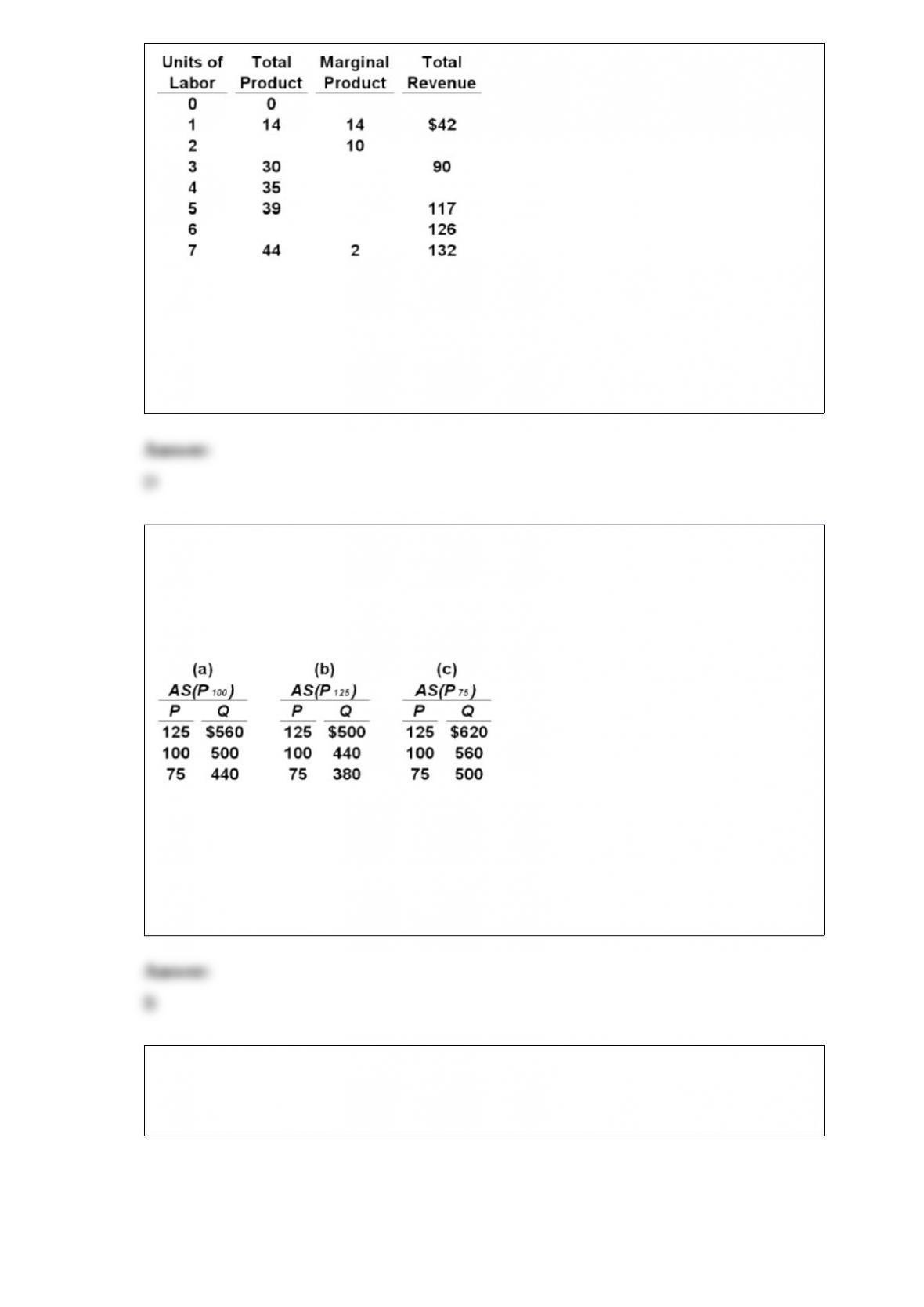
Refer to the above data. If the wage rate is $11 and Manfred’s only fixed input is
capital, the total cost of which is $30, then what will be his economic profit?
A.$62
B.$42
C.$28
D.$32
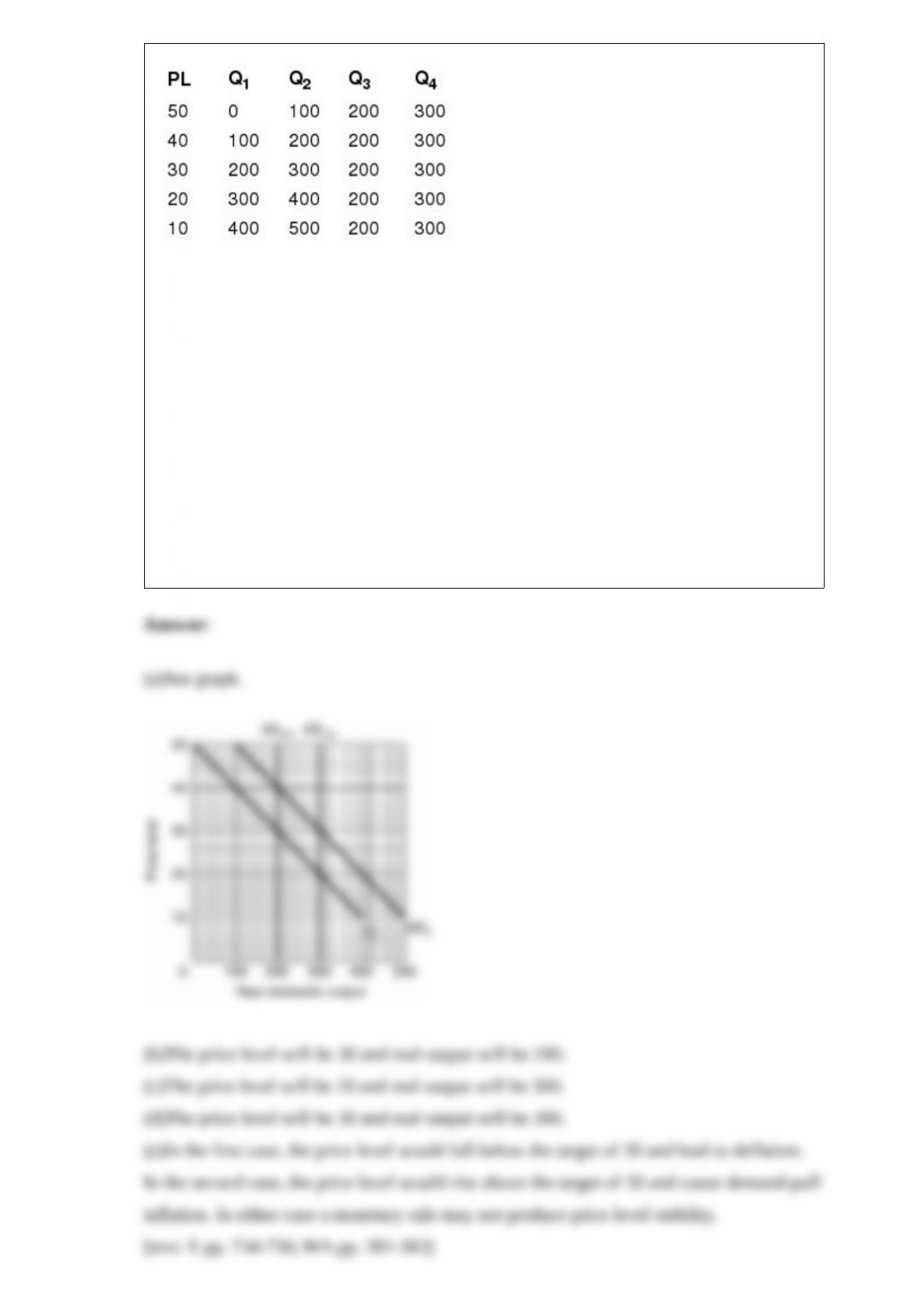
6) Suppose the full employment level of real output (Q) for a hypothetical economy is
$500, the price level (P) initially is 100, and that prices and wages are flexible both
upward and downward. Use the following short-run aggregate supply schedules to
answer the next question(s).
Refer to the information above. If the price level unexpectedly declines from 100 to 75,
the level of real output in the short run will:
A.rise from $500 to $560.
B.fall from $500 to $440.
C.fall from $560 to $500.
D.rise from $440 to $500.
7) Below are price level (PL) and output (Q) combinations to describe aggregate
demand and aggregate supply curves: (1) PL and Q1 are AD1. (2) PL and Q2 are AD2.
(3) PL and Q3 are ASLR1. (4) PL and Q4 are ASLR2.
(a)Use the graph below to graph AD1, AD2, ASLR1, and ASLR2. Label the vertical
axis as the price level and the horizontal axis as real output (Q).
(b)If the economy is initially in equilibrium where AD1 and ASLR1 intersect, what will
the price level and real output be?
(c)If over time, the economy grows from ASLR1 to ASLR2, what will be the
equilibrium price level and real output?
(d)Assume a monetary rule is adopted that increases the money supply proportionate to
the increase in aggregate supply. Aggregate demand will increase from AD1 to AD2, so
what will the equilibrium price level and real output be?
(e)Mainstream economists would argue that velocity is unstable, so a constant increase
in the money supply might not shift AD1 all the way to AD2. It might also be the case
that the constant increase in the money supply might shift AD2 beyond its expected
level of output. For both cases, explain what mainstream economists think will happen
to the price level.
8) Which of the following would increase GDP by the greatest amount?
A.a $20 billion reduction in taxes
B.$20 billion increases in both government spending and taxes
C.$20 billion decreases in both government spending and taxes
D.a $20 billion increase in government spending
9) a purely competitive firm:
a.must earn a normal profit in the short run.
b.cannot earn economic profit in the long run.
c.may realize either economic profit or losses in the long run.
d.cannot earn economic profit in the short run.
10)
Refer to the above diagram in which S is the before-tax supply curve and St is the
supply curve after an excise tax is imposed. The efficiency loss of the tax is shown by
area(s):
A.A + B + C + E + F.
B.A + B + C.
C.A + B + F.
D.E + F.
11)
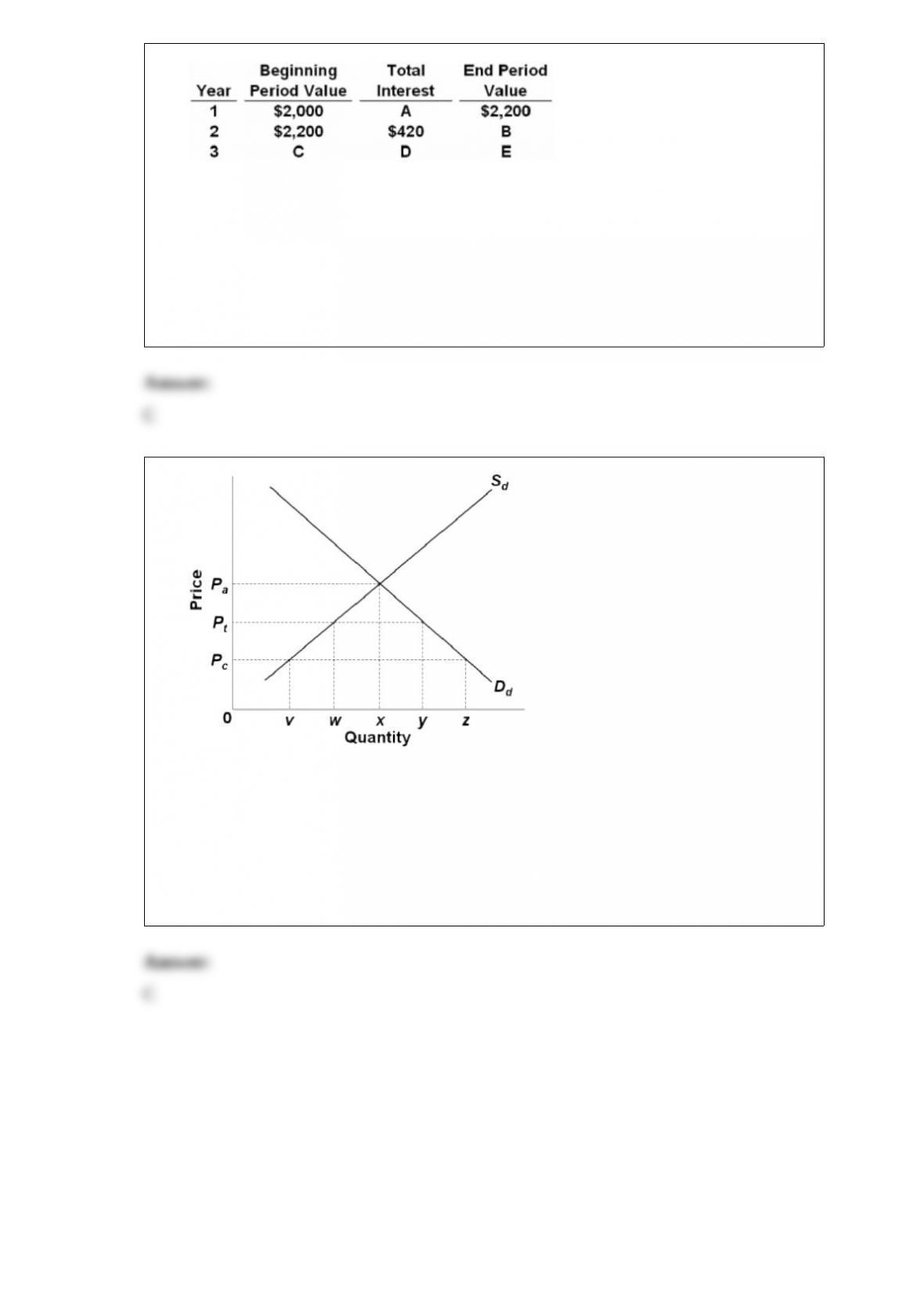
Refer to the above table representing Kara’s bank account. Assuming that $2000 was
deposited into her account at the beginning of year 1, and no further deposits or
withdrawals were made, the value for cell B:
A.cannot be determined.
B.is $2,220.
C.is $2,420.
D.is $2,620.
12)
Refer to the above diagram, where Sd and Dd are the domestic supply and demand for a
product and Pc is the world price of that product. With a per unit tariff in the amount
PcPt, price and total quantity sold will be:
A.Pt and x
B.Pc and z
C.Pt and y
D.Pa and x
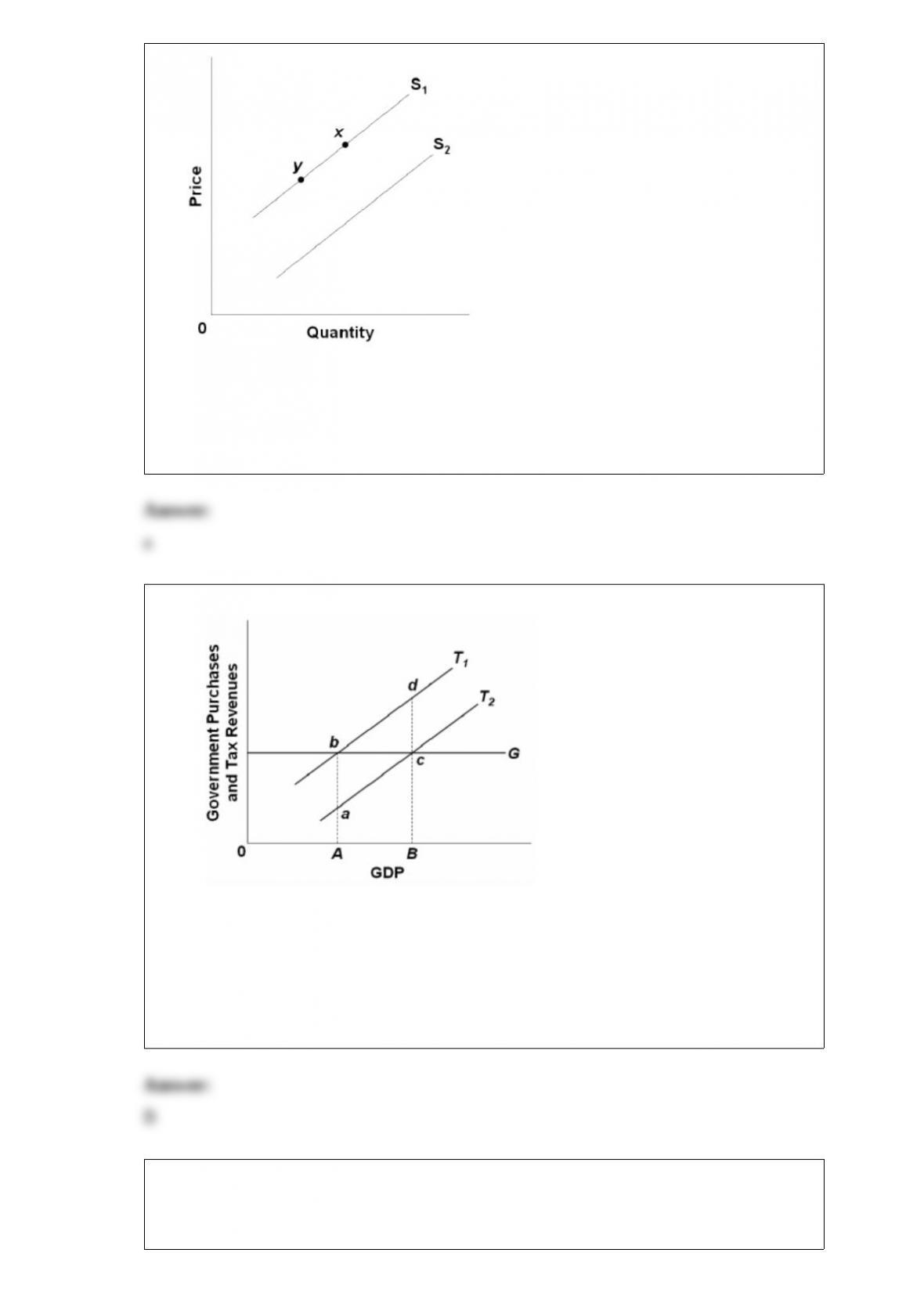
13)
refer to the above diagram. an increase in quantity supplied is depicted by a:
a.move from point y to point x.
b.shift from s1 to s2.
c.shift from s2 to s1.
d.move from point x to point y.
14)
Refer to the above diagram. Assume that G and T2 are the relevant curves, the economy
is currently at A, and the full-employment GDP is B. This economy has a(n):
A.standardized budget surplus.
B.actual budget deficit.
C.standardized budget deficit.
D.actual budget surplus.
15) for comparing changes in potential military strength and political preeminence, the
most meaningful measure of economic growth would be:
a.changes in total nominal output.

b.changes in total real output.
c.changes in per capita output.
d.changes in per family output.