1) suppose that steve heads to the local hamburger shop with $3, expecting to spend $2
for his favorite burger and $1 for french fries. when he gets there he discovers that his
favorite burger is on sale for $1, so he buys two burgers and one order of french fries.
steve’s consumption behavior is best explained by:
a.the income effect.
b.the substitution effect.
c.diminishing marginal utility.
d.increasing marginal utility.
2)
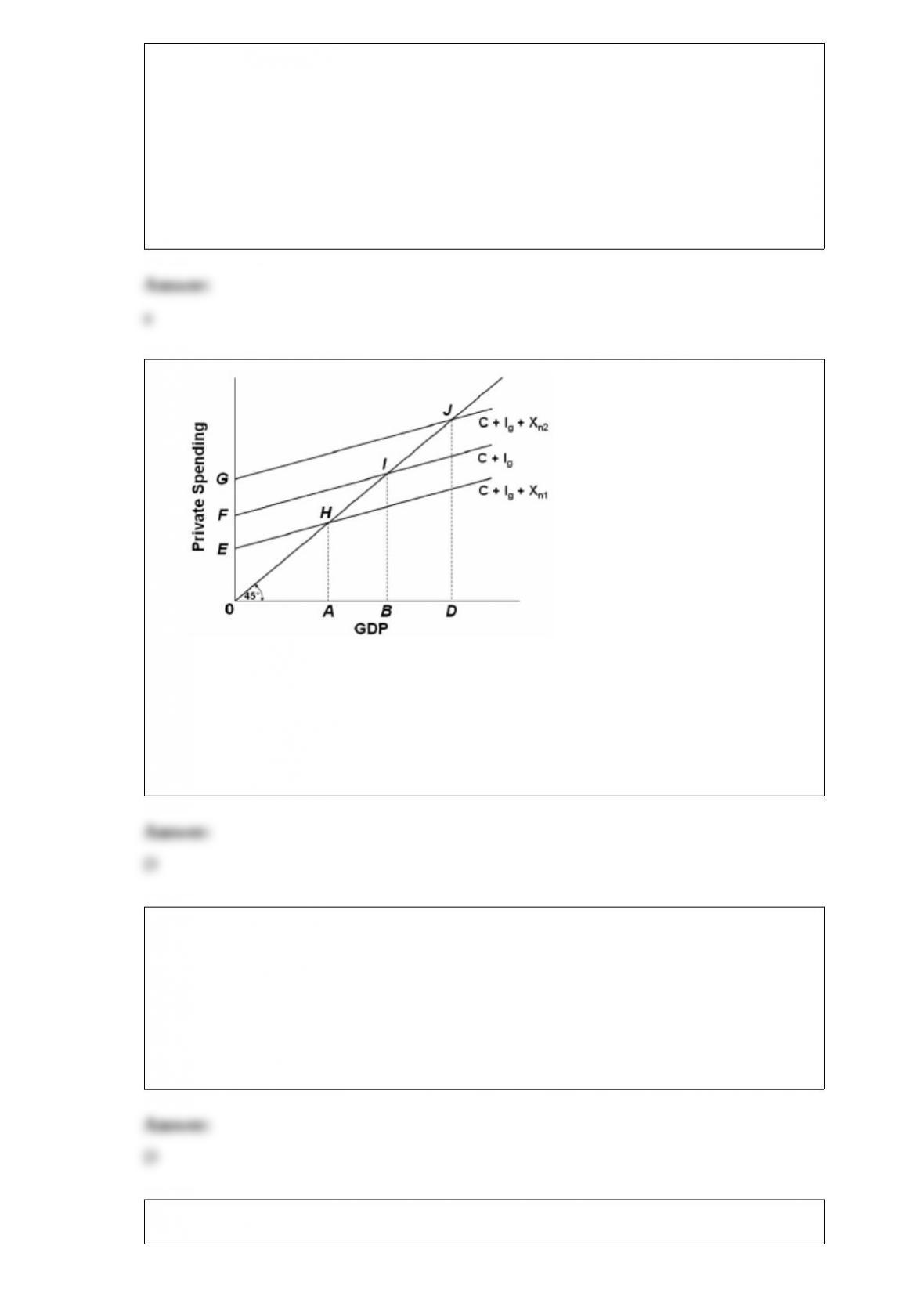
Refer to the above diagram. If net exports are Xn2, the GDP in the open economy will
exceed GDP in the closed economy by:
A.AB.
B.AD.
C.FG.
D.BD.
3) The view that the antitrust laws need to be strongly enforced to prevent illegal
business behaviors, monopolization of markets, and allocative inefficiency is known as
the:
A.structuralist view of antitrust.
B.behavioralist view of antitrust.
C.laissez-faire perspective on antitrust.
D.active antitrust perspective.
4) if competitive industry z is making substantial economic profit, output will:
a.fall in industry z, and firms will likely leave the market.
b.fall in all industries except industry z.
c.expand in industry z, as more resources will move to that industry.
d.expand in industry z, but no new firms will enter the market.
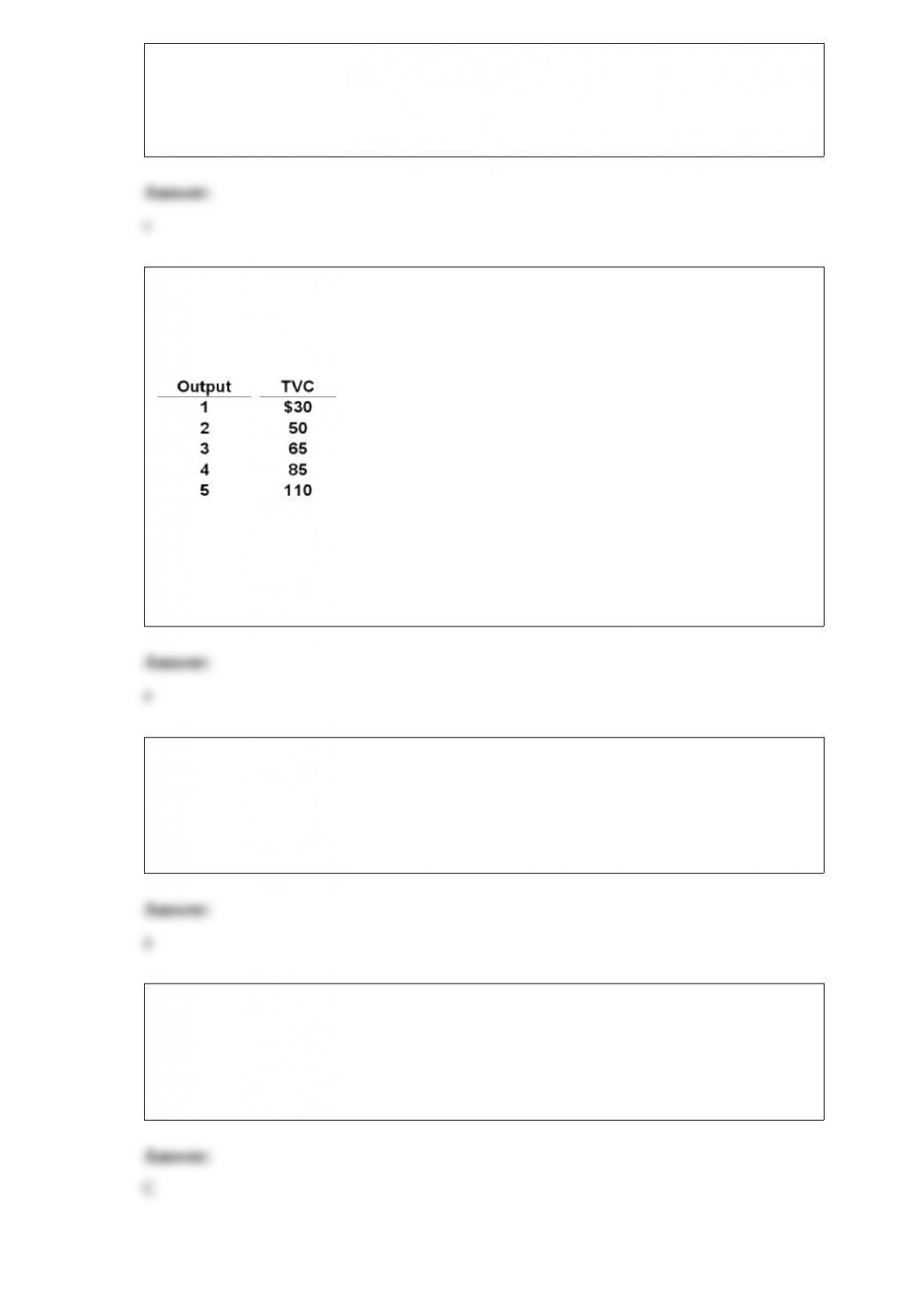
5) the sunshine corporation finds that its costs are $40 when it produces no output. its
total variable costs (tvc) change with output as shown in the accompanying table. use
this information to answer the following question(s).
refer to the above information. the average fixed cost of 3 units of output is:
a.$13.33.
b.$12.50.
c.$40.
d.$18.50.
6) a person should consume more of something when its marginal:
a.benefit exceeds its marginal cost.
b.cost exceeds its marginal benefit.
c.cost equals its marginal benefit.
d.benefit is still positive.
7) Banks create money when they:
A.allow loans to mature.
B.accept deposits of cash.
C.buy government bonds from households.
D.sell government bonds from households.
8) since world war ii:
a.north korea’s command economy has significantly outperformed south korea’s market
economy.
b.south korea’s command economy has significantly outperformed north korea’s market
economy.
c.north korea’s market economy has significantly outperformed south korea’s command
economy.
d.south korea’s market economy has significantly outperformed north korea’s command
economy.
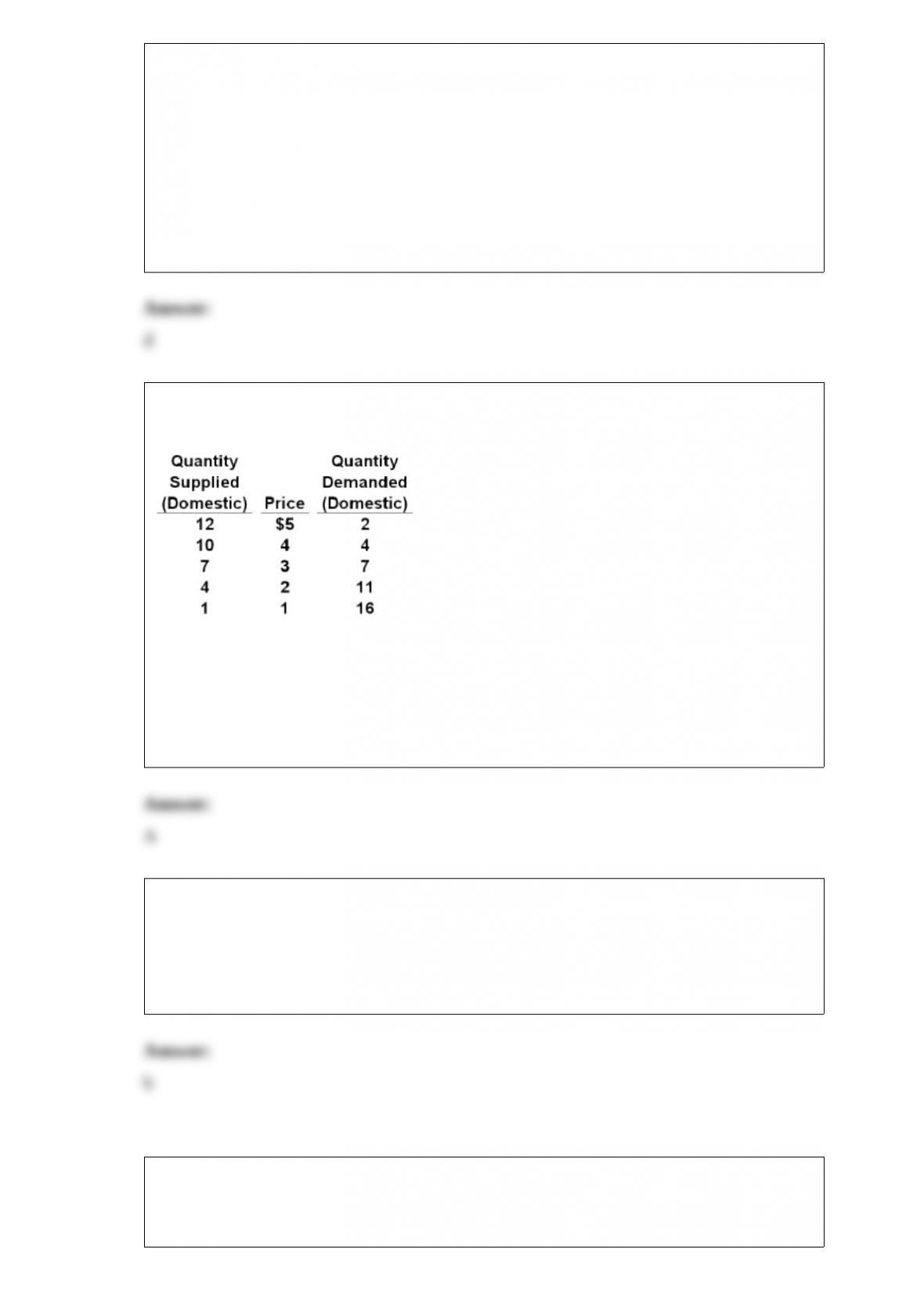
9) The following domestic supply and demand schedules for a product. Suppose that the
world price of the product is $1.
Refer to the above data. With a $1 per unit tariff, prices (revenue per unit) received by
domestic and foreign producers respectively will be:
A.$2 and $1.
B.$1 and $2.
C.$2 and $2.
D.$3 and $2.
10) the more time consumers have to adjust to a change in price:
a.the smaller will be the price elasticity of demand.
b.the greater will be the price elasticity of demand.
c.the more likely the product is a normal good.
d.the more likely the product is an inferior good.
11) Consider the following situations and decide whether they represent diversifiable
risk or non-diversifiable risk. Explain your answer.
(a)An automobile maker is concerned about the rising demand for motorcycles.
(b)An investor is considering developing a portfolio, but is concerned with the troubled
state of the market.
(c)An investor wants to purchase stock to add to their portfolio but is concerned it will
increase the volatility of their portfolios return.
12)
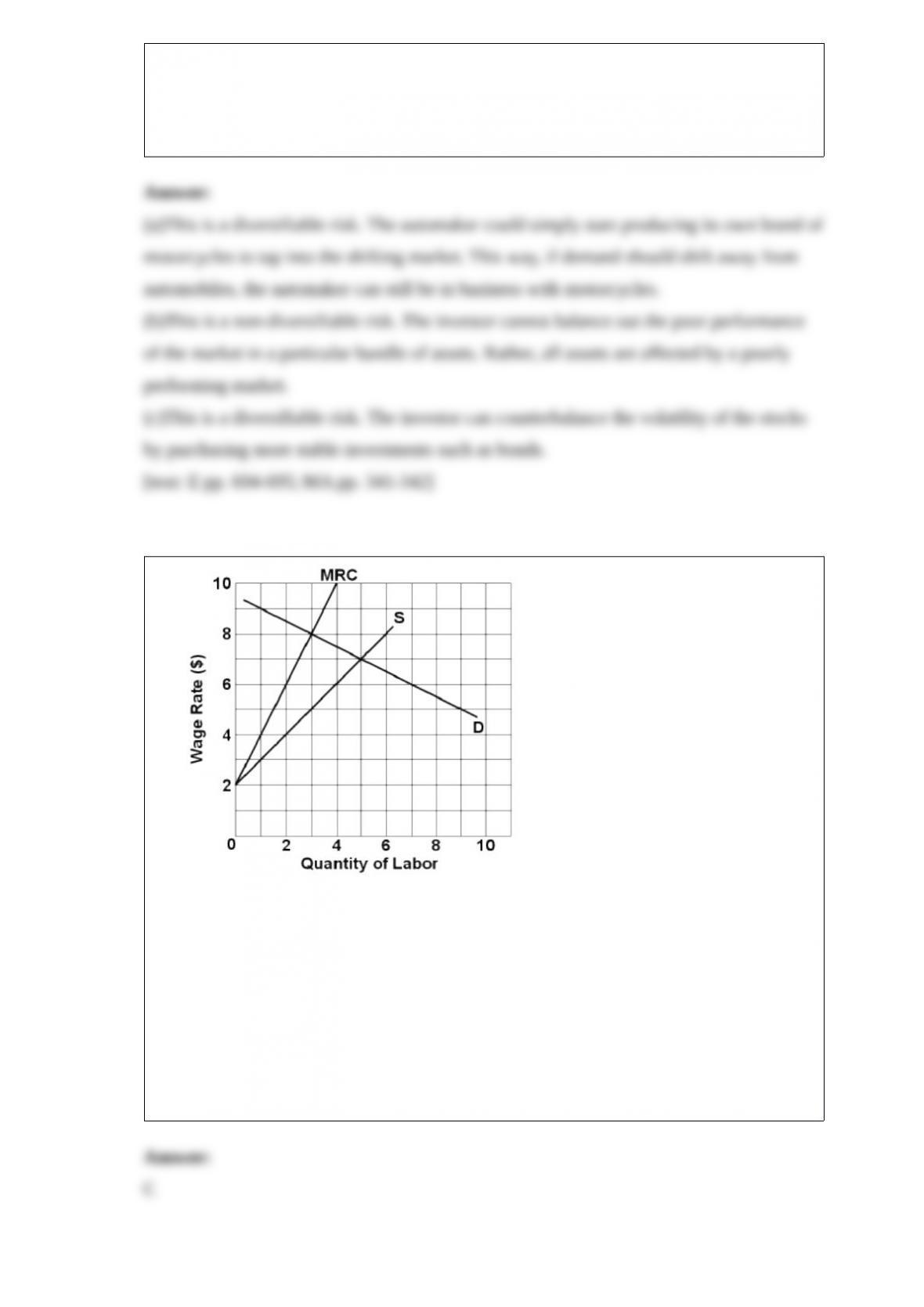
Refer to the above labor market diagram where D is the labor demand curve, S is the
labor supply curve, and MRC is the marginal resource (labor) cost curve. If an inclusive
union was able to get the monopsonist to pay a $6 wage rate, then:
A.the supply curve would be perfectly elastic for the first four workers, but the MRC
curve would be unaffected.
B.the supply curve would be perfectly elastic for all workers and the MRC curve would
coincide with it.
C.the supply curve would be perfectly elastic for the first four workers and the MRC
would be $6 for the first four workers.
D.eight workers would be hired.
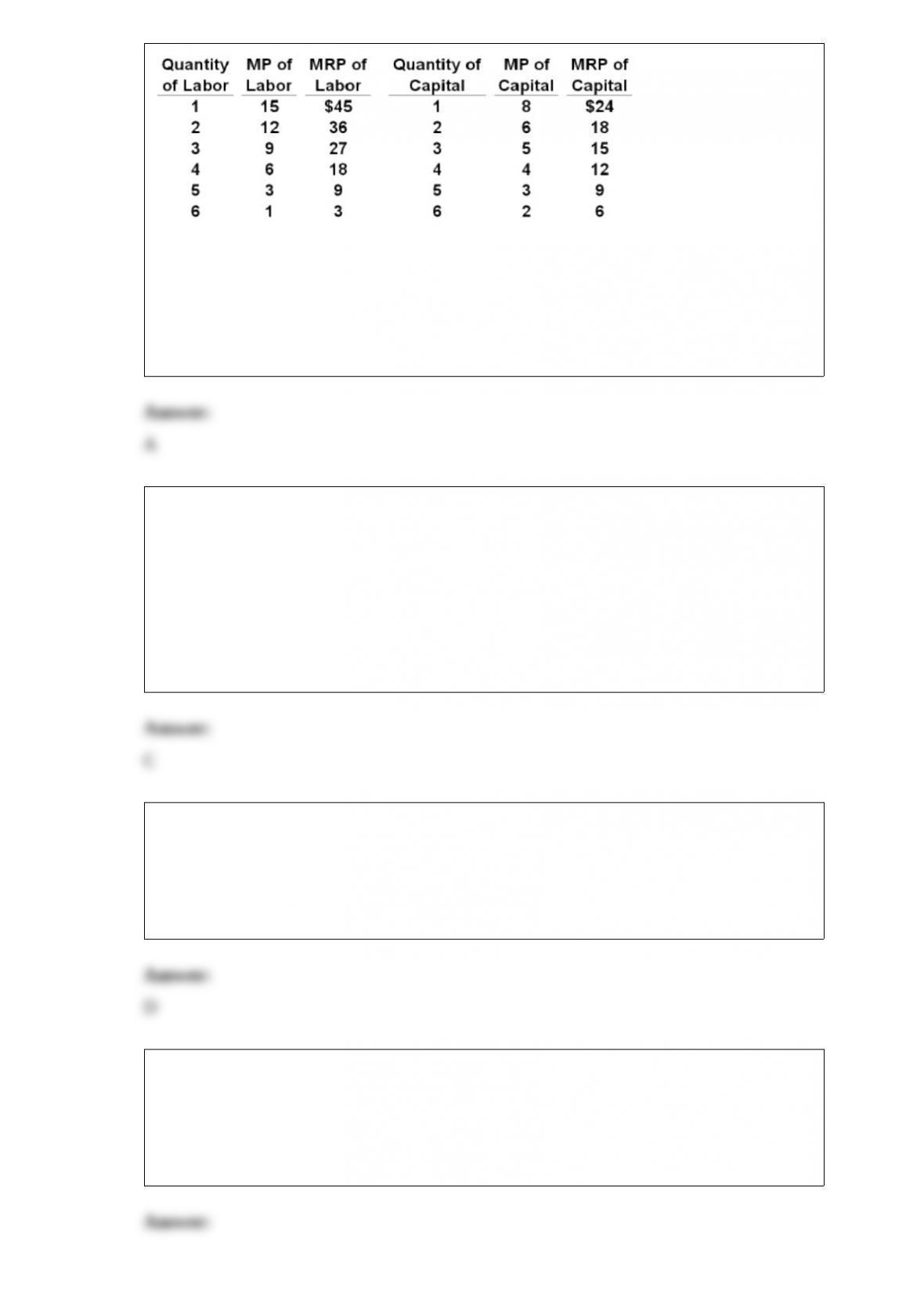
13) Refer to the above
data. If the prices of labor and capital are $9 and $15 respectively, the
profit-maximizing firm will hire:
A.5 units of labor and 3 of capital.
B.5 units of labor and 2 of capital.
C.4 units of labor and 4 of capital.
D.3 units of labor and 4 of capital.
14) (Last Word) In their effort to provide disaster relief after Hurricane Katrina, the
Federal Emergency Management Agency (FEMA) made payouts on as many as
900,000 claims with invalid Social Security numbers or false names and addresses. This
example illustrates:
A.the benefits-received principle.
B.logrolling.
C.bureaucracy inefficiency.
D.the problem of limited and bundled choices.
15) The real-business-cycle theory:
A.is a monetarist view of the business cycle.
B.is the mainstream view of the business cycle.
C.assumes that the supply of money is constant.
D.says that macro instability results from shifts in the long-run aggregate supply curve.
16) Which of the following is not part of a nation’s infrastructure?
A.communications facilities
B.roads, highways, and bridges
C.the electrical power system
D.industrial plants and equipment